RTO driving test track guide: layout, manoeuvres and slots
An RTO driving test track is the marked course where the transport office checks whether a learner can control a vehicle before issuing a permanent licence. You book a slot on Sarathi, bring your learner licence and vehicle, and drive set manoeuvres such as a figure 8, reverse parking and a slope start. Many cities now use automated tracks with sensors and cameras.
Key takeaways
- The RTO driving test track checks control in set manoeuvres; a road drive may follow in some states.
- Automated tracks in cities such as Delhi and Bengaluru use cameras and pole sensors and mark errors by computer.
- You need a valid learner licence, a booked slot and a roadworthy vehicle of the class you applied for.
- A slot can usually be rescheduled or cancelled on Sarathi with your application number and date of birth.
- Since 1 July 2021, a pass from an accredited driver training centre can replace the RTO track test.
- If you fail, you pay the repeat test fee and book again; you do not start the whole application over.
On this page · 26 sections
What is an RTO driving test track?
An RTO driving test track is a fenced, marked course at or near a transport office where applicants show they can control a vehicle before the RTO issues a permanent licence. It is the practical half of the licence process that begins with the learner licence described in our driving licence guide.
Why the RTO uses a track
A closed course lets the inspector test the same skills for every applicant without traffic in the way. Slow control, steering accuracy and judging space are hard to check on a busy road, but easy to check between poles and painted lines.
Where it sits in the licence process
You reach the track only after holding a learner licence and waiting the minimum period before a driving test can be booked. After a pass, the application moves to approval and the licence card is printed and posted.
How does a driving test track work?
A driving test track works as a fixed route of short exercises. You drive each part in order, such as a figure 8, a reverse into a bay and a stop on a slope, while an inspector watches or sensors record contact with poles, lines and stop markers.
Order of the exercises
Most courses start with a straight run so you settle in, then move into curves, reversing and the slope. The order is printed on a board at many RTOs, so read it before your turn.
Who watches you
On a manual course a motor vehicle inspector stands nearby or rides along. On an automated course the system marks errors, and staff in a control room watch camera feeds and confirm the result.
What is an automated RTO test track?
An automated RTO test track replaces most of the inspector’s judgement with sensors, cameras and software. Delhi opened its first four automated centres on 6 March 2019 at Mayur Vihar, Vishwas Nagar, Sarai Kale Khan and Shakur Basti, where cameras record each attempt and a system decides pass or fail.
How sensors mark errors
In Bengaluru’s automated course, sensors on the poles send a signal to a computer when a pole is touched, and marks are cut. CCTV cameras watch the rest of the drive, such as stopping inside a box.

Driving test ground: what does an open ground test look like?
A driving test ground is the older, simpler format: an open plot with cones, flags or painted lines where the inspector sets the course. Many smaller RTOs still use one. The skills checked are similar to an automated course, but the inspector decides the result by watching you.
What you will see on the ground
Expect cones or bamboo poles, chalk or paint marks for a parking box, and sometimes a short ramp. The layout can be moved from day to day, so do not rely on a video from months ago.
How the inspector decides
The inspector notes whether you stalled, rolled back, crossed a line or ignored a signal. On some grounds you then drive a short loop on a nearby road before the result is given.
Which manoeuvres are on a car driving test track?
A car driving test track usually includes forward and reverse control, a slope start and a parking task. Delhi’s automated centres test parallel parking, an upward gradient, a forward 8, a reverse S and overtaking. Other states mix similar elements in their own layouts.

| Manoeuvre | What it checks | Common slip |
|---|---|---|
| Forward 8 | Steering in tight curves | Cutting the corner and touching a pole |
| Reverse S | Mirror use while reversing | Over-steering and crossing the line |
| Parallel parking | Judging length and gap | Stopping too far from the kerb |
| Upward gradient | Clutch and handbrake control | Rolling back or stalling |
| Overtaking lane | Signals and lane discipline | Changing lane without indicating |
The H track in some states
Some RTOs use an H-shaped reversing course instead of a reverse S. It has its own dimensions and technique, explained on our H driving test page.
Seat belt, mirrors and signals
Even before you move, the inspector notices whether you wear the seat belt, set the mirrors and release the handbrake. These checks rarely carry a separate mark, but missing them leaves a bad first impression.
How is the car driving test conducted?
The car driving test begins with a document and vehicle check, then you drive the track at the inspector’s signal. On automated centres a green light or screen message tells you when to start. Some states add a short road drive afterwards to see how you handle traffic.
Before you start the engine
Staff check your learner licence, appointment slip and the vehicle’s RC, insurance and PUC. A car with an expired document may be refused, which means a lost slot.
During the drive
Drive slowly and evenly. Stopping briefly to correct a line is often allowed, but touching a pole, crossing a boundary or rolling back can count as an error. Follow the inspector’s instructions exactly.
After the drive
You are told the result at the track or later at the counter. A pass is updated in your Sarathi application, and the licence moves to approval and printing.
Can you use an automatic or electric car for the test?
Yes, in general. In a judgment reported on 17 July 2025, the Kerala High Court held that the state cannot bar automatic or electric light motor vehicles from the driving test, and said tests must follow Rule 15 of the Central Motor Vehicles Rules.
What to check first
Ask your RTO whether the licence will carry any note about the transmission type. Practice the slope start in an automatic too, because creep and brake control still matter on a gradient.
RTO motor driving test track: which vehicles are tested?
An RTO motor driving test track serves every licence class the office issues: motorcycles with and without gear, light motor vehicles such as cars, and transport vehicles such as buses and trucks. Large RTOs keep separate lanes or courses for two-wheelers, cars and heavy vehicles.
Heavy and transport vehicles
Heavy vehicle courses are longer and wider and often include a reversing bay for trucks. Applicants usually need a transport-vehicle training certificate before they can book.
One test per class
If you apply for two classes, such as a motorcycle and a car, you sit one test for each class. Each class carries its own test fee.
How are two-wheeler riders tested on the track?
Two-wheeler riders follow a shorter course. Delhi’s automated centres test a straight ramp, a serpentine track and emergency braking, while many other RTOs use a figure 8. Riders must keep both feet up and avoid touching markers.
Where to learn more
The figure 8 layout, balance tips and scoring for motorcycles and scooters are covered on our 2 wheeler driving test page. Wear a proper helmet for the test; riders without one are usually turned away.
Where is the DL test track for your RTO?
The DL test track is normally at your RTO or at a separate test centre linked to it. Your Sarathi appointment slip names the venue. In bigger cities, one automated centre may serve several RTOs, so the track can be some distance from the office where you applied.
Reading your appointment slip
The slip shows the date, time slot and test venue. Save it as a PDF and carry a printed copy, because some centres scan a barcode or QR code at the gate.
How to find a driving test track near me?
To find a driving test track near me, start with your own RTO, because you are tested at the venue linked to the office that holds your application. The state transport department website and the Sarathi slot page list the test centres for each office.
Using maps and notices
Map apps often label automated centres, but names can be outdated. Check the address on the state transport site before travelling. We do not list addresses here because they change and must come from the official source.
How do you book a slot for the driving licence test track?
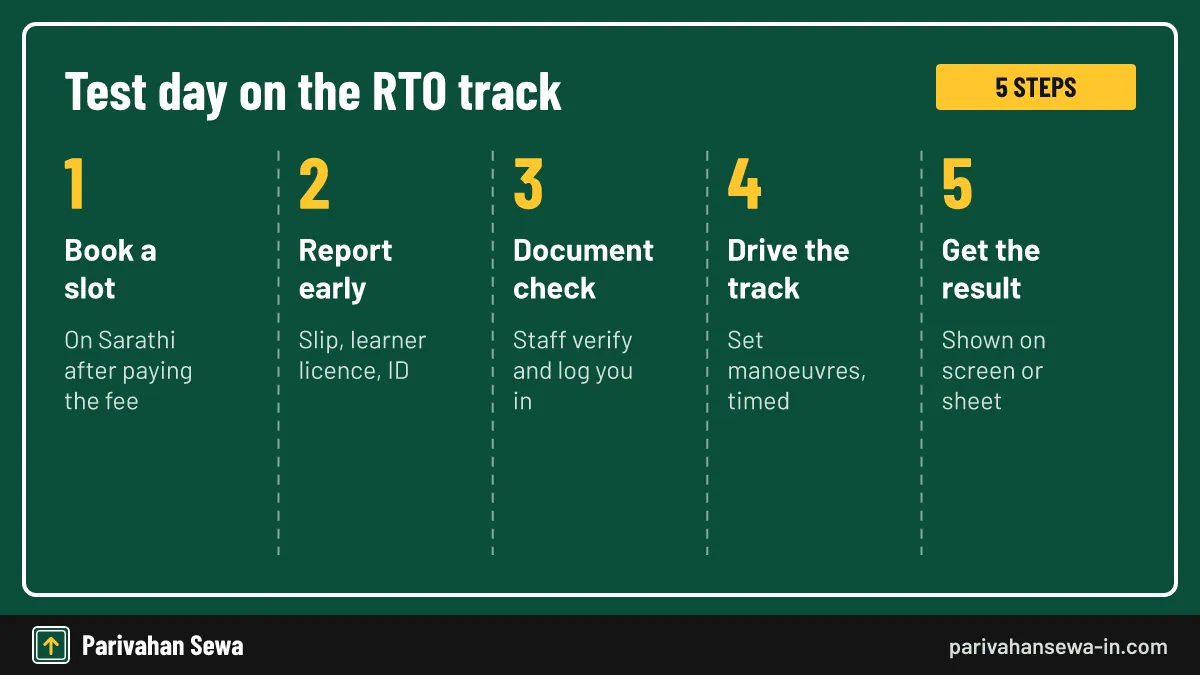
You book the driving licence test track slot on Sarathi after completing the permanent licence application and paying the fee. Choose your state, open the slot booking option, enter the application number and date of birth, and select an open date and time.
- Book a slot. Open Sarathi, choose your state and book a test slot after the fee is paid.
- Report early. Reach the track before your time with the slip, learner licence and ID.
- Pass the document check. Staff verify your papers and the vehicle documents.
- Drive the track. Complete each manoeuvre at a steady speed.
- Collect the result. Read it on screen or on the test sheet; a pass moves the licence to printing.
When slots open
Popular RTOs fill quickly. New dates are often released in batches, so check early in the morning or a few days later if the calendar looks full.
Learner licence timing
Your learner licence must still be valid on the test date. If it is close to expiry, book the earliest slot rather than the most convenient one.
How to change driving test date?
To change driving test dates, open Sarathi, choose your state, go to the appointments section and use the reschedule option. Enter your application number and date of birth, select a new slot and save the new appointment slip. Some states offer only cancel, after which you book again.

Do it before the slot
Change the date before the test day. A missed slot is usually treated as absent, and you may have to rebook from scratch.
Limits on changes
Some guides say the number of reschedules is limited, but the limit is set in the portal and can differ by state. Check the message on the Sarathi screen instead of relying on a third-party figure.
What does change test mean on the Sarathi portal?
On Sarathi, a change test option generally means moving an existing driving test appointment to a different date or time. In some states the same menu is labelled reschedule appointment, slot cancellation or similar. It does not change your licence class or your RTO.
Changing vehicle class
Adding or removing a vehicle class is a different service and is done on the application, not in the slot menu. Ask the RTO if you booked the wrong class.
OTP and security codes
Some states send a security code to your mobile before cancelling. Keep the phone linked to the application with you.
What should you carry to the RTO driving track?
Bring everything the RTO driving track staff need to confirm your identity and the vehicle. That usually means the appointment slip, learner licence, an ID document, and the vehicle’s RC, insurance and PUC. The full document list for a licence is on our documents required for driving licence page.
The vehicle itself
The vehicle should match the licence class, carry an L sign and be in good condition: working lights, horn, indicators and brakes. A dual-control school car is accepted at many RTOs.
What fee is charged for the test on the track?
Under the central fee table in Rule 32, the test of competence to drive costs a fixed amount per vehicle class, and a repeat test costs the same again. The licence issue fee is separate. States can add service or smart-card charges, so the total on Sarathi may be higher.
| Item | Central fee |
|---|---|
| Driving test, each class | ₹300 |
| Repeat driving test, each class | ₹300 |
| Issue of driving licence | ₹200 |
| Smart card licence (extra) | ₹200 |
What is a driving test sheet?
A driving test sheet is the record of your practical test. On a manual course the inspector fills it by hand or on a tablet; on an automated course the system produces a report. It lists each exercise and the final result, and it is linked to your application number.
Who keeps the sheet
The RTO keeps the original. Many centres show the result on a screen at the exit, and the outcome appears in your Sarathi application status within a short time.
Asking for a copy
If you failed and want to know why, ask the counter for the report. Some automated centres print a slip listing which element caused the fail.
What does a test sheet for driving test record?
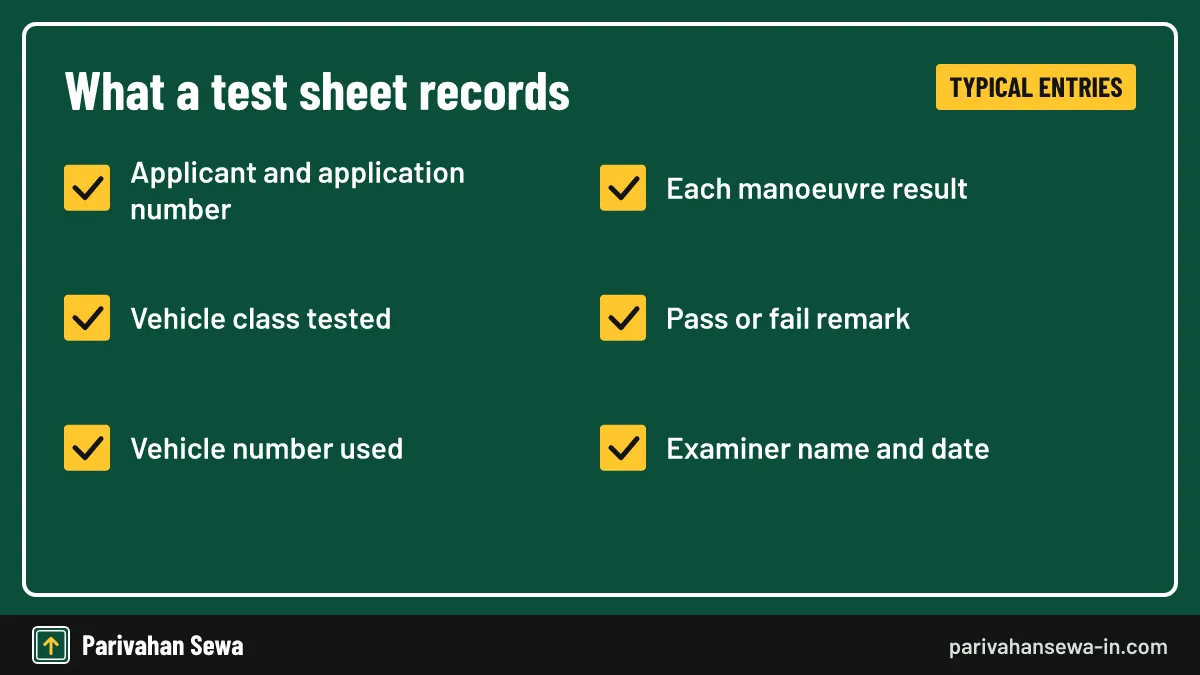
A test sheet for driving test usually records your name, application number, vehicle class, the vehicle number used, a mark or remark for each manoeuvre, the final pass or fail, and the examiner’s name and date. Exact formats differ between states and between manual and automated centres.
Why the vehicle number matters
The sheet links the test to the vehicle you drove. That is one reason the RTO checks the RC and insurance of the vehicle before you start.
Remarks you might see
Typical remarks are phrases such as “touched pole”, “rolled back”, “crossed line” or “did not signal”. They point to what to practise for the retest.
How do examiners score you on the track?
Examiners or sensors note errors in each element and decide whether the drive meets the standard. Some systems count errors against a limit, others fail you on one serious mistake such as hitting a pole hard. The marks, limits and pass rules are explained on our driving test pass score page.
Serious versus minor errors
A minor slip, such as a brief stall, may be tolerated. Dangerous actions, such as ignoring the inspector or driving off the course, usually end the test.
Can you watch a driving test video before your test?
Yes. A driving test video of your own RTO’s track is one of the most useful things to watch before test day. Look for recent clips that show the exact layout, the start point and where you must stop.
Picking a reliable video
Choose videos that name the RTO and look recent. Old clips may show a layout that has changed, especially where a manual ground was converted to an automated track.
What to watch for
Notice where drivers start each element, how far they turn the wheel and where they look. Count the poles and markers so nothing surprises you.
What does a driving road test video show?
A driving road test video usually shows the drive on public roads that some states add after the track. It covers starting from the kerb, lane discipline, signals, giving way at junctions and stopping safely. It is useful only if it comes from the same state or RTO.
Road part versus track part
Not every RTO has a road part. Where it exists, the inspector rides with you and checks traffic sense, not just control. Ask the RTO whether your test includes one.
Track test or traffic drive: how do they differ?
The track test checks vehicle control in a closed space, while a traffic drive checks how you behave among other road users. Many RTOs use only the track; others add a short traffic drive. The table shows how the two formats compare.
| Point | Track test | Traffic drive |
|---|---|---|
| Place | Closed RTO course | Public road near the RTO |
| Main skill | Steering, reversing, slope control | Signals, lanes, junctions, speed |
| Who judges | Inspector or sensors | Inspector riding with you |
| Common fail | Touching a pole or line | Missing a signal or a give-way |
Preparing for both
Practise slow-speed control on an empty plot and normal driving on quiet roads. Phone use while driving is a fineable offence, so keep the phone away in practice too.
What happens if you fail on the test track?
If you fail, the RTO records the result and you can book a repeat test for that class after paying the repeat test fee. The Motor Vehicles Act allows a re-test after a short waiting period, commonly reported as seven days. Your learner licence must still be valid on the new date.
Booking the retest
Use the same application number on Sarathi to book again. You do not repeat the learner test or the document upload unless the learner licence has expired.
If the learner licence expires
An expired learner licence means a fresh learner application before you can return to the track. Plan retests well before the expiry date.
Common mistakes on the test track and how to avoid them
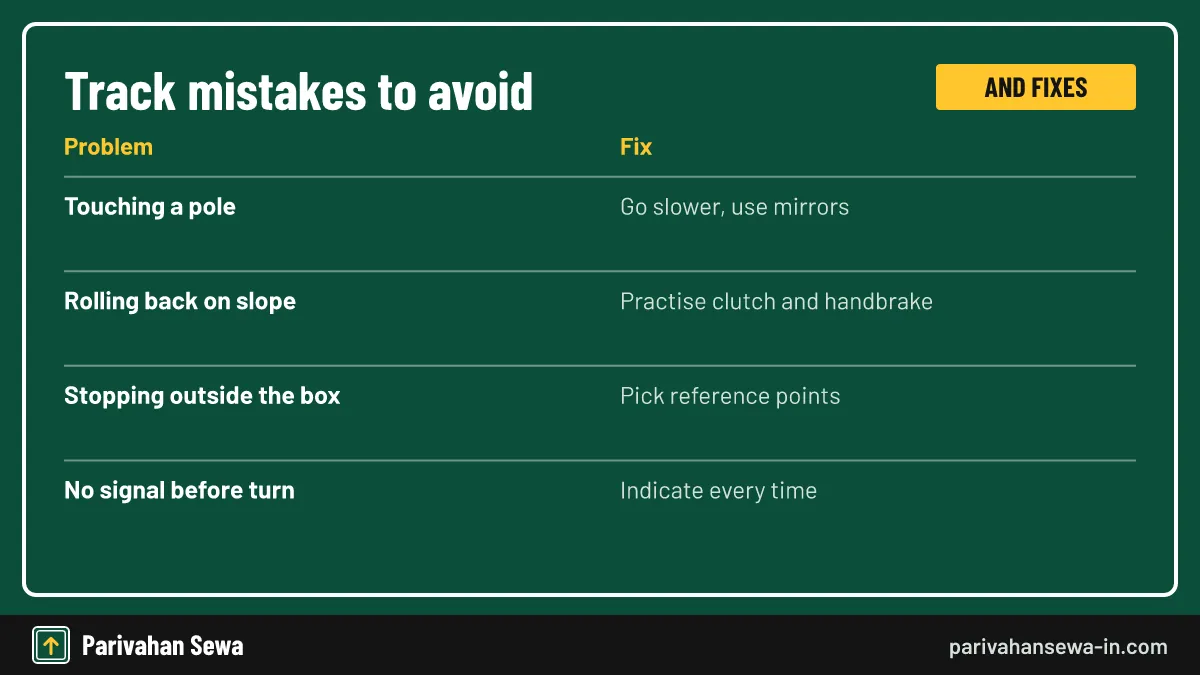
Most failures on a driving test track come from rushing, poor mirror use and nerves, not from a lack of skill. Touching poles, rolling back on the slope and stopping outside the box are the usual faults. Each has a simple fix you can practise in a quiet place.
Practising the slope
Find a gentle slope and practise holding the car with the clutch and handbrake. Release slowly so the car moves forward without rolling back.
How to practise for the RTO test track?
Prepare for the RTO test track by practising each element separately, then the full course in order. Use cones or bottles in an empty plot, and copy the layout from a recent video. A driving school with its own practice track helps, especially for reversing and parking.
Building a practice course
Mark a figure 8 and a parking box with cones at roughly the size you saw in the video. Repeat each element until it feels routine, then time the full run.
Who can use the track at a driving school instead of the RTO?
Rules from MoRTH that took effect on 1 July 2021 allow accredited driver training centres to test their own students. Candidates who pass there are exempt from the RTO driving test when they apply for a licence. These centres must have simulators and a dedicated test track.
Course length at accredited centres
The light motor vehicle course runs 29 hours over up to four weeks, and the medium and heavy vehicle course 38 hours over up to six weeks. Accreditation lasts five years and can be renewed.
Ordinary schools are different
An ordinary driving school can train you but cannot excuse you from the RTO test. Ask the school to show its accreditation before you assume you can skip the track.
Official links
Sarathi licence servicessarathi.parivahan.gov.in ↗Parivahan Sewaparivahan.gov.in ↗Ministry of Road Transport and Highwaysmorth.nic.in ↗Motor Vehicles Act, 1988 (India Code)indiacode.nic.in ↗RTO driving test track questions
Can I take the driving test in my own car?
Yes. Most RTOs expect you to bring a roadworthy vehicle of the class you applied for, with valid RC, insurance and PUC. Some driving schools let students use the school car. Check your RTO's rule before the test day.
Is the RTO driving test track the same in every state?
No. The skills are similar because the test follows Rule 15 of the Central Motor Vehicles Rules, but each state chooses its own layout, cones, sensors and order of manoeuvres.
How long does the track test take?
The drive itself usually takes only a few minutes per applicant. Waiting for your turn, the document check and the result can take much longer, so plan for a few hours at the RTO.
Can I change my driving test date after booking?
Usually yes. Sarathi has a reschedule or cancel option under appointments for most states. You need the application number and date of birth. Do it before the slot date, not after missing it.
What happens if I miss my slot?
The slot is normally lost. You book a new one on Sarathi, as long as your learner licence is still valid. Some states may ask you to pay the test fee again; confirm at your RTO.
Can I use an automatic car for the car driving test?
Generally yes, and the Kerala High Court said in 2025 that a state cannot bar automatic or electric light motor vehicles from the test. The RTO may note the licence class according to the vehicle used, so ask before booking.
Do I get a printed driving test sheet?
Some automated centres print or display a result report, and manual tests are recorded by the inspector. Ask at the counter if you want a copy; the result also appears in your Sarathi application status.
Can I watch the track before my test?
Many RTOs allow you to watch from a waiting area, and some publish videos of their track layout. Watching other applicants is one of the best ways to learn the exact path and stop points.
Is the track test needed if I trained at an accredited centre?
Not at the RTO. Rules effective 1 July 2021 let candidates who pass the test at an accredited driver training centre skip the RTO driving test. Ordinary driving schools are not the same as accredited centres.
Parivahan Sewa (parivahansewa-in.com) is an independent information website and is not affiliated with MoRTH, Parivahan or any state transport department. Confirm fees and rules on the official portal before you pay or apply.