LMV full form: what Light Motor Vehicle means on your licence
The LMV full form is Light Motor Vehicle. On an Indian driving licence it is the class for cars, jeeps, taxis, small vans and other vehicles whose weight is within 7,500 kg under section 2(21) of the Motor Vehicles Act, 1988. It does not cover motorcycles or scooters, which need MCWG or MCWOG, and heavier trucks and buses need a transport class.
Key takeaways
- LMV stands for Light Motor Vehicle, one of the classes listed in section 10(2) of the Motor Vehicles Act.
- The test is weight: 7,500 kg gross weight for transport vehicles and omnibuses, or unladen weight for cars, tractors and road-rollers.
- LMV-NT is for private use and LMV-TR for commercial use; the card shows a separate validity date for each.
- An LMV class does not let you ride a bike. Add MCWG or MCWOG for two-wheelers.
- A light tractor usually falls inside LMV by weight, while trucks and buses above 7,500 kg need a transport class.
On this page · 40 sections
LMV full form: what do the three letters stand for?
The LMV full form is Light Motor Vehicle. It is the name of a licence class in section 10(2) of the Motor Vehicles Act, 1988, and it is printed on driving licences across India for people allowed to drive cars, jeeps, vans and similar vehicles within a set weight.

Light, Motor, Vehicle
“Light” refers to weight, not size or power. “Motor vehicle” means any mechanically propelled vehicle on the road. Together they describe the lightest class of four-wheel vehicles that the Act recognises.
Why a short form is used
Licence cards have little space, so classes are printed as codes. LMV sits beside codes like MCWG for geared bikes. Our MCWG full form guide explains the two-wheeler code.
What is LMV in simple words?
What is LMV? In plain terms it is the car licence. If you hold an LMV class, you may drive an ordinary car, SUV, jeep or small van in a public place, provided the vehicle stays within the weight the law sets for light vehicles.
What a learner should take from it
When you apply for a licence to drive a family car, the class you pick on Sarathi is LMV. You do not need a separate class for a hatchback, sedan or SUV.
What it is not
LMV is not a vehicle brand or model. It is a legal category. A vehicle can look large and still be an LMV if its registered weight is below the limit.
LMV means in driving license: what does the class let you drive?
LMV means in driving license that the holder is permitted to drive light motor vehicles: motor cars, jeeps, light goods carriers, small passenger vehicles and light tractors whose weight is within 7,500 kg. It does not include motorcycles, scooters, or medium and heavy vehicles.
Vehicles you can drive
Private cars of any fuel type, SUVs and MUVs, pick-ups, mini-trucks and taxis registered within the limit are all covered. Electric and automatic cars fall in the same class.
Vehicles you cannot drive
Two-wheelers, three-wheel autos registered in their own class, e-rickshaws with their own training rule, and buses or trucks above 7,500 kg are outside LMV.
Light motor vehicle: what weight limit decides the class?
A light motor vehicle is any vehicle within 7,500 kg. For a transport vehicle or omnibus, the figure checked is the gross vehicle weight. For a motor car, tractor or road-roller, the figure is the unladen weight. Above 7,500 kg, a vehicle moves into the medium or heavy band.

| Band | Weight test | Examples |
|---|---|---|
| Light (LMV) | Up to 7,500 kg | Car, jeep, taxi, small goods van |
| Medium | 7,500 kg to 12,000 kg | Mid-size truck, minibus |
| Heavy | Above 12,000 kg | Full-size bus, multi-axle truck, trailer |
Gross weight versus unladen weight
Gross vehicle weight is the vehicle plus its permitted load, as certified by the registering authority. Unladen weight is the vehicle with its ordinary equipment but no load. Both figures are printed on the RC.
Why the limit matters
The weight band decides which licence class you need, which affects insurance claims after an accident. Driving outside your class can lead to a claim being disputed.
Light motor vehicle means what in the Motor Vehicles Act?
Light motor vehicle means, under section 2(21) of the Act, a transport vehicle or omnibus whose gross vehicle weight, or a motor car, tractor or road-roller whose unladen weight, does not exceed 7,500 kilograms. The definition joins two different weight tests in one sentence.
Reading the definition
The first half covers vehicles that carry goods or passengers for hire. The second half covers vehicles that do not, where only the empty weight counts. A car’s own weight is far below the limit.
Related definitions
Section 2(15) defines gross vehicle weight and section 2(48) defines unladen weight. Section 2(47) says a transport vehicle is a public service vehicle, goods carriage, educational institution bus or private service vehicle.
Is car a light motor vehicle?
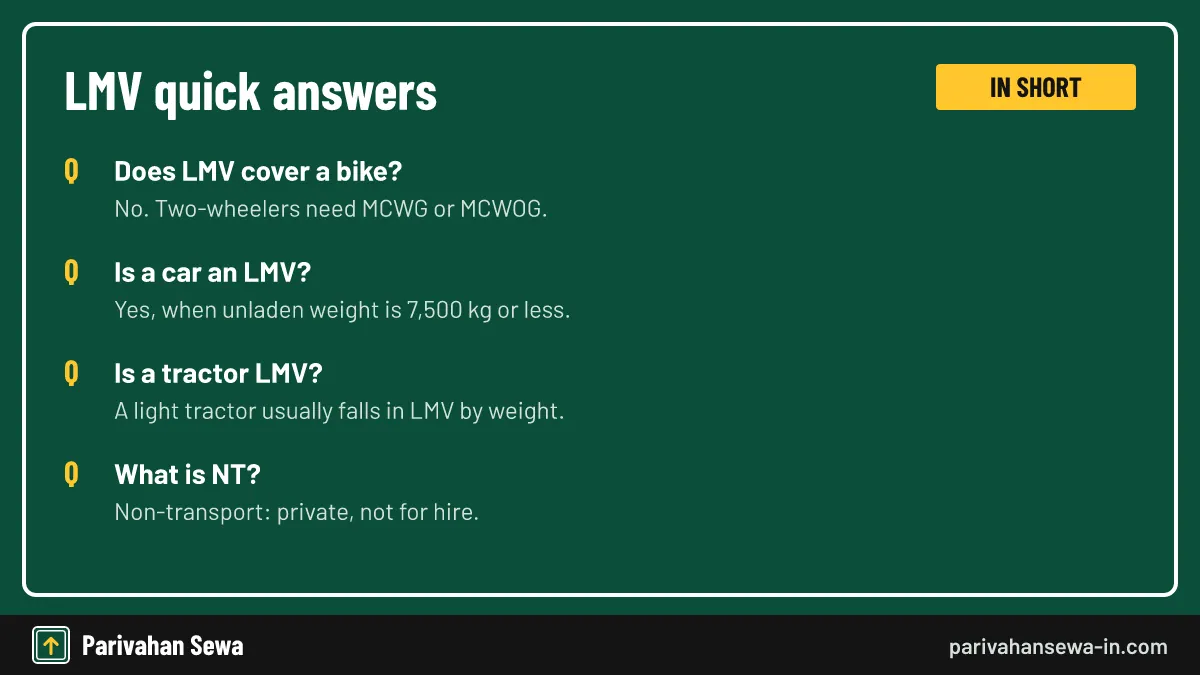
Yes. Is car a light motor vehicle? Every ordinary passenger car sold in India weighs far less than 7,500 kg unladen, so it falls inside the LMV definition. Hatchbacks, sedans, SUVs and electric cars are all light motor vehicles for licensing.
Private car
A car registered for private use is a non-transport LMV. A licence with the LMV or LMV-NT class is enough to drive it.
Car used as a taxi
A car registered as a taxi is a transport vehicle but still light by weight. The 2024 Supreme Court ruling discussed below says an LMV licence holder may drive it.
Motor car LMV: how does the Act define a motor car?
The motor car LMV link comes from section 2(26), which defines a motor car as any motor vehicle other than a transport vehicle, omnibus, road-roller, tractor, motor cycle or invalid carriage. In effect, it is the private car, and section 2(21) places it in the light class when its unladen weight is within the limit.
Motor car versus motorcab
A motorcab under section 2(25) carries up to six passengers, excluding the driver, for hire or reward. It is a taxi, so it is a transport vehicle, while a motor car is private.
Motor car versus omnibus
An omnibus under section 2(29) carries more than six persons excluding the driver. A large van can be an omnibus, yet it stays light if its gross weight is within 7,500 kg.
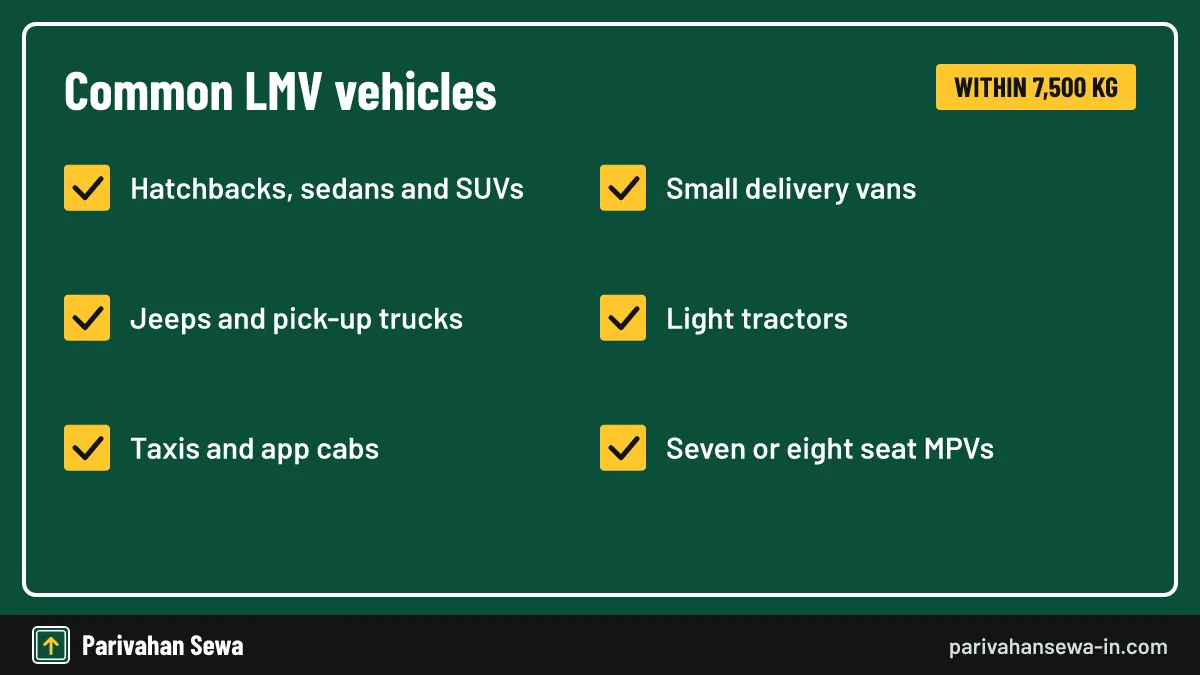
LMV vehicle list: which vehicles are included?
The LMV vehicle list covers every motor vehicle within the weight limit that is not a two-wheeler or a separately classed vehicle. The table groups the common types by how they are used, so you can see which validity line applies.
| Vehicle | Use | Licence line |
|---|---|---|
| Hatchback, sedan, SUV | Private | LMV or LMV-NT |
| Jeep, pick-up for own use | Private | LMV or LMV-NT |
| Taxi, app cab | Hire or reward | LMV-TR or transport validity |
| Small goods van, mini-truck | Goods carriage | LMV-TR or transport validity |
| Light tractor | Farm or haulage | LMV (check RTO practice) |
| Small passenger van | Private or hire | Depends on registration |
How to use the table
Find the vehicle, then check its registration. The same body style can be private or commercial, and that changes the validity line, not the light class itself.
When the list does not settle it
Some vehicles sit near the limit, such as loaded light trucks. The RC’s gross weight figure is the final word.
Which vehicles come under LMV?
Which vehicles come under LMV depends on two things: the type named in section 2(21) and the weight. Motor cars, tractors and road-rollers qualify by unladen weight. Transport vehicles and omnibuses qualify by gross weight. If either figure is within 7,500 kg, the vehicle is light.
Passenger vehicles
Cars, jeeps, MUVs, taxis and small vans that carry people come under LMV within the weight limit, whether used privately or for hire.
Goods vehicles
Light goods carriers, such as pick-ups and small delivery trucks, come under LMV when their gross vehicle weight is within the limit, even when loaded to capacity.
LMV vehicle: how do you check if your vehicle qualifies?
To check whether your LMV vehicle qualifies, open its registration certificate, physical or digital, and read the gross vehicle weight and unladen weight. Compare the right figure for your vehicle type with 7,500 kg. The vehicle class line on the RC also names the category.
Where the figures appear
On a smart card RC, the weights and the vehicle class are printed on the card or in the Vahan record. The digital RC in DigiLocker or mParivahan shows the same fields.
Asking the dealer or RTO
For a new vehicle, the dealer’s sale certificate and the manufacturer’s type approval give the weights. The RTO can confirm the class if the RC is unclear.
Light motor vehicles list: which vehicles are left out?
The light motor vehicles list leaves out motorcycles and scooters, invalid carriages, e-rickshaws and e-carts with their own rules, and any truck, bus or trailer above 7,500 kg. These need their own class even though some of them are small.
Two-wheelers and invalid carriages
Section 10(2) lists motor cycles with and without gear and invalid carriages as separate classes, so they are never covered by LMV.
E-rickshaws and e-carts
CMVR rule 8A requires at least ten days of training and a certificate for an e-rickshaw or e-cart licence. The 2024 Supreme Court ruling kept this special rule in place.
LMV vehicle type: how are transport and non-transport split?
Within the light class, the LMV vehicle type is split by use. A non-transport vehicle is used privately. A transport vehicle carries goods or passengers for hire or reward. The card may show the class as LMV-NT, LMV-TR or simply LMV with separate validity lines.

The plate colour clue
Private vehicles carry black characters on a white plate. Commercial transport vehicles carry black characters on a yellow plate. The plate colour tells you which validity line matters.
Why the split exists
Transport drivers face extra rules: a higher minimum age of 20, medical checks and state badge or permit rules. Private drivers face fewer conditions.
What is non transport vehicle?
What is non transport vehicle? It is any vehicle that is not a transport vehicle under section 2(47): not a public service vehicle, goods carriage, educational institution bus or private service vehicle. In practice, it is a car, bike or jeep used for yourself and your family.
Examples
Your own car, your own motorcycle and a jeep used on your farm are non-transport. A car rented out with a driver is not.
Why the word matters on your card
A licence with only a non-transport validity line is the usual private licence. For a fuller explanation of the validity lines, see our page on LMV in driving licence.
LMV NT full form: what does NT add?
The LMV NT full form is Light Motor Vehicle, Non-Transport. The NT suffix tells an officer that the holder may drive light vehicles for private use. It is the class most car owners hold.
Who gets LMV-NT
Anyone who passes the car driving test for a private vehicle receives it. There is no extra test for SUVs or automatics.
How long it lasts
The non-transport validity follows the age slabs set in 2019: until age 40 if issued before 30, 10 years between 30 and 50, until 60 between 50 and 55, and 5 years after 55.
LMV NT means in driving license for private owners?
LMV NT means in driving license that you may drive your own car, or a friend’s or family car, in a public place. It does not by itself make you a professional driver. For a paid driving job, check the transport rules in your state.
Driving a friend’s car
Yes, an LMV-NT holder may drive any private light vehicle, whoever owns it, as long as it is insured and the papers are valid.
Driving for a living
A professional driver of a private car, such as a chauffeur, is usually still driving a non-transport vehicle. A driver of a taxi is driving a transport vehicle.
LMV TR full form: what does TR add?
The LMV TR full form is Light Motor Vehicle, Transport. TR shows the holder may drive light commercial vehicles such as taxis, cabs and small goods vans. Earlier this needed a separate endorsement; the position changed with the Supreme Court rulings of 2017 and 2024.
What the card shows
A TR class usually comes with its own validity date and sometimes a badge number from the state. The NT and TR dates can be different.
Getting TR added
Apply on Sarathi for the transport class or endorsement your state uses. Many states ask for a medical certificate in Form 1A. See our medical certificate form 1a guide.
TR license full form: what is a transport licence?
The TR license full form is Transport licence: a licence class or endorsement for driving transport vehicles, meaning vehicles used for hire, goods or public service. Section 10(2)(e) names “transport vehicle” as a single class that covers light, medium and heavy commercial vehicles.
Minimum age
Section 4(2) of the Act sets 20 years as the minimum age to drive a transport vehicle in a public place.
Prior licence needed
Section 7(1) says a learner’s licence for a transport vehicle is granted only to someone who has held an LMV licence for at least one year.
TR licence full form: who needs transport validity?
The TR licence full form is the same: transport. You need transport validity if you drive a medium or heavy goods or passenger vehicle, or a vehicle carrying hazardous goods. For light taxis and vans, the 2024 ruling says an LMV is enough, though states may still ask for a badge.
Bus and truck drivers
Any vehicle above 7,500 kg needs the transport class for that size, with medical fitness and the section 7 conditions.
Fleet and cab operators
Operators should keep a copy of each driver’s licence and check the class and validity online before assigning a vehicle.
Light motor vehicle and goods carriers: what did the Supreme Court say?
On 6 November 2024, a five-judge bench of the Supreme Court in Bajaj Alliance General Insurance v Rambha Devi held that an LMV licence holder can drive a transport vehicle under 7,500 kg without a separate endorsement. It upheld the 2017 Mukund Dewangan judgment.
What stayed the same
The court said e-carts, e-rickshaws and vehicles carrying hazardous goods keep their special rules. Medium and heavy transport vehicles still need the extra age, medical and section 7 conditions.
Why it matters for claims
Insurers had refused claims when an LMV holder drove a light commercial vehicle. After the ruling, such a licence counts as valid for vehicles within the limit.
LMV full form in driving license: where is it printed?
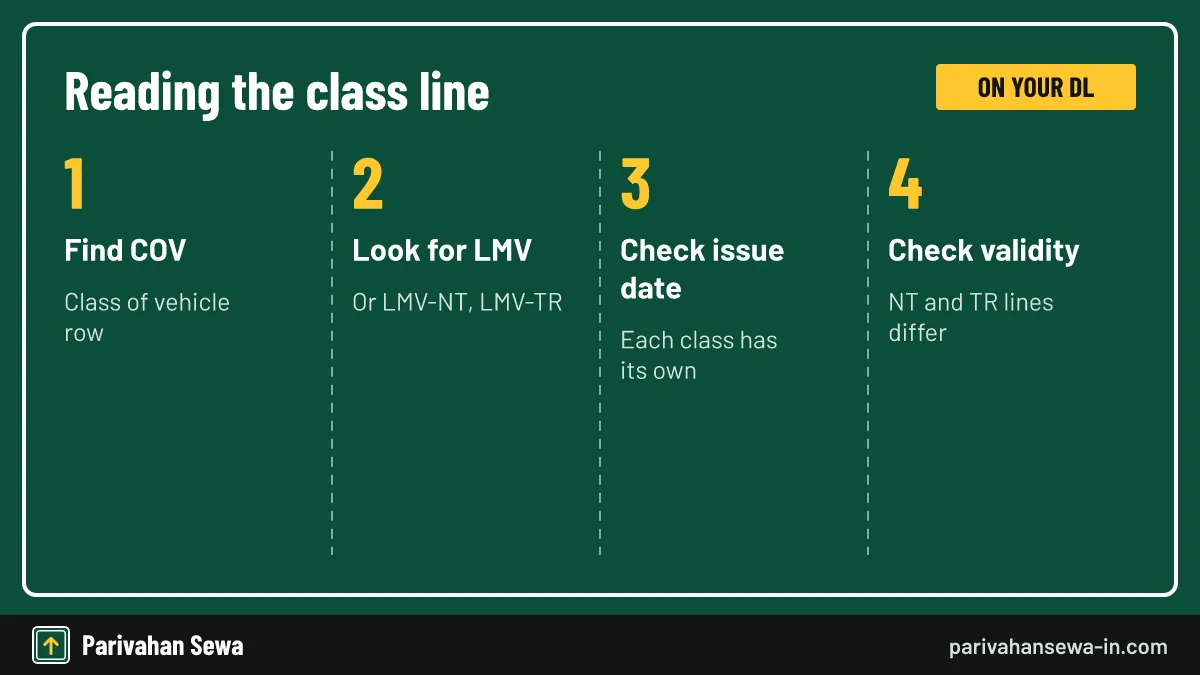
The LMV full form in driving license is not printed; only the code is. On a smart card licence, the class of vehicle (COV) block lists each code, such as LMV, with its issue date. The full words appear in the Sarathi record and the DigiLocker copy.
On the front or back
Card designs vary between states. Some print the class list on the front beside the photo; others on the back with validity dates.
Old paper licences
Older booklet licences may write “LMV” by hand or by stamp. If the class is unclear, search the licence on our online licence check guide.
LMV meaning in driving licence: how do you read the class line?
The LMV meaning in driving licence becomes clear when you read the COV line: the code tells you the class, the date beside it tells you when it was added, and the validity block tells you until when you may drive non-transport and transport vehicles.
Several codes on one line
A licence showing “MCWG, LMV” lets you ride a geared bike and drive a car. Each was added after its own test.
Validity is shared
The non-transport validity covers all private classes on the card. You renew the licence once, not class by class.
What does LMV mean in driving licence if the class is missing?
What does LMV mean in driving licence when it is absent? It means you may not drive a car on that licence. If your card shows only MCWG or MCWOG, you must add the LMV class by passing a car learner test and a driving test.
Adding LMV to an existing licence
Apply on Sarathi for a learner licence for the LMV class, practise, then book the driving test. The new class joins your existing licence number.
Driving without the class
Driving a car without the LMV class is treated as driving without a valid licence for that vehicle, and an insurer may dispute an accident claim.
LMV licence means what for a private car owner?
LMV licence means that you may drive your own car and any other private light vehicle anywhere in India. The licence is national; a class issued in one state is valid in every state, and the record sits in the Sarathi register.
Driving in another state
You do not need a new licence when you move. Update your address on Sarathi when you change state of residence.
Carrying the licence
Carry the card, or show it in DigiLocker or mParivahan, which are accepted as valid digital copies.
Which license is required for car?
Which license is required for car? A driving licence with the LMV class (or LMV-NT) is required for a private car. A taxi or other commercial car also needs the vehicle’s permit and any badge your state asks for. Learners need a learner licence for the LMV class first.
Minimum age
Section 4(1) of the Act sets 18 years as the minimum age to drive a car in a public place.
Learner stage
A learner licence for LMV is valid for six months. You must drive with a licensed adult beside you and an L-plate displayed.
How do you apply for an LMV driving licence?
To apply for an LMV driving licence, get a learner licence for the LMV class on Sarathi, practise for the required period, book and pass the driving test at your RTO, and then receive the card. For the full form-by-form walk-through, see our guide on how to apply for driving license.
- Get a learner licence. Apply on Sarathi for the LMV class and pass the learner test.
- Practise with L-plates. Drive only with a licensed adult beside you while the learner licence is valid.
- Book the driving test. Book a slot once the waiting period after the learner licence is over.
- Take the test. Drive the test route or track at the RTO in a car you bring.
- Receive the card. Track the application and receive the smart card by post.

| Service | Central fee |
|---|---|
| Learner licence, each class | Rs 150 |
| Learner licence test | Rs 50 |
| Driving test, each class | Rs 300 |
| Issue of driving licence | Rs 200 |
| Smart card | Rs 200 |
Waiting period
The driving test can be booked 30 days after the learner licence is issued. States may add service or online charges to the fees above, so check the amount on Sarathi.
Forms involved
The learner application is filled online on Sarathi, and the full licence application follows after you pass the learner stage, with documents uploaded on the same portal.
Does LMV include bike?
No. Does LMV include bike? The answer is no, because section 10(2) lists motor cycles as separate classes. An LMV holder who rides a motorcycle without an MCWG or MCWOG class is riding without a valid licence for that vehicle.
Why bikes are separate
Two-wheelers need balance and different control skills. The law tests them separately and records them as their own class.
What to add
For a geared bike, add MCWG. For a scooter or moped without gears, add MCWOG. You can apply for both classes along with LMV in one learner application.
What is LMV and MCWG in driving licence?
What is LMV and MCWG in driving licence? LMV is the car class and MCWG is the class for a motorcycle with gear. When both appear, the holder may drive a car and ride a geared motorcycle, and also a gearless scooter in most states’ practice.
How they get added
You can apply for both together in one learner licence application and take two driving tests, or add one later.
Hindi readers
For the same explanation in Hindi, see our LMV MCWG full form in Hindi page.
LMV MCWG full form: what does a combined licence mean?
The LMV MCWG full form is Light Motor Vehicle and Motor Cycle With Gear. A combined licence is still one licence with one number, showing two classes. It is the most common licence held by people who drive a car and ride a bike.
One renewal
Both classes share the same non-transport validity, so a single renewal keeps both active.
Fees on combined applications
The learner fee and test fee are charged for each class, so a combined application costs more than a single-class one.
Vehicle class MCWG: how is it different from LMV?
The vehicle class MCWG covers two-wheeled motorcycles with a manual gearbox, while LMV covers four-wheeled cars and light goods or passenger vehicles. The two classes have different tests, and holding one never gives you the right to drive under the other.
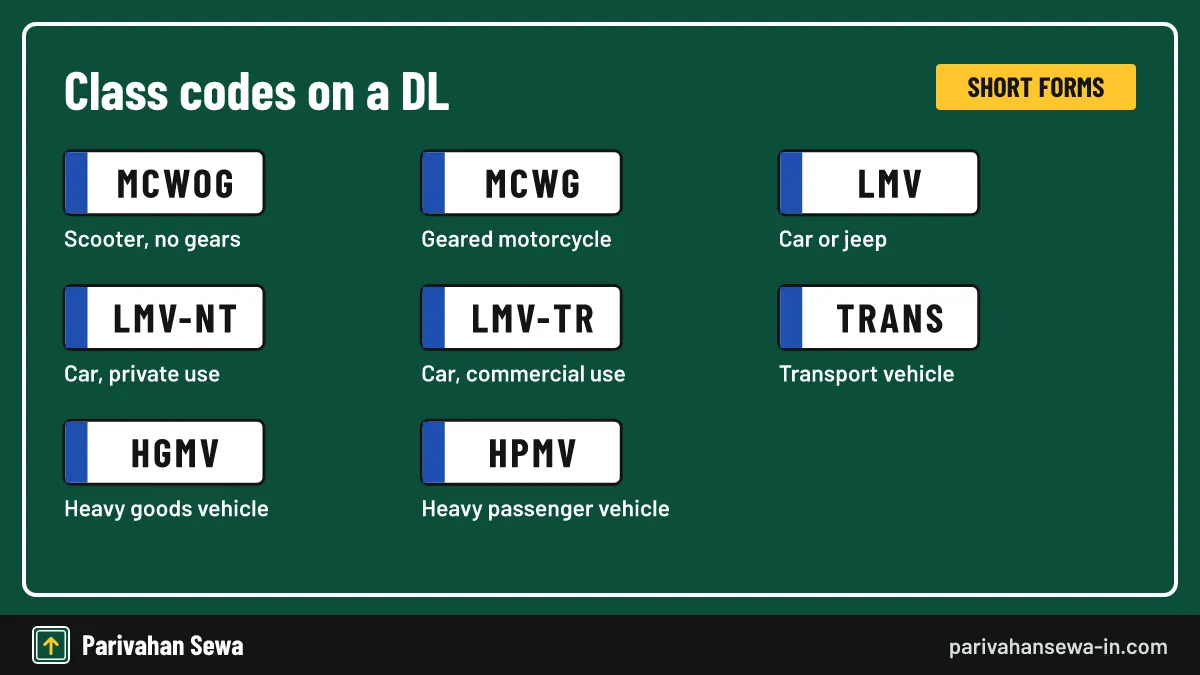
| Code | Full form | Covers |
|---|---|---|
| MCWOG | Motor cycle without gear | Scooters, mopeds, gearless bikes |
| MCWG | Motor cycle with gear | Geared motorcycles |
| LMV | Light motor vehicle | Cars, jeeps, light vans within 7,500 kg |
| LMV-NT | Light motor vehicle, non-transport | Private light vehicles |
| LMV-TR | Light motor vehicle, transport | Taxis, light goods carriers |
| TRANS | Transport vehicle | Commercial vehicles, including medium and heavy |
| HGMV / HPMV | Heavy goods / passenger motor vehicle | Trucks and buses above 12,000 kg |
Testing differences
The MCWG test checks balance, slow riding and turns. The LMV test checks steering, reversing, parking and road behaviour in a car.
More detail
Our MCWG full form page covers the two-wheeler class in full.
Motorcycle with gear non transport means what?
Motorcycle with gear non transport means a geared motorcycle used privately, not for hire. On a licence it is shown as MCWG, sometimes with an NT validity line, and it is the class most bike owners hold.
Bike taxis
A geared bike used as a bike taxi is a transport vehicle. States set their own rules for bike taxis, so riders should check local permits.
Age
A person aged 16 may hold a licence only for a motorcycle of up to 50cc. A normal geared bike needs the holder to be 18.
Motor cycle with gear non transport: what does the card show?
For motor cycle with gear non transport, the card shows MCWG in the class list with an issue date, and the licence’s non-transport validity date applies to it. There is no separate expiry for the bike class alone.
Older cards
Older paper or booklet licences may write the class in words or a local short form rather than MCWG. The Sarathi record shows the standard name.
Checking online
The Sarathi record lists the class with its full description and date, which helps when the printed card is worn.
MCWOG vehicle type: which two-wheelers need it?
The MCWOG vehicle type is the motor cycle without gear: scooters, mopeds and gearless electric two-wheelers that need a licence. MCWOG is a separate class from MCWG and LMV, and it is often the first class young riders get.
Gearless electric scooters
Electric scooters that are registered motor vehicles need a licence. Low-speed models outside the registration rules are an exception set by the rules, so check your vehicle’s papers.
MCWOG versus MCWG
An MCWOG holder may not ride a geared bike. An MCWG holder is commonly allowed to ride a gearless scooter, but check your state’s practice.
2 wheeler learning: how does a learner licence work for bikes?
2 wheeler learning starts with a learner licence for MCWG or MCWOG. You apply on Sarathi, pass the online or RTO learner test, and then ride with an L-plate displayed while you practise for the riding test. Follow any extra learner conditions your state prints on the licence.
Validity and next step
The learner licence lasts six months. After the waiting period, book the riding test. Our LLR means guide explains the learner licence itself.
Learning a car and bike together
You can add LMV, MCWG and MCWOG on one learner application, paying the learner fee for each class.
HMV vehicle: where does the heavy class begin?
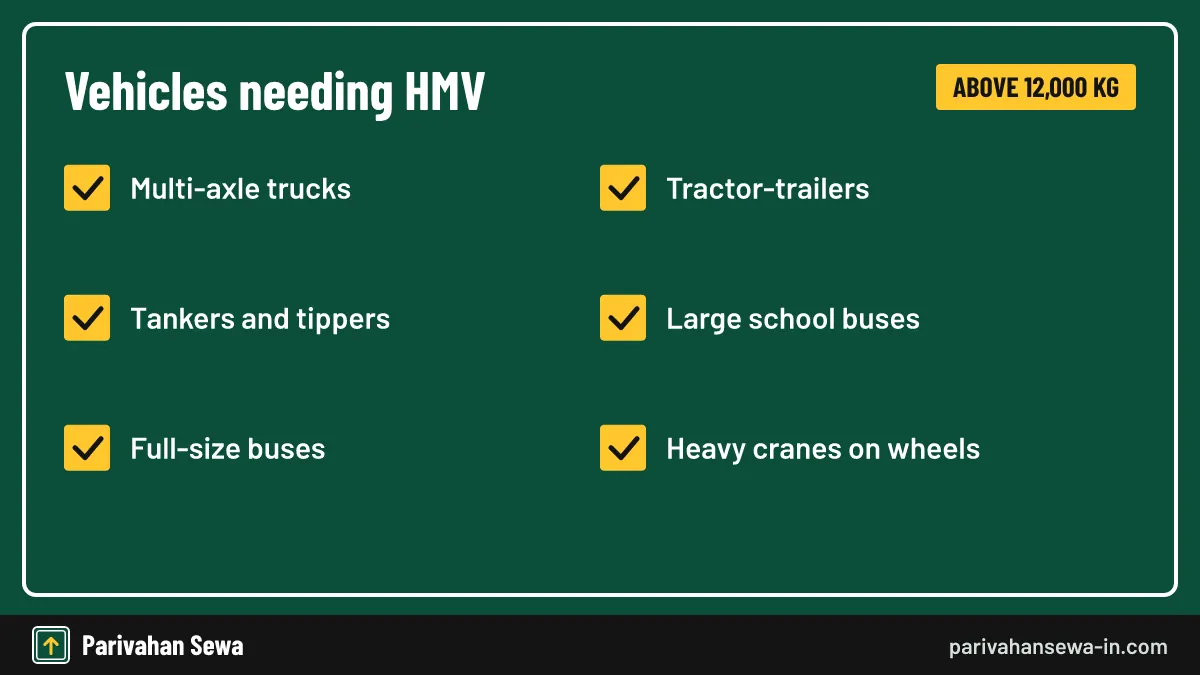
An HMV vehicle is one above 12,000 kg: a heavy goods vehicle by gross weight, or a heavy passenger vehicle such as a full-size bus. Between 7,500 and 12,000 kg is the medium band. Both medium and heavy vehicles need a transport class, not LMV.
Heavy goods versus heavy passenger
Sections 2(16) and 2(17) define the two heavy groups. Licence codes such as HGMV and HPMV reflect this split.
Further reading
For eligibility, tests and documents, see our full guide to the heavy motor vehicle licence.
HMV vehicle list: which vehicles need a heavy licence?
The HMV vehicle list includes multi-axle trucks, tankers, tippers, tractor-trailer combinations, full-size buses and large school buses, all above 12,000 kg. Mid-size trucks and minibuses in the medium band also need a transport class, so check the RC weight.
Common heavy vehicles
Long-haul trucks, intercity buses, container carriers and construction tippers are the usual heavy vehicles.
Hazardous goods
Drivers of vehicles carrying hazardous goods face extra training requirements, whatever the vehicle’s weight.
LMV, MCWG and HMV vehicle classes compared
The three most searched classes differ in vehicle, weight, minimum age and use. LMV covers light four-wheelers within 7,500 kg, MCWG covers geared motorcycles, and the HMV vehicle classes cover goods and passenger vehicles above 12,000 kg.
| Feature | MCWG | LMV | HMV (heavy transport) |
|---|---|---|---|
| Vehicle | Geared motorcycle | Car, jeep, light van | Truck, bus above 12,000 kg |
| Minimum age | 18 | 18 | 20 |
| Prior licence | None | None | LMV held for one year |
| Use | Private or bike taxi | Private or light commercial | Commercial only |
Moving up the ladder
Most heavy drivers start with LMV, hold it for a year, then apply for a transport learner licence under section 7.
Insurance view
Insurers check that the class matches the vehicle at the time of an accident, so keep each class you use on your card.
Tractor is LMV or HMV?
Tractor is LMV or HMV? A tractor with unladen weight up to 7,500 kg is a light motor vehicle under section 2(21), so it is LMV, not HMV. Most farm tractors are well under this weight. A tractor pulling a heavy trailer may raise separate questions about the combination.
What courts have said
The Supreme Court in Mukund Dewangan (2017) and High Courts in Delhi and Karnataka have held that an LMV licence covers a tractor within the weight limit.
Tractor-trailer
A tractor with a loaded trailer used for hire may be treated as a transport vehicle. Check the trailer’s registration and your RTO’s view.
Tractor licence: do farmers need a separate one?
A separate tractor licence is not required by the definition, because a light tractor is an LMV. Some RTOs still list “tractor” as its own class on Sarathi, and some people get it added for clarity. Ask your RTO which class it issues.

Farm use
Driving a tractor on public roads needs a licence, even when it is used only for farm work. Fields and private land are a different matter.
Practical advice
If your licence shows only MCWG, add LMV or the tractor class before driving a tractor on the road.
MVSD full form in driving licence: what is it?
We could not find an official expansion of the MVSD full form in driving licence. It most likely stands for “motor vehicle of a specified description”, the last class in section 10(2)(j), used for special vehicles that do not fit the other classes. Confirm on your Sarathi record or with your RTO.
Where it may appear
Special vehicles such as cranes, forklifts or construction equipment registered for road use may be licensed under a specified description.
If you see it on your card
Ask the issuing RTO what vehicle the class covers, because the description is set locally.
LMV means what outside the licence?
LMV means the same light vehicle category in other road rules too. Traffic fines, number plate sizes and some toll and tax rules use “LMV” for cars and light vans. For example, the section 183 over-speeding fine for an LMV is Rs 1,000 to Rs 2,000.
Fines and plates
Fines for LMVs are often lower than for medium and heavy vehicles. Check the current amounts on the e-Challan portal. Plates for light vehicles are 50 cm by 12 cm.
Other meanings
Outside transport, LMV may be an abbreviation in other fields. On licences and RCs in India, it always means light motor vehicle. For other licence terms, see our DL full form page or the driving licence guide.
Official links
Sarathi: driving licence servicessarathi.parivahan.gov.in ↗Parivahan Sewaparivahan.gov.in ↗Motor Vehicles Act, 1988 (India Code)indiacode.nic.in ↗Ministry of Road Transport and Highwaysmorth.nic.in ↗LMV full form questions
What is the LMV full form?
LMV stands for Light Motor Vehicle. It is the licence class used for cars, jeeps, taxis and other vehicles within 7,500 kg.
Can I drive an automatic car on an LMV licence?
Yes. The class is set by weight and use, not by gearbox type, so an LMV class covers manual and automatic cars alike.
Can I drive an electric car on an LMV licence?
Yes. An electric car within the weight limit is still a light motor vehicle, so the same LMV class applies.
Does an LMV licence allow me to ride a scooter?
No. Scooters need the MCWOG class and geared bikes need MCWG. Each class must be on your licence separately.
Is a tractor covered under LMV?
A tractor with unladen weight up to 7,500 kg falls inside the LMV definition, and courts have accepted this. Some RTOs still list a tractor class, so check with yours.
What is the minimum age for an LMV licence?
18 years for a non-transport LMV. Driving any transport vehicle needs the holder to be at least 20.
Can I drive a taxi with an LMV licence?
The Supreme Court held in 2024 that an LMV holder may drive a transport vehicle under 7,500 kg. You still need the vehicle's permit and any badge your state requires.
What does NT mean next to LMV?
NT means non-transport, that is a private vehicle not used for hire or reward.
What does TR mean on a driving licence?
TR stands for transport. It shows that the holder may drive commercial vehicles of that class, with its own validity date.
How many classes can one licence hold?
One licence can carry several classes, such as MCWG, LMV and a transport class, each with its own issue date.
Is HMV the same as a transport licence?
HMV is a common name for the heavy classes. A heavy class is a transport class, but a transport class can also be medium or light.
Where can I see the classes on my licence online?
Search your licence on Sarathi or add it in mParivahan or DigiLocker. The class of vehicle list appears with its dates.
Parivahan Sewa (parivahansewa-in.com) is an independent information website and is not affiliated with MoRTH, Parivahan or any state transport department. Confirm fees and rules on the official portal before you pay or apply.