Types of licenses in India: every class, code and stage
The types of licenses for drivers in India fall into two groups. By stage there is a learner's licence (valid six months) and a permanent driving licence. By vehicle, section 10 of the Motor Vehicles Act lists classes such as motor cycle without gear, motor cycle with gear, light motor vehicle and transport vehicle, printed on cards as MCWOG, MCWG, LMV and TRANS.
Key takeaways
- There are two stages (learner and permanent) and about seven legal classes; one card can carry several classes.
- Codes such as LMV-NT, MCWG, HTV and AGTLR are short forms of those classes and vary slightly by state.
- Minimum ages are 16 for a motorcycle up to 50cc, 18 for most private vehicles and 20 for transport vehicles.
- You must hold a learner's licence for at least 30 days before the driving test, and it lapses after six months.
- Central fees under CMVR Rule 32 are charged per class, so ticking two classes costs more than one.
- A non-transport class follows age-based validity; a transport class is valid for five years at a time.
On this page · 40 sections
Types of licenses explained for Indian drivers
The types of licenses issued to drivers in India are sorted two ways at once: by the stage you have reached (learner or full licence) and by the vehicle class you are allowed to drive. Knowing both helps you tick the right boxes on Sarathi and avoid a second application later.

Stage and class work together
Every licence has one stage and one or more classes. A learner’s licence for a car is a learner stage with the LMV class. A full licence for a car and a scooter is a permanent stage with two classes on the same card.
Where this guide fits
This page explains the categories and how to move between them. For every other service, such as status checks, renewals and corrections, start from our driving licence hub, which links each task in one place.
How many types of driving licence are there?
The short answer: two stages and about seven legal classes. The Act also allows transport authorisations, endorsements and an international permit, so the number you hear depends on what is being counted. Most people only ever need one or two classes.
Counting by stage
There is the learner’s licence (LL) issued in Form 3 and the driving licence (DL) issued after the practical test. Some people also count the international driving permit as a third stage, though it is only a companion to the DL.
Counting by vehicle
Section 10(2) of the Motor Vehicles Act lists the classes a licence can cover. Cards then print shorter codes, and states add sub-codes such as LMV-NT or MC 50CC, which is why online lists can show fifteen or more “types”.
What are the types of licence in India by stage?
There are three stages a driver may pass through: the learner’s licence for practice, the permanent licence for independent driving, and optional add-ons such as an extra class or an international permit. Each stage has its own form, fee and test.
Learner’s licence
This is your training permission. It lasts six months under section 14 and lets you drive only with a qualified instructor beside you and an L plate shown. You get it after an objective test on road rules and signs.
Driving licence and its add-ons
The full licence follows a practical test. Later you can add a class, add a transport authorisation, or apply for a permit to drive abroad. None of these changes your licence number; they are new entries on the same record.
Types of DL: private and commercial
A second way to split the types of DL is by purpose. A class marked non-transport covers private driving. A class marked transport covers vehicles used to carry passengers or goods for hire. The vehicle may be the same; the use decides which label you need.
Private (non-transport) use
Your own car, scooter or family SUV driven for personal trips falls here. The validity of a non-transport class follows your age, and no medical certificate is needed until you reach 40.
Commercial (transport) use
Taxis, goods carriers, buses and school vans fall here. Applicants must be at least 20, need a driving school certificate under section 9(4) and must renew the class every five years.
Vehicle licence types under section 10
The legal list of vehicle licence types sits in section 10(2) of the Motor Vehicles Act, 1988. It names motor cycle without gear, motor cycle with gear, adapted vehicle, light motor vehicle, transport vehicle, road-roller and a motor vehicle of a specified description.
Why the list is short
Medium and heavy goods and passenger classes once had their own clauses. A later amendment folded them into the single transport vehicle class, which is why the Act lists fewer classes than the codes printed on cards.
The catch-all class
Clause (j), a “motor vehicle of a specified description”, lets authorities issue a licence for vehicles that fit no other class, such as construction equipment. States decide how to print it, so the code varies.
Driving licence categories in India: the legal classes
The table below lines up the driving licence categories in India in the Act with the codes you are most likely to see. Use it to translate the legal wording into what appears on a smart card or a Sarathi record.
| Section 10(2) clause | Legal class | Common card codes |
|---|---|---|
| (a) | Motor cycle without gear | MCWOG, MC 50CC, M/CYCL.WOG |
| (b) | Motor cycle with gear | MCWG, M/CYCLWG |
| (c) | Adapted vehicle (formerly invalid carriage) | LMV-INVCRG-NT |
| (d) | Light motor vehicle | LMV, LMV-NT, LMV-TR |
| (e) | Transport vehicle | TRANS, HTV, HPMV, HGMV |
| (i) | Road-roller | State-specific code |
| (j) | Motor vehicle of a specified description | AGTLR, LDRXCV and similar |
How to use the table
Find your code in the right column, then read across to the legal class. The legal class is what police, insurers and courts rely on when deciding whether you were licensed for a vehicle.
What the table does not show
Endorsements such as hazardous goods or hill driving are not classes. They are extra permissions added to a transport class, and they appear as separate notes on your record.
Licence list: every class code you may see
Here is a working licence list of the codes Indian cards and Sarathi records commonly show. Older paper licences may use longer or slightly different spellings, but the meanings match these entries.
| Code | What it covers |
|---|---|
| MC 50CC | Motorcycles with engine capacity up to 50cc |
| MCWOG | Gearless scooters and mopeds |
| MCWG | Motorcycles with gears |
| LMV-NT | Light motor vehicle for personal use |
| LMV-TR | Light motor vehicle for commercial transport |
| LMV-INVCRG-NT | Light vehicle adapted for a driver with a disability |
| HPMV | Heavy passenger motor vehicle |
| HTV | Heavy transport vehicle (goods or passenger) |
| TRANS | Heavy goods and passenger vehicles, plus trailers |
| AGTLR | Agricultural tractor and power tiller |
| LDRXCV | Loaders, excavators and hydraulic equipment, where offered |
| AEDL | Additional endorsement for taxis or public transport |
Codes that look alike
HTV, HPMV and TRANS overlap. All three sit inside the transport class, and states choose which one to print. If your card shows TRANS, you can generally drive heavy goods and passenger vehicles of the kind you were tested on.
Codes your state may add
Some states add their own short forms for road-rollers, cranes or e-rickshaws. If a code is not on this list, search your licence number on Sarathi and read the class description there.
What do driving license codes mean on the card?
Driving license codes are short labels for the classes you passed. Each one sits in the class of vehicle (COV) area of your card with an issue date, and on newer cards a validity date. Together they tell an officer exactly which vehicles you may drive.

Reading the COV block
Read each line left to right: code, date of first issue and, where shown, the last date of validity. A transport code may have a different end date from a private code on the same card.
Codes on digital copies
DigiLocker and mParivahan show the same codes as the Sarathi record. If a code on your plastic card does not match the digital copy, the online record usually reflects the latest update at the RTO.
What is the car licence code?
The car licence code is LMV, short for light motor vehicle. On most cards it appears as LMV-NT for private cars. If you drive a cab or a light goods vehicle for hire, you may see LMV-TR or a separate transport entry.
Manual, automatic and electric cars
The code does not change with the gearbox or fuel. A licence earned in an automatic car is still an LMV licence, and the Kerala High Court has said states cannot bar automatic or electric cars from the test.
Where to read more
The letters are explained in full in our LMV full form guide, which also covers the weight limit and the legal definition of a motor car.
Which car license category should you choose?
For a private car, choose the LMV class when you fill in the learner form; Sarathi records it as non-transport by default. Pick a transport class only if you plan to drive a vehicle for hire and you meet the age and training conditions.
Your first car
Tick LMV only. If you also ride a scooter or motorbike, tick the two-wheeler class in the same application; one learner test covers every class you select.
Planning a commercial career
You can start with LMV and later add transport. Section 7 says a transport learner’s licence needs an LMV licence held for at least one year, so starting early saves time.
What does motorcycle without gear non transport mean?
Motorcycle without gear non transport is the full wording behind the MCWOG class used for private riding. It covers scooters, mopeds and gearless electric two-wheelers ridden for personal travel, not for delivery or hire.
Who should pick it
Choose it if you will only ever ride a gearless scooter. A 16-year-old can get this class for vehicles up to 50cc with written consent from a parent or guardian.
Its limits
It does not cover a geared motorcycle. Many insurers treat a geared licence as covering scooters too, but the Act lists the two classes separately, so ask for MCWG as well if you ride both. See our MCWG full form guide for the geared class.
What is the MCYL full form?
We could not find an official MCYL full form. The Motor Vehicles Act has no class called MCYL. It most likely shortens “motor cycle”, as in older card abbreviations such as M/CYCL.WOG and M/CYCLWG for motorcycles without and with gear.
If your card shows MCYL
Treat it as a motorcycle entry and confirm the details on Sarathi. The online record will name the class in full, telling you whether the entry covers geared bikes, gearless scooters or both.
Why the codes changed
Paper and early laminated licences were filled in by hand or on local software. National smart cards and Sarathi brought shorter, more uniform codes, so some old spellings no longer appear on new cards.
What is NT in driving license?
NT in driving license records means non-transport. It marks a class used only for private driving. The most common example is LMV-NT for a family car, though two-wheeler entries can carry the same label.
What NT allows
You can drive your own vehicle, or one borrowed from family or friends, for personal trips. You cannot charge fares or carry goods for payment under a non-transport entry.
What NT does not allow
Driving a vehicle registered as a transport vehicle for hire generally needs a transport entry, subject to the 2024 ruling on light vehicles. Our guide to LMV in driving licence explains NT and TR lines in detail.
What is a private licence?
A private licence is the everyday name for a licence holding only non-transport classes. It is what most car owners and scooter riders carry. It needs no driving school certificate and no medical certificate before age 40.
Benefits of a private licence
It is cheaper and quicker to get than a transport class, and its validity is long: until age 40 if issued before 30, then ten-year or shorter blocks as you get older.
Moving from private to commercial
You do not need a new licence. Apply to add a transport class to the same record, complete the training required, and pass the test for that class.
What is the HTV licence full form?
The HTV licence full form is heavy transport vehicle. It is a code inside the transport class that covers heavy goods carriers and heavy passenger vehicles, meaning trucks and buses above the light and medium weight bands.
Who holds an HTV entry
Truck drivers, bus drivers and drivers of large tankers usually hold it. They must be at least 20, hold a driving school certificate and pass a test in a heavy vehicle.
HTV, HGMV and HPMV
Some states split heavy vehicles into goods (HGMV) and passenger (HPMV) entries instead of one HTV line. Our HMV licence guide covers the eligibility and steps for heavy classes.
LMV and HMV: how do the two classes differ?
LMV and HMV differ by weight and purpose. A light motor vehicle stays within 7,500 kg; a heavy vehicle goes above 12,000 kg. HMV driving always counts as transport work, so it carries a higher age limit, training rules and shorter validity.

Weight bands in the Act
Section 2 defines light vehicles up to 7,500 kg and heavy vehicles above 12,000 kg. Vehicles between the two are medium goods or passenger vehicles and sit inside the transport class.
Getting from LMV to HMV
You first hold an LMV licence, usually for a year, then apply for a transport learner’s licence for the heavy class. Training at a recognised school and a test in a heavy vehicle follow.
Which classes can a road-roller or tractor driver hold?
Tractors and road-rollers are named in the Act’s definition of light motor vehicles when their unladen weight is within 7,500 kg. Courts have accepted that an LMV licence covers such a tractor, while some states also print a separate tractor code.
Tractors on farms
Many farmers hold an ordinary LMV class. Where states offer it, an AGTLR entry covers an agricultural tractor and power tiller. Check your state’s Sarathi options when you apply.
Construction equipment
Loaders and excavators may be licensed under the specified-description class, printed as LDRXCV in some states. Training for such machines is often given by skill agencies rather than driving schools.
Is there a licence for adapted vehicles?
Yes. Section 10(2)(c) covers an adapted vehicle, the term the 2019 amendment used in place of “invalid carriage”. It is a vehicle specially built or modified for a person with a disability, and cards may show it as LMV-INVCRG-NT.
Who can apply
Any person who can drive such a vehicle safely may apply. The test is taken in the adapted vehicle itself, so bring the vehicle you will actually drive.
What to expect at the RTO
You may be asked for a medical certificate in Form 1A describing the disability and the adaptation. The class then lets you drive that type of adapted vehicle for private use.
Which licence does an e-rickshaw driver need?
E-rickshaws and e-carts have their own eligibility rule. Under CMVR rule 8A, an applicant must complete at least ten days of training and hold a certificate from an institution authorised by the state before the licence is issued.
Why the rule exists
E-rickshaws carry passengers for hire in crowded areas, so the training covers basic road rules, passenger safety and battery care before the driver goes solo.
How it is printed
States show this entry in different ways, often as a transport class for e-rickshaw or e-cart. The 2024 Supreme Court ruling left the special rules for these vehicles in place.
Types of licenses in India for transport drivers
For commercial drivers, the types of licenses in India narrow to transport entries: light transport (LMV-TR), medium and heavy transport (TRANS, HTV, HPMV), and endorsements for hazardous goods or hill driving. Each needs a minimum age of 20.
The 2024 Supreme Court ruling
On 6 November 2024 a Constitution Bench held that an LMV holder can drive a transport vehicle under 7,500 kg without a separate entry. Medium and heavy transport vehicles still need the extra licensing steps.
Badges and endorsements
Some states issue a badge or an AEDL endorsement for taxi and public transport drivers. Hazardous goods need a further endorsement, and that entry is valid for only three years.
What is the DL full form in vehicle papers?
The DL full form in vehicle papers is driving licence. You will see “DL” on insurance forms, challans, rental agreements and RC transfer forms, always asking for the number on your licence card.
The DL number format
The number usually starts with your two-letter state code and the RTO code, followed by the year of issue and a serial number. Use it exactly as printed when filling in forms.
Not to be confused with Delhi plates
“DL” is also the registration code for vehicles from Delhi, as in DL 3C. On a number plate it means the state, not a driving licence.
What is the DL full form in RTO language?
In RTO language the DL full form in RTO use is the same, driving licence, but staff use it alongside other short forms: LL for learner’s licence, COV for class of vehicle, and DDL for duplicate driving licence.
Short forms you will hear
Expect LL, DL, COV, NT, TR and IDP at the counter. Knowing them helps you pick the right service on Sarathi without asking for help at every step.
Short forms on receipts
Fee receipts list the service, such as “Issue of DL” or “Test for DL”, with an amount for each class. Keep them until the card arrives.
What is a permanent licence?
A permanent licence is the full driving licence issued after you pass the practical test. “Permanent” is the common word, not a legal term; the Act simply calls it a driving licence. It replaces your learner’s licence and lets you drive without supervision.
Is it really permanent?
No licence lasts forever. A non-transport licence first runs until age 40 if issued before 30, then needs renewal. Transport classes need renewal every five years.
What the card looks like
Most states issue a PVC smart card with your photo, licence number, classes and validity. A digital copy in DigiLocker or mParivahan is accepted as a valid document.
Permanent license: what does it allow?
A permanent license allows you to drive alone, on any road open to the class shown on your card, anywhere in India. It also lets you carry passengers, a right a learner on a motorcycle does not have.
Driving across states
A licence issued in one state is valid in every state. You only need to update the address on the record if you move, not apply for a new licence.
Showing it to officers
You can show the card or the DigiLocker or mParivahan version. Officers can also check the licence directly against the Sarathi database.
What is the difference between learner licence and driving licence?
The difference between learner licence and driving licence is about freedom and testing. A learner may drive only with a licensed instructor beside them; a DL holder may drive alone. The table sets out the main contrasts.
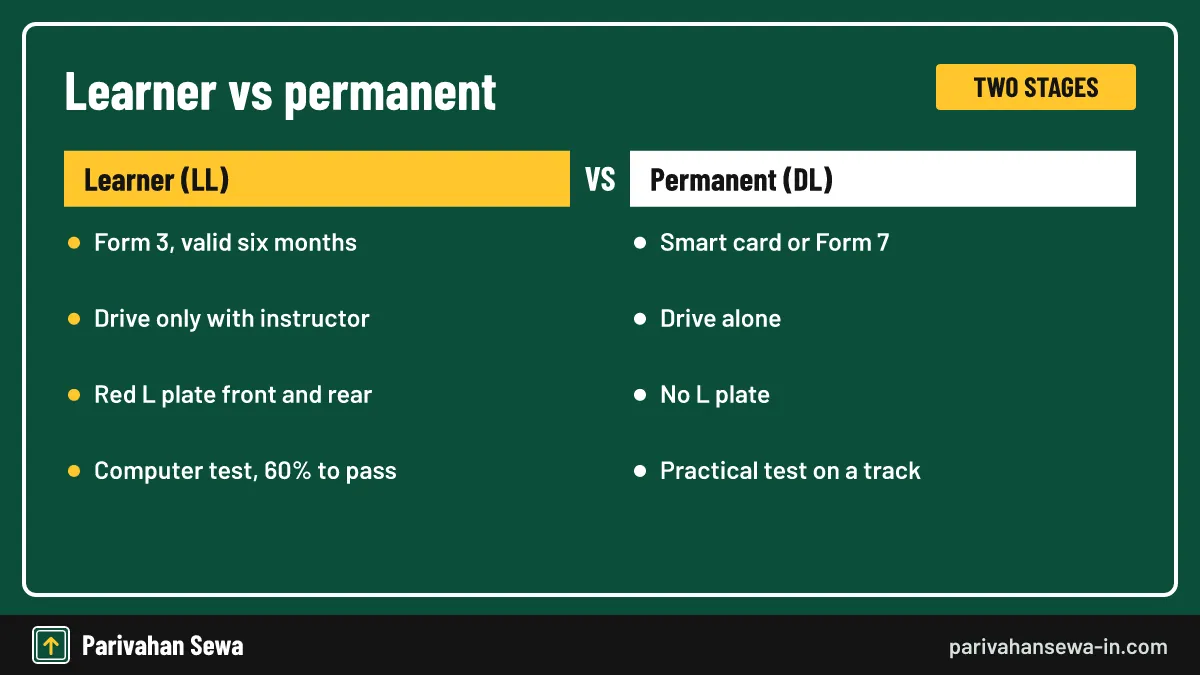
| Point | Learner’s licence (LL) | Driving licence (DL) |
|---|---|---|
| Form | Form 3 | Smart card (Form 7 in most states) |
| Validity | Six months | Until age 40 or longer blocks (private) |
| Test | Objective test, 60% to pass | Practical test on a track or road |
| Supervision | Instructor must sit beside you | None needed |
| L plate | Red L on front and rear | Not needed |
What learners cannot do
On a motorcycle, a learner may not carry any passenger other than the instructor. In a car, the instructor must be able to control or stop the vehicle.
Why both exist
The learner stage gives you time to practise legally. It also lets the RTO confirm you know road signs before you face a practical test.
After LL how many days for DL?
The answer to after LL how many days for DL is at least 30 days. CMVR rule 15 says you cannot take the driving test until you have held the learner’s licence for 30 days, and you must pass before it expires at six months.

If you miss the window
If the six months run out, the learner’s licence lapses. You will usually need to apply again and pay the learner fee, though some states allow renewal of the LL.
If you fail the test
You can retake the test after seven days. Book the retest early so it still falls inside the learner’s validity period.
How to apply for permanent driving license?
To apply for permanent driving license status, use the Sarathi portal once your learner’s licence is at least 30 days old. You fill in an online form, pay the fee, book a slot and then take the practical test at the RTO.
- Choose your state. Open sarathi.parivahan.gov.in and select the state where you will take the test.
- Open the driving licence application. Choose the new driving licence service and enter your learner’s licence number and date of birth.
- Confirm the classes. Check that the classes shown match your learner’s licence; you can only be tested for those.
- Upload and pay. Upload any documents the state asks for and pay the test and issue fee online.
- Book the test slot. Pick a date at your RTO or automated track and save the slip.
- Take the test and wait for the card. Once you pass, the licence is approved and the card is printed and posted in most states.

Before you start
Have your learner’s licence number, date of birth and mobile number ready. The application number from the form is needed for slot booking and status checks.
On test day
Carry your learner’s licence, the fee receipt and the original documents. Bring a roadworthy vehicle of the class you are testing for, with valid papers and L plates.
What is the license procedure from start to finish?
The full license procedure has five stages: learner application, learner test, a waiting period of at least 30 days, the driving test, and card issue. Most applicants finish within two to three months if they book tests promptly.
Learner stage
Apply on Sarathi in Form 2, upload documents and pay. Take the objective test online or at the RTO; you need at least 60% correct to pass.
Driving licence stage
Apply in Form 4 after 30 days, book a slot and pass the practical test. Some states hand over the card at the RTO; most send it by post.
What happens in the permanent driving license test?
The permanent driving license test is a practical check of control and road sense under CMVR rule 15. You drive a vehicle of the class you applied for, on a test track or a set route, while an inspector or an automated system watches.
Car test tasks
Typical tasks include a forward figure 8, a reverse S, parallel parking and starting on an upward slope. You must also show correct signals, mirror use and lane discipline.
Two-wheeler test tasks
Riders usually face a serpentine track, a straight ramp and emergency braking. Wear a helmet; arriving without one can end the test before it starts.
Where can you find a driving test centre?
A driving test centre is either your RTO’s own track or an automated test track run for the state. Sarathi lists the centres open to you when you book. Since 1 July 2021, accredited driver training centres can also test their own students.
Automated test tracks
Delhi opened its first automated centres in 2019, and other states followed. Cameras and sensors record each attempt, and the result is decided by the system rather than an inspector. Our driving test track guide covers the manoeuvres.
Accredited training centres
Students who pass the test at an accredited centre are exempt from the RTO driving test. The light vehicle course runs 29 hours over up to four weeks.
What is the minimum age for license in India?
The minimum age for license in India depends on the class. Section 4 of the Act sets 16 for motorcycles up to 50cc, 18 for other vehicles in a public place, and 20 for transport vehicles. You apply for the learner’s licence at these ages.
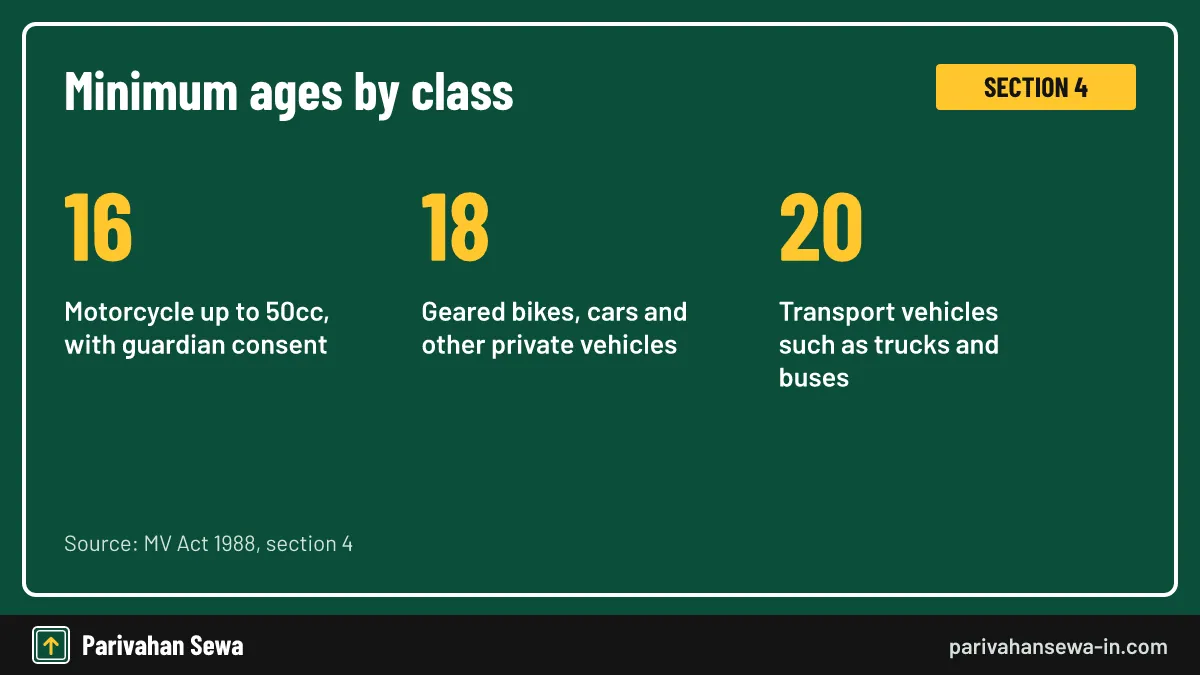
| Class | Minimum age | Extra condition |
|---|---|---|
| Motorcycle up to 50cc | 16 | Written consent of parent or guardian |
| Geared motorcycle, car (private) | 18 | None |
| Transport vehicle | 20 | Driving school certificate |
| Heavy transport vehicle | 20 | LMV held for one year first |
Is there an upper age limit?
No. There is no maximum age. From 40 onwards you attach a medical certificate in Form 1A, and validity blocks get shorter as you get older.
More on learner ages
Our learning licence age guide covers age rules for the learner stage, including what a 16-year-old may ride.
How long is each licence type valid?
Validity depends on the stage and on whether the class is private or transport. A learner’s licence lasts six months. A private class follows age slabs set by the 2019 amendment. A transport class lasts five years, and a hazardous goods entry three.
Private classes by age
Issued before 30: valid until age 40. Issued between 30 and 50: ten years. Issued between 50 and 55: until age 60. Issued after 55: five years.
Renewing on time
You can renew up to one year before or after the expiry date. After a year you may be asked to retest, and late fees apply for every year of delay.
What does each licence type cost?
Central fees come from CMVR Rule 32 and are charged per class. States may add card, service and online charges, so your final receipt is usually higher. The core amounts are below.
| Service | Central fee |
|---|---|
| Learner’s licence, each class | ₹150 |
| Learner’s licence test | ₹50 |
| Driving test, each class | ₹300 |
| Issue of driving licence | ₹200 |
| Smart card | ₹200 |
| Renewal | ₹200 |
Why two classes cost more
Because the learner and driving test fees are charged per class, ticking both a bike and a car class adds a second learner fee and a second test fee, though the learner test fee is paid once.
Late renewal
Renewal after the grace period costs more, with an extra amount for each year of delay. Confirm the current figure on your state’s Sarathi fee page before paying.
Which documents does each licence type need?
Every type needs proof of age, proof of address and photographs. Transport classes add a driving school certificate and a medical certificate. Applicants aged 40 and above attach Form 1A for any class.
Learner and private classes
Bring proof of age and address, such as Aadhaar, passport or school certificate, plus photographs and a signature. Our documents required for driving licence guide lists accepted papers.
Transport and heavy classes
Add your existing LMV licence, the Form 5 driving certificate from a recognised school and a Form 1A medical certificate. Some states also ask for a police verification for public service vehicles.
Which licence rules apply to every class?
Some licence rules apply whatever class you hold. You must hold an effective licence for the vehicle you drive, carry it or a digital copy, renew on time and never let an unlicensed person drive your vehicle.

Rules for drivers
Section 3 bars driving in a public place without an effective licence for that vehicle. You may hold only one driving licence at a time; extra classes go on the same record.
Rules for owners
Section 5 makes the owner responsible if they allow someone without a valid licence to drive. Check a driver’s classes before handing over the keys.
Can one card carry several classes?
Yes. One licence number can hold every class you qualify for. Under section 11 you apply to add a class to your existing licence, take the learner test and driving test for it, and the new entry is printed with its own date.
Adding a class later
Apply for a learner’s licence for the new class on Sarathi using your existing DL number. After 30 days, book the driving test for that class only.
Applying for two at once
New applicants can select a two-wheeler and a car class together. One learner test covers both, but each class has its own practical test.
How do you check which classes your licence has?
Use the licence status service on Sarathi or Parivahan. Enter your DL number and date of birth, and the result lists each class with its issue and validity dates. DigiLocker and mParivahan show the same information.
When to check
Check before you buy a new type of vehicle, before applying for a transport job and before travelling abroad. It takes a minute and can save a fine or an insurance dispute.
If a class is missing
If a class you passed does not appear, contact the RTO that issued the licence with your test receipt. Errors in the record are corrected at the office.
Can you drive abroad on an Indian licence?
Some countries accept an Indian licence for short visits, but most expect an international driving permit alongside it. The permit is issued by your RTO in Form 6A and is valid for up to one year.
What the permit covers
It repeats the classes on your Indian licence in several languages. It is not valid in India and must always be carried with the original licence.
How to get one
Apply through Sarathi or your RTO with your licence, passport and visa. Our international driving license India guide explains the full process.
What happens if you drive without the right class?
Driving a vehicle your licence does not cover is treated as driving without a valid licence for it. Section 181 sets a fine of ₹5,000, and the owner who allowed it can face the same amount under section 180.
Insurance risk
Insurers can dispute or recover a claim when the driver’s class does not match the vehicle. That can leave you paying for damage and third-party costs yourself.
Where to read more
Our without licence fine guide explains the penalties, how challans are issued and what happens in court.
What mistakes do people make when choosing a class?
The most common error is ticking too few classes at the learner stage, then needing a second round of tests. Others include confusing geared and gearless bikes and letting a transport line lapse. Each is fixable on the same licence.

Choosing by vehicle, not by habit
Look at the vehicle you will drive, then check its weight and use. Our types of vehicles guide explains how vehicles are grouped on the registration side, which mirrors the licence classes.
Checking the record after the test
Once the card arrives, compare every class and date with your application. Mistakes are easier to correct within the first few weeks than years later.
Official links
Sarathi: driving licence servicessarathi.parivahan.gov.in ↗Parivahan Sewaparivahan.gov.in ↗Motor Vehicles Act, 1988 (India Code)indiacode.nic.in ↗Ministry of Road Transport and Highwaysmorth.nic.in ↗Types of licenses questions
How many types of driving licence are there in India?
Two stages (learner and permanent) and about seven legal vehicle classes under section 10 of the Motor Vehicles Act. States print those classes as codes like MCWOG, MCWG, LMV and TRANS.
What is a permanent licence?
It is the full driving licence you get after passing the practical driving test. It lets you drive alone and stays valid for years, unlike the six-month learner's licence.
After LL how many days for DL test?
At least 30 days. CMVR rule 15 says you must hold the learner's licence for 30 days before the test, and you must take it before the LL expires at six months.
What is the car licence code?
Cars come under LMV, usually printed as LMV-NT for private use or LMV-TR for commercial use.
What does NT mean in a driving license?
NT means non-transport: the class is for private driving, not for carrying passengers or goods for hire.
What is the HTV licence full form?
HTV stands for heavy transport vehicle. It covers heavy goods carriers and heavy passenger vehicles such as trucks and buses.
What is the MCYL full form?
There is no official expansion. MCYL is not a class in the Act; it most likely shortens motor cycle, as in older card codes such as M/CYCL.WOG.
What is the minimum age for a licence in India?
16 for a motorcycle up to 50cc with guardian consent, 18 for geared motorcycles, cars and other private vehicles, and 20 for transport vehicles.
What is the difference between a learner licence and a driving licence?
A learner's licence lets you practise under supervision with an L plate for six months. A driving licence lets you drive alone after passing a practical test.
Can I add a bike class to my car licence?
Yes. Apply to add the class, pass a learner test for it, wait the required period and then pass the riding test. Your licence number stays the same.
Is a private licence different from a commercial licence?
Yes. A private (non-transport) class does not let you drive a vehicle for hire except where the 2024 Supreme Court ruling allows light transport vehicles under 7,500 kg.
Where is my nearest driving test centre?
Tests are held at your RTO track or a state automated test track. Sarathi shows the available centres and dates when you book the slot.
Parivahan Sewa (parivahansewa-in.com) is an independent information website and is not affiliated with MoRTH, Parivahan or any state transport department. Confirm fees and rules on the official portal before you pay or apply.