PD challan explained: generation, status, reprint and payment
A PD challan is a treasury payment slip linked to a Personal Deposit (PD) account, an account that a government office keeps inside the state treasury. Citizens create similar receipt challans on their state portal, such as CFMS in Andhra Pradesh: pick the department and service, enter the amount, save the challan number and pay online or at the bank named. It is not a traffic fine.
Key takeaways
- A PD account is a deposit account an office holds in the treasury; a PD challan puts money into it or records money paid out.
- Citizen receipt challans are made on the state treasury portal (CFMS, IFMS, e-GRAS, Cyber Treasury and others), not on traffic sites.
- Take the department, service and amount from the office that asked you to pay; never guess them.
- Save every number shown: challan number or GRN, bank reference and, after confirmation, the CIN.
- Status and reprint pages search by those numbers, so a lost number makes everything slower.
- Pay only on a .gov.in treasury site or at the bank the challan names.
On this page · 40 sections
What is a PD challan?
A PD challan is a treasury challan tied to a Personal Deposit account. Government offices, courts and local bodies keep these accounts inside the state treasury. Money comes in through a deposit challan and goes out through bills, and each entry carries the challan or bill number for the account holder’s records.
Where you meet a PD challan
Most people see the term when an office tells them to “deposit through PD challan” for a security amount, an auction deposit or a court-ordered sum. The office then gives you the account details or the service to choose on the portal, and you pay into its PD account.
Why this guide covers citizen receipt challans too
On many portals the same screens serve both. In Andhra Pradesh, the CFMS system has a Citizen Challan page for receipts and separate PD screens for offices. The steps a citizen follows are the same: choose the department and service, pay, then keep the receipt.
What does PD mean in a PD challan?
PD stands for Personal Deposit. Treasury rules describe a PD account as working like a bank deposit account kept in the treasury, with every receipt and payment written into a personal ledger. The “personal” part refers to the administrator who runs the account, not to a private person.
Who holds a PD account
PD accounts are opened for government administrators, such as a district collector, a court, a corporation or a welfare board, when they must hold money for a purpose outside the normal budget. Citizens cannot open one; they only pay into it when asked.
How the office uses it
On CFMS, the PD administrator gives staff maker, checker and authoriser roles. A payment out of the account passes through those three steps before it reaches the treasury. That is why a PD refund or release can take longer than a normal bank transfer.
PD account challan versus a receipt challan
A PD account challan adds money to one office’s deposit account, which the office can later spend or return. An ordinary receipt challan sends money straight to a government revenue head, such as a fee or tax. You may fill similar forms, but where the money ends up is different.
Signs you need a PD deposit
The office’s letter mentions a deposit, a refundable amount, a “PD account” or gives an account name with PD in it. Deposits for tenders, land acquisition or court orders often go this way. Follow the letter’s wording rather than picking the closest option on the portal.
Signs you need a revenue receipt
If you are paying a fee for a service, such as a certificate, licence or application, it is usually a receipt into a revenue head. The portal will list it under the department’s services rather than under PD.
Is a receipt challan the same as a traffic fine?
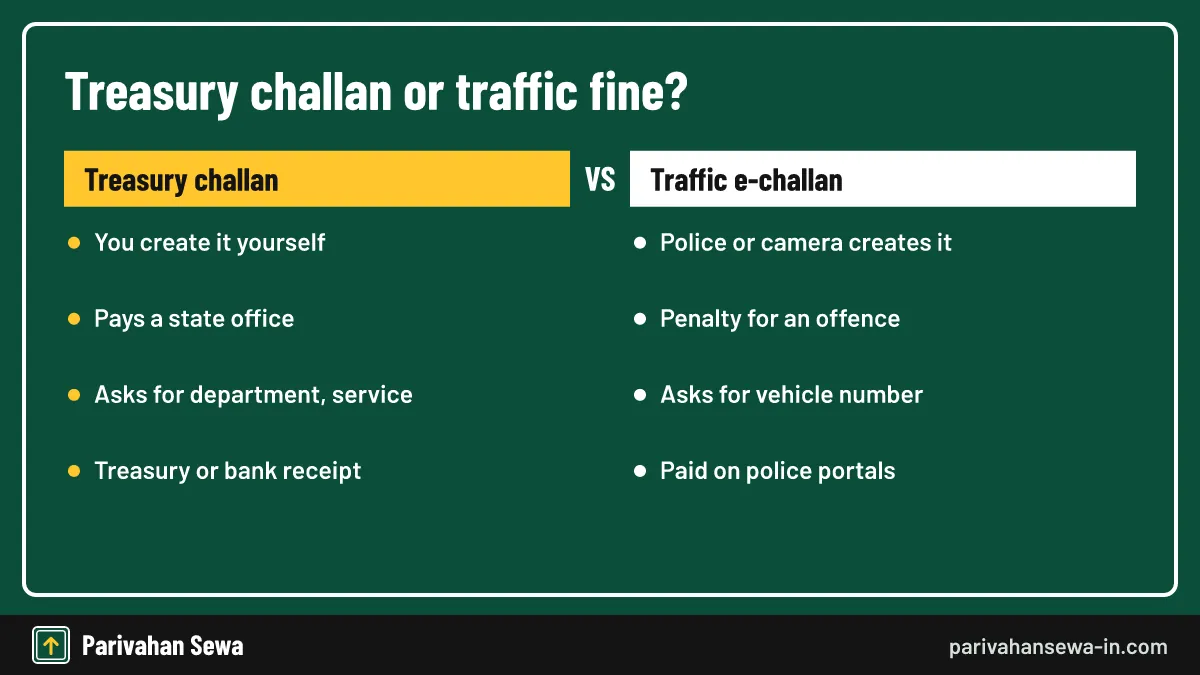
No. A treasury challan is a slip you create to pay a state office, while a traffic e-challan is a penalty raised by police or a camera. The word challan simply means a payment document, which is why both appear in search results. Our guide to challan meaning explains the word in detail.
| Point | Treasury receipt challan | Traffic e-challan |
|---|---|---|
| Who creates it | You, on the treasury portal | Police officer or camera |
| Purpose | Fee, deposit, tax or refund to a state office | Penalty for a road offence |
| Search key | Challan number, GRN, CIN or bank reference | Vehicle, challan or DL number |
| Where to pay | State treasury portal or named bank | Police or national e-Challan portal |
If you received a traffic notice
For road offences, use the national e challan hub, which explains how to check and pay traffic fines anywhere in India. Do not create a treasury challan to clear a traffic penalty; the police system will not see it.
What is challan generation on a treasury portal?
Challan generation is the step where the portal turns your form into a numbered payment slip. Once you submit the department, service, amount and your details, the system creates a challan number (often called a GRN) that the bank and the office both use to match your money.
What the generated challan shows
A typical challan shows the department, office, head of account, amount in figures and words, your name, the challan number and the date. Some portals add a validity date and the bank where it can be paid.
Generated is not paid
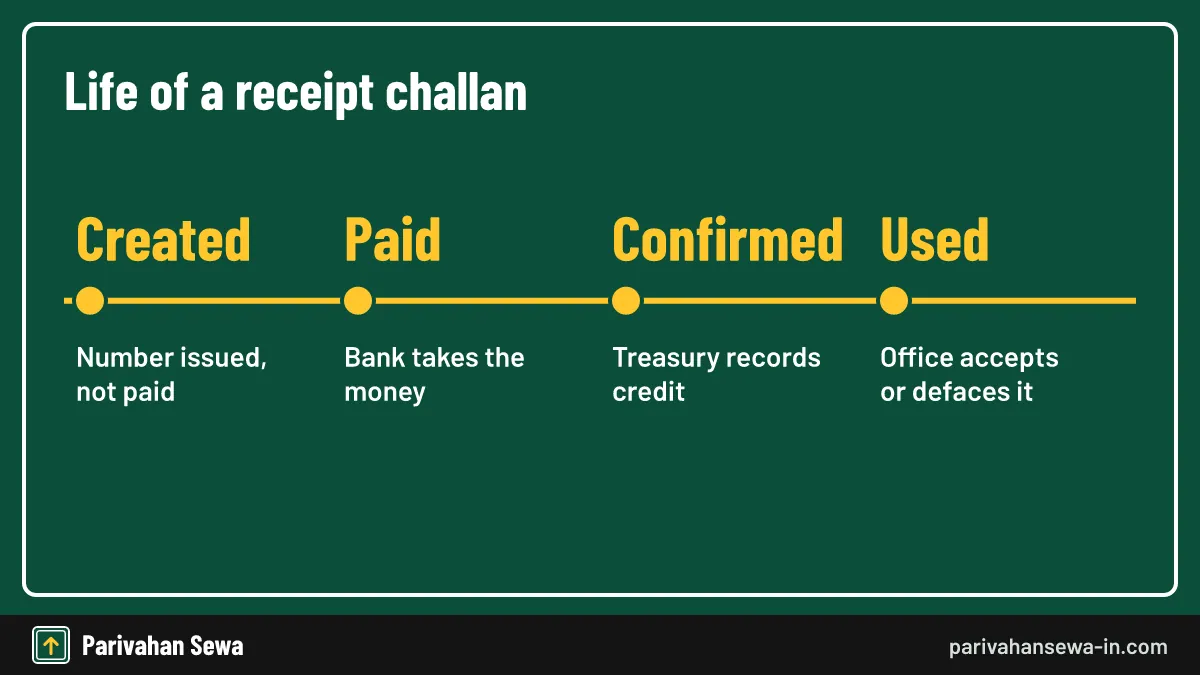
A challan that has only been generated has not moved any money. It becomes a proof of payment only after the bank takes the amount and the treasury confirms it.
Citizen challan creation: what are the steps?
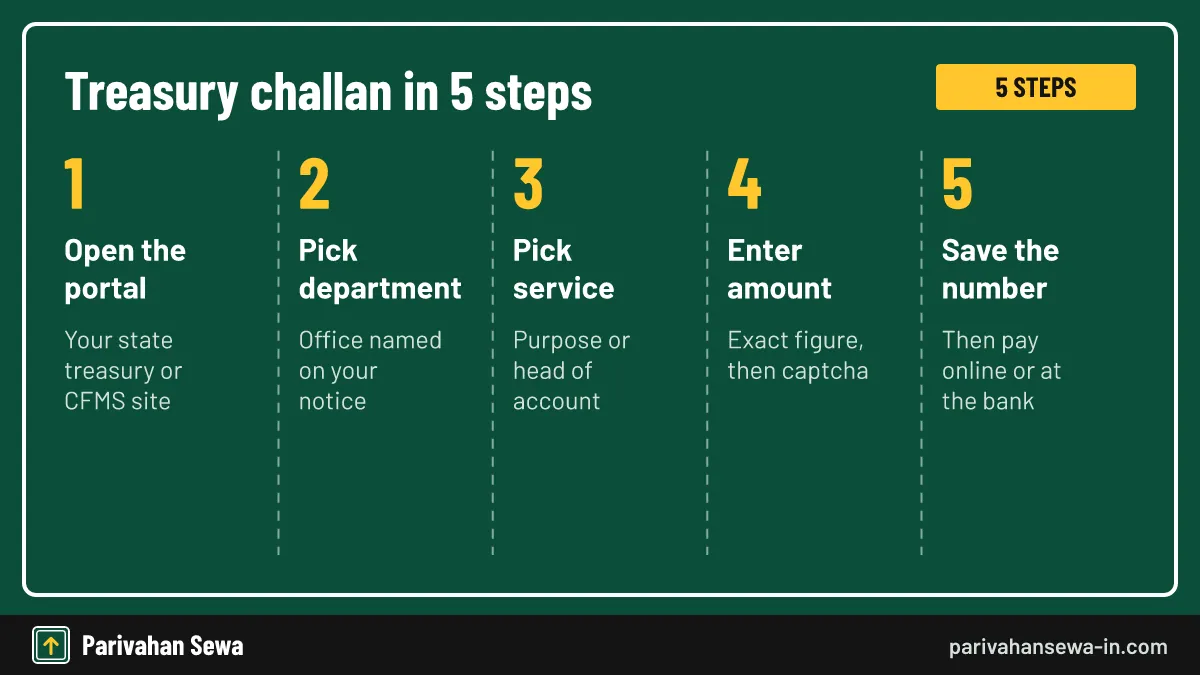
Citizen challan creation follows almost the same pattern on every state portal. On AP CFMS the path is Citizen Services, then Receipts Links, then Citizen Challan; other states use names such as e-Receipt, e-GRAS or Cyber Treasury. The five steps below fit most of them.
- Open the treasury portal. Type your state treasury or CFMS address yourself and open the citizen or receipts section.
- Choose the department. Select the department and office exactly as written on the notice from the office.
- Choose the service. Pick the service, purpose or head of account and enter the exact amount.
- Fill your details. Add your name, mobile number and any application number, type the captcha and submit.
- Save the number and pay. Note the challan number, then pay online or print the challan for the named bank.
On AP CFMS
After you pick the department and service and submit, CFMS shows the challan with its transaction details. If you gave a mobile number or email, CFMS says you may get a message after payment.
On other state portals
Field names change, but the logic stays the same. Some portals ask for a head of account code directly; others hide it behind a service list. If you see a code you were not given, ask the office instead of choosing one.
Challan creation: who can do it?
Challan creation is open to anyone who needs to pay a state office: an individual, a business, a lawyer for a client or a family member. Most portals have a guest or citizen route that needs no login; frequent payers can register to see past challans in one place.
Guest users
Punjab’s IFMS e-Receipt, for example, documents challan creation by a guest. A guest fills the form, then pays online or prints the challan and deposits it at the bank shown at the bottom. No account is needed.
Offices and DDOs
Drawing and disbursing officers (DDOs) and department staff use separate logins to raise challans for refunds, recoveries or PD accounts. Those screens are not open to the public, so if a citizen page does not list your purpose, the office may need to raise it.
How to make challan?
To make a challan, collect the details from the office, open your state’s treasury portal, fill the citizen challan form and save the number it gives.

Details to collect first
Ask the office for the department name, office or district, the service or purpose, the head of account if it uses one, and the exact amount. Keep your own name, mobile number and any application or file number ready.
Mistakes to avoid
Do not round the amount, do not pick a similar-sounding service and do not create several challans “just in case”. If a field is unclear, call the office before you submit.
How do you create challan online?
To create challan online, open the citizen or guest section of your state treasury portal, fill the form and submit. The portal then offers online payment through net banking, a card or UPI where the state supports it, or a printable copy for the bank counter. Choose the method before you submit if the form asks.
Picking the payment mode
Some portals ask for the payment mode during the form; others show options after the challan is generated. If you plan to pay at a bank, choose the counter or manual option so the challan prints with the correct bank details.
After you press submit
Wait for the confirmation screen. Do not refresh or press back, as this can create a second challan. Note the number, then download or print the challan as a PDF.
How does online challan generate work?
When people search online challan generate, they usually want the fully online route: create the challan and pay it in the same sitting. The portal hands you to a bank or payment gateway, the bank debits your account, and you return to the portal with a bank reference and a receipt.
What you should see at the end
A success page with the challan number, bank reference ID and amount.
When it does not finish
If the bank page times out or you land on an error, do not pay again straight away. Check your bank statement and the portal’s status page first, as the payment may still be confirmed.
How does offline challan generation work?
Offline challan generation means you create the challan online but pay at a bank branch. You print the challan, take it with cash or a cheque to an authorised branch, and the teller stamps your copy. A few offices still accept fully handwritten challans, but most states now generate them online first.

Which branch to visit
Go only to the bank the challan names. For AP CFMS, the FAQ says manual payment should be made at an SBI branch, and any SBI branch in India will do. Jharkhand prints the treasury-linked bank on its manual challans.
Keep the stamped copy
The bank returns a stamped counterfoil. It is your proof until the portal shows the payment as confirmed.
What is an IFMS challan?
An IFMS challan is a payment slip from a state’s Integrated Financial Management System, the software that runs its treasury. Rajasthan, Punjab and other states use IFMS names, Telangana uses IFMIS (adopted in November 2018), and Andhra Pradesh uses CFMS. All of them create receipt challans the same way.
What IFMS covers
IFMS runs budgets, bills, salaries, pensions and receipts. Citizens touch only the receipts part. In Rajasthan, IFMS uses e-GRAS for receipts, and challan generation through e-GRAS is mandatory for departments.
How to find yours
Search for your state’s finance or treasury department and look for e-Receipt, e-GRAS, e-Challan or Citizen Challan.
How is an e challan IFMS payment made?
An e challan IFMS payment is made by generating the challan on the IFMS receipt portal and paying it through the bank gateway linked to it. After a successful payment, Rajasthan’s e-GRAS, for example, gives a transaction ID and a challan counterfoil you can print.
Online route
Select net banking or another listed option, sign in to your bank and confirm. Keep the bank reference ID from the final screen, as it is often the fastest way to find a missing challan later.
Counter route
Choose the bank-counter option, print the challan and pay at the listed bank.
Which state treasury portal handles your challan?
Each state runs its own treasury receipt portal, and a challan from one state cannot be paid on another state’s site. The table lists portals we found documented in official or bank sources; check the address yourself before use.
| State | System name | What citizens can do |
|---|---|---|
| Andhra Pradesh | CFMS | Citizen Challan, status display and print |
| Telangana | IFMIS | Treasury receipts through the state system |
| Punjab | IFMS e-Receipt | Guest challan creation, online or bank payment |
| Rajasthan | IFMS e-GRAS | Challan generation, counterfoil print |
| Madhya Pradesh | Cyber Treasury | e-Challan payment, search by CIN, CRN or URN |
| Odisha | Odisha Treasury e-Challan | Online challan and challan details |
| Karnataka | Khajane-II (K2) | Remittance challan, search and e-receipt |
Karnataka and Gujarat-style systems
For Karnataka, see our khajane 2 challan guide. States using the GRAS model print a GRN on each challan; our page on GRAS e challan covers GRN search and download.
If your state is not listed
That does not mean it lacks a portal. Ask the office that wants payment for the exact website, or look it up on the state finance department’s own site.
How does an e challan payment gateway work?
An e challan payment gateway connects the treasury portal to banks. When you click pay, the portal sends the challan number and amount to the gateway, which passes you to your bank. After the debit, the bank tells the gateway and the gateway tells the treasury that the money arrived.
Why the credit can lag
The bank, gateway and treasury settle in batches. Odisha’s treasury, for example, says that for some gateways the treasury challan number is generated after two bank working days.
Gateway charges
Some gateways or banks add a convenience charge for cards. The payment page shows it before you confirm. If you see a charge you did not expect, try net banking or ask the office.
What is a challan reference number?
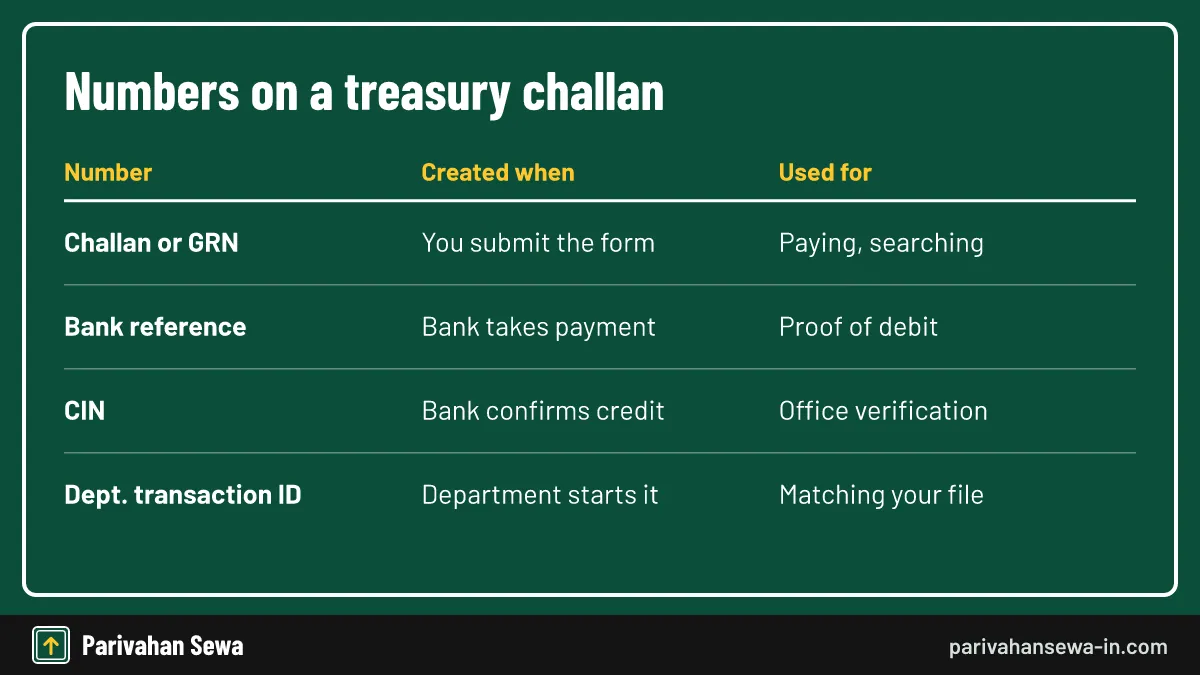
A challan reference number is the unique number that identifies your challan from creation to final receipt. Depending on the state it may be called CRN, GRN, challan number or transaction ID. Once the bank confirms payment, many systems add a CIN (challan identification number) as proof the treasury got the money.
| Number | When it appears | What it proves |
|---|---|---|
| Challan number or GRN | On submitting the form | A challan exists for this amount |
| Bank reference ID | When the bank takes payment | Money left your account |
| CIN | After the bank confirms to the treasury | The treasury received the money |
| Department transaction ID | When a department site starts the payment | Links the challan to your application |
Which one to give the office
Give the office the challan number or GRN and, if available, the CIN. A CAG review of the e-payment flow notes that a printed challan carrying both GRN and CIN is accepted as proof of payment.
If you lost it
Search your email and SMS first. If you have nothing, use your bank statement to find the bank reference ID, which many status pages accept.
How do you check citizen challan status?
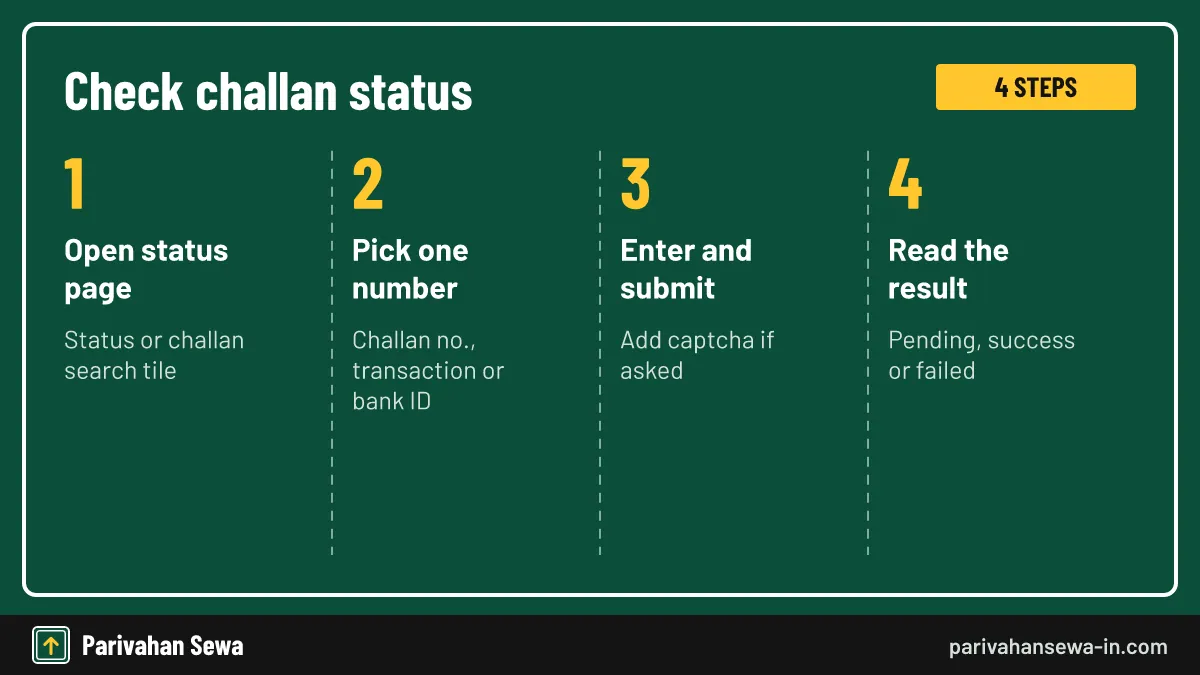
To check citizen challan status, open the status or search page on your state portal and enter one of the numbers you saved. On AP CFMS, the Challan Status Display and Print tile accepts the CFMS transaction ID, department transaction ID, challan number or bank reference ID.
Reading the result
Common states are pending or generated (not paid), success or paid, and failed. If it shows paid, download the receipt. If it shows failed but your account was debited, keep the bank statement and read the debited-but-unpaid section below.
On other states
MP’s Cyber Treasury lets unregistered users search by CIN, CRN or URN, while registered users see a list of their past challans. Other portals use similar search boxes under names such as challan search or verify challan.
How do you check PD challan status?
PD challan status depends on who is checking. A citizen who paid into a PD account checks the deposit challan like any other receipt, by number on the status page. The office that holds the PD account sees its balance and transactions on its own login, which the public cannot open.
As the person who paid
Use the challan number or bank reference on the portal’s status page. When it shows paid, send the receipt to the office so they can match it to their PD ledger.
As the PD account office
Staff check credits and bills through the treasury system’s PD screens. If a deposit is missing, they can trace it with the challan number and date you provide.
How do you reprint challan copies?
To reprint challan copies, open the status or print page, search by your number and download the challan again. Most treasury portals let you reprint both an unpaid challan (to take to the bank) and a paid one (as a receipt). The reprint looks the same as the original.
When you might need a reprint
You lost the first copy, the office wants a fresh printout, or the bank asks for a clean copy.
Reprinting a paid challan
Reprint after the portal shows the payment as successful. A copy printed earlier may not show the paid details or the CIN yet. For tax challans with their own systems, see our guide to profession tax challan reprint.
How do you get an e challan reprint?
An e challan reprint on a treasury site works through the same search page used for status. Enter the challan number or transaction ID, open the record and click print or download. Some portals call this “duplicate challan”, “print receipt” or “verify and print”.
Reprint of a traffic e-challan
If you mean a police traffic challan, the receipt is printed from the traffic portal, not the treasury. Our online challan guide covers traffic challan search and receipts on Parivahan.
Echallan reprint: what details do you need?
For an echallan reprint, you usually need only one identifier plus the captcha. The most useful are the challan number or GRN, the bank reference ID and, on department sites, the department transaction ID. Some states also ask for the date of payment or the remitter’s mobile number.
If nothing is found
Check for typing errors, such as an O for a zero. For very recent payments, wait a working day and search again before contacting the office.
What is a challan entry form?
A challan entry form is the screen or paper form where you enter the details that become a challan: department, head of account, amount and remitter details. On portals it is the online form; in offices and banks it may still be a printed form you fill by hand.
Online entry form fields
Typical fields are department, district, office, purpose, head of account, period (for taxes), amount, remitter name, address and mobile number.
Paper entry forms
Some offices still hand out printed challan forms. For a general look at the format and its parts, see our page on the challan form.
What is the TS challan form?
The TS challan form is the treasury challan used in Telangana (TS is the old short code for the state). Today, Telangana treasury receipts run through its IFMIS system, and departments may also have their own payment pages that create the challan for you.
Getting the right form
Ask the receiving office whether to use the treasury system or the department’s own portal. The office should give you the head of account and amount. We could not verify a public URL for the Telangana citizen challan page, so check it on the state finance department’s site.
Not the traffic challan
TS traffic fines are a separate police system. For those, read our TG challan guide for Hyderabad and Telangana traffic challans.
What is a bank challan?
A bank challan is the copy of a challan used to pay at a bank branch. The bank takes the money, stamps the counterfoil and sends the details to the treasury. It can be created online and printed, or filled by hand where an office still uses paper forms.
Parts of a bank challan
Most bank challans have two to four copies: one for you, one for the bank and one or more for the department or treasury.
Bank challan versus online payment
Both credit the same account. Online payments usually show sooner; bank challans can take an extra day to appear. Keep the stamped copy until the portal confirms it.
What is a deposit challan?
A deposit challan puts money into a deposit account, such as a PD account, a court deposit or a security deposit, rather than paying a fee. The money stays recorded against a purpose and can later be returned, adjusted or released under the account’s rules.
Common examples
Earnest money for tenders, security deposits for licences, court-ordered deposits and land-related deposits are common cases.
Getting it back
Refunds of deposits go through the office that holds the account. Keep the deposit challan, receipt and letter, because the office will ask for them when you apply for release.
What is a royalty challan?
A royalty challan is a payment slip for royalty on minerals, such as sand, stone or other minor minerals, paid to a state’s mines and geology department. Lease holders and permit holders pay it, and the challan or the permit linked to it may be checked when material is transported.
| Challan type | Who usually pays | Paid to |
|---|---|---|
| Royalty challan | Mine lease or permit holders | State mines and geology department |
| Excise challan | Excise licensees and permit holders | State excise department |
| Deposit or PD challan | Anyone told to deposit money | Office’s deposit or PD account |
| Registration challan | Property or document registrants | Registration department |
| Birth certificate challan | Applicants for late or extra copies | Local registrar or municipal body |
Where to generate it
Many states generate royalty challans on the mines department’s own portal, which links to the treasury. Others use the general treasury receipt portal.
Rates
Royalty rates vary by mineral and state and are set by state notifications. We do not list rates here; use the figure your department or permit gives.
What is an excise challan?
An excise challan pays state excise money, such as licence fees, duty or permit fees on liquor and related goods, into the state treasury. Licensees, distributors and permit holders use it. The excise department or its portal tells you the head of account and amount.
Online or office
Many states let excise payments be made through the treasury portal or an excise portal linked to it. Some fees are still paid by bank challan after the excise office checks the amount.
How do you pay a Telangana excise challan?
To pay a Telangana excise challan, get the head of account and amount from the excise office or its portal, then pay through the state’s treasury system or the department’s payment page. We could not open an official Telangana excise payment page from here, so confirm the route with your excise office.
What to ask the office
Ask which portal to use, the exact service name, the head of account and whether the payment must be made online or at a bank.
After payment
Submit the receipt to the excise office and ask them to confirm it in their records. Keep the challan with the licence or permit papers for renewals.
What is an STO challan?
STO usually stands for Sub-Treasury Office, the treasury branch at taluk or block level. An STO challan is a treasury challan paid into, or accounted at, a sub-treasury rather than the district treasury. With online systems, most citizens now pay without visiting the STO.
When the STO still matters
Some offices still name a particular STO on the challan so the money is credited to the right local account. If your form asks for the treasury or sub-treasury, choose the one the office named.
What is a TR challan?
TR challan is used in different ways. In treasury use, TR often stands for treasury receipt, and some state treasury codes give their challan forms a TR form number. At transport offices, TR can also mean temporary registration of a vehicle, which is paid on the Parivahan Vahan portal.
Finding out which you need
If an office gave you a TR form number, it is a treasury form; ask them for the head of account. If you just bought a vehicle, the dealer usually pays temporary registration fees on Vahan.
Do not guess the form number
Form numbers vary by state and change over time. Use the form the office names rather than one found in an old search result.
What is a registration challan?
A registration challan pays registration fees, most often for property documents, marriage registration or similar records, through the state treasury or the registration department’s portal. Many states now create these challans inside their registration sites, which pass you to the treasury gateway.
Vehicle registration is different
Vehicle registration fees are paid on the Parivahan Vahan portal, not by a separate treasury challan in most states. If a transport office asks for a treasury challan, ask it to name the head of account.
Keep the receipt for the office
The registration office checks the challan before it books your slot or accepts your document, so keep the receipt and number handy.
How do you pay a birth certificate challan?
A birth certificate challan pays the fee for late registration, corrections or extra copies of a birth certificate. Depending on the state, it is paid at the municipal or panchayat office, on the civil registration portal, or by treasury challan. The registrar’s office tells you which.
Steps that usually apply
Ask the registrar for the amount and head of account, create the challan on the portal they name, pay, and submit the receipt with your application.
Fees are set locally
Fees differ by state and by how late the registration is. We do not list figures here; ask the registrar or check the state’s civil registration page.
What is a cyber challan?
Cyber challan has no single official meaning. Most often it refers to a challan paid through Madhya Pradesh’s Cyber Treasury, the state’s online treasury payment portal. Some people also use it for any online treasury challan, or by mistake for a cybercrime notice.
MP Cyber Treasury
Registered users of MP’s Cyber Treasury can see their past challans in one place, while others can search by CIN, CRN or URN. A bank guide on the portal says that if you are debited but the challan does not appear, wait a day and search again.
If it is about a cybercrime
A message claiming you owe a “cyber challan” fine is likely a scam. Report suspicious payment demands on cybercrime.gov.in.
What is an employee challan?
An employee challan usually means a challan used by a government employee to pay money back into the treasury, such as an excess salary amount, an unused advance or a recovery. The employee’s DDO normally tells them the head of account and may raise the challan for them.
For private employers
Private employers also use challans for employee-related payments, such as provident fund or ESI contributions. Those use their own portals, not the state treasury receipt page.
What is a PVC challan?
PVC challan is not a recognised treasury term. People who search it may mean the fee for a PVC smart-card driving licence or RC, or a challan for a PVC card issued by another department. For licence and RC cards, the fee is paid online on Parivahan, not by treasury challan.
Checking what you need
Look at the notice or form that mentioned it. If it names a department and head of account, use the treasury portal; if it is about a DL or RC card, use the Parivahan Sarathi or Vahan service.
Is challan cancellation possible?
Challan cancellation is possible only for an unpaid challan, and even then many portals simply let it expire. Once a challan is paid, it cannot be cancelled on the portal; any correction or refund goes through the office that received the money.
Unpaid challans
If you created a challan with the wrong details, do not pay it. Create a fresh one with the correct details. Some portals have a cancel button; others let the old one lapse after its validity date.
Paid challans
Write to the receiving office with the challan number, receipt and bank statement, and explain the mistake. The office decides whether to adjust it against the correct service or process a refund.
What if money is debited but the challan shows unpaid?
If money leaves your account but the challan still shows unpaid, wait at least one or two working days and check again. Banks and gateways settle in batches, and the treasury confirms only after the bank reports. Our guide on a challan payment pending from bank covers this in more depth.

What to keep
Save the bank statement or SMS showing the debit, the bank reference ID and the challan number.
If it does not clear
Contact your bank first with the reference ID. If the bank confirms the money was sent, contact the treasury helpdesk or the receiving office with the same details. Do not pay a second time unless the first debit is reversed.
How long does an unpaid challan stay valid?
An unpaid treasury challan usually stays valid only for a limited time, often shown on the challan itself as a valid up to date. After that, the bank or gateway will reject it and you must create a new one. Validity rules vary by state, so read the challan.
After payment
A paid challan is a permanent record of payment, but an office may accept it only once. Kerala’s treasury, for example, told offices to deface an e-challan once the service it was created for has been given, so the same challan cannot be reused.
Can you pay a state office challan for someone else?
Yes, in most cases the person paying can be different from the person the payment is for. Enter the details the office needs to link the challan to the right file, such as the applicant’s name or application number, and give the receipt to the applicant.
Whose name to enter
If the form has separate fields for remitter and beneficiary, fill both correctly. If it has only one name, use the applicant’s name unless the office says otherwise.
How do you spot a fake challan generation site?
A real challan generation site for a state treasury ends in .gov.in and does not ask for OTPs over the phone or payment through personal UPI IDs. Fake sites copy logos and charge extra or keep the money. Type the address yourself rather than following SMS links.

Warning signs
Payment to a personal UPI ID, extra “service charge” before the government amount, spelling mistakes in the address, and pressure to pay immediately are all warning signs.
If you already paid a fake site
Call your bank at once to try to stop the payment, then report it on cybercrime.gov.in or by calling the national cybercrime helpline shown on that site.
Official links
AP CFMS: citizen challan and statuscfms.ap.gov.in ↗Punjab IFMS e-Receiptifms.punjab.gov.in ↗Odisha Treasury e-Challanodishatreasury.gov.in ↗e-Challan: traffic finesechallan.parivahan.gov.in ↗Report cyber fraudcybercrime.gov.in ↗Pd challan questions
Is a PD challan the same as a traffic e-challan?
No. A PD challan moves money into or out of a Personal Deposit account in the state treasury. A traffic e-challan is a penalty issued by police for a road offence and is paid on police or Parivahan portals.
Can an ordinary citizen open a PD account?
No. PD accounts are opened for government offices, courts, local bodies and similar administrators under the state treasury rules. Citizens only deposit money into them when an office asks.
Which bank accepts a CFMS challan at the counter?
The CFMS FAQ says manual payment should be made only at an SBI branch, and any SBI branch in India can take it. Confirm on the portal before you go, as rules can change.
What numbers can I use to check CFMS challan status?
The CFMS status page accepts the CFMS transaction ID, department transaction ID, challan number or bank reference ID. One correct number is enough.
Is there a charge for challan generation?
We found no official mention of a separate charge for creating a treasury challan. Your bank may add its own charges for some payment methods, so read the payment page before confirming.
Can I edit a challan after creating it?
Usually not. If the amount or service is wrong and you have not paid, create a fresh challan. If you have paid, ask the receiving office how to correct or adjust it.
How do I get a refund for a wrong challan payment?
Write to the department that received the money with the challan number, receipt and bank statement. The portal itself does not issue refunds; the office processes them under treasury rules.
Why does my challan show a GRN but no CIN?
The GRN is created when you submit the form. The CIN appears only after the bank confirms the money to the treasury, which can take longer for counter or gateway payments.
Can I use a mobile phone to create a treasury challan?
Yes, most portals open in a mobile browser, although the forms are easier on a larger screen. Download the PDF before closing the page.
Does the RTO use treasury challans?
Most vehicle and licence fees are paid on the Parivahan Vahan and Sarathi portals. Use a treasury challan only if a transport office tells you to and names the head of account.
Is it safe to pay a challan through an agent site?
It is risky. Agent sites can charge extra or take money without crediting the treasury. Pay only on the .gov.in portal or at the bank printed on the challan.
Can a used challan be shown again for another service?
No. Offices mark a challan as used once the service is given. Kerala treasury, for example, asked offices to deface e-challans after use so they cannot be reused.
Parivahan Sewa (parivahansewa-in.com) is an independent information website and is not affiliated with MoRTH, Parivahan or any state transport department. Confirm fees and rules on the official portal before you pay or apply.