Court challan online payment: pay a court-sent traffic fine, court fees and PTEC dues
Court challan online payment means paying a traffic fine after the police have sent your unpaid challan to a court. Most states use the virtual court portal, vcourts.gov.in: search by challan number or CNR, read the amount the judge has set, plead guilty and pay by net banking, card or UPI. Save the receipt. Court fees and PTEC dues use different treasury portals.
Key takeaways
- Once a challan is sent to court, the police portal usually stops taking payment and the judge sets the amount.
- Pay virtual court fines only on vcourts.gov.in or a link from the official e-Challan site.
- If you do not plead guilty online, the case goes to a regular court for a hearing.
- Court fees for suits and petitions are paid as e-court fee, stamps or through the state treasury, not on the challan portal.
- PTEC is Maharashtra's profession tax enrolment; it is paid on the GRAS portal and has nothing to do with traffic.
- Keep the GRN, CIN or transaction number; it is your proof if a status does not update.
On this page · 26 sections
What is court challan online payment?
Court challan online payment is the step you take when a traffic challan has left the police system and is now a court case. Instead of the police amount, you pay the fine a magistrate or virtual court fixes. The phrase is also used for court fees and treasury challans, so all three are covered here.
Three payments that get mixed up
Searchers usually mean one of three things: a court-sent traffic fine, a court fee for filing a case, or a profession tax (PTEC) challan paid to the Maharashtra treasury. Each has its own portal.
When does an unpaid challan move to court?
An unpaid challan moves to court when the deadline the police allow runs out, or when the offence is one the police cannot settle on the spot. The exact period is set by each state. Gujarat, for example, forwards unpaid e-challans to virtual traffic courts after 90 days, according to an NIC write-up.
Compoundable and non-compoundable offences
Compoundable offences can be closed by paying the police. Non-compoundable ones, and challans with an impounded vehicle, must go before a court. Chandigarh, for instance, sends all non-compoundable challans to the virtual court directly.
What the notice tells you
The SMS or email summons names the court, the case or challan number and often a CNR, the 16-character case code used across eCourts. Keep that message.
What is the virtual court and who runs it?
A virtual court is an online court, run under the eCourts project of the Supreme Court’s e-Committee, that disposes of minor traffic cases without a physical hearing. The first one opened at Tis Hazari, Delhi, on 26 July 2019, and Haryana followed at Faridabad on 17 August 2019 for the whole state.
A real judge, an online file
A judicial officer still reads each case and fixes the fine. Its orders are binding, so ignoring a virtual court notice can push the case to a regular court.
Which cases it takes
Virtual courts take minor, compoundable traffic cases that the offender is willing to settle. Serious road crimes, accident cases and contested matters go to the magistrate in person. For how the higher criminal courts fit in, see our session court explainer.
How do you know your challan has gone to court?
Search the challan on the national e-Challan portal by challan number, vehicle number or DL number. If the status reads sent to court or virtual court, the police can no longer take payment. A court SMS or email summons with a case number is the other clear sign.
Status labels to read
Pending means you can still pay the police. Paid or disposed means it is closed. A court label means the payment now goes through the court. Our e-challan guide explains each label in detail.
Checking by CNR
If you have a CNR, search it on eCourts services. The case page shows the court, the next date and whether it has been disposed of.
How does court challan online payment work, step by step?
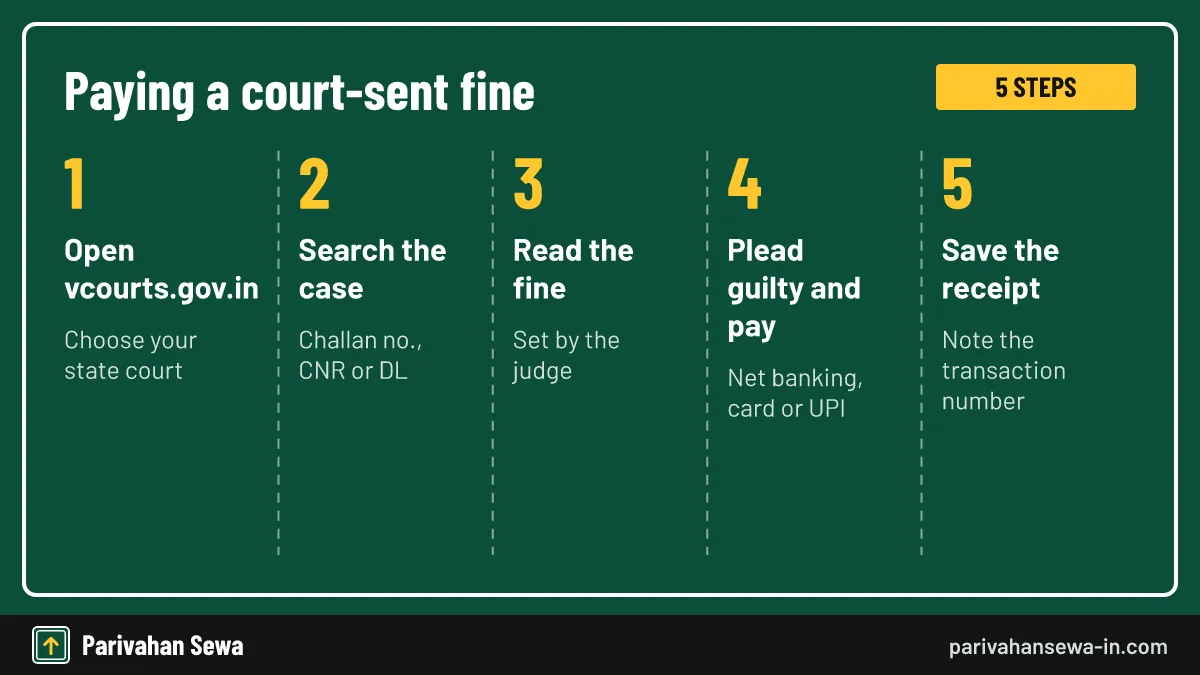
For court challan online payment, open vcourts.gov.in, pick the court, search your case, read the fine, plead guilty and pay. The flow below follows the virtual court process described for Delhi and Haryana. Labels differ slightly by state.
- Open the virtual court portal. Go to vcourts.gov.in and choose the state or court that holds your traffic case.
- Search the case. Enter the challan number, CNR, party name or driving licence number shown in the notice.
- Read the proceedings. Check the offence, vehicle number and the fine proposed by the judge.
- Plead guilty and pay. Accept the offence online and pay by net banking, debit or credit card or UPI.
- Save the receipt. Download the acknowledgement and note the transaction number until the case shows disposed.
After you pay
In Haryana’s description of the system, the case is disposed of automatically once the payment is realised. Delhi’s system gives an acknowledgement with a transaction number. Check the status again after a day or two.
If the search returns nothing
Choose the right state first; each state’s virtual court is listed separately. A fresh challan may take a few days to reach the court list, so try again if it was transferred only recently.
What do you need before paying a virtual court fine?
You need the challan or case number, the vehicle registration number, access to the mobile number on the record, and a working payment method. A driving licence number helps when the case was booked against the driver.

Payment methods
Delhi’s virtual court uses the SBI payment gateway, which accepts net banking and cards. Many state courts also accept UPI. Chandigarh’s Sector 43 district courts even put up QR codes that open the payment gateway for any UPI app.
Who can pay
Anyone can pay for the vehicle owner or driver, such as a family member, as long as they enter the right case. The receipt is issued against the case, not the payer’s name, so keep a copy for the owner.
Can a fine sent to court be paid on the national challan portal?
Usually not directly. Once a challan is marked as sent to court, the national portal shows its status but routes payment to the virtual court.
Why the police portal refuses it
The police lose the power to compound the offence when the court takes cognisance.
How do you pay a court fine in person?
To pay a court fine in person, go to the court named in the notice on the listed date, appear before the magistrate, accept the offence and pay the fine at the court’s cash or nazarat counter. Carry the notice, your ID, the vehicle papers and the challan copy. Always ask for a stamped receipt.
When a visit is required
A visit is needed when the challan is non-compoundable, when the vehicle or licence was seized, or when you contest the challan.
Evening and special courts
Some cities run evening courts or special traffic magistrates to clear backlogs. The notice tells you which court and time apply.
What if you want to contest instead of paying?
If you think the challan is wrong, do not plead guilty online. Choose the option to contest, or simply do not pay, and the case moves to the regular court with jurisdiction. You, or a lawyer, then argue it before the magistrate, who may drop, reduce or confirm the fine.
What to collect
Keep photos, dashcam clips, fuel or toll receipts showing you were elsewhere, and any proof that the number plate was misread.
What does a traffic court challan mean?
A traffic court challan is a traffic case pending before a court: a virtual court, a special traffic magistrate or an evening court. Payment, contest and closure all now follow the court’s procedure and the court’s records.

Different names by state
Notices may say virtual traffic court, traffic magistrate, CJM court or JMFC court. All are courts under the High Court of the state. The JMFC court page explains the magistrate tier.
What is a judicial challan?
A judicial challan is not one official form. People use it for two things: a traffic or police challan that has moved into the judicial system, and a treasury challan used to deposit court fees, fines or judicial deposits. In some northern states “challan” also means the police report filed in court.
The police report meaning
In Punjab, Haryana and nearby states, lawyers say the police “put up the challan” when they file the final report (charge sheet) in court.
The deposit meaning
Courts direct some payments, such as fines or security deposits, into the treasury through a challan. The court gives the head of account and amount.
How do you pay court fees online?
To pay court fees online, use the route your state’s court allows: an e-court fee receipt bought from an authorised vendor or portal, the state treasury’s online challan, or the judiciary’s ePay service. Enter the court, case type and amount, pay, and attach the receipt or its number when filing.
What court fee covers
Court fee is the charge for filing a suit, petition, appeal or application. It is set by the Court-fees Act, 1870 as amended by each state, or by a state’s own court fees law, so the same filing can cost different amounts in different states.
Checking the amount
Your lawyer or the court’s filing counter confirms the fee. The detailed rules and stamps are covered on our court fee stamp page.
Which portals take court fees and fines?
Court fees and fines go through three main channels: the eCourts ePay service, where a state has joined it; the state treasury portal such as Maharashtra’s GRAS; and e-court fee receipts sold by authorised e-stamp vendors. Traffic fines in court go through vcourts.gov.in instead.
| Payment | Where it is usually paid | Proof you keep |
|---|---|---|
| Traffic fine sent to court | vcourts.gov.in (virtual court) | Acknowledgement with transaction number |
| Court fee on a suit or petition | e-court fee vendor, ePay or state treasury | E-court fee receipt or GRN challan |
| Fine or deposit ordered by a court | ePay or treasury challan | Receipt filed in the case |
| Maharashtra profession tax (PTEC) | GRAS (gras.mahakosh.gov.in) | Challan with GRN and CIN |
Choosing the right one
Ask the court registry which channel it accepts before paying.
ePay availability
eCourts ePay (pay.ecourts.gov.in) is not active for every payment type in every state. If your court is not listed, use the treasury or e-court fee route the court names.
How do you pay court fees at the court counter?
To pay court fees offline, buy court fee stamps or an e-court fee receipt from an authorised vendor inside or near the court complex, or pay at the treasury or bank branch the court names. Attach the receipt to your filing.
At the vendor
Tell the vendor the amount and court. For an e-court fee receipt, the vendor enters your name, the case details and the amount and prints a numbered receipt that the court verifies.
How much are district court fees?
There is no single figure for district court fees. A money or property suit usually pays an ad valorem fee, a percentage of the claim on a sliding scale, while petitions, applications and copies pay small fixed fees. Each state sets its own table, so check the current schedule before filing.
Fixed versus ad valorem
A divorce petition or bail application normally carries a fixed fee. A recovery suit or a suit for possession is valued, and the fee rises with the value.
Where to see the table
The schedule is in the state’s Court-fees Act and published by the High Court.
Court fees for civil cases in Delhi: how are they worked out?
In Delhi, civil suits pay court fee under the Court-fees Act, 1870 as it applies to Delhi, so recovery and property suits pay an ad valorem fee on the value of the claim. Delhi courts accept e-court fee receipts. For the rate tables, see the court fee stamp page linked above.
Filing in Delhi
District courts in Delhi accept e-filing for many case types. The filing screen asks for the court fee receipt number, which the registry verifies before listing the case.
How to pay court fees for divorce
To pay court fees for a divorce, find the fixed fee your state charges for a matrimonial petition, buy an e-court fee receipt or stamp for that amount, or pay through the court’s online option, and file the receipt with the petition in the family court. Mutual consent petitions are filed jointly.
Which court takes it
Family courts sit in every city or town with a population over one million, under the Family Courts Act, 1984. Elsewhere, the district court hears the petition.
Other costs to expect
Besides court fee, expect charges for process fees to serve notice, certified copies, affidavits and lawyer’s fees.
What is PTEC challan payment?
PTEC challan payment is the online payment of profession tax due under a Profession Tax Enrolment Certificate in Maharashtra. It has no link with traffic fines; it is a state tax paid on the GRAS treasury portal. The challan carries a GRN and, after the bank confirms, a CIN.

Who holds a PTEC
Individuals and businesses liable to profession tax in their own capacity, such as professionals, traders and companies, enrol for a PTEC on MahaGST. Maharashtra levies the tax under its 1975 profession tax law.
How much it can be
The Constitution caps profession tax at ₹2,500 a year per person. The exact slab for your category is in the state schedule and on MahaGST.
How do you make a PTEC challan payment on GRAS?
To make a PTEC challan payment, open GRAS at gras.mahakosh.gov.in, log in or use Pay without Registration, choose profession tax and form MTR-6, enter your PTEC number and period, review the draft challan, then pay by net banking. Note the 18-digit GRN before you leave the page.
Registered and unregistered payers
A registered GRAS user sees saved details and past challans. An unregistered payer enters everything each time and should write down the GRN, then the bank’s CIN after payment.
Separate receipts
Maharashtra generates separate cyber receipts for PTEC and PTRC. Pay each under the right certificate number.
How do you do a professional tax payment challan download?
For a professional tax payment challan download in Maharashtra, open GRAS, use Search Challan with the GRN or your details and the date range, then print or save the challan PDF. Older challans sit in the archive section.
Karnataka and other states
Karnataka uses e-Prerana (ptax.karnataka.gov.in), with an Enrolment Login for PTEC holders. Other states use their treasury portals; search for your state’s professional tax department.
PTEC and PTRC: which one applies to you?
Maharashtra has two certificates. A PTRC (registration certificate) is held by an employer that deducts profession tax from employees’ salaries and pays it to the state. A PTEC (enrolment certificate) covers tax a person or business owes for itself.
| Point | PTEC | PTRC |
|---|---|---|
| Who holds it | Individuals and businesses, for their own tax | Employers, for tax deducted from staff |
| Tax paid on | The holder’s own profession or trade | Employees’ salaries |
| Upper limit per person | ₹2,500 a year | ₹2,500 a year per employee |
| Where paid | GRAS (MTR-6) | GRAS (MTR-6) |
Payment by employers
Employers deduct tax from salaries each month and remit it to the state treasury by challan, at the frequency the state sets for their size.
If you are a salaried employee
A salaried employee does not normally pay a PTEC challan. Your employer deducts the tax, and it shows on your salary slip.
What if money is debited but the challan still shows pending?
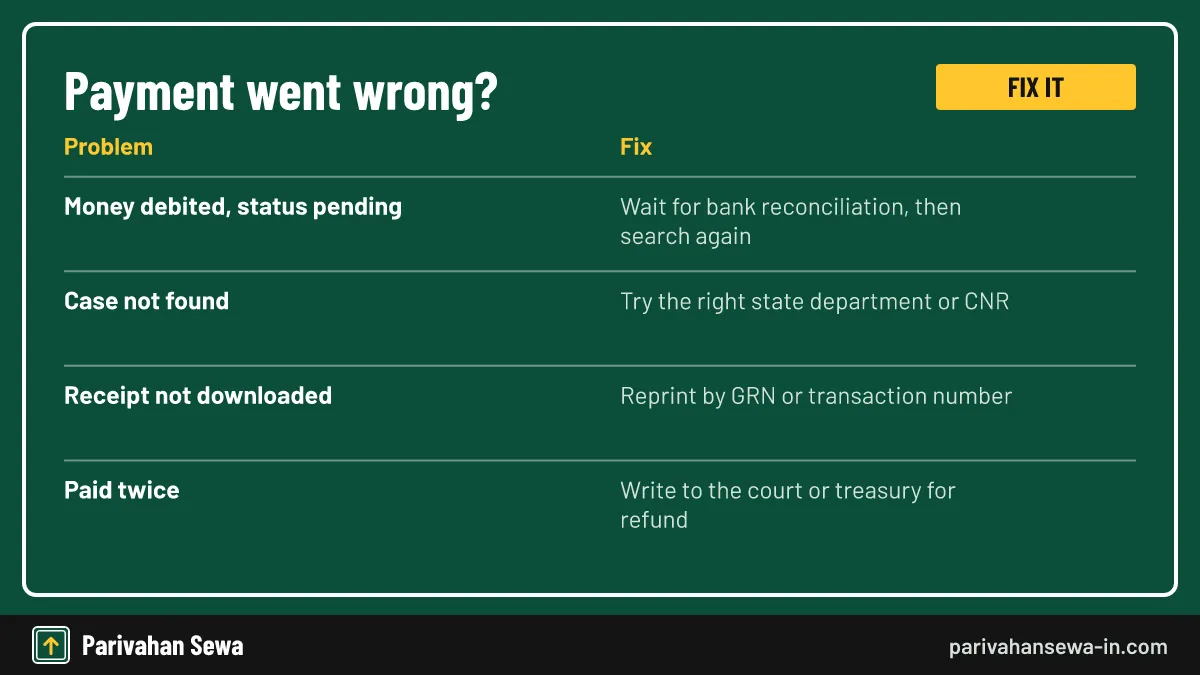
If your bank shows a debit but the court case or treasury challan still shows pending, wait for the bank to reconcile the payment, usually a few working days, then search again with the transaction number or GRN. Do not pay twice.
Who to contact
For a virtual court payment, contact the court’s helpdesk listed on the portal. For a treasury challan, use the GRAS search or the bank. Our guide on challan payment pending from bank walks through the escalation.
Refund of a double payment
If you paid twice, apply to the court or treasury with both receipts.
How can you spot a fake payment link for a court fine?
A fake link usually arrives by SMS or WhatsApp, threatens arrest or licence suspension, and points to a site that is not a gov.in domain. Type vcourts.gov.in yourself and search the case instead of tapping the link.
Red flags
Watch for personal UPI IDs, APK app downloads, “discount” offers from agents and calls asking for an OTP.
What to do if you paid a fake site
Call your bank at once to block the card or UPI, and report the fraud on the national cyber crime portal. Then check the real case status on the official portal.
Which receipt proves the fine is paid?
The receipt that proves a court-sent fine is paid is the acknowledgement from the virtual court, with the case details and a transaction number, or the stamped receipt from the court counter. Keep the PDF until the case shows disposed on the portal.

Can a Lok Adalat settle a court-sent challan?
Yes. Many states list compoundable traffic challans pending before virtual courts in National Lok Adalat sittings. You download a slip or token, attend on the date, and settle the challan, often for a reduced amount. No court fee is charged and the award cannot be appealed.
How Delhi runs it
In Delhi, the legal services authority takes up challans pending on the Virtual Court portal up to a cut-off date and issues slips through the traffic police site. Our lok adalat challan guide has the current notice.
Virtual court fine, court fee and PTEC compared
The three payments look alike because each ends with a challan or receipt, but they go to different authorities. The table below shows who sets the amount and what happens if you do not pay.
| Point | Virtual court fine | Court fee | PTEC challan |
|---|---|---|---|
| Who sets the amount | The judge, within MV Act limits | State court fees law | State profession tax schedule |
| Paid to | Court through vcourts.gov.in | Court via e-court fee, ePay or treasury | Maharashtra treasury via GRAS |
| If unpaid | Case moves to a regular court | Filing is not accepted | Interest and penalty under state law |
One habit for all three
Whatever you pay, note the reference number at once: transaction number, e-court fee number, GRN or CIN.
Official links
Virtual Courts (court-sent traffic challans)vcourts.gov.in ↗e-Challan: check and pay police challansechallan.parivahan.gov.in ↗eCourts services: case status and CNR searchservices.ecourts.gov.in ↗Maharashtra GRAS (PTEC and treasury challans)gras.mahakosh.gov.in ↗MahaGST (profession tax enrolment)mahagst.gov.in ↗Court challan online payment questions
Can I pay a court challan online without going to court?
Yes, in most states. When the case sits with a virtual court, you can plead guilty and pay the fine on vcourts.gov.in. A visit is needed only if you contest the challan or the court lists the case for a physical hearing.
Why can't I pay my challan on the e-Challan portal any more?
Because the police have forwarded it to a court. The status then reads sent to court or virtual court, and the court, not the police, decides the amount and accepts payment.
Is the court amount higher than the challan amount?
It can be different. The judge decides the fine within the limits of the Motor Vehicles Act, so it may be equal to, higher or lower than the police figure. Pay the amount the court shows.
What is a judicial challan?
People use the term for any challan that has moved into the judicial system, such as a traffic case pending in a virtual court, or for a treasury challan used to deposit court fees or fines. Check the notice to see which one you have.
How do I pay court fees for a divorce petition?
The fixed court fee set by your state is paid as an e-court fee receipt or stamp, or through the court's online payment option, and the receipt is filed with the petition in the family court. Your lawyer or the filing counter confirms the exact amount.
What is the PTEC challan in Maharashtra?
It is the payment challan for profession tax due under a PTEC (enrolment certificate). It is generated and paid on GRAS, the state's online treasury, and carries a GRN number.
How much professional tax can a state charge?
Article 276(2) of the Constitution caps the professional tax one person pays to a state at ₹2,500 a year. Each state sets its own slabs within that cap.
My money was debited but the court case still shows pending. What now?
Wait for the bank to confirm the payment, then search again with the transaction number. If it still shows pending after a few working days, contact the court or the payment helpdesk with the bank reference; do not pay a second time.
Parivahan Sewa (parivahansewa-in.com) is an independent information website and is not affiliated with MoRTH, Parivahan or any state transport department. Confirm fees and rules on the official portal before you pay or apply.