Drink and drive in India: fines, jail terms and how the case works
Drink and drive means driving with more than 30 mg of alcohol per 100 ml of blood, an offence under section 185 of the Motor Vehicles Act. A first offence carries up to ₹10,000 fine and/or six months in jail; a repeat within three years, up to ₹15,000 and/or two years. Police cannot settle it on the spot, so a magistrate decides the final penalty.
Key takeaways
- The legal drink and drive limit is 30 mg of alcohol per 100 ml of blood, checked by a breath analyser or blood test.
- First offence: up to ₹10,000 and/or 6 months; repeat within three years: up to ₹15,000 and/or 2 years.
- Section 185 is not compoundable, so the challan goes to a court, not an online payment page.
- Police can seize your licence at the checkpoint, and the licensing authority can suspend it.
- The same central law applies in Bangalore, Hyderabad, Goa, Haryana and every other state.
- A crash while drunk can add BNS charges such as causing death by negligence.
On this page · 40 sections
What does drink and drive mean under Indian law?
Drink and drive is the common name for driving, or trying to drive, a motor vehicle with alcohol in your blood above the legal limit. Section 185 of the Motor Vehicles Act, 1988 makes it an offence when the reading is over 30 mg per 100 ml of blood, or when drugs leave you unable to control the vehicle.

“Driving or attempting to drive”
The wording covers more than moving traffic. Sitting at the wheel with the engine running, or starting to pull away, can count as an attempt. It applies on any public place, which includes roads, parking areas open to the public and fuel stations.
Alcohol and drugs are treated alike
The same section covers drugs. A person under the influence of a drug to the point of losing proper control commits the same offence, and drugs notified by the Central Government are presumed to cause that loss of control.
What is the drink and drive fine in India?
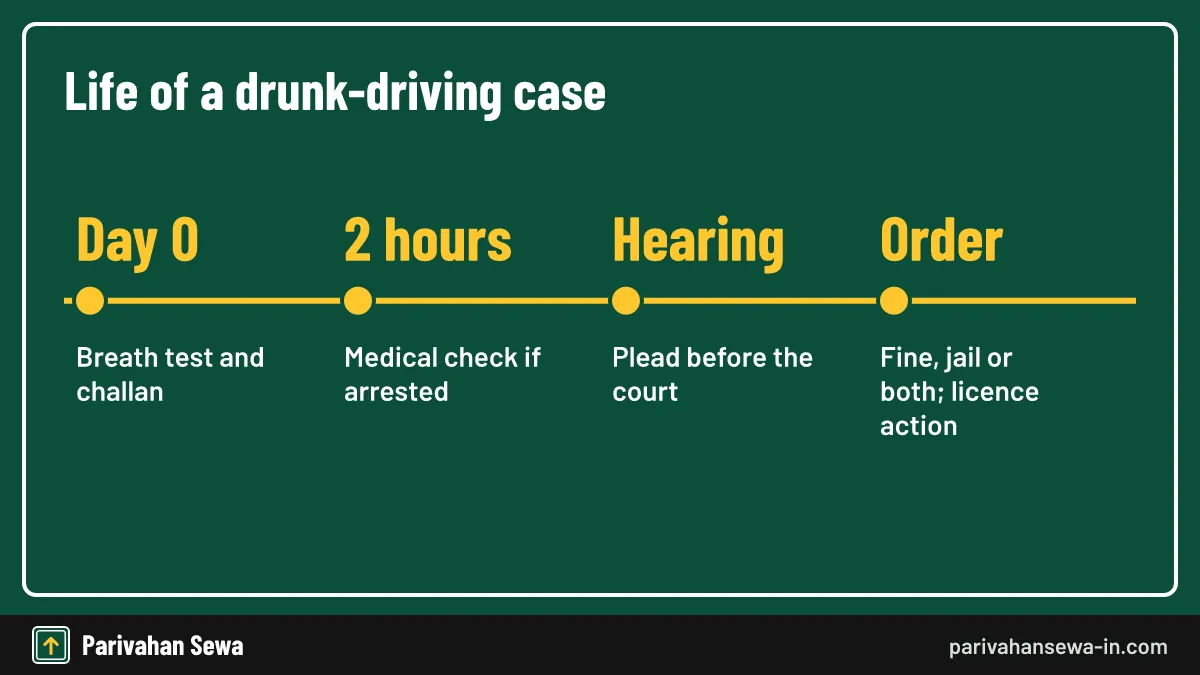
The drink and drive fine in India is set by the central Act, not by each city. A first offence carries a fine of up to ₹10,000, a jail term of up to six months, or both. A second offence within three years carries up to ₹15,000, up to two years, or both.
Who issues it
Traffic police run the checks and record the offence, but they cannot close it with a spot payment. The case goes to a magistrate, who chooses the amount and any jail term within the limits.
Why the amount varies
Two people caught on the same night can pay different amounts. The court looks at the alcohol reading, whether there was a crash, earlier offences and how the accused behaved, then fixes a figure up to the ceiling.
Drink and drive fine amount: first and repeat offence
The drink and drive fine amount depends mainly on whether you have a similar offence in the last three years. The table below shows the central limits that apply in every state. They are maximums: a court may order less, but not more.
| Offence | Maximum jail | Maximum fine |
|---|---|---|
| First offence (section 185) | Six months, or both | ₹10,000 |
| Second offence within 3 years | Two years, or both | ₹15,000 |
| Before September 2019, first offence | Six months, or both | ₹2,000 |
| Before September 2019, second offence | Two years, or both | ₹3,000 |
How “within three years” is counted
The clock runs from the date of the previous similar offence, not the date of the court order. A second offence 34 months after the first is treated as a repeat; one after 37 months is again a first offence.
Annual increases
The 2019 amendment lets the government raise fines by up to 10% a year. Always read the amount printed on your court notice instead of relying on an old figure.
Drunk and drive fine amount: who decides the final sum?
The drunk and drive fine amount you finally pay is set by the magistrate hearing the case. Police and transport officers can settle many offences on the spot under section 200, but drunk driving is not in that compounding list, so the court always has the final word.
What the court considers
Magistrates usually weigh the breath or blood reading, any damage or injury, your licence history, and whether you admit the offence. A guilty plea at the first hearing often closes the matter the same day.
Paying the court
Once the order is passed you pay at the court counter or, where available, through the virtual court system. Keep the receipt.
Drunk driving fine India: what changed in 2019?
The drunk driving fine India applies today came from the Motor Vehicles (Amendment) Act, 2019, in force from 1 September 2019. It raised the first-offence ceiling from ₹2,000 to ₹10,000 and the repeat ceiling from ₹3,000 to ₹15,000. Jail terms stayed at six months and two years.
Why Parliament raised it
The old amounts had not changed in decades and were too low to deter. The amendment raised most penalties at once and linked them to an annual increase so they keep pace with prices.
What did not change
The 30 mg limit stayed the same. So did the rule that a repeat offence within three years draws the higher penalty, and that the offence goes to court rather than being compounded.
What is the punishment for drunk driving?
The punishment for drunk driving has three parts: a fine, possible imprisonment and action against your licence. Under section 185 the court can impose the fine, the jail term, or both. Separately, the licensing authority can suspend or disqualify your driving licence.
Fine and jail together
“Or both” means the magistrate may combine a fine with a short jail term. Courts tend to do this where the reading was very high, there was a crash, or it is not the first offence.
Other orders
Some courts add conditions such as community service or attending a road-safety session, alongside or instead of jail. These are at the court’s discretion, so there is no fixed list.
Drink and drive punishment beyond the fine
The drink and drive punishment does not stop at the court fine. Your licence can be seized at the checkpoint, and the licensing authority can suspend it. Your vehicle may be held until a sober driver collects it, and your insurer may refuse an own-damage claim if you crashed while drunk.
Licence seizure and suspension
Section 206(4) lets an officer seize the licence of a person accused under section 185 and send it for disqualification proceedings. A Supreme Court road-safety committee also directed at least three months’ suspension for drunk driving.
The vehicle
When an officer arrests a driver, section 202 asks them to take reasonable steps to dispose of the vehicle temporarily. In practice that means a sober licensed friend drives it away, or it is parked at the police station.
What is a drink and drive challan?
A drink and drive challan is the official record of a section 185 offence. It notes your name, licence, vehicle number, place, time and the breath analyser reading. Unlike a helmet or parking challan, it usually carries no fixed amount, because the court decides the penalty.
What the challan shows
Look for the offence section (185), the reading in mg per 100 ml, the officer’s name and the court name and date. If any of these are missing or wrong, point it out at the station or in court.
Paper or electronic
Most cities now issue an electronic challan from a handheld device, so it also appears on the national e-Challan portal against your vehicle number. Some smaller towns still write paper challans.
How is a drunken drive challan issued at a checkpoint?
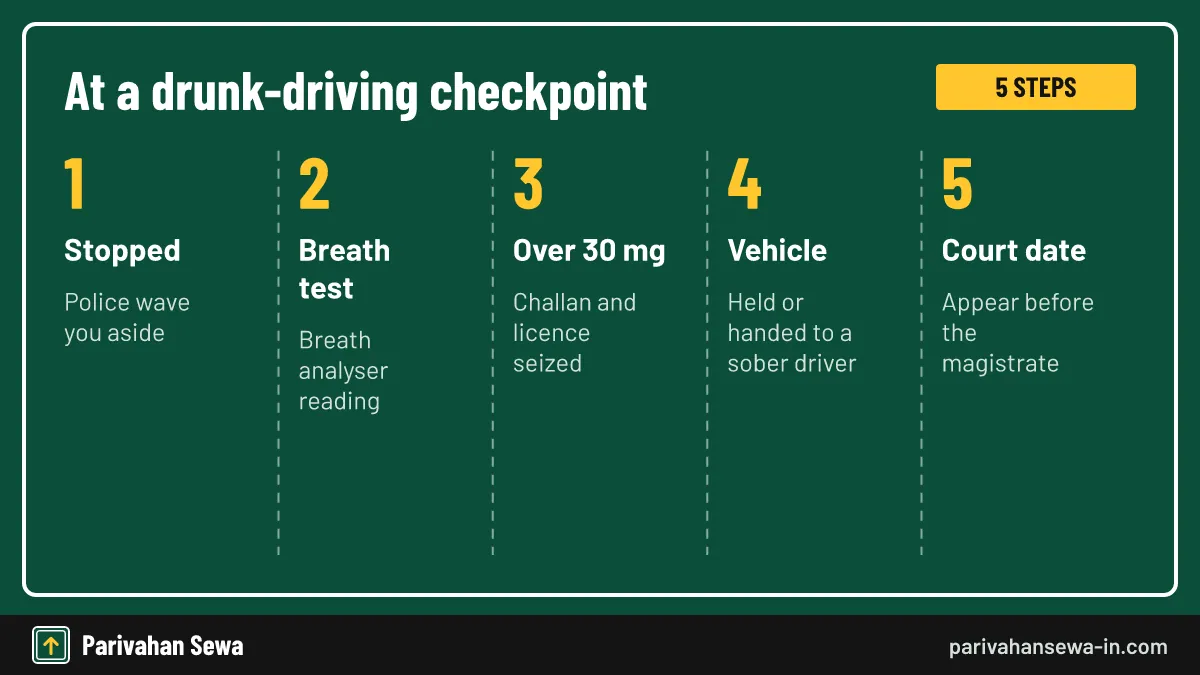
A drunken drive challan usually follows a short checkpoint routine. Police stop vehicles, ask the driver to blow into a breath analyser, and record the result. If it exceeds 30 mg per 100 ml, they issue the challan, seize the licence and arrange for the vehicle.
- Stop and cooperate. Pull over when signalled and give the breath sample the officer asks for.
- Read the reading. Ask to see the breath analyser result; above 30 mg per 100 ml is an offence.
- Collect papers. Take the challan copy and the receipt for your seized licence.
- Arrange the vehicle. Let a sober licensed driver take the vehicle, or note where police keep it.
- Attend court. Appear on the date given, pay the fine the magistrate sets and keep the receipt.
Asking to see the device
You can politely ask to see the printout or screen showing your reading. Many breath analysers print a slip with the time and value, which is useful when you check the challan later.
Medical check after arrest
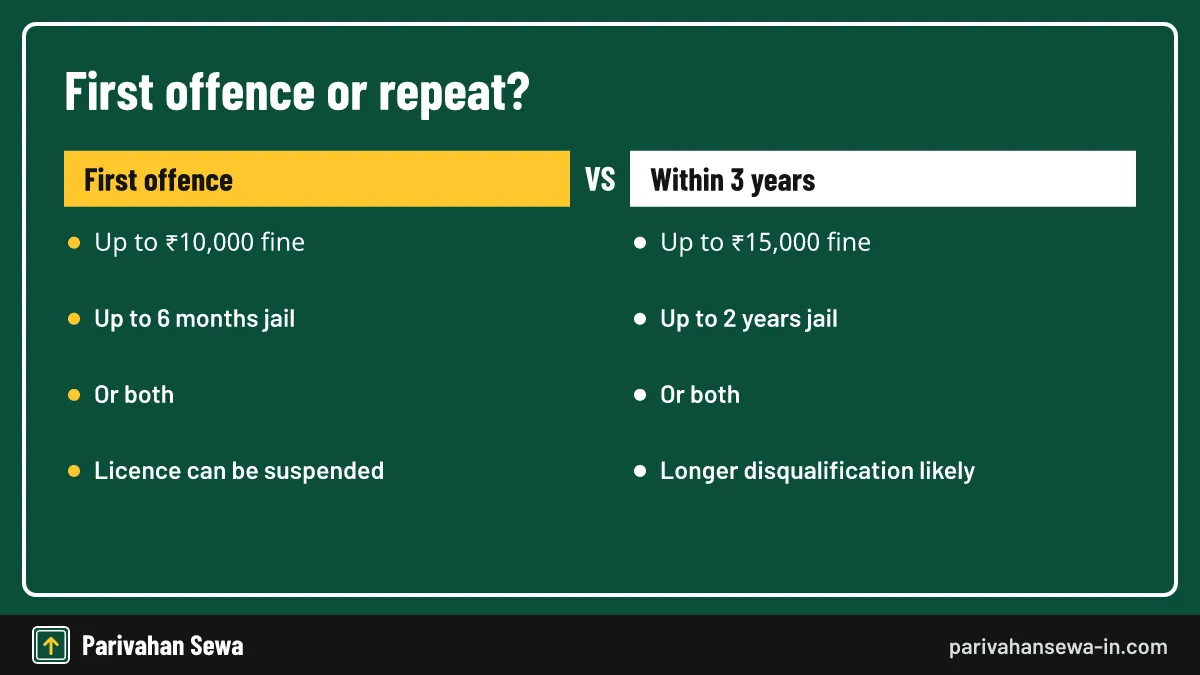
If police arrest you, section 202 requires a medical examination by a registered doctor within two hours of arrest; otherwise you must be released.
Drink n drive challan: can you pay it online?
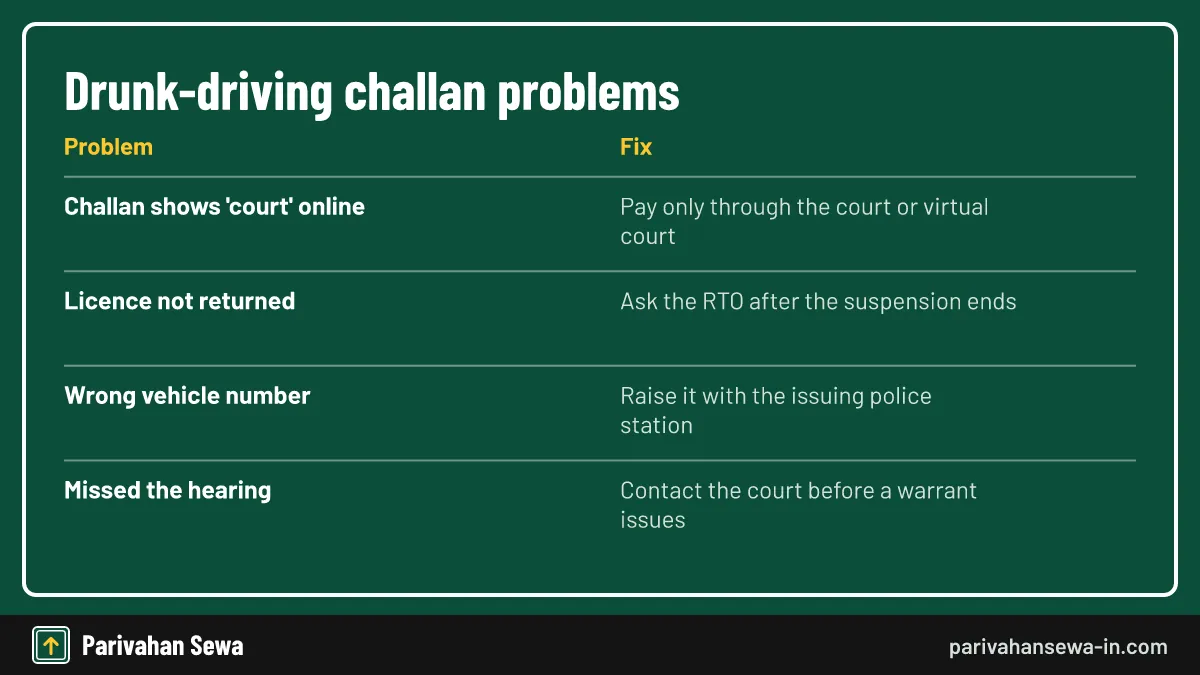
A drink n drive challan generally cannot be paid on the ordinary e-Challan payment page. Because section 185 is not compoundable, the portal shows it as a court challan or “sent to court”. You pay only after the magistrate fixes the amount.
What you will see online
Search your vehicle number on echallan.parivahan.gov.in. A drunk-driving entry typically shows the offence and a status such as pending in court, with no “pay now” button.
Virtual court payment
Some courts handle traffic matters through the virtual court system at vcourts.gov.in. Where your case is listed there, you may be able to plead and pay online; if not, go to the court in person.
Drink n drive fine: why is there no spot payment?
People expect to pay a drink n drive fine like a parking fine, but the law does not allow it. Section 200 lists the offences officers can compound, and section 185 is not on it, so only a court can impose the penalty.
Beware of “settle it here” offers
Any offer to make the case go away for cash at the roadside is unlawful. Ask for a written challan and pay only through the court, so you have a receipt that closes the case.
Fake payment links
Fraudsters send SMS links claiming to clear traffic fines. A drunk-driving case will not be settled by a random link; check the status on the official portal and report fraud at cybercrime.gov.in.
What happens in a drink and drive case?
A drink and drive case moves from the checkpoint to a magistrate’s court. You receive a challan with a court date, appear, and either admit the offence or contest it. The court then passes an order: a fine, jail, both, and often a direction about your licence.
Pleading guilty
Most first-time accused plead guilty at the first hearing. The magistrate records the plea, hears a short explanation and passes the order. You pay the fine and the case ends.
Contesting the case
If you believe the reading or procedure was wrong, you can contest. The court then looks at the breath or blood test, the officer’s evidence and any medical report. This takes longer and a lawyer helps.
Drink and drive case section: which laws are applied?
A plain checkpoint drink and drive case section list starts and ends with section 185 of the MV Act. A crash or injury brings in more sections, from both the MV Act and the Bharatiya Nyaya Sanhita (BNS). For a full reading of section 185 itself, see our guide to section 185 of the motor vehicle act.
| Law and section | What it deals with | Penalty or effect |
|---|---|---|
| MV Act 185 | Driving above 30 mg per 100 ml, or drugged | ₹10,000 and/or 6 months; repeat ₹15,000 and/or 2 years |
| MV Act 202 | Arrest without warrant | Medical exam within 2 hours |
| MV Act 204 | Blood sample test | Result admissible in court |
| MV Act 206(4) | Licence seizure | Sent for suspension proceedings |
| BNS 281 | Rash driving on a public way | Up to 6 months, or ₹1,000, or both |
| BNS 106 | Causing death by negligence | Up to 5 years and fine |
Sections 203 and 204 on testing
Section 203 covers the breath test at the roadside, and section 204 the laboratory test at a police station or hospital. Together they let police confirm a reading if you refuse or the device is in doubt.
When the case grows
If someone is hurt, police may add BNS charges for rash driving or causing hurt. Those are criminal charges heard separately from, or alongside, the section 185 matter.
Drunk driving IPC: what applies now under the BNS?
People still search drunk driving IPC because older news reports cite IPC sections such as 279 and 304A. The Bharatiya Nyaya Sanhita, 2023 replaced the Indian Penal Code on 1 July 2024, so offences after that date are charged under BNS numbers.

The old and new numbers
IPC 279 (rash driving) is now BNS 281, and IPC 304A (causing death by negligence) is now BNS 106.
Higher penalty for escaping
BNS 106 adds a heavier term, up to 10 years, where a rash or negligent driver causes death and escapes without reporting it to police or a magistrate. Staying and reporting matters.
What is the drunk and drive limit in India?
The drunk and drive limit in India is 30 mg of alcohol per 100 ml of blood, often written as 0.03% BAC. Anything above that, detected by a breath analyser or blood test, is an offence. Our drink drive limit guide explains how readings and tests work in detail.
How much is that?
There is no reliable “number of drinks” equal to 30 mg. Body weight, food, sex, tiredness and the strength of the drink all change the result, so one drink can put some people over.
No separate limit by vehicle
The section sets one figure for every motor vehicle, from scooters to trucks.
Drunk and drive limit points: what does the reading mean?
Searches for drunk and drive limit points usually mean the number on the breath analyser. India’s MV Act does not run a national penalty-points system for licences. The number people call “points” is the device reading, compared against 30 mg per 100 ml.
Reading the screen
Devices show the value in mg per 100 ml or as a percentage. A reading of 30 or 0.030 is the line; anything above it is an offence.
Readings change over time
Blood alcohol rises for a while after drinking and then falls slowly. Waiting a few minutes rarely helps; waiting until the next day is far safer.
What are the drink and drive rules for every driver?
The drink and drive rules come down to a few points: stay under 30 mg per 100 ml, give a breath sample when asked, accept that police may hold your licence and vehicle, and attend court. They apply equally to owners, hired drivers and learners.

Rules for learners and new drivers
A learner licence holder is also bound by section 185, and a case can delay the move to a permanent licence.
Rules for passengers
Passengers are not charged under section 185, but they can stop the offence.
Is drinking in car allowed in India?
Drinking in car is not allowed for the driver: any alcohol above the limit is an offence, and drinking at the wheel makes that almost certain. For passengers, the MV Act has no separate open-bottle rule, but state excise and police laws often ban drinking in public places, which can include a parked car on a road.
A parked car is not a safe zone
Sitting in the driver’s seat with the engine running can be treated as an attempt to drive. Even a parked car on a public road can attract action under state laws on public drinking.
Check your state’s excise law
Rules on carrying and consuming liquor differ by state, and some states, such as Gujarat and Bihar, prohibit alcohol altogether. Check the local excise rules before carrying bottles across state lines.
DD fine amount: what does DD mean on a challan?
In traffic slang, DD means drunk driving, so a “DD fine amount” is the drunk-driving penalty: up to ₹10,000 and/or six months for a first offence. “DD” can also mean the old Daman and Diu vehicle code, so check the context.
DD in police records
Some police systems and local news reports use “DD case” or “D&D” for a section 185 booking. On the official challan you will see the section number, which is the reliable way to confirm the offence.
DD as a plate code
Vehicles registered in Daman and Diu carried “DD” plates. A search for “DD fine” may also come from those owners; the fine amounts for them are the regular ones for each offence, not a drunk-driving charge.
What is the drink and drive fine in Bangalore?
The drink and drive fine in Bangalore follows the central limit of up to ₹10,000 for a first offence. When Karnataka cut several 2019 fines, such as helmet and seat-belt penalties, it left drunk driving at ₹10,000. Bengaluru Traffic Police book the case and the court decides.
Checks in the city
Bengaluru Traffic Police run breath-analyser checks across the city, especially at night. If you are booked, your licence is usually seized and you get a challan with a court date.
Discount schemes do not apply
Karnataka’s 50% concessions on pending challans in 2025 excluded serious offences such as drunk driving.
Drunk and drive fine in Bangalore: what happens in court?
A drunk and drive fine in Bangalore is paid after the hearing in the traffic court named on your challan. You appear, the magistrate hears the case, and you pay the amount ordered. Paying the other traffic fines on BTP or KarnatakaOne does not settle a section 185 case.
Before the hearing
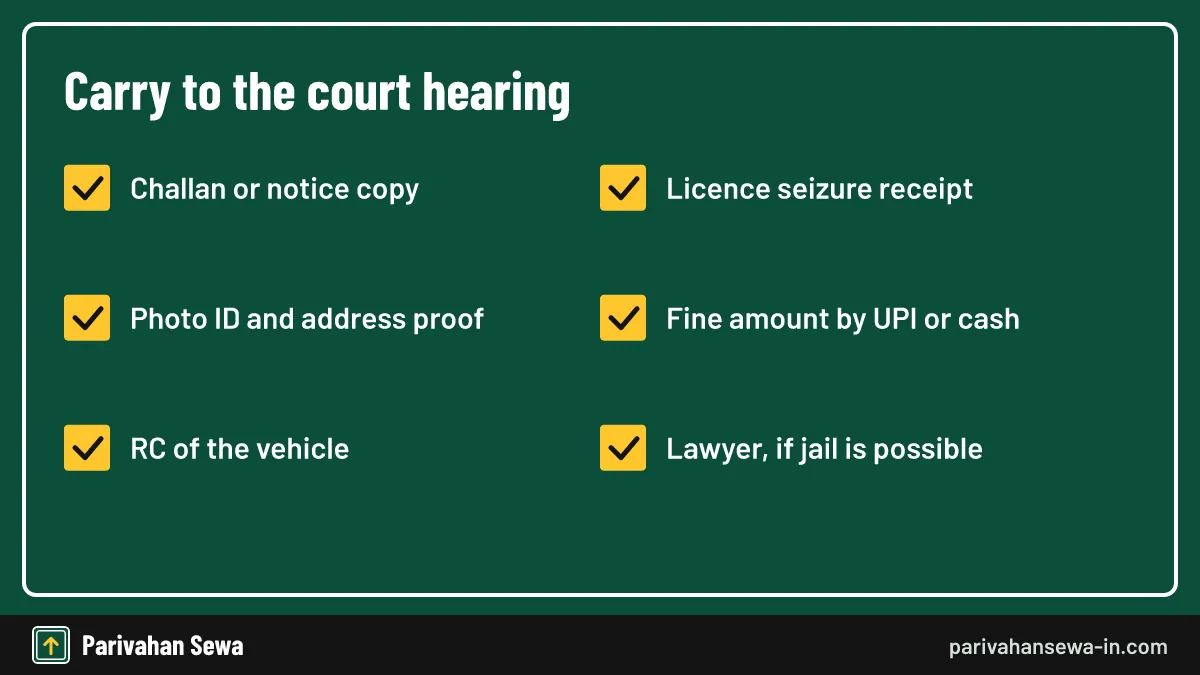
Search your vehicle number on the BTP website or the national portal to confirm the case is listed. Carry the challan copy, ID and the licence seizure receipt.
After the order
Once you pay, keep the receipt. You will need it to ask for your licence back after any suspension period, and to show the matter is closed if the record still shows pending.
What is the drink and drive fine in Mysore?
The drink and drive fine in Mysore is the same as anywhere in Karnataka: up to ₹10,000 and/or six months for a first offence, decided by a court. Mysuru City Traffic Police enforce it, and the state’s 2019 cuts to other fines did not touch drunk driving.
Where the case is heard
Your challan names the court in Mysuru. Check the date, plan to attend in person, and carry your documents.
Out-of-town drivers
Tourists from Bengaluru or other states booked in Mysuru must still attend the Mysuru court. Ask whether the court accepts virtual appearance for traffic matters before travelling.
What is the drunk and drive fine in Hyderabad?
The drunk and drive fine in Hyderabad is set by the court under section 185: up to ₹10,000 and/or six months for a first offence, and up to ₹15,000 and/or two years for a repeat. Hyderabad, Cyberabad and Rachakonda traffic police book the cases; magistrates fix the penalty.
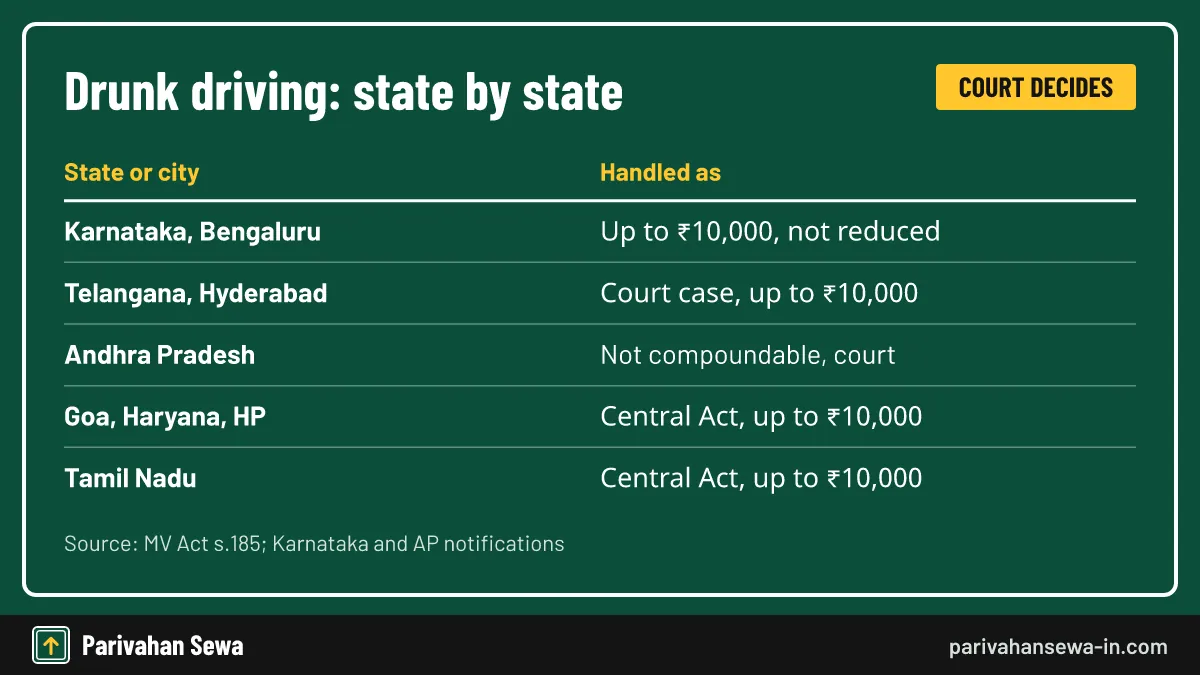
| State or city | Who books the case | Penalty basis |
|---|---|---|
| Karnataka (Bengaluru, Mysuru) | City traffic police | Court, up to ₹10,000; not reduced in 2019 |
| Telangana (Hyderabad) | City traffic police | Court, up to ₹10,000 |
| Andhra Pradesh | Police | Not in AP compounding list; court |
| Goa, Haryana, Chandigarh, Himachal Pradesh | State or UT police | Court, central limits |
| Tamil Nadu | State police | Court, central limits |
| Repeat offence anywhere | Any | Court, up to ₹15,000 |
Why amounts reported in the news differ
Local reports often quote what individual courts ordered. Those are case outcomes, not a fixed city rate, and they can be lower or higher than another person’s within the ceiling.
Jail is a real possibility
Hyderabad courts have the same power as others to order a short jail term, so treat the case seriously and attend every hearing.
Drunk and drive challan in Hyderabad: how to check it
A drunk and drive challan in Hyderabad can be checked on the Telangana police e-challan site, echallan.tspolice.gov.in, by vehicle number. The case usually shows as pending in court rather than payable. The national e-Challan portal may also list it.
What to look for
Check the challan number, date, place and offence. If the status reads court, follow the date on your paper or SMS notice.
When it does not appear
Electronic records can take a few days to upload. If nothing shows after a week, ask the traffic police station that booked you, with your challan copy.
Drunk and drive in Hyderabad: how do the checks run?
Drunk and drive in Hyderabad checks follow the usual pattern: police set up points, stop vehicles and test drivers with a breath analyser. Those above the limit get a challan, their licence is seized, and the vehicle is either handed to a sober driver or held at the station.
What to expect at the point
Officers ask for your licence and RC, then the breath sample.
Recording and evidence
Many checkpoints use devices that store or print the reading. That record is the evidence placed before the court.
Does Hyderabad use a different drunk and drive limit?
No. The drunk and drive limit in Hyderabad is the national figure: more than 30 mg per 100 ml of blood is an offence. Telangana has no separate state limit for alcohol while driving, so the same rule applies in the city and on highways.
Same device, same rule
Hyderabad’s checks use breath analysers calibrated to the section 185 limit. A reading just above 30 is still an offence, even if you feel fine.
Commercial and cab drivers
Cab and app-based drivers face the same legal limit, but their operators may suspend them for any positive reading.
What is the drunk and drive fine in Telangana?
The drunk and drive fine in Telangana follows the central Act everywhere in the state, from Hyderabad to Warangal and Karimnagar. A first offence carries up to ₹10,000 and/or six months; a repeat within three years up to ₹15,000 and/or two years, decided by the local court.
Outside the city
District police run checks on highways and in towns, especially at festivals and on weekends. The procedure and penalty are the same as in Hyderabad.
Licence action in Telangana
The court can direct that your licence be suspended, and the RTO acts on that order.
What is the drunk and drive fine in AP?
The drunk and drive fine in AP is decided by a court. Andhra Pradesh’s 2020 compounding order (G.O.Ms.No.21) lists amounts for most offences but leaves out section 185, so drunk driving goes before a magistrate under the central limits. For other AP penalties and payments, see our AP e challan guide.
Same ceiling as the rest of India
Up to ₹10,000 and/or six months for a first offence, and up to ₹15,000 and/or two years for a repeat. The AP order does not set a lower figure.
Cities in AP
Vijayawada, Visakhapatnam, Tirupati and other cities run their own checks. Your challan names the court; attend there even if you live elsewhere in the state.
What is the drink and drive fine in Goa?
The drink and drive fine in Goa is the same central penalty: up to ₹10,000 and/or six months for a first offence. Goa Police and traffic cells run checks, especially in tourist areas and during the holiday season, and the court decides the final amount.
Tourists and rented vehicles
Many visitors ride rented scooters. The rider is the accused, not the rental owner, and a case may need a return trip to Goa for the hearing, so the holiday can end up costing far more.
Beach belts and highways
Checks are common on the roads linking beach areas, and on highways at night.
Is drink and drive allowed in Goa?
No, drink and drive is not allowed in Goa. Goa follows the same Motor Vehicles Act as every other state, with the 30 mg per 100 ml limit. Easy availability of alcohol does not change the driving law.

Why the myth exists
Goa’s relaxed image and cheap drinks lead some visitors to believe rules are lighter there. They are not, and police in tourist areas actively look for drunk riders.
The safer plan
Use taxis, app cabs or a designated driver. That is cheaper than a court case.
What is the drink and drive challan in Haryana?
A drink and drive challan in Haryana is a court challan under section 185, with the central ceiling of ₹10,000 and/or six months for a first offence. Haryana Police and Gurugram and Faridabad traffic police book cases, and the magistrate sets the penalty.
Gurugram and the NCR
Gurugram’s nightlife areas see regular night checks. Drivers from Delhi or Uttar Pradesh booked in Haryana must attend the Haryana court named on the challan.
Checking the challan
Search your vehicle number on the national e-Challan portal. A section 185 entry will show as sent to court, not payable online.
Drink and drive challan in Chandigarh: what to expect
A drink and drive challan in Chandigarh follows the same court process. Chandigarh Traffic Police run checks around the city’s sectors and entry points, seize licences of those over the limit, and send cases to the local court, which applies the central limits.
A shared city
Chandigarh borders Punjab and Haryana. Where you are booked decides which police and court handle the case, so read the challan carefully.
After the hearing
Keep the court receipt. Chandigarh challans appear on the national portal, and the receipt helps if the online record is slow to update.
Drink and drive challan in Himachal Pradesh: how it works
A drink and drive challan in Himachal Pradesh is handled the same way: breath test, challan, licence seizure and a court hearing under the central penalties. Mountain roads make drunk driving especially dangerous, and police check vehicles on tourist routes.
Tourists on hill roads
Visitors driving to Shimla, Manali or Dharamshala are often booked far from home. Ask whether the court allows virtual appearance; otherwise you must return for the hearing.
Rental and taxi drivers
Commercial drivers caught over the limit risk their licence and their permit-linked work.
What is the drunk and drive fine amount in Tamilnadu?
The drunk and drive fine amount in Tamilnadu is the central figure: up to ₹10,000 and/or six months for a first offence, and up to ₹15,000 and/or two years for a repeat. Greater Chennai Traffic Police and district police book the cases; courts decide.
Chennai and other cities
Chennai, Coimbatore and Madurai police run breath-analyser checks, often late at night. If you are booked, expect a seized licence and a court date.
Checking the challan
Tamil Nadu challans appear on the national e-Challan portal by vehicle number. A section 185 entry will be marked for court, with no online payment option.
How to check if a drink and drive challan is pending?
To check whether a drink and drive challan is pending, search your vehicle number, challan number or licence number on echallan.parivahan.gov.in or your state police site. A section 185 case shows as pending in court until the magistrate’s order is recorded.
Searching by licence number
Because drunk driving is tied to the driver, searching by DL number can be more reliable than by vehicle, especially if you were driving someone else’s car.
After paying in court
Court payments can take time to reflect online. If the case still shows pending weeks later, take the court receipt to the traffic police station or the court clerk.
What should you do after a drink and drive challan?
After a drink and drive challan, collect your papers, arrange the vehicle, and note the court date. Do not drive until you are sober and have your licence back. Attend the hearing, pay what the court orders, and follow up on the licence.
Within the first week
Check the challan online, make copies of the challan and licence seizure receipt, and decide whether you need a lawyer. If there was an accident, inform your insurer.
After the case
Once the suspension ends, ask the RTO or court for your licence. Driving while disqualified is a separate offence, so check the end date first. Our guide to the without licence fine explains those penalties.
How can you avoid a drink and drive case?
The only sure way to avoid a drink and drive case is not to drive after drinking. Decide how you will get home before the first drink: a designated driver, a cab, public transport, or staying the night.
Myths that do not work
Coffee, mints, cold showers and mouthwash do not lower your blood alcohol. Only time brings the level down.
The morning after
Alcohol can stay above the limit the next morning after a late, heavy night. If you drank a lot, wait longer or take a cab to work.
Is the drink and drive fine the same for bikes?
Yes. The drink and drive fine is the same for motorcycles, scooters, cars and trucks, because section 185 covers anyone driving or attempting to drive any motor vehicle. A drunk rider also often breaks the helmet rule, which adds a separate fine.
Higher risk on two wheelers
Alcohol slows reactions and affects balance, which matters even more on a bike.
Electric two-wheelers
Registered electric scooters and bikes are motor vehicles too. Low-speed models exempt from registration may fall outside some rules, but riding drunk is still dangerous and can bring other charges.
Does drink and drive affect your insurance claim?
Yes, drink and drive can hurt an insurance claim. Most motor policies exclude own-damage cover when the driver was under the influence of alcohol. Third-party victims are still protected by law, but the insurer may try to recover what it pays from the owner.
Own damage
Read your policy’s exclusions. If the police record shows a section 185 offence, expect the insurer to reject a claim for repairs to your own vehicle.
Third-party liability
Victims can still claim through the Motor Accident Claims Tribunal. Courts have allowed insurers to pay victims first and then recover the amount from the owner where the driver was drunk.
What is the drink and drive fine for a second offence?
The drink and drive fine for a second offence within three years rises to up to ₹15,000, with up to two years’ imprisonment, or both.
Proving the earlier case
The court relies on the record of the earlier case from the same or another court. The three years run from when the earlier offence was committed; if that first case is still pending, ask a lawyer how the court will treat it.
Licence consequences
Repeat offenders risk having their licence revoked, not just suspended. A new licence then means starting again with a learner licence and test. For city-specific rules in Maharashtra, see our guide to the drink and drive fine in Mumbai, and for other offences the traffic fines overview. The e-challan hub lists every challan service.
Official links
e-Challan: check challans by vehicle numberechallan.parivahan.gov.in ↗Virtual Courts (court challans)vcourts.gov.in ↗Hyderabad Traffic Police e-Challanechallan.tspolice.gov.in ↗KarnatakaOne (Bengaluru traffic fines)karnatakaone.gov.in ↗MV (Amendment) Act 2019 summarypib.gov.in ↗Drink and drive questions
Can I pay a drink and drive fine online?
Usually not on the regular e-Challan page. Section 185 is not compoundable, so the case shows as a court challan. Some courts accept payment through the virtual court after the order.
How much alcohol is allowed while driving in India?
Anything above 30 mg per 100 ml of blood is an offence. Because one drink can push some people over, the only safe amount is none.
Will I go to jail for a first drunk driving offence?
The law allows up to six months, but the magistrate decides. Many first cases end with a fine, though jail is possible, especially after a crash.
Can the police take my driving licence?
Yes. Section 206(4) lets an officer seize the licence and send it for suspension or disqualification proceedings.
Is drunk riding on a bike treated differently?
No. Section 185 covers anyone driving or trying to drive any motor vehicle, so a two-wheeler rider faces the same limits and penalties.
What if I refuse the breath analyser test?
Refusing does not end the matter. Under section 204 the police can ask for a blood sample taken by a registered doctor, and the result is admissible in court.
Does a drunk driving case go on my record?
Yes. The court order is recorded, and a second offence within three years attracts the higher penalty.
Can the owner be punished if a friend drove drunk?
The driver is the accused under section 185. An owner who knowingly lets an unfit or unlicensed person drive can face separate action.
Is the fine lower in some states?
States can notify lower compounding amounts for many offences, but section 185 is decided by courts under the central limits. Karnataka kept drunk driving at ₹10,000 when it cut other fines in 2019.
Does medicine count as drink and drive?
Section 185 also covers driving under the influence of a drug to the point you cannot control the vehicle. Ask your doctor before driving on sedating medicines.
How long until I get my licence back?
It depends on the suspension or disqualification period ordered. Check with your RTO once that period ends.
Can I get a lawyer for a drink and drive case?
Yes. You can engage a lawyer for any court case, and it is worth doing if there was an accident or a second offence.
Parivahan Sewa (parivahansewa-in.com) is an independent information website and is not affiliated with MoRTH, Parivahan or any state transport department. Confirm fees and rules on the official portal before you pay or apply.