Highest challan in India and the full traffic fine rate list
The highest challan in India under the Motor Vehicles Act is up to ₹100 crore, but it applies only to vehicle makers that break construction standards. For road users, the biggest fixed fines are ₹40,000 for refusing to stop a goods vehicle for weighing, ₹20,000 plus ₹2,000 a tonne for overloading, ₹25,000 for a guardian when a juvenile drives, and ₹10,000 to ₹15,000 for drunk driving.
Key takeaways
- The biggest penalty in the Act is up to ₹100 crore for manufacturers, under section 182A(2).
- For everyday drivers, drunk driving, emergency-vehicle and permit offences carry ₹10,000 fines.
- Helmet, seat belt and triple riding cost ₹1,000 each centrally; helmet and pillion offences add a 3-month licence disqualification.
- Red light jumping and wrong-side driving fall under dangerous driving (₹1,000 to ₹5,000, first offence).
- States can notify their own compounding amounts, so always read the amount on your actual challan.
On this page · 42 sections
What is the highest challan in India?
The highest challan in India written into law is a fine of up to ₹100 crore under section 182A(2) of the Motor Vehicles Act. It targets vehicle manufacturers that fail to meet construction and maintenance standards, not individual drivers. For ordinary road users, the largest single fines sit between ₹10,000 and ₹40,000.

The largest amount for one offence
After the manufacturer penalty, the next biggest amounts belong to dealers and component sellers: ₹1,00,000 per vehicle or per safety component that does not comply with the rules. Road contractors who ignore design standards also face up to ₹1,00,000 under section 198A.
Why record challans make the news
Headlines about challans worth lakhs usually describe a combined challan. A truck stopped once may be booked for overloading, a missing permit, no fitness certificate and no insurance at the same time. Each section is added, so the total grows quickly even though every single figure comes from the Act.
Which traffic rules violation fine is the biggest?
The biggest traffic rules violation fine for a person driving is the ₹40,000 penalty under section 194(2) for refusing to stop a goods vehicle for weighing or to remove excess load. Drunk driving repeats (₹15,000) and juvenile driving cases (₹25,000 for the guardian) follow.
Fines aimed at drivers and owners
| Offence | Section | Central penalty |
|---|---|---|
| Refusing to stop for weighing | 194(2) | ₹40,000 |
| Juvenile driving (guardian or owner) | 199A | ₹25,000 and up to 3 years |
| Overloading | 194(1) | ₹20,000 + ₹2,000 per extra tonne |
| Load sticking out of the body | 194(1A) | ₹20,000 + off-loading charges |
| Hazardous goods, repeat | 190(3) | ₹20,000 |
| Drunk driving, repeat | 185 | ₹15,000 and/or up to 2 years |
| Blocking an ambulance or fire engine | 194E | ₹10,000 and/or 6 months |
| No permit | 192A | ₹10,000 and up to 6 months |
Fines aimed at companies
Makers, importers and dealers carry the heaviest exposure. Section 182A(1) charges ₹1,00,000 per non-compliant vehicle sold or altered, and an unlicensed cab aggregator can be fined ₹25,000 to ₹1,00,000 under section 193(2).
Fines tied to road tax
Section 192B sets registration penalties as a multiple of tax: an owner who never applies for registration pays five times the annual road tax or one-third of the lifetime tax, whichever is higher. For an expensive car this can exceed every fixed fine above.
New traffic fines: what changed on 1 September 2019?
The new traffic fines came from the Motor Vehicles (Amendment) Act, 2019, whose penalty sections took effect on 1 September 2019. Most amounts rose five to ten times, several offences got their own sections for the first time, and the Act allowed yearly increases.

Old and new amounts side by side
| Offence | Before 2019 | After 2019 |
|---|---|---|
| General offence (section 177), first | Up to ₹100 | ₹500 |
| General offence, repeat | Up to ₹300 | ₹1,500 |
| Disobeying authorities (179) | Up to ₹500 | Up to ₹2,000 |
| Driving without licence (181) | Up to ₹500 | Up to ₹5,000 |
| Over-speeding, light vehicle (183) | Up to ₹400 | ₹1,000 to ₹2,000 |
| Drunk driving, first (185) | Up to ₹2,000 | ₹10,000 |
| No insurance, first (196) | ₹1,000 | ₹2,000 |
| Overloading (194) | ₹2,000 + ₹1,000/tonne | ₹20,000 + ₹2,000/tonne |
The yearly increase rule
Section 199B lets the central government raise every fine by up to 10% each year on 1 April. Any increase needs a notification, so a figure in an old list is not automatically wrong, but it should be checked.
New challan rules: can states change the amount?
Under the new challan rules, states cannot exceed the Act, but they can notify compounding amounts, the sum you pay to settle a challan without going to court. Section 200 lists which offences can be compounded, so state amounts are often lower than the central figure.
What compounding means for you
When an offence is compoundable, the officer or portal shows a fixed amount. Paying it closes the case. A compounded offence still counts as a previous offence, so a second one draws the higher repeat fine.
Offences that cannot simply be compounded
Drunk driving under section 185 is not on the compounding list. Section 184 is compoundable only for handheld phone use, so other dangerous driving cases may be sent to court, where a magistrate fixes the amount.
Vehicle challan rate list: what are the central amounts?
This vehicle challan rate list shows the central amounts for offences people search for most. Use it to understand the scale of a challan, then check your state’s notified figure on the challan itself, because the amount payable is what the official record shows.
Common offences and central penalties
| Offence | Section | Central fine |
|---|---|---|
| Not wearing a helmet | 194D | ₹1,000 + 3-month disqualification |
| No seat belt (driver or passenger) | 194B | ₹1,000 |
| Triple riding | 194C | ₹1,000 + 3-month disqualification |
| Red light jump or wrong side | 184 | ₹1,000 to ₹5,000 |
| Needless horn or cut-out silencer | 194F | ₹1,000, repeat ₹2,000 |
| Vehicle in unsafe condition | 190(1) | ₹1,500 |
| Pollution or noise standards | 190(2) | Up to ₹10,000 |
| Obstructing traffic | 201 | ₹500 + removal charges |
| Excess passengers in a transport vehicle | 194A | ₹200 per passenger |
Who fixes the final amount
For a compoundable challan, the state’s notified amount applies. For a court challan, the magistrate decides within the range in the Act. The full section-by-section guide is on our page about traffic fines.
Traffic offence and fine chart: how do you read section numbers?
A traffic offence and fine chart links each offence to a section of the Motor Vehicles Act. Every challan prints these section numbers, so once you know the main ones, you can tell at a glance whether a challan is a small general penalty or a serious one.

Rule section and penalty section
Many challans show two numbers. The first is the duty (for example section 129, wearing a helmet) and the second is the penalty (section 194D). The penalty section decides the amount.
When several sections appear
If a challan lists three or four penalty sections, each one is a separate offence. The total is the sum. For background on the law itself, read our guide to the Motor Vehicle Act.
Traffic challan list PDF: where is an official copy?
There is no single official traffic challan list PDF for all of India. The reliable sources are the Gazette text of the 2019 amendment, the MoRTH section summary hosted by PIB, and each state’s own compounding notification published by its transport or home department.
Central documents worth saving
The amendment text on PRS Legislative Research and the PIB summary of sections in force from 1 September 2019 give the central amounts. Both are linked in the source lines on this page.
Be careful with forwarded PDFs
Lists shared on messaging apps are often old, mix states, or invent amounts. Check the date and the issuing office. If neither is printed, treat the list as unverified.
Challan list: which offences are booked most often?
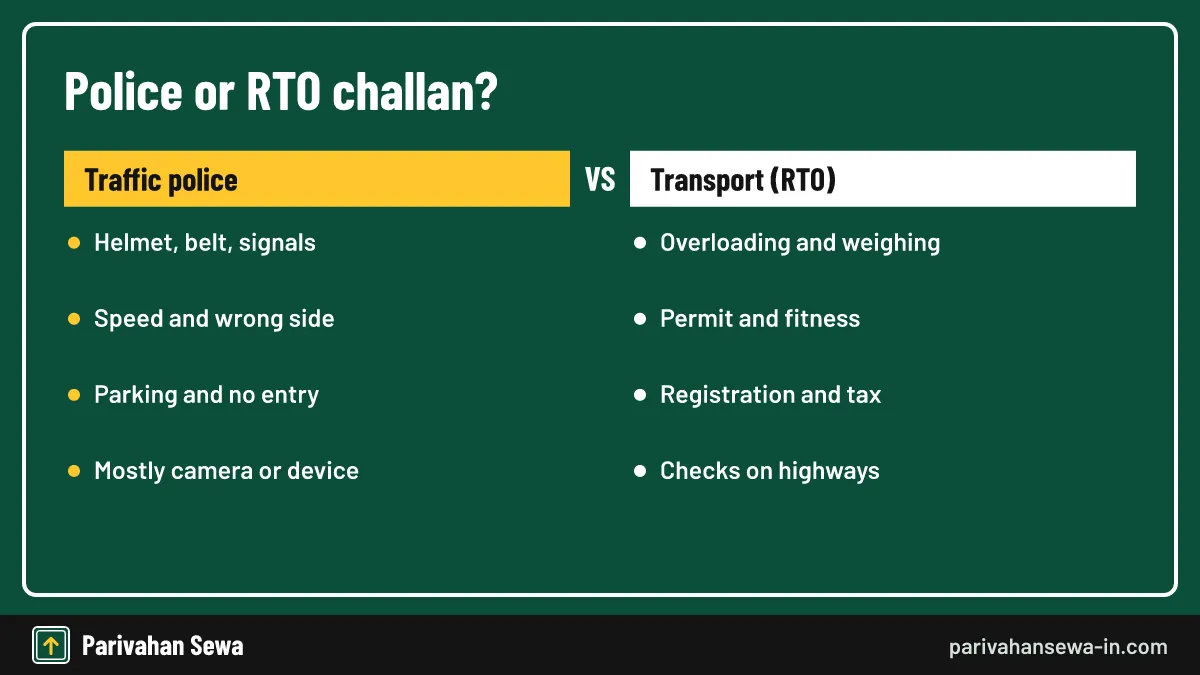
A typical challan list on a vehicle is dominated by offences that cameras catch: signal jumping, speeding, no helmet, no seat belt and stop-line violations. Officer-issued challans add documents offences such as no licence, no insurance and no PUC certificate.
Camera-detected offences
Cameras read the number plate, so the challan is issued to the registered owner. Photos are usually attached, which you can view when you open the challan online.
Officer-issued offences
Handheld devices let officers create a challan on the spot and link it to your licence. These often include several documents offences recorded together.
New challan list: which offences were added in 2019?
The new challan list of 2019 created six sections that did not exist before: 194A to 194F. They cover excess passengers, seat belts and child seats, pillion rules, helmets, blocking emergency vehicles, and horns or silencers. Section 199A on juveniles was added at the same time.
The 194 series in one line each
194A charges ₹200 per extra passenger; 194B ₹1,000 for belts; 194C and 194D ₹1,000 plus disqualification; 194E ₹10,000 for blocking an ambulance; 194F ₹1,000 for horn and silencer offences.
The juvenile section
Section 199A makes the guardian or owner liable when a minor drives, with up to three years in jail and a ₹25,000 fine, unless they prove they did not know or took all due care.
RTO challan list: which fines come from transport officers?
The RTO challan list covers offences checked by transport department officers, usually on highways and at check posts: overloading, permits, fitness certificates, registration and tax. These are the offences behind most very large challans, because commercial vehicles often carry several at once.
Goods vehicle offences
Overloading starts at ₹20,000, a load sticking out of the body adds another ₹20,000, and refusing to stop for weighing costs ₹40,000. The vehicle may not move until the excess load is removed.
Paperwork offences
Driving without a permit attracts ₹10,000. Using a transport vehicle without a valid fitness certificate is treated as driving an unregistered vehicle under section 192.
Fine amount: why is the challan sometimes lower than the Act?
The fine amount on your challan may be lower than the central figure because many sections say “up to”, and states notify fixed compounding amounts below that ceiling. Other sections, such as 194B, set a fixed figure that should match the Act unless a state has notified otherwise.
“Up to” against fixed amounts
“Up to ₹5,000” for driving without a licence means the state or court may choose any figure up to that. Karnataka, for example, notified ₹1,000 for two-wheelers and ₹2,000 for cars.
When a court decides
Once a challan goes to court, the magistrate sets the amount. It can be lower or higher than the compounded figure, within the range in the Act.
Fine charges and traffic challan charges
Ordinary fine charges cover only the offence. Extra traffic challan charges appear only in specific cases: removal charges for towing and storage under section 201, or off-loading charges for an over-dimension load. The payment page shows the full total before you pay.
Challan rate: why does the same offence cost more in one state?
The challan rate differs because each state notifies its own compounding amounts under section 200. Karnataka followed Maharashtra and Gujarat in cutting several 2019 fines, while West Bengal said in 2019 it would not implement the amended Act at first because of the size of the fines.
Central amounts against two states
| Offence | Central Act | Karnataka (2019 notification) | Andhra Pradesh (2020 G.O.) |
|---|---|---|---|
| No helmet | ₹1,000 | ₹500 | ₹1,000 |
| No seat belt | ₹1,000 | ₹500 | ₹1,000 |
| No licence, two-wheeler | Up to ₹5,000 | ₹1,000 | ₹5,000 |
| No insurance, first offence | ₹2,000 | ₹1,000 (two-wheeler) | ₹2,000 |
How to find your state’s amount
Open your challan on the e-Challan portal. The amount shown is the one notified for the state where the offence happened, not where your vehicle is registered.
Red light jumping challan: how much is the fine?
A red light jumping challan is booked as dangerous driving under section 184 in the central Act: ₹1,000 to ₹5,000 and/or six months to one year in jail for a first offence. A second offence can reach ₹10,000 and/or two years.
First and repeat offences
The jump in the repeat penalty is steep, and section 206(4) lets an officer seize the licence of someone accused under section 184 and send it for disqualification proceedings.
Other sections you may see
Some challans book a signal violation under section 119 (duty to obey traffic signs) read with the general penalty in section 177. The section printed on your challan decides which amount applies.
Red light jump challan amount: why is it dangerous driving?
The red light jump challan amount is high because the 2019 amendment added an Explanation to section 184 that names jumping a red light as dangerous driving. The same list includes ignoring stop signs, handheld phones, illegal overtaking and driving against traffic.

Why it is not always compounded
Section 200 allows section 184 to be compounded only for handheld phone use. A red-light case under 184 may therefore be sent to court, depending on how the state handles it.
Licence consequences
A dangerous driving case can lead to licence suspension through the licensing authority, even after the fine is paid.
Red light jump challan in Delhi: how do cameras catch it?
A red light jump challan in Delhi is usually generated by signal cameras that photograph the number plate when a vehicle crosses the stop line on red. The challan is sent to the registered mobile number and appears on the e-Challan portal with the image.
Red light jump fine in Delhi
The red light jump fine in Delhi follows the offence section printed on the challan. Delhi’s own compounding amounts and payment options are covered on our Delhi traffic challan page.
Red light cross challan in Delhi
A red light cross challan in Delhi can be issued even if you stopped just past the line. The camera image shows the vehicle’s position; if it shows you stopped before the line, raise a grievance with that image.
Checking the evidence
Open the challan online and zoom into the photo. Check the plate, the vehicle model and the signal state before paying.
Red light jump challan in Gurgaon: what should drivers expect?
A red light jump challan in Gurgaon (Gurugram) is issued by Haryana’s traffic police and appears on the same national e-Challan record. Haryana camera and officer challans can be checked and paid online by vehicle or challan number.
Haryana’s process
Haryana challans can be searched on the national portal like any other state’s. The steps, Haryana-specific payment channels and court process are on our e challan Haryana page.
Amount you will see
The amount shown follows Haryana’s notification for the offence section. If it is marked as court, the e-Challan pay button no longer applies.
Seatbelt challan: who gets fined in the car?
A seatbelt challan costs ₹1,000 under section 194B, and it covers both the driver who does not wear a belt and a driver who carries passengers not wearing belts. A separate ₹1,000 applies when a child under 14 is not secured by a belt or child restraint.
Driver responsibility
The challan is issued to the person driving. That is why drivers should insist that every passenger buckles up before setting off.
Child safety
Section 194B(2) is about children under 14. A lap is not a child restraint, so carrying a small child unsecured is an offence.
Seat belt challan in Delhi: do rear passengers need belts?
A seat belt challan in Delhi can be issued for rear passengers too, because section 194B says “carries passengers not wearing seat belts” without limiting it to front seats. Enforcement of rear-seat belts varies, so the safest habit is to belt every seat.
Exemptions for some vehicles
States may exclude transport vehicles that carry standing passengers, such as city buses, from the seat belt rule by notification.
When the car has no rear belts
Older vehicles built without rear belts are a grey area. Fitting approved belts removes any doubt.
Without helmet challan: what is the fine and suspension?
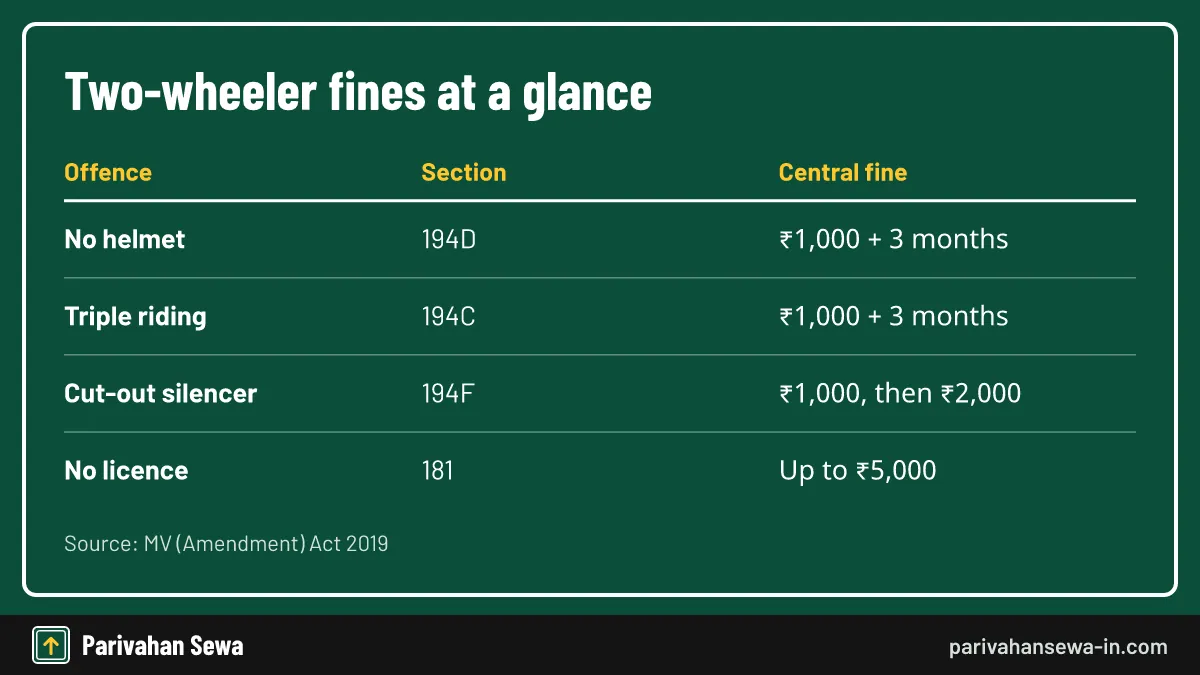
A without helmet challan under section 194D is ₹1,000 plus a three-month disqualification from holding a licence. The rule behind it, section 129, requires a helmet meeting BIS standards, with an exemption for a Sikh wearing a turban.
What a proper helmet means
The helmet must meet the BIS standard and be fastened. An unbuckled helmet can be treated as not wearing one.
State differences
Karnataka notified ₹500 for riding without a helmet in 2019. Other states follow their own notifications, so check the challan amount.
Without helmet challan in Delhi: is the pillion fined too?
A without helmet challan in Delhi can be issued when either the rider or the pillion is bare-headed. Section 194D penalises whoever “drives a motor cycle or causes or allows” it to be driven against section 129, so the rider usually receives it.
Pillion riders and children
Section 129 applies to every person riding or being carried on a motorcycle, apart from the turban exemption and any state exceptions.
Disqualification in practice
The three-month disqualification is applied by the licensing authority after the case is forwarded, so it may not appear on the challan itself.
Tripling challan: what is the fine for three on a bike?
A tripling challan is issued under section 194C for breaking the pillion rule in section 128, which allows only one person besides the driver on a motorcycle. The central penalty is ₹1,000 and a three-month licence disqualification.
What section 128 requires
Only one pillion, seated on a proper seat behind the driver. Carrying two passengers, or a passenger sitting side-on without a seat, breaks the rule.
Combined with helmet offences
If the extra passenger has no helmet either, a separate 194D challan may be added, doubling the cost.
Over speed challan in Delhi: how are speed limits enforced?
An over speed challan in Delhi is generated mainly by speed cameras on arterial roads and expressways. The camera records the speed and the number plate, and the challan reaches the owner by SMS and the e-Challan record, usually within days.
Overspeed challan in Delhi: limits
Limits are notified by the authorities for each road and shown on signboards. The overspeed challan in Delhi depends on the vehicle class, not on how far over the limit you were.
Repeat offences
A second speeding offence lets the police impound the driving licence under section 183.
Overspeed challan amount: how much for cars and trucks?
The overspeed challan amount under section 183 is ₹1,000 to ₹2,000 for a light motor vehicle, including cars and two-wheelers, and ₹2,000 to ₹4,000 for medium or heavy goods and passenger vehicles. A second offence also allows the licence to be impounded.

Overspeeding challan price for employers
Section 183 also covers anyone who “causes” an employee to speed. A transport company that sets impossible delivery times can be held liable.
Speeding violation or overspeeding ticket?
A speeding violation and an overspeeding ticket mean the same thing: a challan under section 183. Racing or speed trials on a public road are different and fall under section 189, with up to ₹5,000 and/or three months for a first offence.
Wrong side driving challan: what does the law say?
A wrong side driving challan is booked as dangerous driving, because section 184’s Explanation lists “driving against the authorised flow of traffic”. The central penalty is ₹1,000 to ₹5,000 and/or six months to one year for a first offence.
Why it is treated seriously
Head-on collisions at even moderate speed are often fatal. That is why the law groups wrong-side driving with signal jumping and phone use.
Short cuts on service roads
Driving a few metres the wrong way to reach a gap still counts. Cameras at U-turns and gaps commonly catch it.
Wrong side challan price: how much does it cost in Delhi?
The wrong side challan price follows section 184, so the wrong side challan in Delhi falls within the ₹1,000 to ₹5,000 first-offence range, or is decided by a court. The exact figure is on the challan and in Delhi’s own notification.
Court or compounded?
Because section 184 is compoundable only for phone use, a wrong-side case may be marked for court. Watch the challan status for a court date.
What to keep ready
If you contest it, keep any dashcam footage or a map showing that the road was two-way at the time.
Without licence challan: what is the central fine?
A without licence challan under section 181 carries up to ₹5,000, ten times the old ceiling of ₹500. Section 180 adds a separate fine of up to ₹5,000 for the owner who allows an unlicensed person to drive. Full details are on our without licence fine page.
Driving with an expired licence
A licence can be renewed up to one year after expiry; beyond that, you must pass the test again. Driving on a long-expired licence can be treated as driving without one.
Minors driving
If the driver is under age, section 199A makes the guardian or owner liable, with the ₹25,000 fine and registration cancelled for a year.
Without licence challan in Delhi: what if you forgot the card?
A without licence challan in Delhi, or without license challan in Delhi, is meant for people who do not hold a valid licence. If you hold one but left the card at home, a DL shown in DigiLocker or mParivahan is treated as valid under CMVR rule 139.
Producing the licence later
Rule 139 allows documents not available on the spot to be produced later, within 15 days, by registered post or in person, as attested copies.
If a challan was still issued
Raise a grievance with a copy of your valid licence. The issuing police can withdraw or modify the challan.
Insurance challan price: what if your policy has lapsed?
The insurance challan price under section 196 is ₹2,000 and/or up to three months in jail for a first offence, and ₹4,000 and/or three months for a second. Even one day of lapse counts, because third-party cover is compulsory under section 146.
Renew before paying
Paying the challan does not insure the vehicle. Renew the policy first, then settle the challan, so a second stop does not bring the higher repeat amount.
State amounts
Karnataka notified ₹1,000 for two-wheelers and ₹2,000 for cars. Andhra Pradesh uses ₹2,000 for a first offence.
Insurance challan in Delhi: does bike insurance count?
An insurance challan in Delhi applies equally to two-wheelers, so a bike insurance challan in Delhi costs the same under section 196. New two-wheelers come with five-year third-party cover, which often expires unnoticed; check the date on Vahan or with our bike insurance check guide.
Insurance challan price in Delhi
The insurance challan price in Delhi is the amount on the challan, following Delhi’s notification for section 196.
Insurance challan in Haryana
An insurance challan in Haryana is often generated by cameras that compare number plates with insurer data uploaded to Vahan. If a recently renewed policy has not appeared yet, keep the policy document to contest the challan.
Pollution challan price: what is the PUC fine?
The pollution challan price comes from section 190(2): up to ₹10,000 and/or three months in jail, plus a three-month licence disqualification for a first offence. A PUC challan price on a compounded challan may be lower, but the ceiling is high, so a valid certificate is worth keeping.

Validity of a PUC certificate
A certificate is normally valid for six months, and for twelve months on BS-IV and BS-VI vehicles. How to get and download one is on our PUC certificate page.
Failed tests
If a vehicle fails, the centre issues a rejection slip. Repair the vehicle and retest; driving on with a failed result risks the challan.
Pollution challan price in Delhi: why is enforcement stricter?
The pollution challan price in Delhi follows section 190(2), but enforcement is tighter. Delhi’s “No PUCC, No Fuel” rule has been enforced since 18 December 2025, and from 1 October 2026 cameras at about 500 fuel stations check certificates.
Cost of a test in Delhi
A PUC test in Delhi costs ₹80 for petrol, CNG or LPG two- and three-wheelers, ₹110 for four-wheelers and ₹140 for diesel vehicles, a fraction of the fine.
How the fuel-station check works
The cameras read the plate and check the PUC database. Vehicles without a valid certificate can be refused fuel and booked.
Number plate fine: what if the plate is missing or wrong?
A number plate fine depends on the problem. A without number plate challan can be booked under section 39 read with section 192, which for a first offence carries ₹2,000 to ₹5,000. Plates that break the design rules are usually booked under the general penalty or state notifications.
HSRP deadlines
Some states set deadlines to fit high security registration plates on older vehicles. Maharashtra, for instance, set a ₹1,000 fine from 1 July 2026 for pre-April 2019 vehicles without HSRP. See our HSRP number plate guide.
Number plate challan price in Punjab
The number plate challan price in Punjab follows the same central sections, with amounts set by Punjab’s own notification. We have not verified a current Punjab figure, so check the challan or Punjab transport department notices before relying on any list.
Black film challan in Delhi: is tinted glass allowed?
A black film challan in Delhi is issued when windows carry dark films that block visibility. Glass must meet the light-transmission rules in the Central Motor Vehicles Rules, and aftermarket films are a common reason for a challan in Delhi and across India.
Tinted glass challan in Delhi
A tinted glass challan in Delhi usually comes from an officer’s check, often with an instruction to remove the film. The amount follows the section on the challan.
Factory-tinted glass
Glass tinted by the manufacturer within the permitted limits is legal. The problem is films pasted on later. Check with your dealer if unsure.
Pressure horn challan: what is the fine for loud horns?
A pressure horn challan can arise under section 194F, which fines needless or continuous horn use and horn use in no-horn zones: ₹1,000 for a first offence and ₹2,000 for a repeat. Fitting a non-approved horn may also be treated as an illegal alteration.

Alteration penalty
Section 182A(4) fines an owner ₹5,000 per alteration for changing a vehicle in a way the rules do not allow. A pressure horn and a loud silencer could be two alterations.
Silence zones
Hospitals and schools are often marked as no-horn zones. Any horn use there can be fined under 194F.
Bullet silencer challan price in Punjab: what can you be fined?
A bullet silencer challan price in Punjab depends on the section used. Section 194F charges ₹1,000, then ₹2,000, for a cut-out that releases exhaust other than through the silencer. A modified silencer may also bring the ₹5,000 alteration fine and noise penalties under section 190(2).
Why modified silencers are targeted
Loud aftermarket silencers on motorcycles cause noise complaints, and police drives in several states focus on them.
Removing the modification
Refitting the original silencer is the simplest fix. Keep the bill in case you need to show the change was reversed.
No parking challan price: what are improper and wrong parking challans?
The no parking challan price depends on how the offence is booked. Parking that blocks traffic falls under section 201: ₹500 plus removal charges for towing and storage. Other parking breaches are usually booked under the general penalty of section 177.
Improper parking challan
An improper parking challan covers parking on footpaths, at bus stops, near junctions or double-parking. These break the road regulations, which section 177A fines at ₹500 to ₹1,000.
Wrong parking challan and towing
A wrong parking challan in a tow-away zone adds removal charges. Collect the vehicle from the pound with the RC and pay both amounts.
No entry challan in Delhi: when do trucks get fined?
A no entry challan in Delhi is usually issued to goods vehicles entering the city during restricted hours, or to any vehicle using a road marked no entry. Restrictions are set by notification, and the challan shows the section used.
No entry challan for cars and bikes
A no entry challan for private vehicles mostly comes from entering a one-way street from the wrong end. That can also be booked as driving against the authorised flow of traffic.
Checking timings
Restricted hours for heavy vehicles are announced by the traffic police. Transporters should check the current notice before planning a route.
Haryana challan list: how does Haryana compare?
The Haryana challan list uses the same central sections, with amounts set by Haryana’s own notification. We could not verify a current Haryana compounding table from an official source, so this page does not quote Haryana-specific amounts.
Where to see Haryana amounts
Open the challan on the e-Challan portal; the amount shown is the notified one. Haryana’s state process is on our e challan Haryana page.
Gurugram and highway checks
Gurugram has heavy camera coverage, and highway checks by transport officers add RTO-type offences for goods vehicles.
Delhi traffic challan list: where to see Delhi amounts?
The Delhi traffic challan list is published by the Delhi Traffic Police and applies the central sections to Delhi. Because Delhi’s site could not be reached when this page was checked, we do not reproduce its amounts here; use the challan record or our Delhi page.
Matching a Delhi challan to the Act
Read the section on the challan and compare it with the central table above. If the Delhi amount differs, the Delhi notification governs.
Paying a Delhi challan
Pending Delhi challans can be paid online on the national portal. Court challans go through the virtual court for Delhi.
Challan list with price in Delhi 2020: are old lists still valid?
A challan list with price in Delhi 2020 may still match many current amounts, because the 2019 central figures have not been broadly revised. But section 199B allows yearly increases, and states can change compounding amounts, so an old list is a guide only.
How to check a list’s age
Look for a notification number and date. Lists without them cannot be trusted for exact amounts.
What changed since 2020
Delhi’s PUC enforcement, camera coverage and towing practice have all changed. The fine for an offence may be the same, but the chance of getting one is higher.
122 177 MVA Act: what does this challan mean?
A challan showing 122 177 MVA Act combines section 122, which bars leaving a vehicle in a dangerous position or one that obstructs others, with section 177, the general penalty. The amount is ₹500 for a first offence and ₹1,500 for a repeat.
Typical situations
Parking on a carriageway, stopping in the middle of a junction, or leaving a broken-down vehicle without warning signs.
Why two numbers appear
Section 122 sets the duty but has no penalty of its own. Section 177 supplies the penalty for any rule without a specific fine.
Violation of traffic rules: what happens after repeated offences?
Repeated violation of traffic rules brings higher repeat fines and, for serious offences, licence action. Section 206(4) lets officers seize the licence for speeding, dangerous or drunk driving, racing, pollution, pillion, helmet and emergency-vehicle offences, and forward it for disqualification.

What to do after a challan
- Check the challan record. Search your vehicle or challan number on echallan.parivahan.gov.in.
- Read the section. Note the section number printed against each offence.
- Compare with the Act. Match the section with the central amount and your state’s notified amount.
- Pay or contest. Pay pending challans online or raise a grievance with evidence.
Unpaid challans and court
Unpaid challans move to court, and pending ones can hold up RTO services. Clearing them is explained on our e challan guide.
Official links
e-Challan: check and pay challansechallan.parivahan.gov.in ↗MV (Amendment) Act 2019 text (PRS)prsindia.org ↗Virtual Courts (court challans)vcourts.gov.in ↗Parivahan Sewaparivahan.gov.in ↗Highest challan in india questions
What is the highest traffic challan a car driver can get?
Single offences rarely cross ₹10,000 for a private car driver. Drunk driving goes up to ₹15,000 for a repeat offence, and several offences on one stop are added together.
Is the ₹100 crore fine for ordinary drivers?
No. Section 182A(2) applies to manufacturers that fail to follow the Act's construction and maintenance rules. Owners who illegally modify a vehicle face ₹5,000 per alteration instead.
Why do news reports show challans of over ₹1 lakh?
Big challans usually add several offences together, often for goods vehicles with overloading, permit, fitness and tax issues on one stop. Each offence has its own amount.
What is the red light jumping challan amount?
Section 184 treats it as dangerous driving: ₹1,000 to ₹5,000 and/or jail for a first offence. Some challans show a different section or state amount, so read your challan.
How much is the seat belt fine?
The central fine is ₹1,000 under section 194B for the driver or any passenger without a belt, and the same for an unsecured child under 14.
What is the without helmet challan?
₹1,000 plus a three-month licence disqualification under section 194D. Karnataka notified a lower ₹500 amount in 2019.
Is the pillion rider also fined for no helmet?
The challan is issued under section 194D against the person driving the motorcycle, so the rider is penalised when a pillion does not wear a helmet.
What is the fine for no PUC certificate?
Section 190(2) allows up to ₹10,000 and/or three months in jail, plus a three-month licence disqualification. The amount on a compounded challan may be lower.
Can the challan amount increase every year?
Yes. Section 199B lets the central government raise fines by up to 10% each year from 1 April, by notification.
Is a 2020 Delhi challan list still correct?
Use it only as a guide. Check the current Delhi Traffic Police notice and your actual challan, because amounts can be revised by notification.
What does 122 177 on a challan mean?
Section 122 bars leaving a vehicle in a dangerous or obstructive position, and section 177 supplies the general penalty: ₹500, then ₹1,500 for a repeat.
Can I reduce a large challan?
If it is still pending, you can raise a grievance with evidence. If it has gone to court, the court or a Lok Adalat decides the final amount.
Parivahan Sewa (parivahansewa-in.com) is an independent information website and is not affiliated with MoRTH, Parivahan or any state transport department. Confirm fees and rules on the official portal before you pay or apply.