Road safety quiz: test yourself with answers and tips
This road safety quiz has more than 100 questions with answers, grouped by topic: road signs, lanes and overtaking, signals, helmets and seat belts, speed, drink driving, phones, pedestrians, children, emergencies and fines. Every answer follows the Motor Vehicles Act and Indian sign rules. Use it to revise for the learner licence test, run a school competition or build a pamphlet.
Key takeaways
- The quiz covers 12 topic rounds, each with multiple-choice or short-answer questions and the reason behind every answer.
- Sign questions get easier once you know the shape code: circles order, triangles warn, rectangles inform.
- Fine questions use the central Motor Vehicles Act amounts; states may notify different compounding figures.
- The Sarathi learner test asks 15 questions and needs 9 correct to pass, so practise in short rounds.
- The same answers can be turned into a pamphlet, slogans or placards for a school road safety week.
- Answers that people most often get wrong concern overtaking, rear seat belts and Good Samaritan protection.
On this page · 40 sections
What is a road safety quiz?
A road safety quiz is a set of questions that checks whether someone knows the traffic rules, the road signs and the safe habits that prevent crashes. Schools, colleges, offices and driving schools use quizzes because a question forces the reader to recall a rule, not just recognise it.
What a good quiz checks
A useful quiz tests three things: knowledge of the law (who must wear a helmet), reading of signs (what a blue circle means) and judgement (what to do when an ambulance comes up behind you). This page covers all three.
Quiz on road safety with answer: how does this page work?
This quiz on road safety with answer is split into topic rounds. Each question is an H3 heading, followed by the answer and a one-line reason. Read the question, decide your answer, then check. At the end, an answer key table lists every round.
How to score yourself
Give one point for each correct answer. Note the rounds where you dropped points and read our full guide to road safety rules for that topic before you try again.

Road safety quiz questions and answers: the warm-up round
These road safety quiz questions and answers open any session. They are short, they cover the rules everyone should know, and they set the tone for harder rounds. A group that gets all four right is ready for the sign rounds.
Q1. Which side of the road do vehicles keep to in India?
(a) Right (b) Left (c) Centre (d) Any side. Answer: (b) Left. India drives on the left, and you overtake from the right.
Q2. What is the single emergency number in India?
Answer: 112. It connects to the Emergency Response Support System, which links police, fire and health helplines through one number.
Q3. How many people may ride behind the driver on a two-wheeler?
Answer: One. Section 128 allows only one person besides the driver, sitting on a proper seat behind the driver. Triple riding is an offence.
Q4. Who must wear a helmet on a motorcycle?
(a) Only the rider (b) Only the pillion (c) Both (d) Neither on short trips. Answer: (c) Both. Section 129 requires a BIS-standard helmet for everyone riding. Sikhs wearing a turban are exempt.
Road signs quiz: what does each shape and colour mean?
A road signs quiz is easier than it looks, because Indian signs follow a shape and colour code set by the Indian Roads Congress. Know the code and you can work out the type of most signs before you read the symbol.

Q5. A sign is a triangle with a red border. What type is it?
Answer: A cautionary (warning) sign. Triangles warn about something ahead, such as a curve, a slope or a crossing.
Q6. Why does the stop sign have eight sides?
Answer: So it can be recognised even from behind or when covered in dust. No other sign uses the octagon, so drivers know its meaning by shape alone.
Q7. What does a blue circular sign tell you?
Answer: To do something. Blue circles give positive instructions, such as compulsory ahead or keep left. A full family-by-family guide is on our traffic signs page.
Traffic signs quiz on mandatory signs
This traffic signs quiz round covers mandatory signs. Section 119 of the Motor Vehicles Act makes obeying them a legal duty, so ignoring one can lead to a challan. These are the questions most learner tests ask.
Q8. A red circle shows a horn with a slash. What does it mean?
Answer: No horn. You must not sound the horn in that zone, which is usually near hospitals and schools.
Q9. A red-bordered circle shows the number 50. What must you do?
Answer: Keep your speed at or below 50 km/h until a sign ends the limit or a new one appears.
Q10. What does an inverted triangle with a red border mean?
(a) Stop (b) Give way (c) Danger (d) Road ends. Answer: (b) Give way. Slow down and let traffic on the main road pass first.
Q11. A sign shows a white bar on a red circle. What is it?
Answer: No entry. Vehicles must not enter the road from that side, usually because it is one way against you.
Driving signs quiz on warning signs
This driving signs quiz round covers warning signs. They do not order you to do anything, but they tell you to slow down and expect a hazard. Missing one is a common cause of crashes on bends and near schools.
Q12. A triangle shows two children walking. What should a driver do?
Answer: Slow down and watch for children. It means a school is ahead, so children may cross without warning.
Q13. A triangle shows a road narrowing to a single track over water. What is it?
Answer: Narrow bridge ahead. Slow down, give way to vehicles already on the bridge and never overtake on it.
Q14. What does a triangle with a gated barrier warn about?
Answer: A guarded level crossing ahead. Stop when the gate is closing or closed and wait until it fully opens.
Q15. A triangle shows a zig-zag road. What should you expect?
Answer: A series of bends. Reduce speed before the first bend, keep left and do not overtake until the road straightens.
Which information signs come up in a sign test?
Information signs are rectangles that tell you about places and facilities. A sign test usually includes a few of them, because new drivers sometimes mistake them for orders. They guide you but do not carry a penalty on their own.
Q16. A blue rectangle shows a white H. What is ahead?
Answer: A hospital. Drive quietly and be ready for ambulances turning in and out.
Q17. A rectangle shows a fuel pump. What does it mean?
Answer: A petrol pump ahead. It is an informatory sign; it does not require you to stop or slow down.
Q18. Are green direction boards orders or information?
Answer: Information. Direction and route boards help you choose a lane early, but they carry no legal order.
Traffic rules questions and answers on lanes and overtaking
These traffic rules questions and answers test lane discipline, the area where most new drivers lose marks. The Motor Vehicles (Driving) Regulations 2017 set the duties, and the answers below follow them.
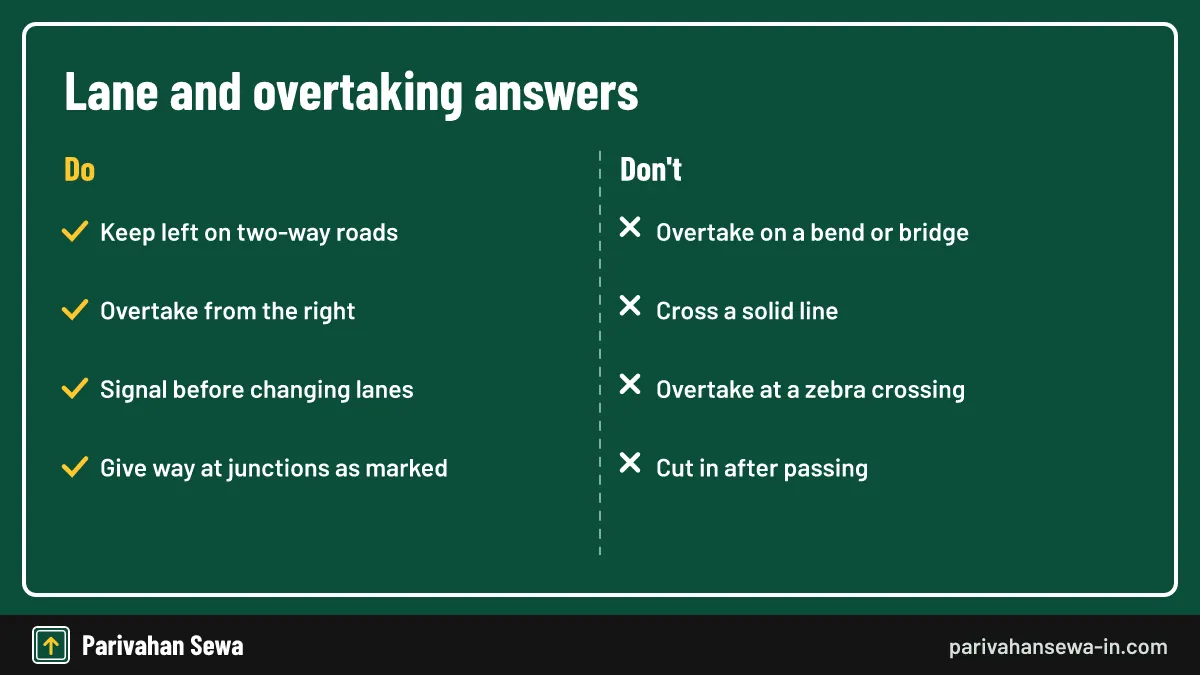
Q19. From which side should you overtake?
Answer: From the right. The one exception is a vehicle ahead that has signalled and moved to turn right; then you may pass on its left.
Q20. You see a solid white line in the centre of the road. Can you cross it to overtake?
Answer: No. A solid line means do not cross. A broken line allows lane changes when it is safe.
Q21. Where must you never overtake?
(a) On a bend (b) On a bridge (c) At a pedestrian crossing (d) All of these. Answer: (d) All of these. Each place hides oncoming traffic or people on foot.
Q22. A vehicle is overtaking you. What should you do?
Answer: Keep left and do not speed up until it has passed. Speeding up while being overtaken is a common cause of head-on crashes.
Questions about traffic rules at signals and junctions
These questions about traffic rules focus on signals and junctions. They test whether you know what to do in the seconds when a light changes, which is where many side-impact crashes happen.
Q23. The signal turns amber as you approach. What should you do?
Answer: Stop behind the stop line if you can do so safely. Amber means the light is about to turn red; it is not a signal to speed up.
Q24. What does a flashing amber light mean?
Answer: Slow down and go with care. A flashing red, by contrast, means stop and go only when the road is clear.
Q25. The light is green but a pedestrian is still crossing. Who goes first?
Answer: The pedestrian. A green light lets you move only when the way ahead is clear. Read more on signals in our traffic signs for kids guide.
Q26. At an unmarked junction, who has priority?
Answer: Traffic on your right, unless signs or markings say otherwise. Slow down and look both ways before entering.
Road safety questions on helmets and seat belts
These road safety questions cover the two items that most decide whether a crash is survivable. They are also among the most commonly fined offences in Indian cities.
Q27. What makes a helmet legal for road use?
Answer: It must meet the BIS standard (it carries the ISI mark) and be fastened. An unbuckled helmet can fly off in a fall.
Q28. Do rear passengers in a car need seat belts?
(a) No (b) Only on highways (c) Yes, always (d) Only children. Answer: (c) Yes, always. Section 194B penalises driving or travelling without a safety belt.
Q29. A child aged three rides pillion. What must the child have?
Answer: A crash helmet and a safety harness attaching the child to the rider. The rider must not exceed 40 km/h under the 2022 rules for children aged 9 months to 4 years.
MCQ questions on road safety: speed and stopping distance
These MCQ questions on road safety cover speed. Speed decides both whether you can stop in time and how hard the impact is if you cannot. Limits differ by road and vehicle, so read the signs.
Q30. Who fixes the speed limit on a road?
Answer: The central and state governments, under section 112. States and local authorities can set lower limits for safety or road conditions.
Q31. What happens to stopping distance when speed doubles?
(a) It halves (b) It stays the same (c) It roughly doubles (d) It grows much more than double. Answer: (d). Braking distance grows with the square of speed, so it rises far faster than speed itself.
Q32. How much gap should you keep from the vehicle ahead in dry weather?
Answer: At least a two- to three-second gap. Pick a fixed point, count the seconds after the vehicle ahead passes it, and double the gap in rain.
Q33. In heavy rain, what should you do first?
Answer: Slow down and switch on dipped headlights. Wet roads lengthen stopping distance and reduce how well others can see you.
Road safety question and answer on drink driving
This road safety question and answer round covers alcohol and drugs. Even a small amount of alcohol slows reaction time, which is why the Indian limit is low. For the science behind the limit, see our drink drive limit guide.
Q34. What is the legal blood alcohol limit for drivers in India?
Answer: 30 mg per 100 ml of blood. More than that, found by a breath analyser or another test, is an offence under section 185.
Q35. Does section 185 cover drugs as well as alcohol?
Answer: Yes. Driving under the influence of a drug to the point where you cannot control the vehicle is also an offence.
Q36. What can happen if you refuse a breath test?
Answer: The refusal may be presumed to support the prosecution’s case under section 205, unless you show a reasonable cause.
Road safety question answer on phones and distraction
This road safety question answer round is about distraction. Looking at a phone for two seconds at city speed means travelling many metres without watching the road. Hands-free calls still take your attention away.
Q37. Is using a handheld phone while driving allowed?
Answer: No. The 2019 amendment lists using handheld communication devices as an example of dangerous driving under section 184.
Q38. What is the safest way to use navigation?
Answer: Set the route before you start and mount the phone where you can glance at it without holding it.
Q39. Which of these is a distraction?
(a) Eating (b) Adjusting the music (c) Reading a message (d) All of these. Answer: (d). Anything that takes your eyes, hands or mind off driving counts.
Which road safety questions cover pedestrians and cyclists?
People on foot and on cycles have no protection in a crash, so quizzes always include a round for them. These questions suit school students as well as adults who walk to work.
Q40. Which way should you look before crossing in India?
Answer: Right, then left, then right again. Traffic on the near side comes from the right because vehicles keep left.
Q41. Where should you walk when there is no footpath?
Answer: On the right edge of the road, facing oncoming traffic, so you can see vehicles coming towards you.
Q42. What should a cyclist use at night?
Answer: A front light, a rear red reflector or light, and light-coloured clothing. Being seen is the cyclist’s main protection after dark.
Road safety quiz question on children and school trips
This road safety quiz question round suits primary classes. Keep the language simple and use a picture card for each question if the children are young. For a sign-by-sign lesson plan, see our page on traffic signs for children.
Q43. Where should a child stand while waiting for the school bus?
Answer: On the footpath, well back from the kerb, and wait until the bus has stopped fully before moving.
Q44. A ball rolls onto the road. What should a child do?
Answer: Stop, and ask an adult to fetch it. Never run onto the road after a ball or a pet.
Q45. Can a child under 14 travel in a car without a belt?
Answer: No. Section 194B also penalises carrying a child under 14 who is not secured by a belt or child restraint.
What should you do after a crash? Emergency questions
These questions test the duties that start the moment a crash happens. The first hour after a serious injury, which the 2019 amendment defines as the golden hour, is when quick help most often saves a life.
Q46. What is the first thing to do at a crash scene?
Answer: Make the scene safe and call 112. Switch on hazard lights, warn other traffic and do not move the injured unless there is a fire or other danger.
Q47. What must a driver involved in an accident do?
Answer: Get medical help for the injured and report to the police within 24 hours if no officer is present (section 134).
Q48. Will a bystander who takes a victim to hospital face police questioning?
Answer: No. Section 134A and the Good Samaritan guidelines, given force of law by the Supreme Court in 2016, protect helpers, and they need not give their identity.
Which fines appear in a road safety quiz?
Fine questions show up in many quizzes, especially for adults and new drivers. The answers below are the central amounts in the Motor Vehicles (Amendment) Act 2019. States may notify their own compounding amounts, and your e-challan shows the figure that applies. For every offence, see our traffic fines list.

| Quiz question: the fine for… | Section | Central answer |
|---|---|---|
| Riding without a helmet | 194D | ₹1,000 and 3-month licence disqualification |
| Driving without a seat belt | 194B | ₹1,000 |
| Carrying more than one pillion | 194C | ₹1,000 and 3-month licence disqualification |
| Driving without a licence | 181 | Up to ₹5,000 |
| Drunk driving, first offence | 185 | Up to ₹10,000 and/or 6 months jail |
| Not giving way to an ambulance | 194E | ₹10,000 |
| An offence by a juvenile | 199A | ₹25,000 for the guardian or owner |
Q49. Can fines rise each year without a new law?
Answer: Yes. Section 210A lets fines be increased by up to 10 percent every year.
Q50. Who pays when a minor causes a road offence?
Answer: The guardian or the vehicle owner, who faces a fine and possible jail, and the vehicle’s registration can be cancelled for 12 months.
What is a road safety exam?
A road safety exam is any formal test of road knowledge with a mark or result. Schools hold written ones during road safety week, some states hold them for drivers of school vans, and the learner licence test is the legal version every new driver takes.
Written exams in schools
School exams mix multiple-choice questions with short answers such as “write two rules for pedestrians”. Marks matter less than the habit of recalling rules under time pressure.
How is a road safety exam different from the learner licence test?
A school or office road safety exam has no legal effect, while the learner test decides whether you get a learner licence. Both test the same rules, so practice for one helps with the other. Full details are in our guide to learning license test questions.

| Point | School or office exam | Learner licence test |
|---|---|---|
| Who runs it | School, college or employer | State transport department on Sarathi |
| Number of questions | Set by the organiser | 15 multiple-choice questions in most states |
| Pass mark | Set by the organiser | 9 correct answers (60 percent) |
| Time per question | Usually untimed | About 30 seconds on screen |
| Result | Certificate or prize | Learner licence |
Road safety quiz questions and answers PDF: how do you make one?
People search for road safety quiz questions and answers PDF files to print for class or share in a group. The simplest way is to save this page from your browser, but a tailored sheet works better for a set audience.
Saving this page as a PDF
Open the browser menu, choose Print, then choose “Save as PDF” as the printer. Untick headers and footers for a cleaner sheet. Keep the date at the top so readers know when the rules were checked.
Building a custom sheet
Copy the rounds you need into a document, number the questions from one, and move all answers to the last page. That stops students from reading the answer before trying.
What should road safety questions and answers PDF files include?
Good road safety questions and answers PDF handouts are short, mixed and accurate. Aim for 20 to 30 questions on four or five topics, with an answer key on a separate page and a source line for every fine.
A balanced mix
Include signs, lanes, protection (helmets and belts), speed, alcohol, pedestrians and emergencies. Leave out trick questions; they test reading tricks, not road sense.
Road signs test online: where can you practise?
A road signs test online lets you practise with instant marking. The only official test is the learner licence test on the Sarathi portal of Parivahan; every other website or app is unofficial practice. The sign rounds on this page work as a free practice set.
Official practice and study material
Sarathi shows a road safety tutorial before the online learner test in states that run it from home. Some state transport departments also publish study material and practice tests, such as Kerala’s MVD Leads app.
Online driving sign test: what should you expect?
An online driving sign test shows a sign image and asks you to pick its meaning from four options. On the Sarathi learner test you get about 30 seconds per question, so fast recognition matters more than long thought.
On-screen format
Each screen shows one question. You choose an answer and move on; the result appears at the end. In tests taken from home, a face check against your Aadhaar photo comes first.
Common traps
Signs that look alike catch people out: no entry and one way, no parking and no stopping, give way and a warning triangle. Practise these pairs together.
Sign practice: how do you memorise road signs fast?
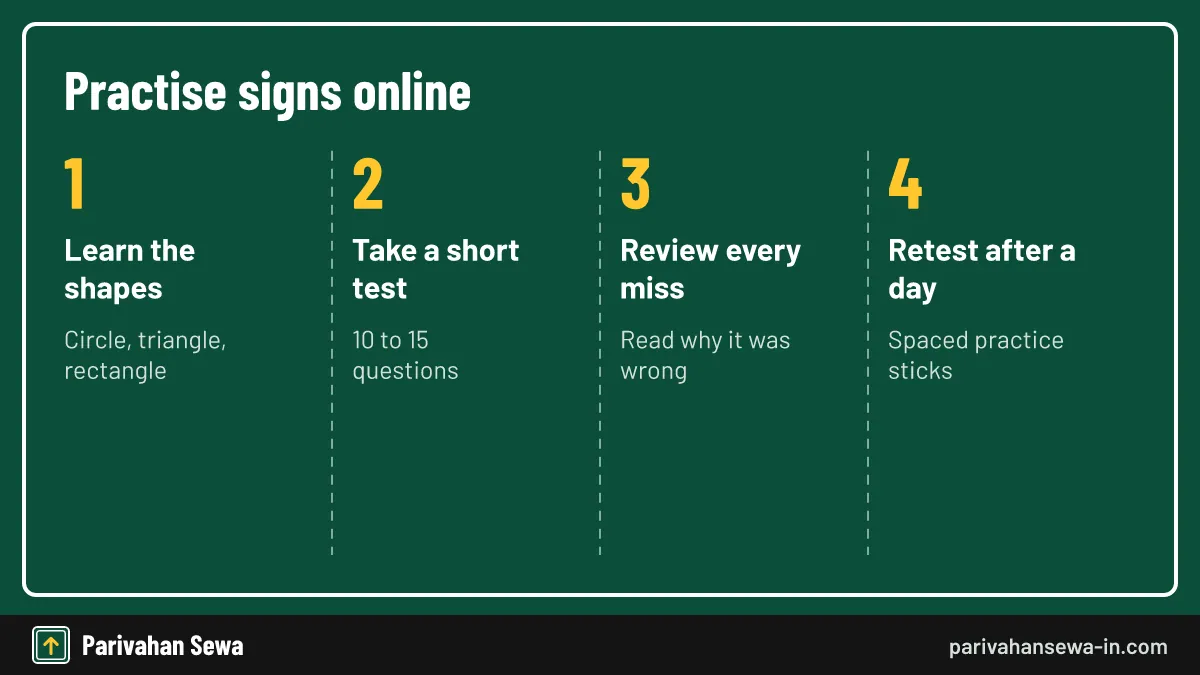
Good sign practice relies on short, repeated sessions rather than one long one. Group signs by shape, say each meaning aloud, and test yourself the next day on the ones you missed.

Group by family
Learn all the warning triangles in one session and all the blue compulsory circles in the next. Your brain stores them as a family, which makes recall faster.
Use real roads
On your daily trip, name each sign you pass. A sign you have seen in place is easier to remember than one on a chart.
Traffic signs test online or a paper quiz: which works better?
A traffic signs test online gives instant feedback and copies the real learner test. A paper quiz suits a classroom, needs no devices and makes group discussion easy. Most learners benefit from both.
| Point | Online test | Paper quiz |
|---|---|---|
| Feedback | Instant | After marking |
| Matches learner test | Yes, on-screen and timed | No |
| Group discussion | Harder | Easy |
| Devices needed | Phone or computer | None |
| Best for | Self-study before the test | Classes and competitions |
How do you organise a road safety quiz in school?
To run a road safety quiz in school, pick teams, set four or five rounds, prepare a picture round for signs and keep the whole event under an hour. Invite a local traffic officer to present prizes and answer questions.
Rounds that work well
Use a sign round with pictures, a rules round, a true or false round, a “what would you do” round and a rapid-fire tie-breaker.
How should you score a quiz competition?
Keep scoring simple and visible. Give ten points for a correct answer on a team’s own question and five for a passed question answered by another team. Show the scores after every round so teams know where they stand.
Negative marking
Use negative marks only in a buzzer round, where guessing could otherwise win. In other rounds, negative marks just discourage quieter students.
What is a pamphlet on road safety?
A pamphlet on road safety is a small folded leaflet that gives a few key rules to one group of readers. Schools ask students to make one as a project, and traffic police hand them out at signals and fairs.
What makes it different from a poster
A poster carries one message seen from a distance. A pamphlet is read up close, so it can hold five or six rules with a short line on each.
How do you prepare a pamphlet on road safety?
To prepare a pamphlet on road safety, decide who will read it, pick five rules that matter most to them, write one short line per rule, add a simple drawing, check the facts and end with help numbers.
- Pick one reader. Decide who the pamphlet is for: school students, new riders, parents or delivery workers.
- Choose five rules. Pick the five rules that matter most for that reader and give each one its own panel.
- Write short lines. Use one instruction of under ten words per rule, starting with a verb.
- Add simple drawings. Draw a helmet, a seat belt, a zebra crossing or a signal head beside each rule.
- Check every fact. Compare fines and rules with the official Motor Vehicles Act text before printing.
- Finish with help numbers. Close with 112 and a line telling readers to help crash victims without fear.

What should a road safety pamphlet say?
A road safety pamphlet should say only what its reader needs to do. For students, that means crossing and helmets. For new drivers, belts, speed and phones. Keep each line to a single action.
Sample text for students
“Cross at the zebra. Look right, left, right. Hold a grown-up’s hand. Wear a helmet on the bike. Never play near the road. In an emergency, dial 112.”
Slogan on road safety with pictures: what makes one work?
A slogan on road safety with pictures works when the words and the image carry the same single idea. The slogan should be under eight words, rhyme or have a beat, and the picture should show the action, not the crash.
Writing the words
Start with a verb (“Belt up”, “Slow down”) and end with a reason or a twist. Read it aloud; if it is hard to say, it is hard to remember.
Choosing the picture
Show the safe action: a helmet buckle clicking, a family belted in. Pictures of crashes shock once, but readers look away from them.
Which slogans pair well with pictures?
The pairs below match one short slogan with one simple drawing. Use them on posters, school walls or placards. For ready image ideas, see our road safety pictures guide, and for Hindi lines see our road safety slogans in Hindi.

Ten slogan ideas
- Strap it, snap it, ride it.
- Belt up, every seat, every trip.
- Red means wait, not hurry.
- Phone down, eyes up.
- Zebra first, speed later.
- One pillion, one helmet each.
- Drink or drive: pick one.
- Dip your lights, save a life.
- Give way to the siren.
- Slow down near schools: small feet, quick steps.
What are road safety placards?
Road safety placards are boards carried on sticks during rallies, school marches and awareness drives. Each one shows a short slogan large enough to read from across a road, often with a sign or symbol beside it.
How do you make road safety placards for a rally?
To make road safety placards, cut a stiff board to about half a chart sheet, write a slogan of four to six words in thick capitals, add one sign symbol and fix it to a light stick. Make each placard carry a different message.
Materials
Use thick card or foam board, black and red markers, a ruler and tape. Avoid glitter and thin fonts; they cannot be read from a distance.
Safety during the rally
Walk on the footpath or a closed lane, never in moving traffic. Keep the sticks short and blunt, and ask for police permission if the march uses a public road.
Which quiz answers do people most often get wrong?
Some answers trip up adults as often as students. Most come from habits seen on the road rather than from the rules. Go through these before any test.

Overtaking from the left
Many people think passing on the left is fine in slow traffic. The rule is to overtake from the right, with one narrow exception for a vehicle turning right.
True or false: quick road safety questions
These true or false road safety questions test common myths. Answer each in a word, then read the reason.
Q51. A helmet is not needed for a short trip to the market. True or false?
False. The helmet rule applies on every public road, whatever the distance.
Q52. You may honk to ask pedestrians to clear a zebra crossing. True or false?
False. Pedestrians on a zebra crossing have priority; you must slow down and stop for them.
Q53. Copies of your documents in DigiLocker are valid if an officer asks for them. True or false?
True. Documents kept in DigiLocker or mParivahan are accepted as valid when shown to an officer.
Rapid-fire tie-breaker questions
Use these short questions to break a tie or end a session. Each has a one-word or one-number answer, so the quizmaster can move fast.
Q54. What colour is the stop line at a signal?
White in most places. The regulations allow white, black or yellow, at least 50 mm wide.
Q55. What is the maximum speed when towing another vehicle?
24 km/h, with a gap of no more than 5 metres between the two vehicles.
Q56. What must a learner display on the vehicle?
An L plate, the letter L in red on a white plate, at the front and rear.
Answer key: all quiz answers at a glance
Use this key to mark a printed sheet or check yourself quickly. Each row lists the round and the short answers in order.
| Round | Questions | Short answers |
|---|---|---|
| Warm-up | Q1 to Q4 | Left; 112; one pillion; both wear helmets |
| Sign shapes | Q5 to Q7 | Warning; octagon is unique; compulsory action |
| Mandatory signs | Q8 to Q11 | No horn; 50 km/h limit; give way; no entry |
| Warning signs | Q12 to Q15 | School; narrow bridge; level crossing; bends |
| Information signs | Q16 to Q18 | Hospital; fuel; information only |
| Lanes and overtaking | Q19 to Q22 | Right; no; all of these; keep left |
| Signals | Q23 to Q26 | Stop if safe; caution; pedestrian; traffic on right |
| Protection and speed | Q27 to Q33 | BIS helmet; yes; harness; governments; much more; 2 to 3 seconds; slow down |
| Alcohol and phones | Q34 to Q39 | 30 mg; yes; presumed against you; no; set route first; all |
| People on foot and children | Q40 to Q45 | Right-left-right; facing traffic; lights; footpath; ask an adult; no |
| Emergencies and fines | Q46 to Q50 | Call 112; report in 24 hours; protected; yes; guardian or owner |
| Myths and tie-breakers | Q51 to Q56 | False; false; true; white; 24 km/h; L plate |
Marking guide
One point per question gives a total of 56. A score above 45 shows a strong grasp of the rules; below 30 means a revision of the weaker rounds.
Where do the quiz answers come from?
Every answer follows Indian law or the Indian sign code. The main sources are the Motor Vehicles Act 1988 as amended in 2019, the Central Motor Vehicles Rules, the Motor Vehicles (Driving) Regulations 2017 and the Indian Roads Congress code for road signs.
Checking state differences
States may set lower speed limits and their own compounding amounts. When a quiz is for one city, check the local traffic police site and the e-challan portal for local fine figures.
Why do road safety questions matter beyond the quiz?
Answering road safety questions correctly is only useful if it changes what people do on the road. A quiz is a starting point: it shows each person which rules they had forgotten and opens a conversation about why the rules exist.
From answers to habits
After a quiz, ask each participant to pick one rule they will follow more closely for a week. For simple daily advice, see our traffic safety tips.
Official links
Sarathi: learner licence servicessarathi.parivahan.gov.in ↗Parivahan Sewaparivahan.gov.in ↗Ministry of Road Transport and Highwaysmorth.nic.in ↗Motor Vehicles Act on India Codeindiacode.nic.in ↗Road safety quiz questions
What is a road safety quiz?
A set of questions on traffic rules, road signs and safe behaviour, used in schools, offices, driving schools and online practice, with answers that explain the rule behind each one.
How many questions should a road safety quiz have?
For a class or office session, 20 to 30 questions in four or five rounds works well. For learner test practice, copy the real format: 15 questions at a time.
What is the pass mark in the learner licence test?
The Sarathi computer test asks 15 multiple-choice questions and you need at least 9 correct answers, which is 60 percent. Some states, such as Kerala, use a longer format.
What is the legal alcohol limit for drivers?
More than 30 mg of alcohol per 100 ml of blood, detected by a breath analyser or another test, is an offence under section 185 of the Motor Vehicles Act.
What does a red octagon sign mean?
Stop. Come to a full stop at the line, look both ways and go only when the road is clear.
Is a seat belt needed in the back seat?
Yes. The penalty in section 194B applies to people driving or travelling without a safety belt, so rear passengers must belt up too.
Can I get into trouble for helping a crash victim?
No. Section 134A and the Good Samaritan guidelines protect people who help accident victims in good faith from civil and criminal action.
Where can I get road safety quiz questions and answers in PDF?
Save this page as a PDF from your browser's print menu, or copy the rounds you need into a document. State transport departments also publish learner study material.
How do I make a pamphlet on road safety?
Choose one reader, pick five rules, write one short line per rule, add a simple drawing to each, check the facts and end with the 112 emergency number.
Is there an official online road signs test?
The official test is the learner licence test on the Sarathi portal of Parivahan. Practice tests on other websites and apps are unofficial, so use them only for revision.
Parivahan Sewa (parivahansewa-in.com) is an independent information website and is not affiliated with MoRTH, Parivahan or any state transport department. Confirm fees and rules on the official portal before you pay or apply.