Railway signs explained: what Indian track boards and signals mean
Railway signs in India fall into two groups. Lineside boards and signals, such as yellow speed boards, T termination boards, W/L whistle boards and red, yellow and green signal lamps, guide the loco pilot. Road signs before a level crossing guide drivers and walkers. Crews must obey the first group; road users must stop, look and wait at the second.
Key takeaways
- Most railway signs beside the track are written for the train crew, not for road users.
- A yellow triangle with a number is a speed board; a yellow circle with T ends the limit.
- W/L means the driver must whistle for a level crossing, usually about 250 m before an unmanned one.
- On colour light signals, red means stop, one yellow caution, two yellows attention and green clear.
- On a road, a railway track sign means slow down, stop short of the rails and never stop on the track.
On this page · 13 sections
What are railway signs?
Railway signs are the fixed boards, markers and signals that keep trains running safely. Most stand beside the track and speak to the loco pilot: how fast to go, when to whistle, where work is going on. A smaller set stands on roads before a level crossing and speaks to drivers and people on foot.
Two audiences, two rulebooks
Track boards and signals follow the railway’s own operating rules. Road warnings before a crossing follow the Indian Roads Congress code used for all traffic signs. The same place can carry both, which is why a crossing may have yellow railway boards on one side and red triangles on the road.
Indian railway sign boards: which boards stand beside the track?
Indian railway sign boards cover speed, caution, whistling, stopping and position. The table below lists the ones a passenger is most likely to notice from a window or a platform end.

| Board | What it looks like | Meaning for the crew |
|---|---|---|
| Speed board | Yellow triangle with a black number | Speed limit in km/h from here |
| Rajdhani or Shatabdi board | Blue board with a white number | Special limit for those trains |
| Termination (T) | Yellow circle marked T | The speed limit ends |
| W/L | Yellow square marked W/L | Whistle for a level crossing |
| S | Yellow circle marked S | Siding points: slow to 50 km/h or less |
| C and P | Yellow diamond or hexagon | Coast (cut power) or apply power |
| Stop warning board | Black disc on a white board | A halt or flag station is ahead |
Shunting and block limit boards
A shunting limit (S/L) board, yellow with a black cross, shows how far shunting may go. A Block Section Limit (BSL) board, with crossed diagonal stripes, marks the end of station limits.
What do speed and termination boards tell a loco pilot?
A yellow triangular speed board gives the limit in km/h, sometimes with a note such as “Rajdhani only”. The restriction lasts until a yellow circular T board. Variants such as T/P (passenger), T/G (goods), T/EMU and T/L (local) end the limit only for that class of train.
Why a board needs a partner
The speed board alone does not say how long the slow stretch is. The driver keeps the limit until the rear of the train passes the matching T board.
Speed indicators near work sites
A rectangular board with white and black bands and a km/h figure stands about 100 m before a defect or work site. It confirms the slower speed close to the spot.
Which caution and stop boards protect track work?
When engineers work on the line, a caution indicator comes first: a reflective yellow arrow board about 700 m before the speed board and 800 m before the work. The arrow points to the affected track. A red-and-white banded stop indicator, lit by two red lamps at night, means the train must stop dead.
Small round caution boards
White circular CP and CG boards show a caution for passenger and goods trains respectively. A P board warns of a vulnerable point on the track, and an E board ends that stretch.
Hill and tunnel warnings
A V board warns of possible landslides or falling rocks, common near tunnels. An R board marks a refuge point where track workers can step aside safely.
What do whistle boards like W and W/L mean?
A square yellow W board is a general whistle indicator. The W/L version means “whistle for level crossing” and is usually placed about 250 m before an unmanned crossing; its Hindi version reads “seetee bajao - phatak”. A W/B board, less common, asks for a whistle before a bridge.
The L board
A black L on a square yellow board tells the crew a level crossing is coming up, even where no whistle is needed.
What a road user should take from it
If you live near a crossing, a W/L board explains the horn you hear.
Railway signals and signs: how do colour light aspects work?
Railway signals and signs work together: boards give fixed information, while signals change with the state of the line. A colour light signal shows red for “on” (stop), one yellow for caution, two yellows for attention in four-aspect areas, and green for clear. The driver plans braking around these aspects.

| Aspect | Name | What the driver does |
|---|---|---|
| Red | On | Stop at the signal |
| One yellow | Caution | Be ready to stop at the next signal |
| Two yellows | Attention | Next signal may show caution |
| Green | Clear | Proceed at permitted speed |
Stop signals in automatic territory
Where an A marker sits below a signal, it is an automatic stop signal. After halting, a train may pass it at red, usually after 1 minute by day and 2 minutes by night, and then move with care.
Route indicators
A row of white lights at an angle, called a feather, sits above a home signal before points. It shows which line the train is being routed onto.
What do semaphore arms and signal markers mean?
On semaphore signals, the arm’s angle gives the order. In the lower-quadrant style a horizontal arm means “on” and an arm lowered about 60 degrees or more means clear. In the upper-quadrant style, horizontal is on, about 45 degrees is caution and straight up is clear. Lamps give the same aspects at night.
Markers on the post
Small plates name the signal type: P for a distant signal, G (black on yellow) for a gate signal, IB for an intermediate block signal, C for calling-on and R for a repeater.
A cross on the signal
An X on a semaphore arm, or a white X over a colour light bracket, means the signal is out of use and need not be obeyed.
What is the railway track symbol on maps and keyboards?
The railway track symbol means different things in different places. On a road, it is the warning sign for a level crossing. On a map, railway lines have their own line style, and Indian topographic sheets often separate lines by gauge, so always read the map’s legend. On phones, the railway track emoji 🛤 arrived with Unicode 7.0 in 2014.
Gauges a map may show
Indian Railways uses broad gauge (1,676 mm), metre gauge (1,000 mm) and narrow gauges of 762 mm and 610 mm. Maps that split lines by gauge reflect these widths.
Railway track sign on Indian roads: what should drivers do?
A railway track sign on a road warns that a level crossing is ahead. Slow down at the first board, stop short of the gate or rails, look and listen both ways, and cross in one go. Our guide to the railway crossing sign covers guarded and unguarded symbols in detail.

- Slow early. Ease off as soon as the first warning board for the crossing comes into view.
- Stop short. Halt behind the gate, barrier or stop line, well clear of the rails.
- Look and listen. Check both directions for a train and listen for a horn before moving.
- Cross in one go. Drive over in a low gear, without changing gear or stopping on the rails.
The legal duty at an unmanned crossing
Section 131 of the Motor Vehicles Act asks the driver to stop and have someone check for a train before crossing an unguarded crossing. See the wider traffic signs list for how this warning fits with other boards.
Fines that can follow
Rushing a crossing can be booked under general road offences. The e-challan guide explains how to check and pay any notice.
Which electric traction signs warn a loco pilot?
On electrified routes, signs on the overhead equipment (OHE) masts matter. A diamond with 500 m or 250 m marks a neutral section where power must be cut. A cross with a broken bar means open the main circuit breaker; a plain broken bar means close it again. Three bars with the middle one offset tell the driver to lower or raise the pantograph.
End of wiring
A board reading “Electric engines STOP here” marks where the overhead wire ends.
Power block boards
Black text on a white board tells the crew the wire ahead is not energised. Even so, the public should treat every overhead wire as live.
What do gradient, kilometre and curve markers show?
These small markers help crews and engineers know exactly where they are. A grade indicator slab with a number such as 500 means a slope of 1 in 500. Kilometre markers are black on white, and pole codes such as 32/4 mean the fourth mast after kilometre 32.
Curve boards
Small white boards at each end of a curve give its number, radius and superelevation, the tilt built into the track.
What do train horn codes signal?
Horn codes are sound signals, not boards, but they pair with whistle boards. One long blast is a normal departure. A very long continuous blast is used when approaching a level crossing or tunnel or running through a station. A rapid series of short blasts signals danger.
Codes for the guard
Short combinations call the guard, ask for brakes to be applied or released, or report that the train cannot move. Many older codes are no longer used.
Indian railway signs and symbols: why should people on foot heed them?
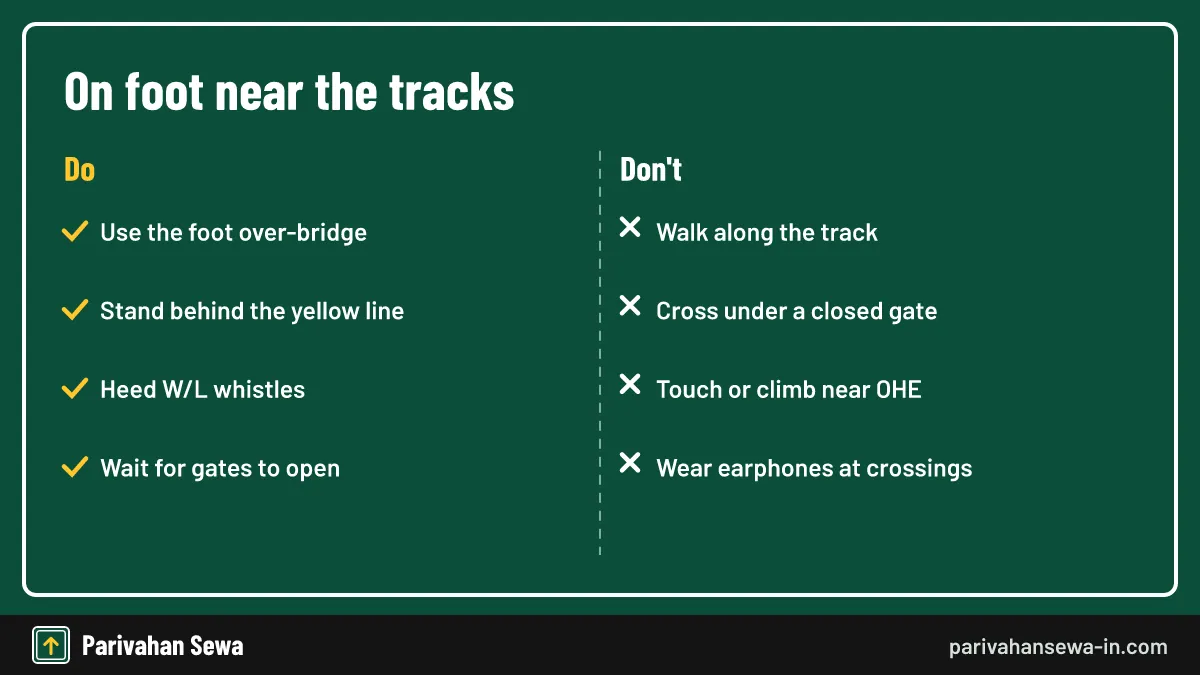
Indian railway signs and symbols are mostly for crews, but they tell walkers a lot. A W/L board means trains will not slow for the crossing, a neutral section board means live wires overhead, and a closed gate means a train is close. Crossing tracks on foot away from a bridge or crossing is unsafe and is treated as trespass.
On the platform
Stay behind the yellow line, use the foot over-bridge and never jump down to cross between platforms.
Near a level crossing
Never duck under a closed gate. Keep earphones out so you can hear the horn, and wait until the gates are fully open before stepping across.
Official links
Indian Railwaysindianrailways.gov.in ↗Ministry of Road Transport and Highwaysmorth.nic.in ↗Indian Roads Congressirc.nic.in (road sign code IRC:67) ↗Parivahan Sewaparivahan.gov.in ↗Railway signs questions
What are railway signs?
They are the boards, markers and signals placed along railway lines and at level crossings. Lineside boards and signals instruct the train crew, while road signs before a crossing warn drivers and pedestrians.
What does W/L mean on Indian Railways?
A yellow square board marked W/L tells the loco pilot to whistle because a level crossing is ahead. It is usually placed about 250 m before an unmanned crossing.
What does the T board on a railway line mean?
A yellow circular board with T marks the end of a speed restriction. Variants such as T/P and T/G apply only to passenger or goods trains.
What do two yellow lights mean on a railway signal?
Two yellow lamps show the attention aspect in four-aspect signalling. It warns the driver that the next signal may show caution, so speed should be controlled.
What is the railway track symbol?
It depends on where you see it. On a road it is a warning sign for a level crossing; on a map it is the line style shown in the legend; on phones it is the railway track emoji, added in Unicode 7.0.
Can road users ignore railway lineside boards?
The lineside boards are meant for the crew, but they still tell you a train may come. A W/L board near a crossing, for example, means trains will sound the horn there.
Parivahan Sewa (parivahansewa-in.com) is an independent information website and is not affiliated with MoRTH, Parivahan or any state transport department. Confirm fees and rules on the official portal before you pay or apply.