Traffic light: how the signal system keeps junctions moving
A traffic light is an electric signal that shares a junction between road users by showing red, amber and green lamps in a fixed order, with red always on top. A controller switches the lamps on a timer or from sensors. In India, section 119 of the Motor Vehicles Act makes obeying the signal a legal duty for every driver.
Key takeaways
- The lamp order never changes: red on top, amber in the middle, green at the bottom.
- A controller runs the lamps on a fixed timer, from detectors or through an adaptive city system.
- The brief all-red moment between phases is deliberate: it lets the junction clear.
- Obeying the signal is a legal duty under section 119 of the Motor Vehicles Act, and an officer's directions come first.
- Crossing on red is usually booked as dangerous driving; cameras at many junctions create the e-challan.
- A dark or stuck signal should be reported to the city traffic police with the exact junction name.
On this page · 38 sections
What is a traffic light?
A traffic light is a powered signal that takes turns giving each road at a junction the right to move. It does this with three coloured lamps, red, amber and green, lit one at a time in a fixed order.
A signal, not a sign
A road sign gives the same message all day. A signal changes its message every few seconds, so it can share one patch of road between several streams of traffic. That ability to switch is what makes it the main tool at crowded city junctions.
Other names you will hear
People call it a traffic signal, a signal light, a stop light or simply “the signal”. In Hindi conversation it is often “laal batti”. All of these describe the same equipment and carry the same legal weight on Indian roads.
How does a traffic light system control a junction?
A traffic light system has three working parts: signal heads that road users see, a controller that decides which lamps are lit, and a timing plan stored in that controller. Detectors or cameras may feed it live information. Together they divide each minute of junction time between competing roads.
The controller decides, the lamps obey
The lamps themselves have no intelligence. The controller cabinet beside the road sends power to the right lamp at the right moment, checks that two conflicting greens are never shown together, and switches to a safe mode if something fails.
Plans change with the clock
Most controllers hold more than one timing plan. A junction may run a long cycle at the morning peak, a shorter one at midday and flashing amber late at night. The switch between plans happens automatically from an internal clock or a central computer.
What is the traffic signal light colour order?
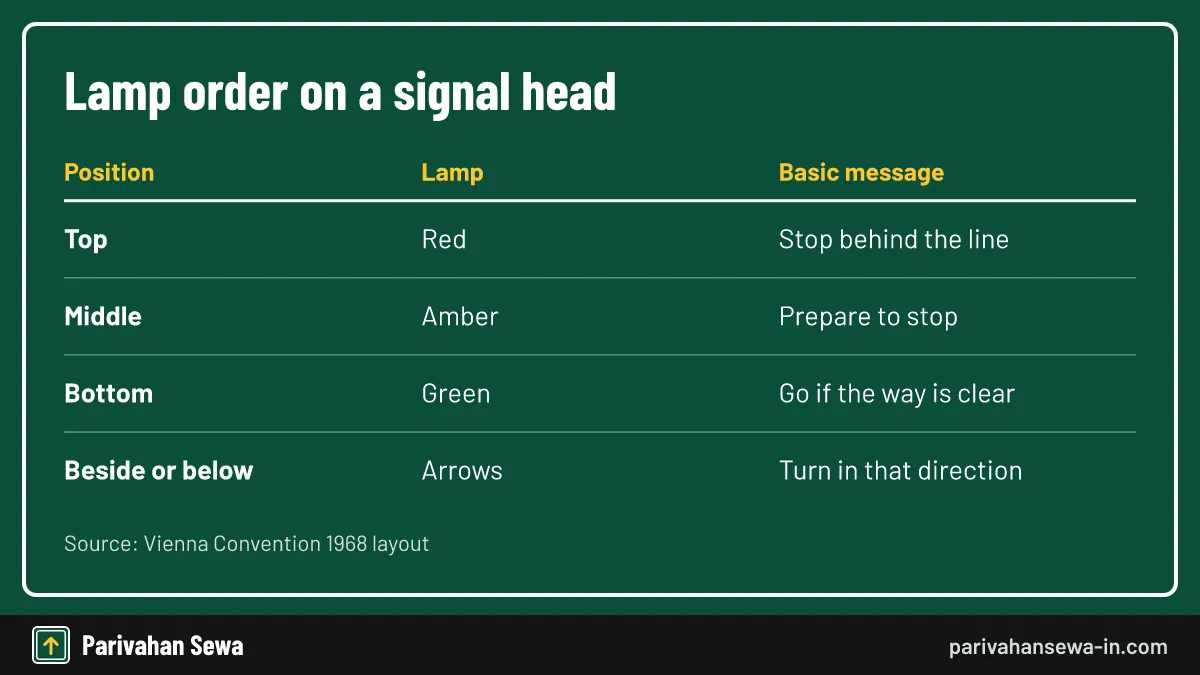
The traffic signal light colour order is the same on every standard head: red at the top, amber in the middle and green at the bottom. On the rare horizontal head, red sits on the side nearest the centre of the road. This layout follows the 1968 Vienna Convention pattern used by most countries.
Arrows and extra lamps
Some heads carry extra aspects beside or below the main three, usually green arrows for a turning movement. They do not change the order of the main lamps; they only add permission for one direction.
Why the order matters for safety
Because the order never changes, a driver can tell which lamp is lit from its position alone, even through glare, fog or a dirty lens. That second cue is a quiet safety feature built into every signal head.
Why were red, amber and green chosen?
Red, amber and green were taken from railway signalling, where red already meant danger and green meant the line was clear. When road signals arrived in the nineteenth century, engineers reused colours that train crews and the public already understood. Amber was added later as a warning in between.
Red carries the furthest
Red light is easy to notice and is strongly linked with danger in most cultures. Placing the most important order in the most attention-grabbing colour was a practical choice, not a design flourish.
Amber as the middle step
Early road signals jumped straight from stop to go, which caught drivers unprepared. A caution colour gave people a moment to react, and amber was distinct enough from both red and green to avoid confusion.
Why is the red lamp always on top?
Red sits on top so that the most important lamp is the least likely to be hidden. A tall truck or bus in front can block the lower part of a signal head, but the top lamp usually stays in view. It also gives every signal in the world the same predictable layout.
Help for colour-blind drivers
Some people find red and green hard to tell apart. With a fixed order, they read the signal by which lamp is glowing rather than by its colour, so top always means stop and bottom always means go.
Consistency across states
Whether you drive in Kerala, Punjab or Assam, the head looks the same. A rider from another state, or a visitor from abroad, does not need to relearn anything at the first junction.
What does each lamp ask you to do?
In short: red means stop behind the stop line, amber means prepare to stop, and green means you may go if the way ahead is clear. Arrows add a permitted direction. The finer points of each colour, including exam-style answers, are covered in our traffic light meaning guide.
Green is permission, not an order
A green lamp lets you proceed, but you still have to check that people are not crossing and that the exit road has space. Entering a junction you cannot clear blocks it for everyone else.
The amber question
Amber causes more arguments than any other lamp. For a detailed look at when you must stop and when you may continue, see our page on yellow traffic light meaning.
What does a flashing amber lamp ask drivers to do?
A flashing amber lamp means proceed with caution. The controller is not allocating green to anyone, so you must slow down, look in every direction and give way to vehicles and people already in the junction. It is common at night, at quiet junctions and during faults.
When signals switch to flashing
Many city signals are programmed to flash amber after midnight when traffic is light. A controller may also drop into flashing mode on its own if it detects a fault, as a safe fallback.
Flashing amber arrows
Where a flashing amber arrow is used, you may turn in that direction, but only after giving way to traffic and pedestrians who have priority. Treat it like a give-way instruction pointing one way.
Arrow lamps and filter signals: when can you turn?
A green arrow, often called a filter signal, lets traffic turn in the arrow’s direction while other movements are held. If the arrow is not lit, the main lamp controls your turn as well. A turn is never allowed simply because the lane looks free.
Reading a head with arrows
Look at the lamp for your lane, not the one beside it. A green arrow pointing left with a red main lamp means only left-turning traffic may move; straight-ahead traffic must still wait.
Arrows still need care
Pedestrians sometimes cross during a filter phase if their own signal is poorly timed. Even with a green arrow, slow down at the corner and be ready to stop for anyone on the crossing.
How do walking figures and countdown timers help people on foot?
Pedestrian signals show a red standing figure for wait and a green walking figure for cross. At some Indian junctions a countdown display beside them shows how many seconds remain, which helps people decide whether there is time to start crossing. Some heads also beep for visually impaired users.
What a countdown changes
Studies of pedestrian countdowns found they tend to improve compliance, although results are mixed. People are less likely to start crossing late when they can see the number.
Who invented the traffic light?
The first road signal was designed by railway engineer John Peake Knight and put up outside the Houses of Parliament in London in December 1868. It used semaphore arms by day and red and green lamps at night, worked by a police constable. It exploded on 2 January 1869 and was removed.
Why the first one failed
The explosion ended the experiment after only a few weeks. Road signals then largely disappeared from streets for several decades, until electric lamps and reliable switching made a safer, unattended version possible.
Garrett Morgan’s contribution
In 1923 American inventor Garrett Morgan patented a manually operated three-way signal with moving arms. It was one of several competing designs of the period that tried to give drivers clearer warning before the right of way changed.
When did the first electric signal appear?
Lester Wire, a policeman in Salt Lake City, built an electric signal in 1912. In August 1914 the American Traffic Signal Company installed an electric signal at East 105th Street and Euclid Avenue in Cleveland, Ohio, which is often described as the first electric installation in regular use.
Detroit adds the third colour
In 1920 William Potts, superintendent of signals for the Detroit police, created the first four-way, three-colour light with an amber caution aspect. By 1921 automatic versions stood in 15 towers across Detroit.
Traffic light history: a short timeline
The traffic light took about a century to reach the form you see at an Indian junction. The milestones below show how gas lamps became electric, how amber arrived and when computers began to run signals. Each step solved a safety or capacity problem the previous design could not.

| Year | Milestone | Where |
|---|---|---|
| 1868 | First road signal with red and green lamps | London |
| 1912 | Electric signal built by Lester Wire | Salt Lake City |
| 1914 | Electric signal installed at a public junction | Cleveland |
| 1920 | Four-way, three-colour light with amber | Detroit |
| 1923 | Morgan’s three-way signal patent | United States |
| 1952 | Computerised signal control | Denver |
| 1967 | Computer control with vehicle detection | Toronto |
What changed after 1967
Once computers could read detectors, signals stopped being simple timers. The same idea, greatly improved, sits behind the adaptive systems that Indian smart-city projects now install.
The LED era
The most visible recent change is the lamp itself. Bright LED arrays have largely replaced filament bulbs, a shift covered in its own section further down this page.
What are the parts of a signal head?
A signal head is the box that holds the lamps. It has a housing, one lens or LED array per aspect, a visor above each lamp to cut sun glare and often a black backplate that makes the lit lamp stand out against the sky. Arrow aspects and countdowns may be mounted beside it.

Primary and secondary heads
A junction usually has a primary head near the stop line and a secondary head on the far side of the junction. If a bus blocks one, the other is still visible. Overhead heads on cantilever arms serve wide roads.
Poles, arms and gantries
The pole also carries detectors, cameras, pedestrian push buttons and sometimes a speaker. Its height and position are chosen so that the head is visible from the stopping distance on that approach.
What does the controller cabinet do?
The controller cabinet is the metal box near the junction that runs everything. It stores the timing plans, switches power to each lamp, reads detectors and records faults. Its most important job is a safety check that prevents two conflicting directions from ever getting green together.
The conflict monitor
A separate circuit watches the lamp outputs. If it ever sees conflicting greens, or a red lamp that has failed, it forces the junction into flashing amber or all-dark mode rather than risk a crash.
Remote links
In cities with a central control room, the cabinet talks to a server over cable or mobile data. Engineers can change timings, see faults and switch plans without visiting the junction.
How do detectors sense waiting vehicles?
Detectors tell the controller that someone is waiting. The oldest type is an inductive loop cut into the road surface that senses the metal of a vehicle above it. Newer junctions use video cameras, radar or infrared units on the pole, which are easier to install and maintain.
Push buttons for pedestrians
A pedestrian push button is also a detector. Pressing it registers a demand so the controller includes the walking phase in the next cycle. At some junctions the phase runs every cycle anyway, so the button has no visible effect.
Why detection matters
Without detection, a signal gives green to an empty road and red to a queue. With it, the controller can skip unused phases and extend green while vehicles keep arriving, cutting wasted time.
Fixed-time, actuated or adaptive: which control is better?
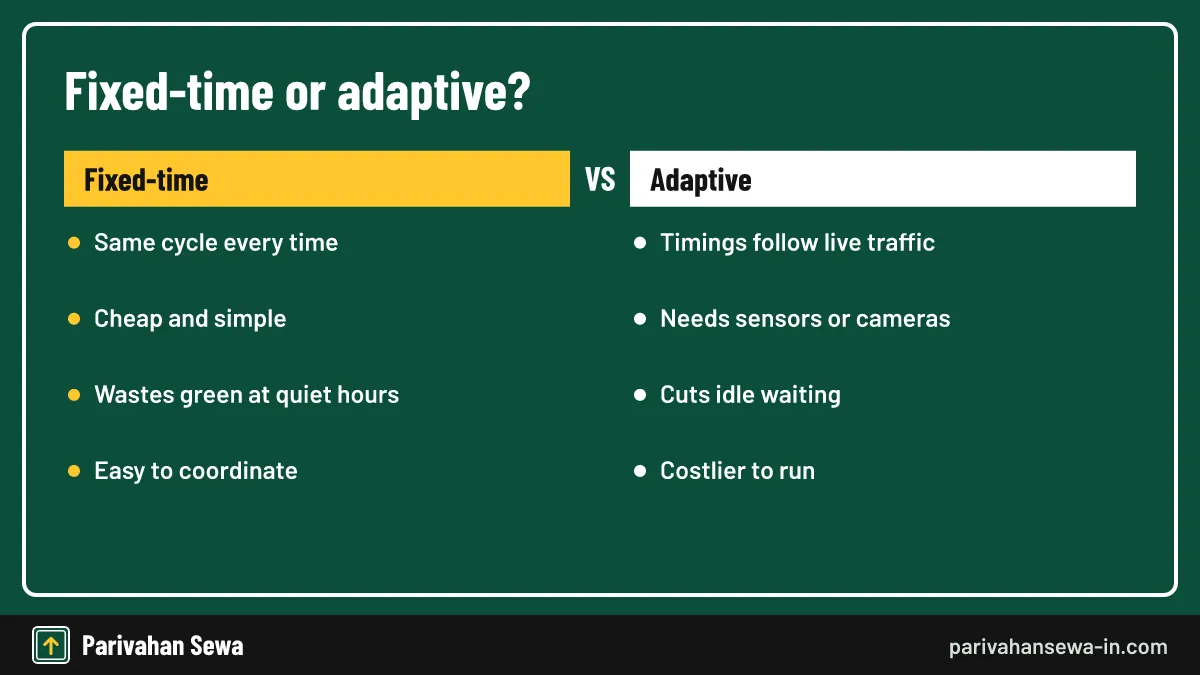
None is best everywhere. Fixed-time control is cheap and predictable, actuated control reacts to detectors at a single junction, and adaptive control retunes a whole network from live data. The right choice depends on how much traffic swings during the day and on the budget for maintenance.
| Control type | How timings are set | Best suited to | Main drawback |
|---|---|---|---|
| Fixed-time | Pre-set cycle that repeats | Steady traffic, linked corridors | Wastes green when demand changes |
| Semi-actuated | Main road green by default; side road on demand | Main road with a quiet side road | Side road can wait long |
| Fully actuated | Detectors on every approach | Isolated junctions with varying traffic | Harder to coordinate with neighbours |
| Adaptive | Live sensor data across many junctions | Busy city networks | Needs reliable sensors and upkeep |
Where fixed-time still wins
On a corridor where every junction must stay in step, fixed-time plans make coordination easy. They also keep working if a detector fails, which matters where maintenance is slow.
Where adaptive pays off
Junctions near markets, schools or offices see sharp peaks. Adaptive control can stretch green for the busy road at 9 am and give it back at noon without anyone reprogramming the cabinet.
What are a signal cycle, phase and stage?
A phase is the signal shown to one movement, such as traffic heading north. A stage is a group of phases that can run together without conflict. A cycle is one complete pass through every stage until the pattern repeats.

How long is a cycle?
It varies by junction and by time of day. Busier junctions tend to run longer cycles. For comparison, the United Kingdom caps cycles at 120 seconds, or 90 seconds where pedestrian facilities exist; Indian cities set their own plans.
Why long cycles frustrate
A long cycle can move more vehicles per hour, but each person waits longer at red. Pedestrians especially lose patience and start crossing against the signal, so planners balance capacity against waiting time.
Why is there an all-red interval between phases?
The all-red interval is a short period when every approach sees red. It gives vehicles that entered on amber time to leave the junction before cross traffic starts.
Part of the intergreen
The time from the end of one green to the start of the next is called the intergreen. It normally includes the amber period plus the all-red period, sized to the width of the junction.
The cost of all-red
During all-red nobody moves, so it is lost capacity. Engineers keep it as short as safety allows, which is why it is usually only a second or two at small junctions.
What is a green wave on a city corridor?
A green wave happens when neighbouring signals are timed so that a group of vehicles meets one green after another. Drivers who keep close to the design speed, often around 50 km/h in towns, can pass several junctions without stopping.
How signals are linked
Each controller starts its green a set number of seconds after the one before it, called the offset. The offset matches the time it takes to drive between the two junctions at the planned speed.
Why green waves break
Two-way roads, buses stopping, side-road traffic and pedestrian phases all disturb the pattern. Many corridors favour the peak direction in the morning and the opposite direction in the evening.
How do smart signal systems work in Indian cities?
Several Indian cities run intelligent traffic management projects that connect junction cameras and controllers to a central control room. Cameras count vehicles and detect violations, software adjusts timings, and the same network feeds the e-challan system. Details differ by city.
What the control room sees
Operators watch live feeds, see which junctions are congested and can push a new plan or hold a corridor green for an emergency convoy. Fault alarms arrive as soon as a lamp or controller fails.
Limits of smart signals
Adaptive software needs working cameras, clean lenses and reliable power. Where those are missing, junctions fall back to fixed plans or manual control, which is why results vary even within one city.
LED or bulb lamps: what changed in signal heads?
Most new signal heads use LED arrays instead of filament bulbs. LEDs use less power, give brighter light and last far longer, so crews replace them less often. Because each aspect is many small LEDs, one failure only dims the lamp rather than turning it off.
| Feature | Filament or halogen bulb | LED array |
|---|---|---|
| Power use | Higher | Lower |
| Brightness | Lower, fades as bulb ages | Higher, more even |
| Life before replacement | Short | Much longer |
| Failure mode | Whole lamp goes dark | Lamp dims as single LEDs fail |
| Cold-weather issue | Heat melts snow on lens | Low heat can let snow settle |
Why it matters on Indian roads
Lower power use makes battery or solar backup more practical, and brighter lamps are easier to see in harsh afternoon sun. The snow problem matters only in a few hill areas.
What happens to signals during a power cut?
When mains power fails, a signal without backup goes dark, and the junction must be treated with extra caution. Some junctions have battery or solar backup that keeps the lamps or at least flashing amber running. Traffic police may also deploy officers to manage the junction by hand.
What to do at a dark junction
Slow right down, look in all directions, give way to anyone already crossing and take turns with traffic from other roads. Follow any officer or warden on duty.
Why backup is not universal
Batteries need regular checks and replacement. On a city network with hundreds of junctions, backup is usually fitted first where traffic is heaviest or power cuts are most frequent.
How do signal cameras catch drivers crossing on red?
A violation camera is linked to the controller, so it knows when the lamp is red. If a vehicle crosses the stop line after that moment, the camera records images or video, reads the number plate and logs the time and junction. The record then becomes an e-challan against the registered owner.
What the evidence shows
A camera challan normally includes a photo of the vehicle beyond the line, the lamp state and a timestamp. You can view these details when you check the challan on the official e-challan portal.
Stop-line discipline
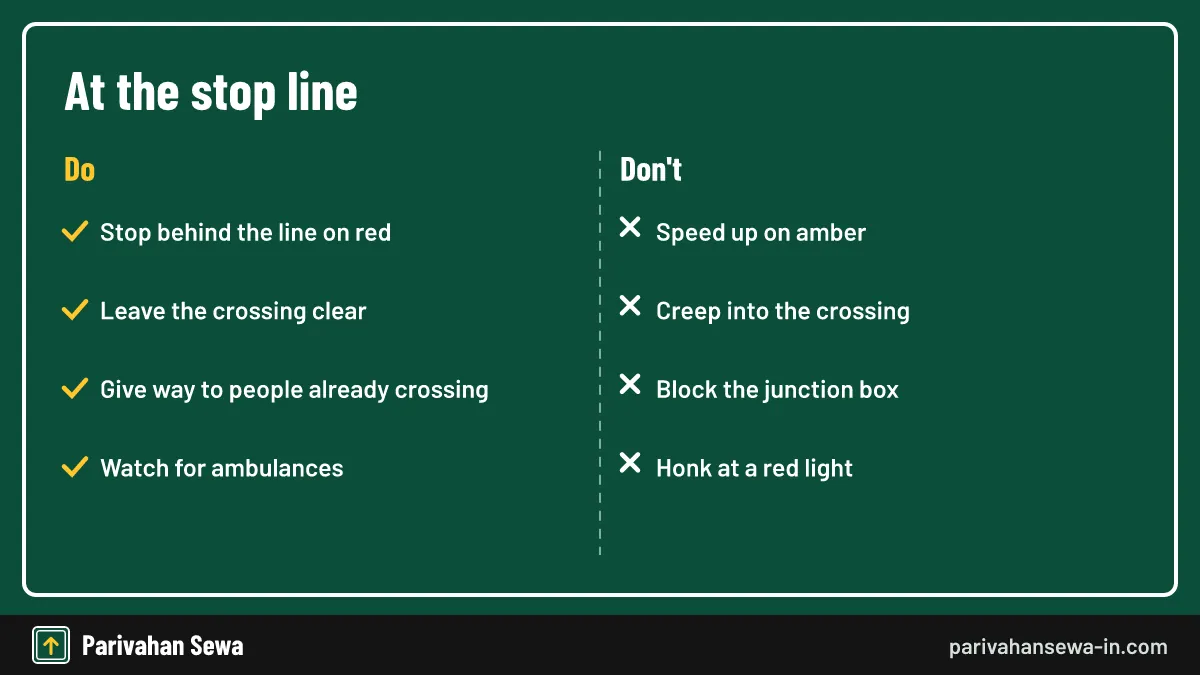
Cameras also flag vehicles stopped on the pedestrian crossing. Stopping a little behind the white line avoids both a challan and the risk of being pushed forward by the vehicle behind.
Is obeying a road safety signal light a legal duty?
Yes. Obeying a road safety signal light is a legal duty, not a courtesy. Section 119 of the Motor Vehicles Act, 1988 requires every driver to follow mandatory traffic signs, the central driving regulations and the directions of a police officer regulating traffic. The Motor Vehicles (Driving) Regulations, 2017 set out how drivers behave at junctions.
Signs and signals work together
A signal junction usually has painted stop lines, lane arrows and signboards as well. All of them are part of the same instruction. For the wider family of boards, shapes and colours, see our guide to traffic signs.
Who the duty covers
The duty applies to every driver and rider, including cyclists and drivers of commercial vehicles. Pedestrians are expected to use their own signals where they are provided.
Who has priority: a police officer or the lights?
A police officer’s directions come first. If an officer at a junction waves you on while your lamp is red, or holds you on green, follow the officer. This is written into section 119 and is common at peak hours, during VIP movements and when signals fail.
Recognising authorised control
Follow uniformed traffic police and authorised wardens. Be cautious of unofficial people waving traffic through; if unsure, slow down and follow the signal or the vehicle ahead with care.
After the officer leaves
Once the officer steps away, the signal is back in charge. Do not assume that a red lamp is still being ignored just because traffic was waved through a minute ago.
What is the penalty for crossing on red?
Crossing on red is usually booked as dangerous driving under section 184, which allows ₹1,000 to ₹5,000 for a first offence, with possible licence action. States notify their own compounding amounts, so the figure on your challan may differ. The full penalty list is on our traffic fines page.
Repeat offences
Section 184 sets a higher penalty for a second offence, and repeated violations can lead to licence suspension by the licensing authority. Camera records make repeat offences easy to trace.
Contesting a challan
If you believe a camera challan is wrong, for example because an officer waved you through, use the grievance option shown on the challan or contest it before the court it is sent to.
Can ambulances and fire engines cross on red?
An ambulance, fire engine or police vehicle on an emergency run may need to pass through a red signal, using lights and siren. Its driver must still do so carefully. Everyone else must make way safely, and the 2019 amendment added section 194E to penalise failing to give way to emergency vehicles.
How to make way at a signal
Move left only if you can do so without entering the junction against the light or hitting a pedestrian. Sometimes the safest help is to stay still and let the emergency vehicle find its path.
Green corridors
For organ transport or critical patients, traffic police sometimes create a green corridor, holding signals green along a route. Officers at each junction manage it, so follow their instructions.
How should two-wheeler riders wait at a signal?
Two-wheeler riders should stop behind the stop line in their lane, just like cars. Filtering to the front and creeping into the pedestrian crossing is one of the most common signal faults in Indian cities. Keep both feet ready, stay in gear only if your bike allows it safely, and watch the lamp rather than the traffic.
The early-start problem
Riders who move as soon as the cross road turns amber risk hitting a late vehicle or pedestrian. Wait for your own green; the all-red gap exists precisely to protect that moment.
Visibility at the front
At the front of the queue, make sure drivers of buses and trucks can see you. Avoid stopping directly beside or in front of a large vehicle’s left corner, where blind spots are biggest.
What should people on foot do at a signalised crossing?
Pedestrians should cross only when their green figure is lit, using the marked crossing. If the figure starts flashing or the countdown is low, do not start; finish crossing if you are already on the road. Look for turning vehicles even when your signal is green.
Turning traffic is the main risk
Vehicles turning left or right may have a filter arrow or may not have noticed you. Make eye contact with drivers before stepping into their path.
Where the crossing is marked
The white stripes beside a signal show where pedestrians have priority. For what those markings mean and how drivers must treat them, see our guide to the zebra crossing sign.
How should you approach signals in fog, rain or at night?
In poor visibility, slow down earlier than usual so you can stop if the lamp changes. Wet roads lengthen stopping distances, and fog can hide a signal until you are close. At night, watch for the lamp itself rather than relying on the movement of traffic around you.
Fog on north Indian highways
In winter fog, some signals near highway junctions are hard to see until the last moment. Use low beam and fog lamps, keep a long gap and be ready for a queue stopped at red.
Night-time flashing mode
If a junction is flashing amber at night, it is not a free road. Cross traffic may also be moving. Slow down and look both ways every time.
What if a signal is stuck on one colour or dark?
A signal stuck on red for far longer than normal, or completely dark, is faulty. Treat the junction as uncontrolled: slow down, give way to traffic already in the junction and take turns. Do not simply drive through red because you have waited a while; wait for an officer or a clear, safe gap.
Signs that a signal is faulty
All approaches showing red for several minutes, lamps flickering, only one lamp of a head working or a head pointing the wrong way after a storm are all faults worth reporting.
How do you report a faulty traffic light?
Report a faulty traffic light to your city’s traffic police or municipal body through their official app, verified social media handle or helpline listed on the police website. Give the junction name, the approach affected and the type of fault.
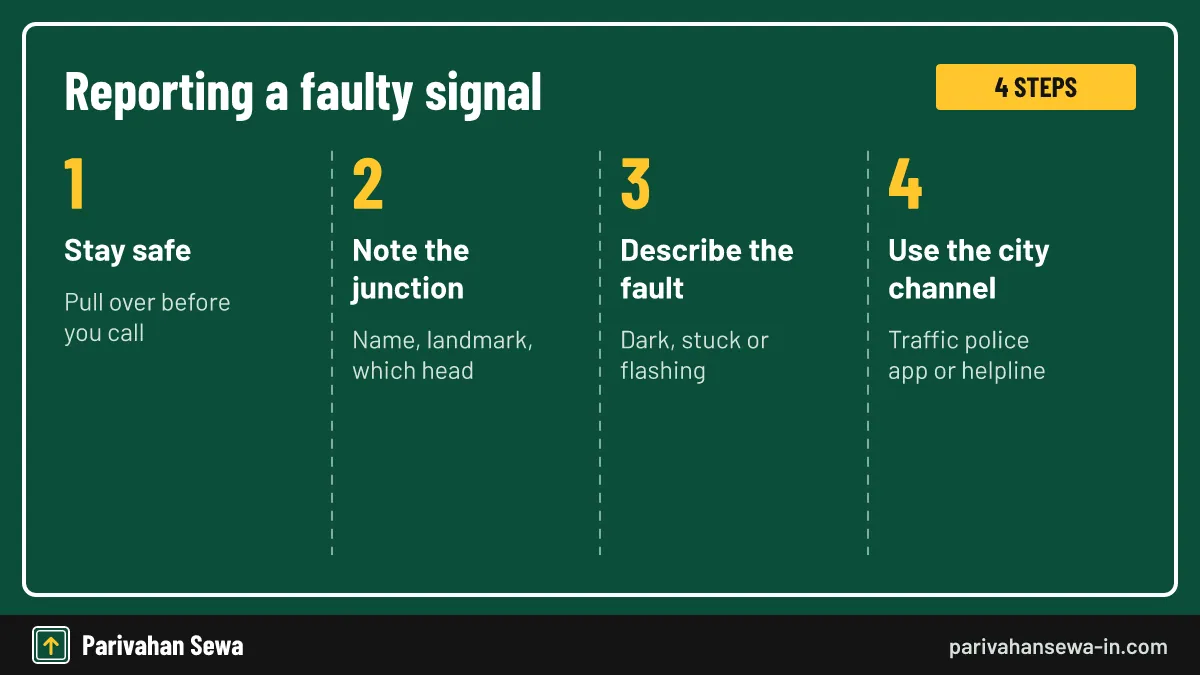
- Stay safe first. Pull over somewhere legal before you make a call or send a message.
- Note the junction. Write down the junction name, a landmark and which approach or signal head is affected.
- Describe the fault. Say whether the lamps are dark, stuck on one colour, flickering or flashing amber.
- Use the official city channel. Report through the traffic police app, official social media handle or helpline listed on the police website.
- Call 112 for danger. If the fault has caused a crash or a blocked emergency vehicle, call 112.
Which number to call
City helplines differ, so check the official traffic police website for your city. In an emergency, 112 is India’s single number connecting police, fire and ambulance services.
Add a photo if you safely can
A passenger can take a photo showing the dark or stuck head and the junction. Never take photos while you are driving.
How are signal timings worked out for a junction?
Engineers start with traffic counts: how many vehicles use each approach, how many turn and how many people cross on foot. From these they work out how much green each stage needs, the length of the cycle and the intergreen times. Indian Roads Congress guidance and local practice shape the final plan.
Pedestrian time
Walking time is based on the crossing length and a slow walking speed, so that older people and children can finish crossing. Long crossings may need a central refuge island.
Reviewing the plan
Traffic patterns change when a new mall, metro station or flyover opens. Good practice is to recount and retime signals regularly, and adaptive systems do part of this automatically.
Who installs and maintains signals in India?
Responsibility varies by city. Typically the municipal corporation or a smart-city company owns the equipment, a contractor installs and maintains it, and the traffic police decide where signals are needed and how they operate. On national highways, the highway authority handles junction design with local agencies.
| Role | Usually handled by |
|---|---|
| Deciding where a signal is needed | Traffic police with the road-owning agency |
| Buying and owning the equipment | Municipal body or smart-city company |
| Installation and repair | Contracted maintenance agency |
| Day-to-day operation and enforcement | City traffic police |
| Highway junction design | Highway authority and state public works department |
Why repairs can be slow
Because several agencies are involved, a report may pass from the police to the municipal body to the contractor. Giving the exact junction and fault in the first report saves time at every step.
Signals near schools and hospitals
Residents’ groups often request signals near schools or hospitals. Requests usually go to the traffic police, who assess traffic and pedestrian numbers before recommending one.
Traffic light system or roundabout: when is each used?
A traffic light system suits busy junctions with heavy pedestrian flows or uneven traffic, because it can give each road a guaranteed share of time. A roundabout suits junctions with balanced traffic and fewer pedestrians, because vehicles keep moving.
| Factor | Signal junction | Roundabout |
|---|---|---|
| Pedestrian safety | Dedicated walking phase | Harder to cross busy arms |
| Waiting at quiet times | Can wait at an empty red | Little or no waiting |
| Heavy unbalanced traffic | Can favour the busy road | Busy road may block others |
| Space needed | Less land | Needs a larger area |
| Running cost | Power and maintenance | Mostly none |
Signals on roundabouts
Some large city roundabouts carry signals on each entry. They regulate who enters the circle so that one heavy road does not lock up the others.
How do colour-blind drivers read the lights?
Many colour-blind drivers rely on position: top lamp for stop, bottom lamp for go. Brightness and the order of change also help. Because the layout is the same everywhere, a driver who cannot easily tell red from green can still read the signal safely.
Licensing and colour vision
Colour vision is assessed as part of the medical fitness requirements for some licence classes. The exact test and standards depend on the licence type, so check with your licensing authority if you have concerns.
Help from design
Visors and black backplates make the lit lamp stand out, and LED heads are brighter. Some countries also use differently shaped lamps, though Indian heads use the standard round aspects.
What mistakes do drivers make at signals?
The most common mistakes are racing the amber, stopping on the pedestrian crossing, entering a junction without a clear exit and turning left without an arrow or sign allowing it. Each one either risks a crash or blocks traffic for everyone, and several are caught by cameras.

Watching the wrong lamp
On multi-lane approaches, drivers sometimes follow the arrow meant for another lane. Read the lamp directly above or beside your own lane.
Following the car in front
Moving because the vehicle ahead moved, not because your lamp turned green, is a frequent cause of red-light camera challans. Keep your eyes on the signal.
Can you turn left on red in India?
Only where a sign or a green left arrow allows it. Some junctions have a marked free left lane with a sign saying so. Where there is no such sign or arrow, the red lamp applies to left-turning traffic as well. Do not block the left lane if you are going straight.

Giving way on a free left
Even where a free left is allowed, you must give way to pedestrians and to traffic already on the road you are joining. It is permission to proceed carefully, not a right of way.
Rules vary between cities
Some cities have removed free left turns at certain junctions to protect pedestrians. Check the signs at each junction rather than relying on what you do in another city.
Official links
e-Challan: check and pay finesechallan.parivahan.gov.in ↗Parivahan Sewaparivahan.gov.in ↗Ministry of Road Transport and Highwaysmorth.nic.in ↗Indian Roads Congressirc.nic.in ↗Traffic light questions
What are the three colours of a traffic light?
Red, amber and green, arranged with red at the top and green at the bottom. Many junctions add green arrows for turns and red or green figures for pedestrians.
Why is red at the top of a traffic light?
Red is the most important instruction, so it sits where it is least likely to be hidden by vehicles in front. The fixed position also helps drivers who find red and green hard to tell apart.
Who invented the traffic light?
The first signal was designed by railway engineer John Peake Knight and installed in London in December 1868. The first electric signal followed in Cleveland, USA, in 1914, and William Potts added amber in Detroit in 1920.
What is a traffic light system?
It is the whole set-up that controls a junction: signal heads, a controller cabinet, detectors or cameras and the timing plan that decides how long each road gets green.
How long does a signal stay red?
There is no single figure. Each junction has its own timing plan based on traffic volume, the number of roads and pedestrian demand, and adaptive systems change it through the day.
Is it legal to cross a red light if the road is empty?
No. The signal applies at all hours while it is working normally. Only a police officer's direction or a sign allowing a free turn changes that.
What should I do if the signal is not working?
Slow down, treat the junction with extra care, give way to traffic already crossing and follow any officer on duty. Report the fault to the city traffic police.
What is the fine for jumping a red light?
It is commonly booked as dangerous driving under section 184, which allows ₹1,000 to ₹5,000 for a first offence. Your state's notified amount may differ, so read the challan.
Do traffic light cameras send challans automatically?
In many cities, yes. Cameras linked to the signal photograph vehicles past the stop line on red, and the e-challan reaches the registered owner by SMS and on the e-Challan portal.
Can an ambulance go through a red light?
An ambulance or fire engine on an emergency run may need to cross. Other drivers must make way for it safely, and failing to do so is a separate offence under the 2019 amendment.
Parivahan Sewa (parivahansewa-in.com) is an independent information website and is not affiliated with MoRTH, Parivahan or any state transport department. Confirm fees and rules on the official portal before you pay or apply.