Traffic police station: what it does, how to reach one and your rights
A traffic police station is the local office of a city or district traffic branch. It runs junction duty, books Motor Vehicles Act offences, issues challans, handles towing and plans diversions. It does not usually register crime FIRs. For an injury, crash or crime dial 112; for a challan, check the state e-challan portal before you visit.
Key takeaways
- A traffic police station, division or chowky handles road traffic only; crimes and most FIRs go to the local police station.
- Cities group traffic offices under a Joint CP Traffic (commissionerates) or an SP Traffic (districts), with an inspector in charge of each office.
- In an emergency dial 112; on a national highway 1033 also works. Station landlines change, so take them from the official police site.
- Under section 130 you must show your licence to an officer in uniform; DigiLocker or mParivahan copies are valid documents.
- E-challan notices must reach you within 15 days of a camera offence, and the 2026 rule gives 30 days to pay an accepted challan.
On this page · 39 sections
What is a traffic police station?
A traffic police station is the area office of a traffic branch. It has its own jurisdiction, a small team led by an inspector, and duties that are limited to roads: managing junctions, booking Motor Vehicles Act offences, towing, and putting diversions in place. Some cities call it a traffic division, traffic guard or traffic unit.

Why cities have separate traffic offices
Traffic work does not follow crime beats. A flyover, a station approach or a market road needs staff who stay on the same corridor every day. Separate offices let the branch post people where vehicles bunch up, rather than where crime cases are filed.
Names you may see
Odisha’s Bhubaneswar-Cuttack Commissionerate lists offices such as Traffic PS A.G. Square. Mumbai uses “traffic division”, Kolkata uses “traffic guard”, and many towns just say “traffic thana”. All describe the same kind of office.
How is it different from a local police station?
The local station deals with crime, public order and FIRs. The traffic office deals with movement on roads. If your bike is stolen, go to the local station. If it was towed from a no-parking spot, go to the traffic office for that area. Many people lose a morning by visiting the wrong one.
| Question | Traffic office | Local police station |
|---|---|---|
| Who heads it? | Inspector (traffic) | Station House Officer or Senior PI |
| Registers FIRs? | Rarely | Yes |
| Handles challans? | Yes | Sometimes, for court cases |
| Towed vehicle? | Yes | No |
| Vehicle theft? | No | Yes |
Where the two overlap
A crash with injuries is a criminal matter, so the local station registers it, while traffic staff clear the road. Drunk driving cases start with traffic staff at a checkpoint but end in court, because the offence cannot be closed on the spot.
What to carry to either office
Take your licence, the RC and any challan or tow slip. A photocopy and a phone photo of each document save time if the desk asks for a copy for its file.
What does a traffic police office handle day to day?
A traffic police office runs the shift roster for its junctions, books offences, collects or records fines, keeps towed vehicles and plans local diversions for events, repairs and processions. It also answers residents’ requests about parking, one-way changes and broken signals, and passes them to the civic body when needed.
Routine work
Morning and evening peaks decide most of the roster. Officers are posted at signals, school gates and bus depots. Between peaks they run checks for helmets, seat belts, wrong-side driving and documents.
Paperwork you can get there
Ask for a copy of a manual challan, a tow receipt or a release slip. For a camera challan, the office can usually only tell you to pay or dispute it on the state portal.
What is a traffic police post?
A traffic police post is a small fixed point, often a booth or kiosk, at a busy junction, bus stand or market. Staff there manage that spot during their shift and report to a traffic office. A post does not keep records or take complaints, so do not expect to settle anything there.
How it differs from a mobile team
Posts are fixed. Interceptor and patrol teams move between hotspots. If the person who stopped you came from a vehicle, the challan is usually booked from a handheld device and appears online within a short time.
When to approach one
Use a post to ask for directions, report a broken signal or flag a stalled vehicle blocking a lane. Anything that needs a receipt or a record belongs at the main office.
What is a traffic police line?
A traffic police line is not an office for the public. “Police lines” is the district compound where reserve and armed police live, train and are posted from, run by a Reserve Inspector. Traffic staff may be drawn from those reserves, which is why some districts refer to a traffic line.
Why the term confuses people
Map apps often label the compound “Police Line” with a pin. People searching for a traffic office land there and find barracks, a parade ground and quarters instead of a public desk.
Where to go instead
For a challan or towing problem, use the city traffic office or the state portal. Visit the police lines only if an officer tells you a detained vehicle is being held in that compound.
Who are the Indian traffic police?
Indian traffic police are not one national force. Policing is a state subject, so each state police and each city commissionerate runs its own traffic branch. The central government writes the Motor Vehicles Act and the national e-Challan software, and states enforce them through their own officers.
Who does what
| Body | Role |
|---|---|
| MoRTH | Writes the Act and central rules |
| NIC | Runs the e-Challan and Vahan systems |
| State police traffic branch | Books offences and runs offices |
| Transport department / RTO | Licences, registration, permits |
Why rules feel different between cities
States notify their own compounding amounts and many cities run their own apps. A fine for the same act can therefore differ between Pune and Kolkata, even though the offence section is the same.
How is a traffic police department organised?
A traffic police department has layers. In a commissionerate city it is led by a Joint or Additional Commissioner, with DCPs for zones and ACPs for groups of divisions. In a district under an SP, an SP or Additional SP (Traffic) leads, with DSPs below. Each traffic office then has its own inspector.

Support units
Most departments also keep a planning cell, a prosecution cell for court challans, a CCTV or control room unit, and a training school. Kolkata’s traffic wing, for example, has a dedicated squad for fatal accidents.
How to read a notice number
Mumbai’s notices carry numbers such as 218/DCP/HQ & Central/Traffic/Temp/2026. The middle part tells you which DCP issued it, and “Temp” marks a temporary order that lasts till further orders.
What does an SP Traffic do?
An SP Traffic is the Superintendent of Police in charge of traffic for a district or a large town outside a commissionerate. The post signs traffic orders, approves diversions, reviews accident black spots and supervises the traffic offices in that district. In metro cities the matching post is usually a DCP Traffic.
When you would deal with the office
Write to the SP Traffic when a local office does not respond, when you want a permanent change such as a speed breaker or a no-parking zone, or to appeal against how a checkpoint was run.
What it does not do
The SP Traffic does not cancel camera challans by phone. Disputes still go through the portal or the court that holds the challan.
What does a traffic inspector do?
A traffic inspector is usually the Police Inspector in charge of one traffic office or division. The inspector draws up the duty roster, signs releases for towed vehicles, approves local diversions and supervises the sub-inspectors and constables who book offences. In Mumbai each area has an in-charge Police Inspector with traffic havaldars under them.
Who can compound an offence
States decide which ranks can collect a compounding fee. Some notify inspectors and sub-inspectors in traffic police stations; others allow head constables with a handheld device for minor offences.
Not the same as a transport inspector
The motor vehicle inspector of the RTO checks fitness and permits. The traffic inspector belongs to the police. Both can stop a vehicle, but their powers come from different parts of the Act.
Who is the Joint CP Traffic Mumbai and what does the post do?
The Joint CP Traffic Mumbai is the Joint Commissioner of Police who heads the city’s traffic branch. It is one of five Joint CP posts in Mumbai Police, alongside Law and Order, Administration, Crime and the Economic Offences Wing. The holder changes with transfers, so check the current name on the Mumbai Police site.
What the office controls
The Joint CP signs city-wide traffic policy, approves permanent one-way and no-parking orders, and oversees the traffic headquarters and its control room. Additional CP notices on the Mumbai list cover permanent changes, such as a Vakola order in October 2026.
How to raise an issue with the office
Start with the division. If nothing moves, write to the traffic headquarters through the address on the Mumbai Police website. For the wider picture of how the city runs challans and apps, see our Mumbai traffic guide.
How are traffic divisions arranged in Mumbai?
A 2022 explainer splits the city’s traffic branch into four sections: headquarters, Traffic City (Colaba to Wadala), Traffic Suburbs (Dahisar to Bandra) and Eastern Suburbs (Mahim to Mankhurd and Kurla to Mulund). Divisions sit inside these sections. In June 2019 the city had 25 traffic divisions and planned at least 10 more.

| Section | Example divisions | Notices in Oct 2026 |
|---|---|---|
| HQ and Central | Dadar, Mahim, Worli | Dadar, Mahim |
| West | Bandra, BKC, Vakola | BKC, Vakola |
| East | Ghatkopar, Mulund, Kanjurmarg | Mulund, Kanjurmarg |
| Western suburbs | Malad, Dindoshi, Borivali | none listed |
Where to see the current list
The official Public Notice List on mtperp.mahatrafficechallan.gov.in shows which DCP issued each order and which division it covers. It is the most up-to-date public record of how the divisions are named.
Why boundaries change
New flyovers, Metro lines and coastal road links shift traffic. Divisions are added or split to match, so a junction can move from one office to another between years.
What does the Dadar traffic division cover?
The Dadar traffic division covers the busy belt around Dadar station, Shivaji Park and the Siddhivinayak Temple in Prabhadevi. Its notices come from the DCP for HQ and Central traffic. Between September and October 2026 the official list shows three Dadar notices, including road closures for Angarki Sankashti Chaturthi and Dussehra Melava changes.
Notices you can read
| Notice | Date | Subject |
|---|---|---|
| No. 205 | 19/09/2026 | Closure of roads in Dadar Division |
| No. 213 | 16/10/2026 | Dussehra Melava arrangements |
| No. 218 | 21/10/2026 | Contractor works in the division |
Planning a trip through Dadar
Check the notice list before festival days and rallies at Shivaji Park. Notices name the roads closed, parking bans and the diversion routes, which helps more than calling the office on a busy day.
Where does Matunga traffic chowky fit?
The Matunga traffic chowky is the local name for the Matunga traffic office and its posts. In Mumbai “chowky” means a small police office or booth. An older directory copied from the Mumbai Traffic Police site lists Matunga as its own traffic unit under a Senior Police Inspector, next to Dadar and Wadala.
What a chowky handles
Mumbai’s chowkis collect fines for towed vehicles and handle local traffic jobs. They are where you go to recover a towed scooter, not where you report a theft.
Finding the right one
Matunga, King’s Circle and Sion roads meet near the chowky area, so confirm the office that covers your exact road from the official list before you travel there.
Where does Chembur traffic police work?
Chembur traffic police manage the eastern suburb roads around Chembur, including stretches of the Eastern Express Highway and the approaches to the Sion-Panvel road. The older directory lists Chembur as a separate traffic unit under a Police Inspector, close to Trombay and Mankhurd units in the same eastern belt.
Common reasons to contact it
Residents contact the Chembur office about towed vehicles, monorail and Metro works and parking near the station. For camera challans recorded in the area, the payment and dispute route is still the state portal.
Neighbouring offices
Trombay, Mankhurd, Kurla and Ghatkopar sit nearby. If an officer from one of these booked you, the challan names the place, which tells you which office to ask.
Is there a Malad traffic police station?
Yes. The older Mumbai directory lists a Malad traffic police station under a PI Traffic, in the western suburbs between Goregaon and Kandivali. Some routes inside Malad East fall under the Dindoshi traffic division instead, for example a 2025 Malad walkathon route.
Malad or Dindoshi?
Use the road name. Western Express Highway stretches east of the railway line may sit with Dindoshi, while roads around Malad station and Malad West sit with the Malad office.
What the office can sort out
The office can release towed vehicles, give copies of manual challans and approve local event traffic. It cannot cancel an online challan; use the portal grievance option for that.
What does Borivali traffic police cover?
Borivali traffic police cover the northern stretch of the western suburbs, around Borivali station, the national park approach and parts of the Western Express Highway. The directory lists Borivali under a Senior PI, between the Kandivali and Dahisar units, at the edge of Mumbai’s limits.
Why Borivali gets heavy traffic
It is the last big hub before the Dahisar check post towards Thane and Gujarat. Interstate buses and trucks add to the evening peak, which is when most checks run.
Next office along
North of Borivali is the Dahisar unit, and south is Kandivali. Challans on the highway near the city limit can come from either, so check the place field on the challan.
What is a traffic police control room?
A traffic police control room is the round-the-clock hub that watches cameras, takes calls, sends staff to jams and coordinates route plans for VIP visits and festivals. Kolkata’s Traffic Control Room at Lalbazar coordinates all its traffic guards, and Mumbai lists a separate CCTV control room within its traffic set-up.

How it links with 112
When you dial 112 about a crash, the ERSS centre passes it to the police control room, which can alert traffic staff to clear the road. You do not need to call both.
Numbers some cities publish
Delhi Traffic Police list 1095, and Gurugram lists 1095 and 0124-2386000 for its control room. Other cities publish landlines that change often, so use the ones on the official site.
How does police traffic control work at a junction?
Police traffic control at a junction means an officer overrides or supports the signal by hand. It happens during power cuts, signal faults, heavy rain, VIP movement and events. Hand signals from an officer take priority over the light, and ignoring them is an offence under the Act.
Signals you should know
An officer facing you with a raised palm means stop. A waving arm means move. An arm stretched to the side holds cross traffic. Our traffic signs guide covers road signs and markings in detail.
Why disobeying costs more
Refusing an officer’s direction can be booked under section 179 for disobeying orders, with a central penalty of up to ₹2,000, on top of the original offence.
Who runs traffic police control of signals and cameras?
Traffic police control of signals is shared. The civic body or a smart-city company often owns the signal hardware and cameras, while the traffic branch sets timings and enforces them. Camera footage reaches the police CCTV room, which generates challans under Rule 167A.
What that means for a complaint
A dead signal or a broken camera pole is fixed by the civic body, but the traffic office passes the report on. Report both through the traffic office or the city’s helpline so a record exists.
Who owns the challan
Even if the camera belongs to a city company, the challan is a police document and is paid on the state e-challan system, not to the corporation.
How do you find a traffic police station number?
The safest way to find a traffic police station number is the official state or city police website. Look for the traffic section and a list of divisions or guards with landlines. Avoid numbers printed in old blogs and map listings; offices move and lines are reassigned. For a curated set of helplines, see our traffic police number page.
- Open the official police site. Type the state or city police address yourself rather than clicking an ad or a forwarded link.
- Find the division list. Look under traffic, contact us, traffic divisions or traffic guards.
- Match your area. Pick the division that covers the road or junction you need, using the place named on your challan.
- Note the landline. Save the office number and the control room number shown on the same page.
- Call in office hours. Call the office for local matters and use 112 for emergencies.
Why directory numbers fail
Many directories still show numbers from the early 2010s, along with officers who have long been transferred. A wrong number wastes time, and some fake listings route you to touts.
When the website will not load
Use the state e-challan helpline instead. Maharashtra’s portal lists 844 844 8960 for challan and payment issues.
When should you call traffic police?
Call traffic police for a road blockage, a broken-down vehicle in a lane, a dangerous driver, a signal that has stopped working, or a towing question. Call 112 instead if anyone is hurt, there is a fire or a crime is happening. Keep the vehicle number, the place and the time ready before you dial.
What to say
Give the road and nearest landmark first, then what is happening and which direction traffic is moving. Short, clear details help the control room send the nearest team.
When not to call
Do not call a station to ask for a challan to be waived. That is handled on the portal or in court. Calls offering to “settle” a challan for a discount are a common scam.
Which number do you dial after a road accident?
Dial 112 after any accident with injuries, fire or a trapped person. On national highways you can also dial 1033, NHAI’s 24x7 helpline, which can send an ambulance, a patrol vehicle or a crane. After the emergency is handled, the local police station registers the case.
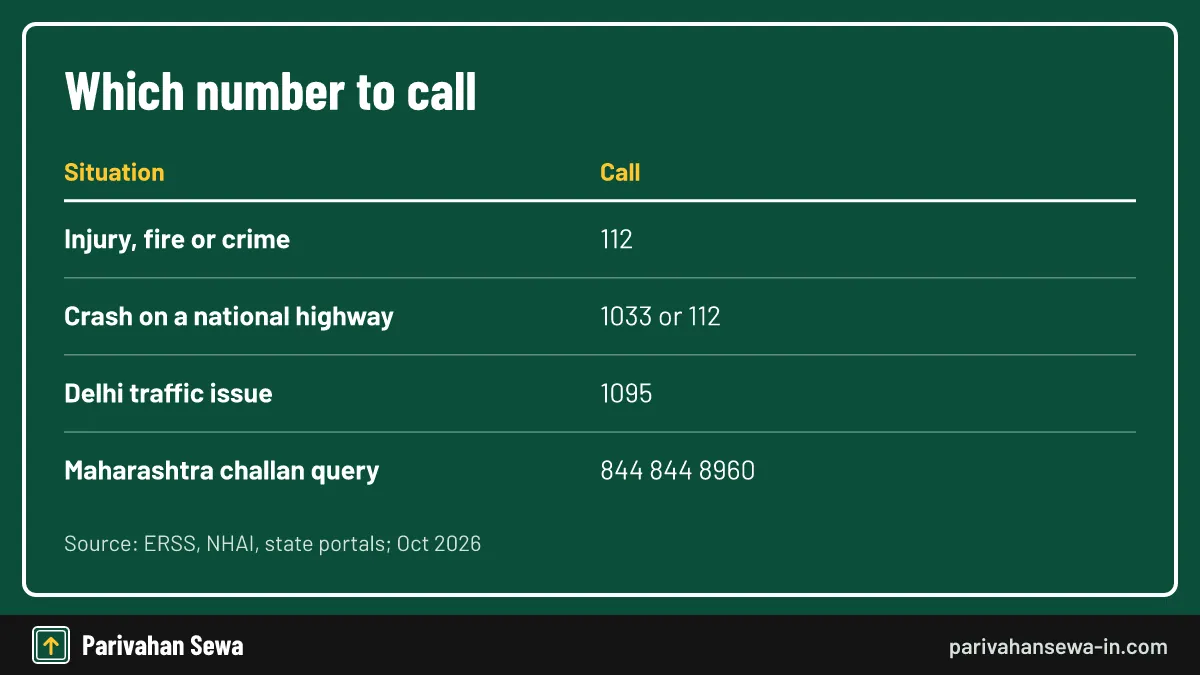
| Situation | Number | Run by |
|---|---|---|
| Injury, fire or crime | 112 | State ERSS centre |
| National highway crash or breakdown | 1033 | NHAI |
| Delhi traffic complaint | 1095 | Delhi Traffic Police |
| Maharashtra challan query | 844 844 8960 | Maharashtra e-challan |
What happens after the call
The control room sends the nearest response vehicle. Traffic staff divert vehicles and the local station records the accident. Keep photos and witness names; your insurer will ask for them.
Helping a victim
If you stop to help, first make the spot safe with hazard lights, then call 112 and share the exact place. Do not move an injured person unless there is a fire or other immediate danger.
How do you find a traffic police location?
To find a traffic police location, start with the place name on your challan or tow slip, then match it to a division on the official police site. Map apps help for directions, but their pins can point to a police lines compound or an old address. Our traffic station near me guide covers phone-based search tips.
Using the challan itself
E-challans show the place of the offence. That place usually belongs to one division, which is where manual paperwork and towing queries are handled.
Using the notice list
In Mumbai, notices on the official list name the division in their title or file. A road closure notice tells you which office runs that area at that time.
Is there a traffic guard near me in Kolkata?
If you are in Kolkata, the traffic guard near me is your local traffic office. Kolkata Traffic Police divide the city into about 25 to 26 traffic guards, coordinated by the control room at Lalbazar. You can pay fines at a traffic guard office as well as at headquarters or to an officer with a card machine.
Finding the right guard
Guards are named after areas, such as Howrah Bridge, Shyambazar and Jorabagan. The Kolkata Traffic Police site lists them; ask for the guard covering the road named on your case.
Lalbazar headquarters
Lalbazar is the headquarters of Kolkata Police. For directions and services there, see our Lalbazar police station page.
What is road traffic police and highway patrol?
Road traffic police is the everyday term for the traffic branch working on city roads. Highways often have their own wing. Maharashtra, for example, created a Highway Traffic Police branch in 1993 to patrol state and national highways, separate from city traffic divisions.
Highway checks
Highway units check speed, lane discipline and overloaded goods vehicles, and help at crashes. Their challans go into the same state e-challan database as city ones.
Toll plazas and expressways
On national highway toll roads, NHAI’s 1033 helpline and the highway patrol share response work. Ask the toll staff to call the patrol if you cannot reach the helpline.
Which is the right traffic police website?
The right traffic police website is the one run by your state or city police, usually on a .gov.in address, plus the national e-Challan portal at echallan.parivahan.gov.in. Maharashtra uses mahatrafficechallan.gov.in, and Kolkata uses kolkatatrafficpolice.gov.in. Look for the operator name in the footer before you enter any details.
Spotting fake sites
Fake sites copy logos, ask for card details on a non-government address or push you to pay through a link sent by SMS. Old addresses can be bought by others; Mumbai’s former traffic site now hosts a law blog.
What an official site offers
Challan search, online payment, grievance forms, division lists and public notices. Contact numbers on the site are the only ones you should rely on.
Which traffic application should you install?
Install a traffic application only from the official publisher: your state or city police, or the Parivahan and mParivahan apps from MoRTH and NIC. These show challans, pay them and keep your digital licence and RC. Avoid apps that only scrape public data and ask for payment details.
How to check the publisher
In the app store, read the developer name and website link. A police or government developer name and a .gov.in link are good signs. Very few reviews or a personal developer name are warning signs.
City apps
Many metro traffic branches run their own apps for complaints and payments. For Mumbai options, see the app section of our Mumbai traffic guide linked above.
What does police challenge mean?
Police challenge is almost always a typing slip for police challan, the notice a traffic officer or camera issues for an offence. There is no service called a police challenge. If you got a message with that word, treat it with care: misspelt notices are a common sign of a fake SMS.
What a real challan contains
A challan number, vehicle number, date, time, place, offence section and amount, with a photo for camera cases. You can confirm it on the e-Challan portal by challan or vehicle number.
If you want to contest a challan
That is a challenge in the plain sense, and you do it through the portal’s grievance option or in court, not at the roadside.
What is meant by police road?
Police road has no single meaning. People use it for a road that runs past a police station or police lines, for roads named after police (for example “Police Line Road” in many towns), or loosely for roads where traffic police are posted. It is not a legal category of road.
Is a road near police lines restricted?
Usually not for normal traffic, but entry into the compound itself is restricted. Parking near police buildings may be banned by a local order, so read signboards.
If you are looking for an address
Use the town name with “police lines” or the station name in a map app, then confirm against the police website.
What is a transport authority?
A transport authority is a body under section 68 of the Motor Vehicles Act. Each state forms a State Transport Authority and Regional Transport Authorities that deal with permits for buses, taxis and goods vehicles. Licences and registration are handled by the RTO. The traffic police enforce the rules on the road.
Police or transport authority?
Go to the RTO or transport authority for a licence, RC, permit, fitness certificate or road tax. Go to the traffic police for a roadside challan, towing or traffic arrangements.
Releasing a seized vehicle
When police detain a vehicle for running without a permit or registration, the transport authority or an officer it authorises orders the release, after you produce the missing documents.
What are the traffic challan rules?
The main traffic challan rules come from the Central Motor Vehicles Rules. Rule 167A (2021) says the notice for a camera-recorded offence must be sent within 15 days and the evidence kept till the challan is closed. A 2026 rewrite of Rule 167 adds delivery within 3 days electronically and 30 days to pay an accepted challan.

Devices allowed
Rule 167A lists speed cameras, CCTV, speed guns, body-worn and dashboard cameras, number plate recognition and weigh-in-motion machines, plus any device a state notifies. It targets high-risk stretches in about 132 cities of over a million people.
Where newer changes are tracked
Rules keep changing. Our new traffic rules page tracks recent amendments and dates in one place.
What can a traffic cop legally ask you for?
A uniformed officer can ask you to stop, show your licence and vehicle papers, take a breath test if drink driving is suspected, and follow hand directions. Section 130 says the licence must be shown to an officer in uniform. The officer can book offences and, in set cases, impound documents or detain the vehicle.
Uniform matters
The Calcutta High Court held that a licence seizure by an officer not in uniform, without the acknowledgement section 206 requires, was illegal. Ask politely for identification if you are unsure.
What they cannot do
They cannot demand cash without a receipt, keep your licence without giving an acknowledgement, or force you to unlock your phone for unrelated checks.
Which documents should you show at a checkpoint?
Carry the driving licence, registration certificate, insurance certificate and PUC certificate. Transport vehicles also need the permit and fitness certificate. Under Rule 139, electronic copies in DigiLocker or mParivahan are valid, so a phone with those apps can replace most paper copies.

If you forgot a document
Rule 139 allows attested copies to be produced within 15 days if the original is not with you. Ask the officer how to do this; some states let you show it at the traffic office.
Photos are not enough
A photo of your licence in the gallery is not a valid document. Use the DigiLocker or mParivahan version, which the officer can verify.
Can an officer seize your licence or vehicle?
Yes, in specific cases. Under section 206 an officer can impound a document if the driver may abscond or avoid a summons, or the document seems fake, and must give an acknowledgement. Under section 207 a vehicle running without registration, a licence or a needed permit can be detained.
What you get in return
Always take the acknowledgement. Section 130 lets you show that receipt instead of the licence until the case ends, and you need it to get the document back.
Getting the vehicle back
Release is ordered by the transport authority or an officer it authorises once you produce the documents. Towing for parking is different and is handled by the traffic office.
Can you pay a fine at a traffic police station?
Often yes. Bengaluru takes payment at any traffic police station and BangaloreOne centre, Kolkata at traffic guard offices, and most cities let officers collect by card on handheld devices. Paying online on the state portal is usually faster and gives an instant receipt you can download.

| Offence | Section | Central penalty |
|---|---|---|
| General offence | 177 | ₹500 first, ₹1,500 repeat |
| Disobeying an officer | 179 | Up to ₹2,000 |
| Driving without a licence | 181 | Up to ₹5,000 |
| Over-speeding, LMV | 183 | ₹1,000 to ₹2,000 |
| Drunk driving, first offence | 185 | Up to ₹10,000 (court) |
What compounding means
Section 200 lets states name the officers who can accept a fee and close an offence on the spot. Drunk driving under section 185 is not on that list, so it goes to court. For the full offence list, see our traffic fines guide.
Court challans
If a challan has been sent to a virtual or regular court, the station cannot take the money. Pay or plead through the court route shown on the challan.
What is a traffic police car used for?
A traffic police car is used for patrol, escorting VIP and emergency convoys, highway interception and towing coordination. Interceptor cars carry speed guns and cameras, and many now carry handheld e-challan devices. Their footage counts as electronic evidence under Rule 167A.
Recognising a genuine vehicle
Official cars carry police markings, a beacon and a government registration. Be careful if an unmarked car signals you to stop on an empty road at night; slow down, stay in the car and call 112 if unsure.
Dashboard and body cameras
Rule 167A allows dashboard and body-worn cameras as enforcement devices, so a stop may be recorded. That record can also help you if you dispute what happened.
Can a traffic police station register an FIR?
Usually not. A traffic police station books Motor Vehicles Act offences and challans, while FIRs for crimes such as hit-and-run, rash driving causing injury or vehicle theft are registered at the local police station. Some states have separate traffic police stations that do register accident cases, so ask if unsure.
What you need for an accident report
Bring the vehicle details, both drivers’ licences if available, photos of the scene and any hospital papers. The insurer will need the FIR copy.
If the station sends you away
Ask which station covers the place. You can also file a complaint online through the state police portal or call 112 for help with registration.
How do you dispute a challan booked by a station?
Start on the state e-challan portal or the national portal, where a grievance option lets you attach proof such as the photo, your location or a sale document. If the challan has reached court, contest it there. For detailed steps, see our traffic police complaint guide.
Grounds that usually work
A wrong number plate read by the camera, a vehicle sold before the date, or a photo that shows a different vehicle. Keep screenshots and transaction IDs.
Grounds that rarely work
Not seeing a sign or being in a hurry. Officers and courts look at whether the offence happened, not why.
What should you do and avoid when stopped?
Stop safely, switch off the engine, keep your hands visible and ask what the offence is. Show documents from DigiLocker if you prefer, and take a receipt or note the challan number for any payment. Stay polite; arguing rarely helps, and a calm record helps if you dispute it later.

Simple checklist
Check the uniform and name badge. Ask for the section of the Act. Pay only by card, UPI or online with a receipt, or decline and let the challan go online.
After the stop
Check the challan on the portal within a day or two. If details are wrong, raise a grievance quickly while the evidence is fresh. Return to the e challan guide for search and payment steps.
Official links
National e-Challan portalechallan.parivahan.gov.in ↗Mumbai traffic public noticesDivision-wise notifications ↗Maharashtra e-challanmahatrafficechallan.gov.in ↗Kolkata Traffic Policekolkatatrafficpolice.gov.in ↗112 India emergency112.gov.in ↗Traffic police station questions
What is the difference between a traffic police station and a police station?
A traffic police station deals with road traffic: junctions, parking, challans, towing and diversions. A regular police station handles crime and law and order and registers FIRs, including accident cases where someone is hurt.
Can I pay my challan at a traffic police station?
In many cities yes. Bengaluru, for example, accepts payment at traffic police stations, and Kolkata at traffic guard offices. Online payment on the state e-challan portal is usually quicker and gives an instant receipt.
What is the traffic police control room number?
It depends on the city. Delhi and Gurugram list 1095. For emergencies anywhere in India, dial 112. Take any other control room number from the official police website, as directory listings go out of date.
Who is the head of a traffic police station?
Usually a Police Inspector, often called the traffic inspector or PI Traffic. In bigger offices a Senior Police Inspector is in charge, with sub-inspectors, havaldars and constables under them.
What is a traffic police post?
A small fixed booth or post at a busy junction, market or toll point where traffic staff are based for the shift. It reports to a traffic division or station and is not a place to file complaints.
Does a traffic police officer need to be in uniform to check my licence?
Section 130 of the Motor Vehicles Act asks drivers to show their licence on demand by a police officer in uniform. The Calcutta High Court held a seizure by an officer not in uniform, without an acknowledgement, to be illegal.
Can traffic police take my vehicle?
Under section 207 they can detain a vehicle driven without registration, a licence or a required permit. The release is ordered by the transport authority after you show the documents.
Is a DigiLocker copy of my licence valid at a checkpoint?
Yes. Rule 139 of the Central Motor Vehicles Rules, amended in 2018, lets you produce documents in electronic form such as DigiLocker or mParivahan.
How do I find the Dadar traffic division office?
Use the Mumbai Police or Mumbai traffic website for the address and phone. Notices for the Dadar Traffic Division appear on the official Mumbai traffic Public Notice List.
What does police challenge mean in search results?
It is almost always a misspelling of police challan, the fine notice issued by traffic police. There is no separate police challenge service.
Within how many days must an e-challan be sent?
Rule 167A of the Central Motor Vehicles Rules says the notice of an electronically recorded offence must be sent within 15 days of the offence.
Is SP Traffic the same as DCP Traffic?
They do the same job in different set-ups. Districts under a Superintendent of Police have an SP or Additional SP Traffic; commissionerate cities have a DCP Traffic under a Joint or Additional CP.
Parivahan Sewa (parivahansewa-in.com) is an independent information website and is not affiliated with MoRTH, Parivahan or any state transport department. Confirm fees and rules on the official portal before you pay or apply.