Traffic signal images and photos explained, colour by colour
Traffic signal images show a signal head with three lamps: red on top, amber in the middle and green at the bottom, often with arrows, a pedestrian figure and a countdown timer. Red means stop behind the stop line, amber means stop if it is safe, and green means go when the junction is clear. Use only freely licensed or your own photos.
Key takeaways
- In real traffic signal images, red is always the top lamp, so position tells you the meaning even without colour.
- A green arrow in a traffic light photo allows only the turn it points to, not straight-ahead movement.
- The traffic line painted on the road, such as the stop line and zebra crossing, is part of the signal system.
- Free HD images must carry a clear licence such as public domain or CC BY; search results are not a licence.
- Never photograph a junction while driving; camera pictures of your vehicle are what create red-light e-challans.
On this page · 25 sections
What do traffic signal images show?
Traffic signal images show the light units that control vehicles and people at a junction. A typical picture shows a dark signal head with three round lamps, mounted on a pole or an overhead arm, with road markings below. Knowing each part helps you read any photo correctly.

Why people search for signal pictures
Students need pictures for charts and homework, learner drivers revise for the licence test and teachers build road safety lessons. Each use needs a different kind of image.
What this page does not cover
The full rules of the road and every sign board are explained in our traffic signs guide. Here the focus stays on what you see in a picture of a signal and how to use those pictures well.
Traffic light photo: what a real signal head looks like
A real traffic light photo shows a rectangular housing, usually black or dark grey, holding three lamps in a column. Each lamp sits under a short visor that blocks sunlight, and a black backing board around the head improves contrast against a bright sky.

The lamp order never changes
The lamps run red, amber and green, and on a vertical head red is always on top. This fixed order lets a driver who is colour-blind still read the signal by position, which is why it is standard worldwide.
Horizontal signal heads
Some photos show the lamps side by side. This layout appears where a tall head would block a view or hit a low bridge. The lamps keep the same red, amber, green sequence, read from one end to the other, so check which end is red before you read the rest.
What is in a traffic light picture of an Indian junction?
A wide traffic light picture of an Indian junction usually shows more than the lights. You will often see a pole-mounted head on the left side, a second head across the junction, a countdown timer, painted stop lines, a zebra crossing and, in bigger cities, a camera on a gantry.
Near-side and far-side signals
Many junctions place one head before the stop line and another across the road. The far head is easier to see once you have stopped at the line, so drivers in the front row should look across, not up.
Signs that appear with signals
Boards such as “no U-turn” near the lights add rules for that junction, so read them together with the lamps.
Traffic light images by colour: red, amber and green
When you study traffic light images, each colour gives one clear instruction. The table below sums up what a lit lamp tells the driver. For the full meaning and rules of each light, see our traffic light guide.
| Lamp in the image | Where it sits | What the driver should do |
|---|---|---|
| Red | Top lamp | Stop and wait behind the stop line |
| Amber (steady) | Middle lamp | Stop, unless stopping suddenly is unsafe |
| Green | Bottom lamp | Proceed if the junction ahead is clear |
| Green arrow | Beside or under the green | Move only in the arrow’s direction |
Why amber is not “go faster”
A steady amber lamp warns that red is coming. In pictures it can look harmless, but the safe reading is stop if you can.
A picture shows only one moment
A photo freezes one phase of a changing cycle, so it cannot tell you how long each phase lasts.
What does a traffic signal photo of an arrow light mean?
In a traffic signal photo, an arrow lamp controls only one movement. A green arrow pointing left lets left-turning vehicles go while others wait; a green arrow pointing right releases right-turning traffic. If the main lamp is red, straight-ahead vehicles must keep waiting.
Arrow lamps beside the main head
Arrow lamps often sit to the side of the three main lamps or below the green one. In pictures they look like a fourth or fifth lamp. Look at the shape inside the lens: a round glow is a full signal, an arrow is a filtered one.
Free left turns
Some junctions allow a left turn at all times, shown by a sign or a permanently lit green left arrow. Where no such sign appears, a red lamp applies to left-turning traffic as well.
How do pedestrian signals look in a traffic light pic?
A pedestrian traffic light pic shows two figures instead of round lamps: a red standing figure that means do not start crossing, and a green walking figure that means you may cross. These heads sit at the kerb, facing people waiting at the zebra crossing.
Flashing green figure
At many crossings the green figure flashes, or a timer counts down, before it turns red. People already crossing should finish; people at the kerb should wait for the next green phase.
Traffic signal pic with a countdown timer: how to read it
A traffic signal pic with a number display shows a countdown timer. It tells you how many seconds remain before the current lamp changes. Red numbers count down your wait; green numbers count down the time you have left to cross the stop line.
Using the timer safely
When a green timer shows only a few seconds, prepare to stop rather than speed up. When a red timer reaches the last seconds, do not creep over the stop line; cameras can still record a jump before green appears.
When timers are blank
Adaptive signals that change with traffic flow sometimes show no countdown, because the controller decides phase length on the spot. A blank timer does not mean the signal is faulty.
What is a traffic line on the road?
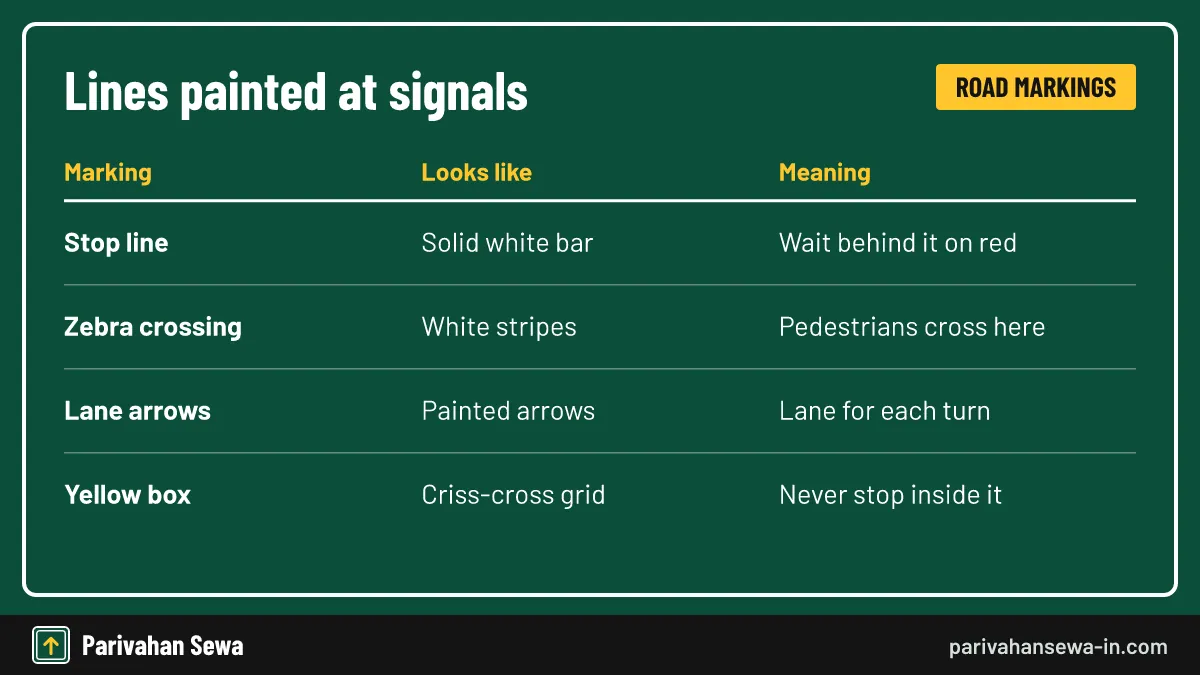
A traffic line is a marking painted on the road surface to guide vehicles. At signals the key ones are the stop line, the zebra crossing, lane arrows and lane dividers. They are part of the signal system, because the lamps tell you when and the lines tell you where.
White and yellow lines
White lines usually separate lanes going the same way and mark stop and crossing points. Yellow lines are commonly used to show restrictions, such as a centre line you should not cross. Markings vary by road, so obey local boards too.
Broken versus solid lines
A broken line means you may change lanes with care. A solid line means stay in your lane. Near signals, lane lines often turn solid so drivers pick the correct lane before the junction.
Which lines on traffic light junctions should drivers know?
The lines on traffic light junctions that matter most are the stop line, the pedestrian crossing, lane-direction arrows and, in some cities, a criss-cross yellow box. Each tells you where your vehicle may wait and which space must stay clear for others.
Stop line and zebra crossing
Wait fully behind the stop line, not on the zebra stripes. Stopping on the crossing forces pedestrians into moving traffic and is one of the most common reasons for camera challans at signals.
Yellow box markings
Some cities paint a yellow grid in the middle of a busy junction. Enter it only if your exit is clear, so you never block cross traffic when the lights change.
Street traffic light: how is it mounted and powered?
A street traffic light is fixed on a pole at the kerb, on an overhead cantilever arm, or on a gantry across a wide road. Cables run from each head to a signal controller cabinet near the junction, which switches the lamps in a timed or traffic-responsive pattern.
The controller cabinet
In photos the controller is a metal box beside the road. It stores the phase plan and, in some cities, links to a traffic control room.
How are LED signal lamps different from old bulbs?
Modern LED signal lamps are made of many small light points, which you can often see as a dotted pattern in close-up photos. Older lamps used a single bulb behind coloured glass and looked like a smooth, even glow.
Why LEDs replaced bulbs
LED lamps use less power, last longer and stay bright in sunlight. A failed bulb left a lamp dark, while an LED lamp usually loses only part of its light points, so the signal stays readable.
What this means for your photos
High-speed camera shots of LED lamps can show flicker bands or look dim, because the lamp pulses faster than the eye can see. Try a slower shutter speed if a lamp looks unlit in your picture.
Where can you find traffic signal images HD for free?
You can find traffic signal images HD on free libraries that state a reuse licence on each file, such as public domain collections, Creative Commons archives and free stock sites. The safest option is often your own photo taken from a footpath or a simple drawing you make yourself.

| Source type | Typical licence | What you must do |
|---|---|---|
| Public domain or CC0 file | No rights reserved | Nothing required; credit is still polite |
| Creative Commons CC BY / BY-SA | Free with conditions | Credit the author; BY-SA needs the same licence on your version |
| Free stock photo site | Site’s own licence | Read the site terms; some ban resale |
| Paid stock or news photo | All rights reserved | Buy a licence or ask permission |
| Your own photo or drawing | You own it | Avoid recognisable faces and number plates |
What “HD” means for a signal image
For print charts, choose images at least about 2,000 pixels wide so lamps stay sharp. For a web page, a smaller file loads faster; resize the picture rather than stretching a low-resolution one.
Can you use any traffic light images you find online?
No. Most traffic light images online belong to a photographer or agency, even when they are easy to download. Reuse is safe only when the image is in the public domain, carries an open licence you follow, or you have the owner’s permission.
Search filters help, but check the source
Image search filters by usage rights are only a guide; confirm the licence on the original page.
Credit lines
When a licence asks for credit, add a short line under the image: the author’s name, where it came from and the licence name. This takes a few seconds and keeps you within the terms.
Traffic signs HD images vs signal photos: what is the difference?
Traffic signs HD images show fixed boards: circles, triangles and rectangles with symbols. Signal photos show lights that change. People often mix the two terms, so check which one your teacher, project or test question actually needs before choosing a picture.
Picture types at a glance
Signs are passive and always say the same thing; signals are active and change with time. A road safety chart usually needs both, side by side, with markings shown as a third group.
How to choose a good traffic light picture for a school project?
A good traffic light picture for a school project is clear, front-facing, shows all three lamps and has a plain background. Choose an image where one lamp is lit, so the meaning is obvious, and print it large enough for the class to see from a distance.
Make a set, not a single image
Three pictures, one per colour, explain the sequence better than one photo.
Label every part
Write short labels: red lamp, amber lamp, green lamp, visor, pole and stop line. Labels turn a photo into a learning tool and show you understood it.
How do you draw a traffic light picture step by step?
To draw a traffic light picture, sketch a tall dark box, add three equal circles, colour them red, amber and green from top to bottom, draw small visors above each lamp and finish with a pole and a white stop line below. It takes about ten minutes.
- Draw a tall box. Draw a dark rectangle with rounded corners for the signal head.
- Add three circles. Space three equal circles from top to bottom inside the box.
- Colour the lamps. Colour the top circle red, the middle amber and the bottom green.
- Add visors. Draw a small hood above each lamp, as on real signals.
- Draw the pole and stop line. Add a pole under the box and a white stop line on the road.

Getting the colours right
Use a bright red, an orange-yellow for amber and a clear green. Shade the unlit lamps darker to show which one is “on”, just as in a real photo.
Ten simple sentences about a traffic signal for students
These ten lines on a traffic signal suit school essays and speeches. They use plain words and stay accurate. For a picture set on wider road rules, see our traffic rules photos page.
The ten lines
- A traffic signal is a set of lights that controls vehicles and people at a road junction.
- It has three lamps: red at the top, amber in the middle and green at the bottom.
- Red means stop and wait behind the stop line.
- Amber means get ready to stop, because red is coming.
- Green means go, but only if the road ahead is clear.
- Pedestrian signals show a red standing person and a green walking person.
- Many signals have a countdown timer showing seconds left.
- The first traffic signal was put up in London in December 1868.
- Traffic signals reduce accidents and help traffic move in turn.
- We should always obey traffic signals, whether we walk, cycle or drive.
A little history for longer essays
The first signal stood in Parliament Square, London, and was invented by John Peake Knight. The first electric traffic light was developed in 1912 by Lester Wire, a policeman in Salt Lake City, USA.
Short sentences on the traffic signal in Hindi
Many students need the same lines in Hindi. Here is a short version in simple Hindi that matches the English lines above, so teachers can use either.
Paanch saral vakya
- ट्रैफिक सिग्नल सड़क पर गाड़ियों और लोगों को नियंत्रित करता है।
- इसमें तीन बत्तियाँ होती हैं: ऊपर लाल, बीच में पीली और नीचे हरी।
- लाल बत्ती का मतलब है रुकें।
- पीली बत्ती का मतलब है रुकने के लिए तैयार रहें।
- हरी बत्ती का मतलब है रास्ता साफ़ हो तो आगे बढ़ें।
How do cameras take a traffic signal photo of a violation?
Enforcement cameras at signals take a traffic signal photo when a vehicle crosses the stop line while the lamp is red. The system records the number plate, the time and the signal state, and many cities then generate an e-challan against the registered owner.
What the evidence usually shows
The evidence image or video normally shows the vehicle beyond the stop line, the red lamp or signal phase and the date and time. Stopping on the zebra crossing can also be recorded.
Why number plates matter
Cameras read plates automatically, so a dirty or bent plate can cause wrong readings.
Can you see the camera photo on a red-light challan?
Often yes. Many camera challans can be viewed with their evidence on the national e-Challan portal or the issuing city’s traffic police site. Search by vehicle number or challan number. If no photo is shown, contact the traffic police unit named on the challan.
If the photo shows another vehicle
Raise a grievance with the issuing traffic police and keep a screenshot of the challan. A wrong plate reading is a known cause of mistaken challans. Our e-challan guide explains checking and disputing challans.
What is the fine for jumping a red signal?
Jumping a red signal is booked under the Motor Vehicles Act, 1988, and states choose the section and compounding amount. The table shows central penalties that may appear on such challans. The figure on your challan is the one that applies.
| Section that may be used | Central penalty | What it covers |
|---|---|---|
| Section 177A | ₹500 to ₹1,000 | Breaking road regulations |
| Section 184 | ₹1,000 to ₹5,000 and/or jail | Dangerous driving, first offence |
| Section 179 | Up to ₹2,000 | Disobeying orders of authorities |
State amounts differ
States notify their own compounding fines within these limits, so the amount for the same offence can differ between cities. For a state-wise view, see our traffic fines page.
How to use traffic signal images to prepare for the learner test?
The learner licence test includes questions on signals, signs and markings, often shown as pictures. Practising with clear signal pictures helps you answer quickly. Go through each lamp, arrow and pedestrian figure until you can name it at a glance. Our learning licence images page has more practice pictures.
Practise with mixed pictures
Mix signal photos with sign boards and markings, because test questions switch between them.
Read the question first
Questions may ask what you should do, not what the light is called. Read the question before looking at the options so you pick the action, not just the name.
Why does a traffic light photo look different at night or in rain?
At night a traffic light photo often shows the lit lamp as a glowing star or a smeared blob, and the housing disappears into darkness. Rain adds reflections on the road that can make a green lamp appear twice. These are camera effects, not changes to the signal.
What drivers see in rain
Drivers face the same glare on a wet windscreen. Slow down near signals in rain so you have time to read the lamp and stop behind the line.
Blinking amber or red: what do flashing signal photos mean?
A photo cannot show flashing, but signals do switch to a flashing mode late at night or when there is a fault. A flashing amber lamp means slow down and cross with care. A flashing red lamp is treated like a stop: halt, look, then go when it is safe.
When flashing mode is used
Some cities switch signals to flashing amber at quiet hours so drivers do not wait at empty junctions. Watch for traffic from side roads, because they may not slow down.
What should you do when the street traffic light is not working?
If a street traffic light is dark or stuck, treat the junction as uncontrolled. Slow right down, give way to traffic already in the junction and to vehicles from your right, and follow any police officer directing traffic.

Report the fault
Call the local traffic police or post the location on their official social media handle or app. Mention the junction name, the direction affected and what the lamp is doing.
Officer directions come first
When an officer is controlling the junction, follow their hand signals even if the lamp shows a different colour. Police directions override the lights.
Official links
e-Challan portal (Parivahan)echallan.parivahan.gov.in ↗Parivahan Sewaparivahan.gov.in ↗Sarathi licence servicessarathi.parivahan.gov.in ↗Motor Vehicles Act, 1988 (India Code)indiacode.nic.in ↗Traffic signal images questions
What colour is at the top of a traffic signal?
Red. On a vertical signal head the lamps run red, amber and green from top to bottom, so drivers who cannot tell colours apart can still read the position.
Can I use traffic signal images from Google in my project?
Not automatically. Search results show pictures owned by many people. Open the source page and reuse the image only if it is public domain or carries a licence such as CC BY, and give credit.
What does a traffic light photo with a green arrow mean?
The arrow allows movement only in the direction it points. If the main lamp is red, traffic going straight must still wait.
What is the traffic line at a signal called?
The thick white bar across your lane is the stop line. Your vehicle should be fully behind it while the light is red.
Why do some traffic signal pics show numbers?
Many Indian cities fit countdown timers that show the seconds left before the light changes. Red numbers count down the wait, green numbers the time left to go.
Is it legal to photograph a traffic signal?
Taking photos of public roads from a safe spot is generally allowed, but never while driving and never by stepping onto the carriageway. Avoid filming police checks if officers ask you not to.
Are traffic signal images useful for the learner licence test?
Yes. The learner test includes signal and sign questions, and practising with clear pictures helps you recognise lamps, arrows and pedestrian signals quickly.
Does a red-light e-challan include a photo?
Camera-based challans are usually backed by a photo or video of the vehicle at the stop line. If you cannot see the evidence online, contact the traffic police that issued the challan.
What is the difference between a signal image and a sign image?
A signal image shows lights that change at a junction. A sign image shows a fixed board on a post, such as a speed limit or no-entry sign.
Parivahan Sewa (parivahansewa-in.com) is an independent information website and is not affiliated with MoRTH, Parivahan or any state transport department. Confirm fees and rules on the official portal before you pay or apply.