Traffic signs for kids explained with pictures and simple words
Traffic signs for kids are easiest to learn by shape. A red eight-sided sign means stop. A circle gives an order: a red edge says do not, a blue disc says you must. A triangle warns of danger ahead, and a rectangle gives directions or help. Start with six signs, practise on walks, then move to the full chart.
Key takeaways
- Teach shape first, symbol second: octagon stops, circle orders, triangle warns, rectangle helps.
- The stop sign means a full stop at the line, then look right, left and right again.
- No parking has one red bar; no stopping has two crossed bars and allows no halt at all.
- Red on a sign usually means do not or danger; blue usually means you must or here is help.
- Begin with six starter signs, then use a home worksheet and real walks to revise.
- Children learn from adults: parents who obey signs teach more than any chart.
On this page · 26 sections
What are traffic signs for kids?
Traffic signs for kids are the same road signs adults use, explained through shapes, colours and simple pictures so a child can read them before reading words. Each board tells road users to stop, to take care or where to go, and children walking or cycling need to understand them too.

Signs are picture messages
A sign works like a picture message from the people who look after the road. The shape says what kind of message it is, and the drawing inside says what it is about.
Who the signs are for
Signs are not only for drivers. Pedestrians, cyclists and children in school vans all share the same road. Under section 119 of the Motor Vehicles Act, drivers must follow mandatory signs, and children who learn them early become safer walkers now and better drivers later.
Why should children learn signs before they start cycling?
A bicycle puts a child on the road among cars, buses and two-wheelers. Knowing what the stop, one way and no entry boards mean helps a young rider make safe choices without an adult calling out every instruction.
Habits stick from a young age
Children copy what they practise. A child who always stops at the kerb, looks both ways and waits for the walking figure carries that habit into their teenage years. For the wider set of rules for walkers and riders, see our guide to road safety rules.
What do sign shapes and colours tell a child?
Indian road signs follow a simple code. A circle gives an order, a triangle gives a warning and a rectangle gives information. A red border or red bar usually means “do not”, while a blue disc means “you must”. Learning this code lets children decode signs they have never seen.
| Shape | Main colour | What it tells you | Example |
|---|---|---|---|
| Octagon (eight sides) | Red | Stop completely | Stop sign |
| Circle with red border | White or blue inside | Something is not allowed | No parking, no horn |
| Blue circle | Blue with white symbol | Something you must do | Keep left, turn left |
| Triangle with red border | White inside | Danger or care needed ahead | School ahead |
| Rectangle | Blue or green | Directions and help | Hospital, parking |
A rhyme to remember shapes
Try this with younger children: “Circles tell, triangles warn, boxes help you find your way.” Say it each time you pass a sign.
What does the stop traffic sign mean?
The stop traffic sign means every vehicle must come to a complete stop at the line, check the road and move only when it is safe. It is a mandatory sign, so it is an order, not advice. Slowing down and rolling through does not count as stopping.
Stop is not the same as give way
At a give way sign, an upside-down triangle, you slow down and stop only if there is traffic. At a stop sign you always stop, even if the road looks empty.
Stop road sign: what should a child do at one?
A child walking or cycling who reaches a stop road sign should do what a driver does: stop fully, look and only then move. On a bicycle that means both feet on the ground. On foot it means standing at the kerb, not at the edge of moving traffic.
- Stop at the line. Come to a complete stop behind the white line, feet down on a cycle.
- Look right. On Indian roads the nearest traffic comes from the right.
- Look left, then right again. Check the far lane, then the near lane once more.
- Go when it is clear. Move only when nobody is coming from either side.
Practise on a quiet lane
Choose a quiet lane with a stop sign and walk the routine together several times.
Stop sign symbol: why is it an eight-sided shape?
The stop sign symbol is a red octagon with the word STOP in white. Its eight sides make it unique: no other common sign uses that outline, so drivers can recognise it from behind, in fog or when the word is faded. The shape was picked in the United States in 1922.

The same around the world
Under the Vienna Convention on road signs, stop is a red octagon with a white STOP legend, and most countries use it. That means a child who learns it in India will recognise it on holiday abroad too.
Where can you find a stop symbol image for class work?
A clear stop symbol image for a school project should show a red octagon, white border and white capital letters. The safest choice is to draw it yourself: it is easy, avoids copyright problems and teaches the shape better than a downloaded picture.
Drawing a stop sign in five minutes
Draw a square, then cut each corner off at an equal angle to get eight sides. Colour it red, leave a thin white edge and write STOP in large white letters.
What does a stop ahead sign warn about?
A stop ahead sign warns that a stop sign is coming up, often around a bend or over a rise where the real sign is hidden. In many countries it is a warning triangle or plate placed before the junction. In India the exact design depends on the road authority, so read the plate below it.
Why an early warning helps
A heavy truck needs a long distance to stop safely. A warning placed before the junction gives drivers time to slow down gradually instead of braking hard at the last moment.
What is a no stopping sign?
A no stopping sign means a vehicle must not halt at that spot at all, not even for a few seconds to let someone out. In the common design it is a blue disc with a red border and two red bars crossing each other. It is used where any halt would block traffic.
Where you see it
No stopping signs appear near busy junctions, on fast main roads, in front of hospital entrances and at bus stops.
What it means for school drop-offs
If the school gate has a no stopping sign, parents should use the drop-off point the school marks instead. Letting a child jump out in a no stopping zone puts them beside moving traffic.
No parking road sign: what does it mean?
A no parking road sign means you must not leave a vehicle standing there, but a very short halt to pick up or drop off a person is usually allowed. In the common design it is a blue disc with a red border and one red diagonal bar.

Reading the small plate
Many no parking signs carry a plate below with hours, such as office times, or an arrow showing which side the rule covers.
Why no parking zones exist
Parked vehicles block the view of children crossing the road. A small child stepping out between two parked cars cannot be seen by a driver until it is too late, so no parking zones near schools protect young walkers.
No parking and no stopping signs: how do you tell them apart?
No parking and no stopping signs look alike at first, which is why children and even adults mix them up. Count the red bars. One bar means no parking, so a short halt is fine. Two bars in a cross means no stopping, so no halt is allowed at all.
| Feature | No parking | No stopping |
|---|---|---|
| Background | Blue disc, red border | Blue disc, red border |
| Red bars | One diagonal bar | Two bars forming a cross |
| Quick drop-off | Usually allowed | Not allowed |
| Leaving the car | Not allowed | Not allowed |
| Typical place | Market streets, gates | Junctions, main roads |
A quick memory trick
“One line, one minute; a cross, no chance.” Say it whenever you pass either sign.
What does the no right turn sign show?
The no right turn sign shows a black arrow bending to the right inside a white circle with a red border, and a red bar across the arrow. It means vehicles must not turn right at that point. Drivers go straight or turn left and find another route.
Why right turns are banned
A right turn in India crosses the path of oncoming traffic. At busy junctions this slows everyone and causes crashes, so authorities ban it and send drivers to a nearby U-turn or signal instead.
Spotting the red bar
Children often say the arrow means “turn right here”. Point out the red bar: whenever a red bar crosses a picture, the picture is not allowed.
Arrow road sign: which way do the arrows point?
An arrow road sign shows a direction. On a blue disc, a white arrow is an order: you must go that way, such as turn left only or keep left. On a red-bordered sign with a bar, the arrow shows a forbidden move. On rectangles, arrows point to places.
Arrows painted on the road
Lanes near junctions often have arrows painted on the surface showing which lane goes straight and which turns. They work together with the signs above.
One way sign board: what does it tell drivers?
A one way sign board tells drivers that traffic on that road moves in one direction only. It usually shows a white arrow on a blue background pointing the way vehicles must go. Drivers must not enter from the other end, and walkers should expect cars from one side only.
Why one way streets help
Narrow old lanes in many Indian cities are too tight for two-way traffic. Making them one way removes head-on meetings and keeps traffic moving.
Still look both ways
Remind children that cyclists and two-wheelers sometimes ride the wrong way on one way roads. Looking both ways is still the safe habit even when the sign says traffic comes from one side.
One way symbol or no entry: what is the difference?
The one way symbol is an arrow on a blue board showing the direction traffic is allowed. A no entry sign is a red disc with a white horizontal bar and is placed at the far end of the same street. One says “go this way”, the other says “do not come in here”.
Two signs, one street
Picture a one way lane. At the start you see the blue arrow; at the exit end, facing the opposite way, you see the red no entry disc.
What does a triangle traffic sign mean for kids?
A triangle traffic sign with a red border is a warning. It does not give an order; it tells road users that something ahead needs extra care, such as a school, a sharp bend, a speed breaker or a pedestrian crossing. Drivers slow down and stay alert when they see one.
Warning signs children meet most
Near homes and schools, the most common triangles show children walking for a school, a walking figure for a pedestrian crossing and a bump for a speed breaker.
The upside-down triangle
One triangle is special. The give way sign points downwards and is an order, not a warning. Teach children that “point down means let others go first”. For every sign family in detail, see our full guide to traffic signs.
Red road signs: why do they matter most?
Red road signs carry the strongest messages. A red octagon means stop, a red border or red bar means something is not allowed, and a red-bordered triangle warns of danger. Children should treat any sign with a lot of red as a signal to slow down and think.
Breaking a red sign has a cost
Ignoring mandatory signs is an offence. The central fine under the Motor Vehicles Act is set out below; states can notify their own compounding amounts, so the actual challan figure may differ. Checking current amounts is covered on our traffic fines page.
| Offence | Section | Central fine |
|---|---|---|
| Breaking road regulations, such as ignoring a sign | 177A | ₹500 to ₹1,000 |
| Over-speeding in a light motor vehicle | 183 | ₹1,000 to ₹2,000 |
| Offence by a juvenile: guardian or owner liable | 199A | ₹25,000 |
Why children should know about fines
Children are often the best rule-keepers in a family. A child who knows that a red sign carries a fine will remind a parent who is about to jump a turn, and that reminder can prevent a crash as well as a challan.
Blue driving signs: what do they ask you to do?
Blue driving signs come in two kinds. A blue circle gives a compulsory instruction, such as keep left, turn left, or a cycle track. A blue rectangle gives useful information, such as parking, a hospital or a petrol pump. Circle means must; rectangle means helpful.
Blue circles are still orders
Some children think blue signs are friendly suggestions. They are not: a blue disc is an order that says what to do.
Blue rectangles near schools
Blue rectangles often point to a hospital, a bus stop or a parking area.
What does a speed limit 80 sign mean?
A speed limit 80 sign is a white circle with a red border and the number 80 inside. It means vehicles must not go faster than 80 km/h on that stretch. The number is the maximum, not a target, and drivers should go slower when it rains or the road is crowded.
Different roads, different numbers
Speed limits change from road to road. A highway may show 80 while a road near a school may show a much lower figure. Section 112 of the Act lets state governments fix limits for safety, so always follow the number on the board.
No horn traffic sign: where is it used?
A no horn traffic sign shows a black horn with a red bar across it inside a red-bordered circle. It means drivers must not sound the horn. It is placed near hospitals, schools, courts and other places that need quiet, often called silent zones.
Why quiet zones matter
Loud horns disturb patients, distract students and startle small children. Section 194F of the Act, added in 2019, provides a penalty for using a horn in a silent zone.
What to use instead of the horn
Drivers can slow down, keep a safe distance and flash lights briefly to warn others.
Zebra crossing sign board: how does it help walkers?
A zebra crossing sign board marks a place where pedestrians cross. The warning version is a red-bordered triangle with a walking figure, placed before the crossing. The road itself carries black and white stripes. Drivers must slow down and let people on the crossing go first.

Using the crossing safely
Children should wait at the kerb, look right, left and right again, and cross only when vehicles have stopped.
Crossings at traffic lights
Where a crossing has lights, wait for the green walking figure. When it flashes, do not start crossing. For how the lamps and countdown timers work, read our explainer on the traffic light.
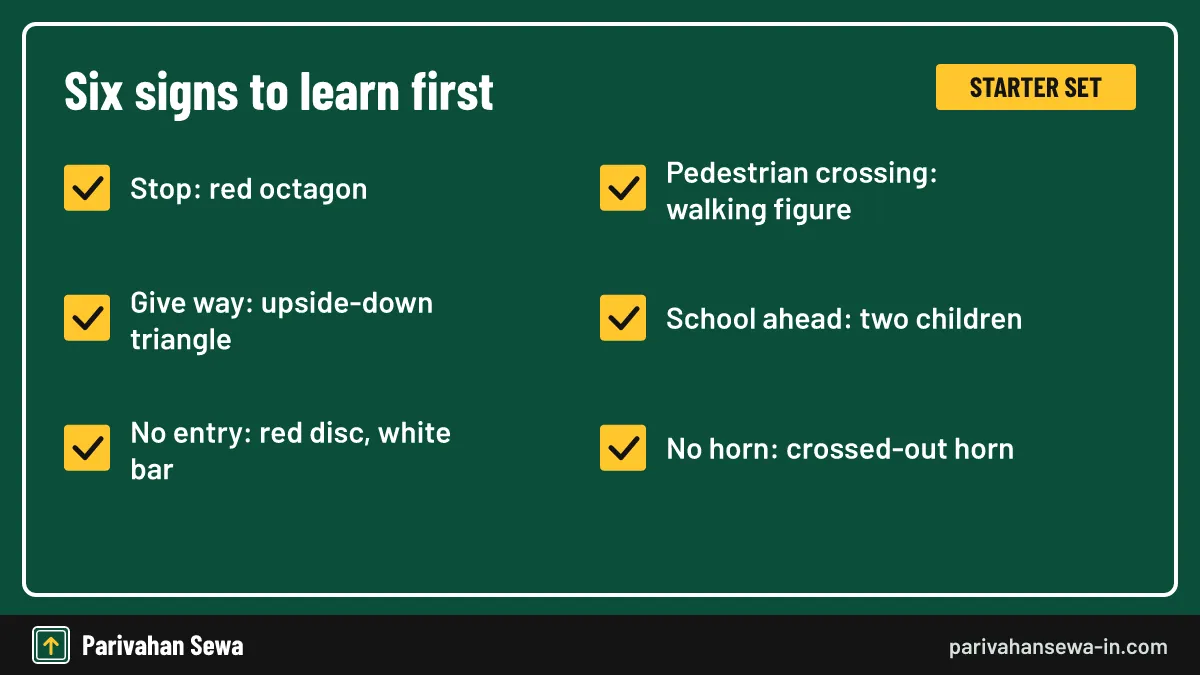
Which 6 traffic signs should every child know first?
These 6 traffic signs cover the situations a child meets most often on foot or on a cycle. Learn them one at a time, point them out on walks and move to new signs only when these feel easy.
| Sign | Shape and colour | What a child should do |
|---|---|---|
| Stop | Red octagon | Stop fully, look, then go |
| Give way | Upside-down triangle | Let others go first |
| No entry | Red disc, white bar | Do not go in this way |
| Pedestrian crossing | Triangle, walking figure | Cross here with care |
| School ahead | Triangle, two children | Expect children nearby |
| No horn | Crossed-out horn | Keep quiet near this place |
Learn one sign a week
Pick one sign each week and look for it everywhere, then add it to the set.
Examples of signs children see every day
Not every sign a child sees is a road sign. Examples of signs in daily life include road signs, safety signs such as exit and fire extinguisher, and information signs such as toilets and lifts. Road signs are special because they follow a national code and many carry the force of law.
Everyday road sign examples
On the way to school a child may pass a school ahead triangle, a speed breaker warning, a pedestrian crossing, a no parking disc and a bus stop rectangle.
Other everyday signs
In malls, schools and stations you will see green exit signs, red fire signs and yellow caution signs for wet floors. These follow safety rules for buildings, not the road sign code.
Traffic signal logo: what does the three-light symbol stand for?
People searching for a traffic signal logo usually want the simple symbol of a signal head: a dark box with red, amber and green lamps. There is no single official logo; it is a common symbol used on posters, books and safety campaigns to stand for road safety.
Drawing the symbol correctly
Draw a tall rectangle with three circles. Put red at the top, amber in the middle and green at the bottom. Keeping that order matters, because the positions help colour-blind drivers know which lamp is lit.
Using it on posters
A traffic signal symbol is a good centrepiece for a road safety poster, with stop, get ready and go written beside the lamps.
Traffic signs worksheet: how to make one at home
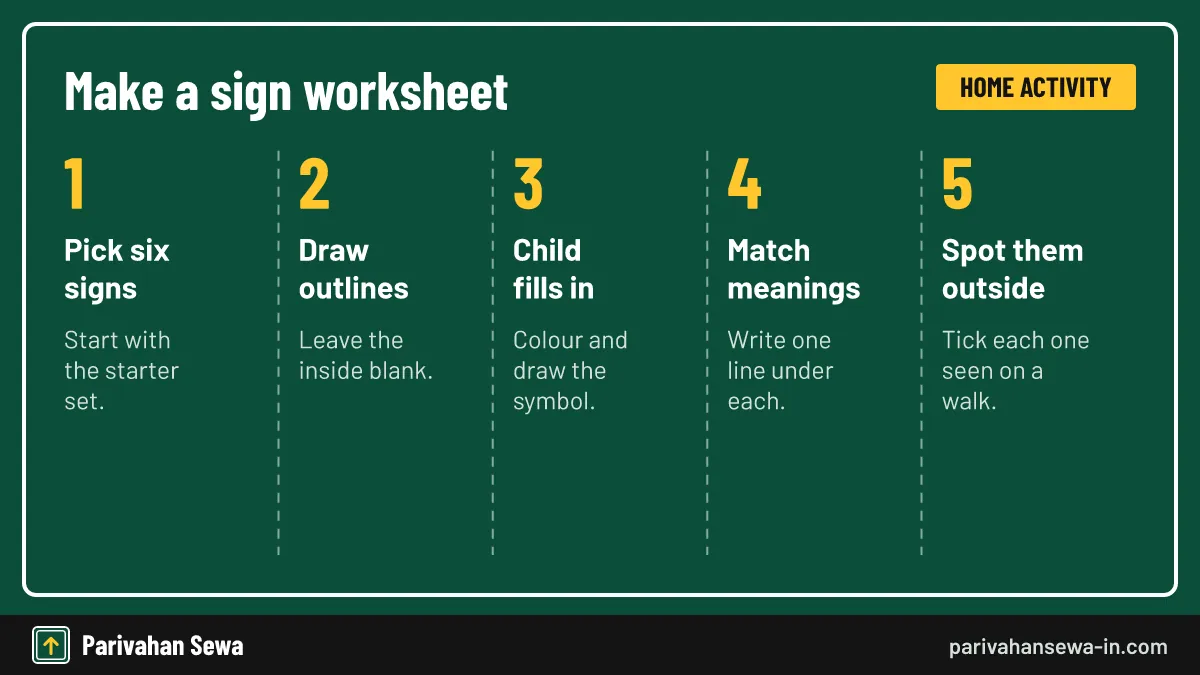
A homemade traffic signs worksheet is often better than a downloaded one because you can match it to your child’s age and the signs on your own streets. All you need is paper, coloured pencils and a few minutes to draw the outlines for your child to complete.
Worksheet ideas by age
For ages four to six, draw shapes and ask the child to colour them correctly. For ages seven to nine, add matching: sign on the left, meaning on the right.
Turning it into a game
Cut the finished signs into cards. Hold one up and ask the child to act out the meaning: freeze for stop, tiptoe for no horn, walk carefully for a crossing.
Road signs to print: where to find accurate charts?
When looking for road signs to print, choose charts based on Indian signs. Good sources include your state transport department, the Sarathi learner licence study material and charts given by schools. Avoid charts with US yellow diamonds or UK-only signs, which can confuse children.
What a good printable chart shows
A useful chart groups signs into the three families, shows each sign in colour and gives a one-line meaning. It should include stop, give way, the common prohibitions, school ahead and pedestrian crossing.
Checking a chart before printing
Look for the red octagon stop sign, red-bordered triangles for warnings and blue discs for compulsory signs.
Official links
Parivahan Sewaparivahan.gov.in ↗Sarathi: learner licence study materialsarathi.parivahan.gov.in ↗Ministry of Road Transport and Highwaysmorth.nic.in ↗Traffic signs for kids questions
What are the first traffic signs a child should learn?
Start with stop, give way, no entry, pedestrian crossing, school ahead and no horn. They are the signs a child meets most on the way to school.
At what age can kids learn road signs?
Most children can match colours and shapes by about four or five. Simple sign games work from then; meanings and rules come more easily from around seven.
Why is the stop sign red and eight-sided?
Red catches the eye from far away, and the octagon is a shape no other common sign uses, so it can be recognised even from behind or when covered in dust.
What is the difference between no parking and no stopping signs?
Both are blue discs with a red border. No parking has one red bar and allows a short halt to drop someone off. No stopping has two crossed bars and allows no halt at all.
Do children have to follow traffic signs?
Yes. Signs apply to everyone on the road, including people walking and cycling. A child walking still has to use the crossing and wait for the walking figure.
What does a red triangle sign mean?
It is a warning. Something ahead needs care, such as a school, a sharp bend or people crossing. It does not give an order by itself.
What do blue round signs tell you?
A blue disc tells you what you must do, such as keep left or turn left only. Blue rectangles give information instead, such as parking or a hospital.
Where can I get printable traffic signs for children?
Use material from your state transport department, the Sarathi learner study pages or your child's school. Check that any chart follows Indian signs, not US or UK versions.
What happens if a child drives a vehicle and breaks a rule?
Under section 199A of the Motor Vehicles Act, the guardian or owner can be fined ₹25,000 and jailed for up to three years, and the vehicle's registration can be cancelled for 12 months.
Parivahan Sewa (parivahansewa-in.com) is an independent information website and is not affiliated with MoRTH, Parivahan or any state transport department. Confirm fees and rules on the official portal before you pay or apply.