Check post tax: how border tax works and how to pay it online
Check post tax (also called border tax or entry tax) is a state tax that some vehicles registered in another state pay when they enter, mainly taxis, tourist buses and goods vehicles. Each state sets its own rates and periods. You can pay it in advance on the Vahan checkpost service by choosing the state you are entering, then show the receipt at the border.
Key takeaways
- Check post tax is charged by the state you enter, not by your home state, and each state sets its own rules.
- It mostly applies to transport vehicles such as taxis, tourist buses and trucks; private cars on short visits are usually not charged.
- You can pay border tax online on the Vahan checkpost page before the trip and keep the receipt on your phone.
- Vehicles with an All India Tourist Permit pay a national permit fee; MoRTH has asked states not to add border tax, but some state demands still stand.
- A vehicle kept in another state for more than 12 months needs re-registration there, which is a different process from entry tax.
On this page · 41 sections
What is check post tax?
Check post tax is the tax a state collects from certain vehicles registered elsewhere when they enter its territory. It is also called entry tax or border tax. The money goes to the state you are entering, and it sits on top of the tax your vehicle already paid at home.

Where the name comes from
States used to collect this levy only at physical checkposts on highways near the state line. A driver stopped, showed papers and paid cash. The name stayed even though most payments now happen online before the trip.
How it fits with your other vehicle taxes
Your home state charges motor vehicle tax when the vehicle is registered or by period. Check post tax is extra and temporary. It covers only the time the vehicle spends in the other state, and the receipt is valid for the period you choose.
Who has to pay check post tax?
Mostly transport vehicles from other states pay check post tax: tourist taxis, contract carriage buses, maxi cabs and goods carriers. Private cars on a short visit are usually outside it. The exact list depends on the visiting state’s taxation law and on the permit the vehicle holds.
Taxis and tourist buses
A taxi or bus with a state permit from its home state usually needs a temporary permit and entry tax in each new state. Operators who run regular interstate trips often pay for longer periods to save time.
Goods vehicles
Trucks with a national permit pay a national permit fee, while some states still charge their own levies on certain goods vehicles. Truck owners should check the destination state’s rule before loading.
Private vehicles
For a private car or bike on a holiday, entry tax is rare. The rule that matters more is re-registration after a long stay, covered further down this guide.
| Vehicle type | Pays at entry? | What to check first |
|---|---|---|
| Private car or bike, short visit | Rarely | Destination state’s current notice |
| Tourist taxi with state permit | Usually | Temporary permit and entry tax |
| Tourist bus or maxi cab | Usually | Seats, permit type and period |
| Vehicle with All India Tourist Permit | Disputed | State demand and court position |
| Goods carrier | Depends on state | National permit and state levies |
How is check post tax worked out?
States work out check post tax from the vehicle class, the seating capacity or load, the permit type and the period of stay. A seven-seat taxi pays a different amount from a 40-seat bus, and a weekly payment costs less than a monthly or quarterly one. The online form calculates it for you.
Inputs the form asks for
Expect to enter the seating capacity excluding the driver, the permit type, the entry date and the number of days or the tax period. For goods vehicles, the gross weight may be asked.
Why the same trip can cost different amounts
Two states can charge very different sums for the same vehicle because each one sets its own schedule. Some states also charge more when a neighbour charges their vehicles more. This is why no single national rate exists.
What is border tax in India?
Border tax in India is the everyday name for the same state entry levy. It is not a central tax. Each state and Union Territory decides whether to charge it, on which vehicles and at what rate, under its own motor vehicles taxation act passed by the state legislature.
Different names in different states
You may see it called entry tax, other state tax, passenger tax or special road tax. A few states also add a temporary permit fee. The receipt name changes, but the idea is the same: tax for using that state’s roads.
What it does not include
Border tax is not toll and is not GST. It also does not replace the insurance, fitness or permit papers a transport vehicle must carry. Paying it only clears the tax part of the entry check.
Why do states charge border tax?
States charge border tax because motor vehicle tax is a state subject. A vehicle registered in one state pays tax there, yet uses the roads of another. Entry tax lets the second state recover some road costs from commercial vehicles that earn money on its routes.
Matching tax with neighbours
Many states set entry tax to match what their own operators pay next door. When one state raises its rate, a neighbour sometimes does the same. Kerala and Karnataka, and Telangana and Andhra Pradesh, have both had such disputes.
Revenue and control
Checkposts also let states check permits and overloading. That said, many states have reduced physical checkposts since GST came in, and moved the tax part online.
Is border tax the same as the tax paid at registration?
No. The tax paid at registration is your home state tax, often one-time for private vehicles or periodic for commercial ones. Border tax is a short-term levy by another state. Paying one never cancels the other, and they appear on separate receipts in separate records.
Two records, two receipts
Your home tax sits in the Vahan registration record of your vehicle. Border tax receipts are generated through the checkpost module and refer to the visiting state. Keep both when you travel.
When home tax affects border tax
Most states want proof that home state tax is paid up to date before they accept entry tax. A vehicle with arrears at home may face trouble at the border even with an entry receipt.
Does vehicle border tax apply to private cars?
Vehicle border tax on private cars is uncommon for short trips. Most states focus entry tax on transport vehicles. A private car crossing for a holiday or a family visit generally pays only highway toll, but a few states have tried other charges, so check before long trips.
When a private car stays longer
Under Section 47 of the Motor Vehicles Act, a vehicle kept in another state for more than 12 months must get a new registration mark there. That means paying the new state’s tax, which is a separate process from entry tax.
Vehicle border tax for taxis, buses and trucks
For commercial vehicles, vehicle border tax is a regular running cost. Taxi and bus operators pay it per trip or per period in each state they enter without a national permit. Truck owners check the levies of each state on the route before they set freight rates.
Taxis on airport and pilgrimage routes
Taxis on routes such as Delhi to Haryana or Chennai to Tirupati cross state lines daily. Their owners often pay for a week, month or quarter at a time to avoid paying on every trip.
Tourist buses on holiday routes
Tour buses carrying groups to Goa, Kerala or Rajasthan pay according to seats. The seating capacity on the RC drives the amount, so the number entered online must match the RC exactly.
What is state border tax and which states collect it?
State border tax is any entry levy charged by a particular state. Several states collect it for transport vehicles, including those discussed on this page. Rates and covered vehicles change often, so treat any list as a starting point and confirm with the visiting state’s transport department before travel.

A quick state reference
| State | Vehicles mainly covered | How to pay | More detail |
|---|---|---|---|
| Uttar Pradesh | Transport vehicles from other states | Vahan checkpost | Our UP border tax guide |
| Haryana | Taxis, buses and goods vehicles | Vahan checkpost | Section below |
| Andhra Pradesh | Transport vehicles, including from Telangana | Vahan checkpost or counter | Section below |
| Karnataka | Tourist vehicles from other states | Vahan checkpost or counter | Section below |
| Goa | Entry tax on outside vehicles has been charged at times | Checkpost or online | Section below |
| Gujarat | Transport vehicles from other states | Vahan checkpost | Our Gujarat guide |
Gujarat and Rajasthan
For the Gujarat rule, our Gujarat border tax page gives the details. Rajasthan entry tax for tourist taxis and buses is summarised on our road tax pillar page.
Other state border tax: what changes when you cross a state line?
Other state border tax starts to matter the moment a transport vehicle leaves its home state. Your registration, insurance and fitness stay valid, but the new state may want its own tax and, for vehicles without a national permit, a temporary permit as well.
Before the trip
Check three things: whether the destination state charges entry tax on your vehicle class, whether your permit covers that state, and whether the Vahan checkpost lists the state for online payment.
During the trip
Keep the receipt where you can show it at once. Officers can check the receipt number online. If the trip runs longer than planned, pay for the extra days before the paid period ends.
How does border tax online payment work?
Border tax online payment runs through the Vahan checkpost module. You pick the state you are entering, enter the vehicle number, fill in the trip details, and the system calculates the tax. After paying by card, UPI or net banking, you download a receipt that serves as proof at the border.
Which gateway handles the money
Each state uses its own treasury or payment gateway behind the Vahan page. Bihar, for example, routes it through OGRAS. The payment screen may look different from state to state.
Paying for Uttar Pradesh
For a step-by-step on the UP entry form, see our UP border tax guide, which covers the fields that state asks for.
Border tax online: step-by-step on Vahan
To pay border tax online, open the Vahan checkpost page, choose Border Tax Payment and then Tax Payment, select the visiting state and service type, enter your vehicle number and trip details, and pay. Save the receipt as a PDF and a screenshot.
- Open the Vahan checkpost service. Go to vahan.parivahan.gov.in/checkpost and choose Border Tax Payment, then Tax Payment.
- Choose the visiting state. Select the state you are entering and the service type that matches your vehicle and permit.
- Enter the vehicle number. Type the registration number and fetch the details from the national record.
- Fill the trip details. Enter the entry date, the tax period, seating or load details and the checkpost you will cross.
- Pay and save the receipt. Calculate the tax, pay online and download the receipt to show at the border.
Choosing the service type
The service list usually separates contract carriage, stage carriage, goods carriage and tourist permit vehicles. Pick the one that matches the permit on your RC; a wrong choice gives a wrong amount.
Choosing the period
Most states offer daily, weekly, monthly or quarterly periods for regular operators. Pick a period that covers the whole stay, with a small margin for delays.
What documents do you need for online border tax?
For online border tax, keep the RC, the permit details, the seating capacity and the planned entry date ready. The system pulls most vehicle data from Vahan. At the border, officers may also ask for insurance, fitness, PUC and proof that home state tax is paid.
Details typed into the form
You type the registration number, the chassis digits if asked, the entry checkpost, the entry date and the period. Some states ask for the driver’s mobile number to send the receipt by SMS.
Papers to carry on the trip
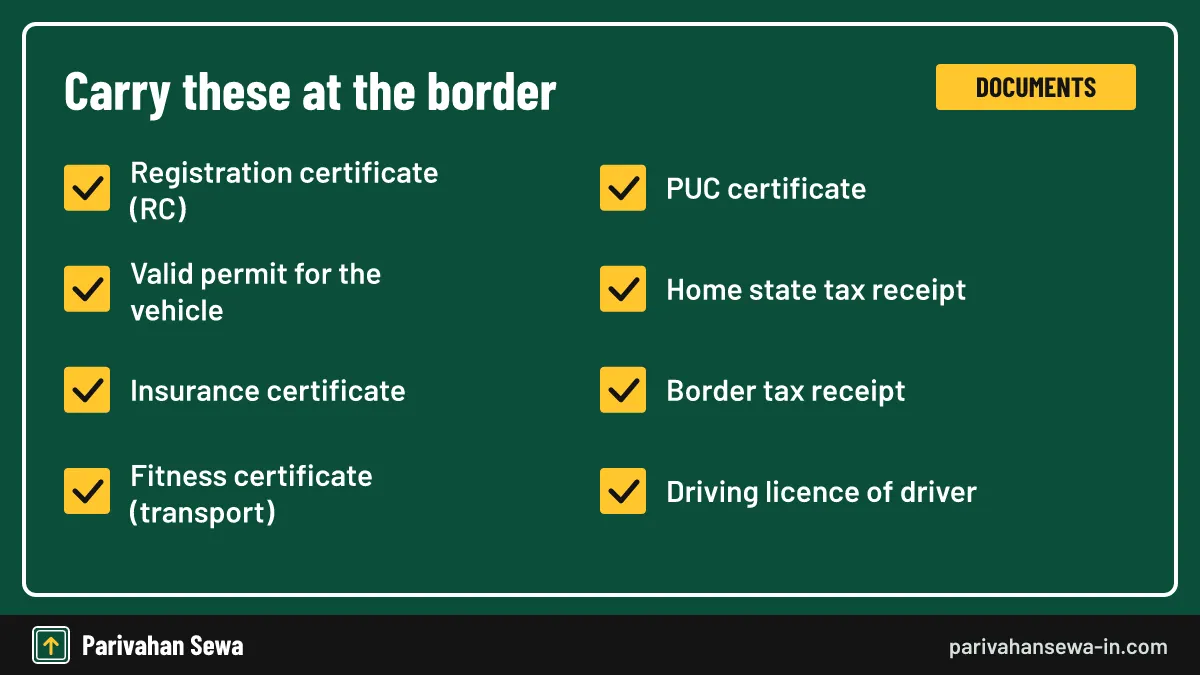
Carry the RC, a valid permit, insurance, fitness certificate for a transport vehicle, PUC, the driver’s licence and the entry tax receipt. Digital copies in DigiLocker or mParivahan are widely accepted.
How do you show an online checkpost tax receipt at the border?
Show the online checkpost tax receipt on your phone or as a printout. It carries a receipt number, the vehicle number, the state, the valid-from and valid-to dates and the amount. The officer can match the number with the Vahan record in seconds.
Phone or paper
A PDF on the phone is enough at most checkposts. Signal is often weak near borders, so save the file offline rather than relying on an email link. A printout in the glovebox helps as a backup.
When there is no physical checkpost
Many states now enforce entry tax through mobile squads or cameras rather than a booth. The receipt still matters: you may be stopped inside the state and asked for it.
What is Vahan checkpost?
Vahan checkpost is the part of the national Vahan system that handles tax and permit payments for vehicles entering another state. It is run by MoRTH with NIC. It replaced many paper counters, so a driver can pay before reaching the state line.
What the module covers
The module handles border tax payment, receipt printing and, in some states, temporary permits. It reads the vehicle data from the registration record so the owner does not have to type everything again.
What can you do on the Vahan checkpost tax service?
On the Vahan checkpost tax service you can pay entry tax, reprint a receipt, check a pending payment, and in some states verify a receipt. The exact menu depends on the visiting state. Options appear only for states that have joined the online system.
Reprint a receipt
If you lose the file, use the print receipt option with the vehicle number or the transaction number. Reprinting does not charge you again.
Check a pending transaction
When money is debited but no receipt appears, the pending transaction option shows whether the payment reached the state. Use it before paying again.
What if a Vahan checkpost tax payment fails?
If a Vahan checkpost tax payment fails, first check whether money left your account. If it did, wait for the transaction to settle and check the pending status. If it did not, simply try again. Many failed payments are settled or reversed within a few hours.

Money debited, no receipt
Note the bank reference number and the time. Check the pending transaction screen after an hour or two. If the payment is confirmed, the receipt can be printed; if not, the bank usually reverses it.
Vehicle details not found
Check the number for typing errors and spacing. Very old or recently transferred records may not load; in that case pay at the checkpost counter and ask your home RTO to update the record.
What is Vahan road tax?
Vahan road tax is the home state tax you pay through Vahan citizen services, separate from border tax. It covers registration-time tax, quarterly or yearly tax for commercial vehicles, and arrears. Most states collect it on Vahan, while a few use their own portals.
How it links to border tax
Border tax checks often look at whether home state tax is current. A vehicle with unpaid Vahan tax may be refused entry papers, so clear it first.
How do you use Vahan pay tax for your home state?
To use Vahan pay tax, open Vahan citizen services, pick your state and RTO, choose the tax payment option, enter the vehicle number and chassis digits, verify the OTP, choose the period and pay. The receipt appears at the end and can be reprinted later.
Who uses it most
Owners of taxis, buses and goods vehicles use it every quarter or year. Private owners use it mainly for a new vehicle, a tax due after a change in use, or arrears after a move.
Paying before an interstate trip
Pay any due home tax a day or two before an interstate trip so the record shows as paid when an officer checks it.
How to check my road tax?
If you are asking how to check my road tax, open Vahan citizen services, choose your state, enter the vehicle number and open the tax or vehicle details option. The screen shows the tax mode, the period paid and any dues. Your RC and the last receipt confirm the same.

What the result means
One-time or lifetime tax means nothing is due for the covered period. A date next to “tax valid up to” means periodic tax that must be renewed. An amount due means arrears.
Other ways to check
Our tax checker guide lists other routes, including the mParivahan app and the RTO counter.
| Where you look | Shows home record? | Shows entry receipt? |
|---|---|---|
| Vahan citizen services | Yes | No |
| Checkpost receipt | No | Yes, for that state and period |
| RC or virtual RC | Tax mode in many states | No |
| RTO counter | Full record | Ask the visiting state |
How do you check vehicle tax before a trip?
To check vehicle tax before an interstate trip, confirm two things: that home state tax is paid up to date on Vahan, and that you have a valid entry tax receipt for each state that charges one. Doing both the day before saves time at the border.
Home tax first
Open the Vahan record and look at the tax valid up to date. If it ends during the trip, pay the next period now.
Entry tax second
For each state on the route, check whether it charges your vehicle class. Pay the ones that do on the checkpost service and save each receipt with the state name in the file name.
What is RTA tax payment?
RTA tax payment means paying vehicle tax at or through the Regional Transport Authority, the name used in states such as Telangana and Andhra Pradesh for the RTO. It usually means home state tax, though transport operators also use the term for entry tax paid to that state.
RTA and RTO
RTA and RTO do the same job: registration, licences, permits and tax. Telangana’s transport services use RTA in many office names. The online payment still runs through Vahan for most services.
Telangana tax for outside vehicles
Telangana rules on vehicles from other states, including re-registration after a long stay, are covered on our Telangana road tax page.
How does UP tax online payment work?
UP tax online payment for a UP-registered vehicle runs through Vahan citizen services with Uttar Pradesh selected. For a vehicle from another state entering UP, the tax is paid on the Vahan checkpost page with Uttar Pradesh as the visiting state. The two payments use different menus.
For UP-registered vehicles
Choose Uttar Pradesh, your RTO, the tax payment service, verify the OTP and pay. Commercial vehicle owners pay by period; private owners rarely need this after registration.
For outside vehicles
Choose Uttar Pradesh in the checkpost module, the service type and the period. The receipt must be valid for the full stay in UP.
UP tax payment for vehicles entering Uttar Pradesh
UP tax payment for outside transport vehicles covers taxis, buses and goods carriers coming in from Delhi, Haryana, Bihar, Uttarakhand and other states. Uttar Pradesh borders more states than almost any other, so its entry rules affect many routes, including Delhi NCR taxis.
Delhi NCR routes
Taxis running between Delhi and Noida or Ghaziabad cross into UP many times a week. Operators usually pay for a longer period rather than per trip, and keep the receipt in the car.
What is HR tax?
HR tax is shorthand for tax paid to Haryana, whose plates start with HR. It can mean the home tax of a Haryana-registered vehicle or the entry tax that outside transport vehicles pay when they come into Haryana. The two are paid through different Vahan services.
HR tax for Haryana vehicles
Haryana-registered owners pay home tax through Vahan with Haryana selected. Our Haryana road tax guide explains the slabs for cars, bikes and commercial vehicles.
Why people search HR tax
Taxi drivers from Delhi, Punjab and Rajasthan often search the term before taking a fare to Gurugram, Faridabad or Chandigarh routes through Haryana.
HR tax for vehicles entering Haryana
For vehicles entering Haryana, HR tax means the entry tax that the state charges certain outside transport vehicles. Pay it on the Vahan checkpost page with Haryana as the visiting state. Private cars on short visits are usually not charged.
Taxis from Delhi and Punjab
Taxis with a Delhi or Punjab state permit going into Haryana usually need the entry tax and, if the permit does not cover Haryana, a temporary permit too.
Buses and trucks
Buses and goods vehicles pay according to seats or weight. Check the service type carefully, because Haryana separates tourist, stage carriage and goods vehicles.
What is Andhra border tax?
Andhra border tax is the entry tax Andhra Pradesh charges on certain transport vehicles registered in other states. It became widely discussed after 2015, when Telangana and Andhra Pradesh each began taxing the other’s transport vehicles after the state split. Pay it through the checkpost service or at the border.
Background of the 2015 dispute
Telangana began levying entry tax on Andhra Pradesh transport vehicles from 1 April 2015, and Andhra Pradesh replied with a similar levy from 25 April 2015. Both affected taxis, buses and goods vehicles. The current rates and status should be confirmed with the AP transport department.
Andhra Pradesh home tax
For tax on AP-registered vehicles, see our AP road tax guide.
Andhra border tax for Telangana vehicles
For a Telangana taxi or bus heading into Andhra Pradesh, Andhra border tax is the main extra cost. Check whether the permit covers AP, pay the entry tax for the trip period, and carry the receipt. A private car on a family visit generally pays no entry tax.
Pilgrimage and holiday routes
Routes from Hyderabad to Tirupati, Srisailam or Vijayawada are busy with tourist vehicles. During festivals, checkpost queues grow, so pay online before leaving.
Moving to Andhra Pradesh for good
If a Telangana vehicle moves to AP for more than 12 months, re-register it there rather than paying entry tax again and again.
What is Karnataka border tax?
Karnataka border tax is the entry tax Karnataka charges on tourist and other transport vehicles registered outside the state. Reports say Karnataka has charged other-state tourist vehicles an annual entry tax since 2013, payable for the whole year however short the stay. Confirm the current schedule before you travel.
Why the annual model matters
An annual tax is costly for an operator who visits only a few times a year. This was one reason Kerala raised its own rates on Karnataka vehicles in 2016.
Karnataka home tax
Tax on Karnataka-registered vehicles is a different topic, covered on our road tax in Karnataka page.
Karnataka border tax for tourist buses and taxis
For tourist buses and taxis, Karnataka border tax depends on the seating capacity and the type of permit. Vehicles from Kerala, Tamil Nadu, Andhra Pradesh, Telangana, Goa and Maharashtra are all affected when they bring tourists to Bengaluru, Mysuru or the coast.
Festival exemptions
Karnataka has at times exempted outside tourist vehicles bound for Mysuru during Dasara, with special permits. Such exemptions are announced each year, so check the transport department notice.
All India Tourist Permit buses
Operators with an AITP have challenged Karnataka’s demands in court. The position for these vehicles is explained in the AITP sections below.
What is Goa border tax?
Goa border tax refers to the entry tax Goa has charged at times on vehicles from other states, collected at border checkposts on national highways. Goa’s rules have changed several times and have drawn protests from transporters in neighbouring Karnataka and Maharashtra. Check the current rule with Goa’s transport department.
Who it has affected
Past Goa entry levies covered three-wheelers, cars and larger vehicles entering by the main highways. Some reports mention a refund if the vehicle left within a few hours. We could not confirm the current rates, so we do not quote them.
Goa border tax and the green cess plan
A June 2023 draft proposed a ₹250 green cess on non-Goan vehicles at border entry points, with a QR code to avoid repeated checks inside the state. At the time, the transport department said it was not aware of a notification. Treat the cess as a proposal unless Goa confirms it.
Tourist taxis from Karnataka and Maharashtra
Tourist taxis bringing visitors to Goa should check both the entry tax and the permit rules, which are separate from any green cess.
Do AITP vehicles still pay border tax?
In principle, a vehicle with an All India Tourist Permit pays one national permit fee instead of state border tax. In August 2023, MoRTH asked all states not to charge such vehicles passenger tax, border tax or check post tax. In practice, some states still raise demands, and the courts have not settled it everywhere.

What the AITP fee is
Under Rule 3(3) of the 2023 rules, the permit fee depends on seats, excluding the driver. The permit runs for 90 days or multiples of 90 days, up to five years. Our all India tourist permit guide explains how to apply.
| Seats (excluding driver) | Annual fee | Quarterly fee |
|---|---|---|
| Less than five | ₹20,000 | ₹6,000 |
| Five to nine | ₹30,000 | ₹9,000 |
| Ten to twenty-two | ₹80,000 | ₹24,000 |
| Twenty-three or more | ₹3,00,000 | ₹90,000 |
Electric and green fuel vehicles
Battery-operated vehicles and those running on methanol or ethanol get the AITP without any permit fee under Rule 3(4).
Home state tax still applies
Rule 4(1) requires an AITP vehicle to have paid the tax of the state where it is registered. The national permit replaces entry tax, not home tax.
What did the Supreme Court say about border tax in 2024?
In 2024, the Supreme Court decided a batch of 117 petitions from tour operators in Muthyala Sunil Kumar v Union of India. It did not strike down state border tax demands on AITP vehicles, because the state laws themselves had not been challenged. It told operators to approach their High Courts.

What it means for operators
State demands remain in force unless a High Court sets aside the state law or the demand. Tax already recovered stays subject to the result of those High Court cases.
What it means for a traveller
If you hire an AITP tourist bus or taxi, ask the operator whether any entry tax is built into the fare. That avoids a surprise demand at the border.
Which vehicles are exempt from check post tax?
Exemptions from check post tax depend on the visiting state. Commonly, private vehicles on short visits, government vehicles, ambulances and some vehicles under special event or pilgrimage notices are left out. AITP vehicles are meant to be exempt nationally, but some states disagree, as explained above.
Event and festival exemptions
States sometimes waive entry tax for a festival or event, such as Dasara in Mysuru. These waivers are time-bound and announced by notice.
How much is border tax?
Border tax has no single national amount. It varies by state, vehicle class, seating capacity, permit and period. A short stay by a small taxi may cost a modest sum, while a large tourist bus on an annual basis can pay lakhs. The online calculator shows the exact figure.
Getting the exact amount
The safest way is to enter your vehicle and trip details in the Vahan checkpost form, which calculates the tax from the state’s current schedule before you pay.
Why we do not list state rates here
Rates change often, and most are published only on state transport sites that we could not confirm. Quoting old figures could mislead you, so we list only figures we could source.

How long is a border tax receipt valid?
A border tax receipt is valid only for the period printed on it, which you pick while paying: a day, a week, a month, a quarter or a year in many states. The vehicle must leave the state, or pay for more time, before the valid-to date passes.
Extending a stay
If the trip runs longer, pay for the extra period on the checkpost service before the receipt expires. Paying late may count as travelling without tax.
What happens if you skip check post tax?
Skipping check post tax can lead to the vehicle being stopped, a penalty under the visiting state’s taxation law and, in serious cases, the vehicle being held until the tax and penalty are paid. The penalty is often several times the tax itself, so paying in advance is cheaper.
At the checkpost
If you reach a checkpost without a receipt, you will usually be told to pay at the counter, sometimes with a penalty. Expect a delay in peak season.
Inside the state
Enforcement squads check vehicles inside the state too. An expired receipt is treated the same as no receipt.
Which border tax mistakes should you avoid?
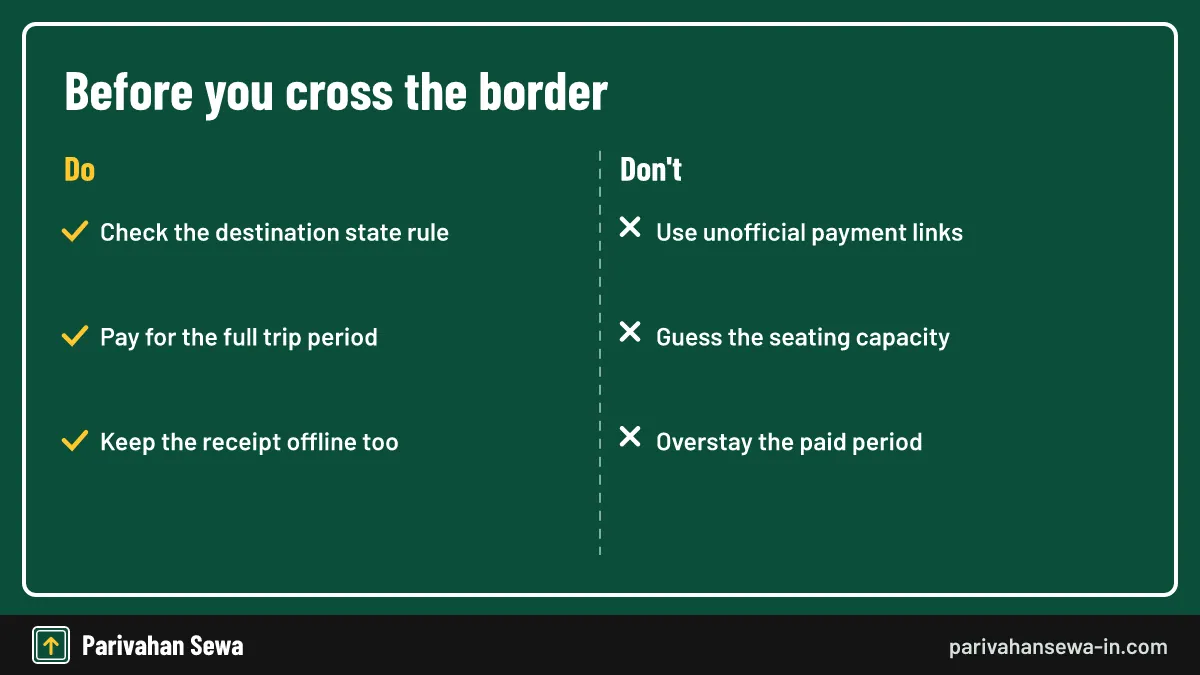
The common border tax mistakes are choosing the wrong visiting state, entering the wrong seating capacity, picking too short a period, paying on an unofficial site and not saving the receipt offline. Each one can lead to a repeat payment or a penalty at the border.
Unofficial payment sites
Pay only on the Vahan checkpost page or the state transport site. Sites that offer to pay border tax for a fee may not pass the money to the state, leaving you with a fake receipt.
Wrong vehicle details
The seats and permit type must match the RC. Entering fewer seats to pay less is easy to spot and leads to a penalty.
Can you get border tax refunded?
A border tax refund is possible in some states when a trip is cancelled or the payment was made twice, but it is not automatic. You apply to the transport department of the state you paid, with the receipt and bank details. Rules and time limits differ.
Double payments
If you paid twice for the same period, keep both receipts and the bank statement. Write to the visiting state’s transport department and the payment gateway.
Cancelled trips
Some states refund unused entry tax only for longer periods. Others do not refund at all. Check before choosing a long period you may not use.
Online border tax or the checkpost counter: which is better?
Online border tax is better for most drivers. You pay before leaving, skip the queue at the border and keep a digital receipt. The checkpost counter is a backup when the online service is down, your state is not listed, or your vehicle record will not load.

| Point | Online on Vahan checkpost | Checkpost counter |
|---|---|---|
| When you pay | Before the trip | On arrival at the border |
| Waiting time | None | Queues in peak season |
| Receipt | PDF on your phone | Paper slip |
| Payment modes | Card, UPI, net banking | Depends on the counter |
| Best for | Planned trips | Backup when online fails |
Toll is separate
FASTag pays highway toll only and never covers border tax. For toll rules, see our FASTag guide.
Official links
Vahan checkpost (border tax payment)vahan.parivahan.gov.in/checkpost ↗Vahan citizen services (home state tax)vahan.parivahan.gov.in ↗Parivahan Sewaparivahan.gov.in ↗Motor Vehicles Act, 1988 (India Code)indiacode.nic.in ↗Check post tax questions
Is check post tax the same in every state?
No. Each state sets its own entry tax under its motor vehicles taxation law, so the amount, the vehicles covered and the periods differ from state to state.
Do private cars pay border tax?
Usually not for short visits. Most states charge entry tax on transport vehicles. A private car kept in another state for more than 12 months must be re-registered there instead.
Can I pay border tax after crossing the checkpost?
Plan to pay before you enter. Crossing without a valid receipt can lead to the vehicle being stopped and a penalty under the state's rules.
Where do I pay border tax online?
Use the Vahan checkpost service at vahan.parivahan.gov.in/checkpost and pick the state you are entering. If your state is not listed, pay at the checkpost counter or on the state transport site.
Is the border tax receipt valid for a return trip?
Only for the period you paid for. Check the dates printed on the receipt. A new trip after that period needs a new payment.
Does FASTag pay border tax?
No. FASTag pays toll on highways. Border tax is a separate state tax paid through the checkpost service or at the counter.
Do AITP vehicles pay border tax?
MoRTH has asked states not to charge them extra, but in 2024 the Supreme Court did not strike down state demands and sent operators to the High Courts. Check the current rule of the state you are entering.
What if my payment is debited but no receipt appears?
Do not pay again at once. Wait for the transaction to settle, then use the pending transaction or print receipt option. Keep the bank reference number.
Is border tax the same as toll tax?
No. Toll is a road user charge on a highway or bridge. Border tax is a state tax on an outside vehicle entering that state.
Can I get border tax back if I cancel the trip?
Refunds depend on the state's rules and are not automatic. Contact the transport department of the state you paid with your receipt number.
Do electric tourist vehicles pay border tax?
Under the 2023 AITP rules, electric, methanol and ethanol vehicles get the national permit without a permit fee. State entry tax rules for other vehicles vary.
Is Vahan checkpost a government service?
Yes. It is part of the Vahan system run by MoRTH and NIC. This website is an independent guide and does not collect any tax.
Parivahan Sewa (parivahansewa-in.com) is an independent information website and is not affiliated with MoRTH, Parivahan or any state transport department. Confirm fees and rules on the official portal before you pay or apply.