Road tax calculator: car tax in India by state, with GST
A road tax calculator multiplies your vehicle's ex-showroom price by the slab rate of the state where it will be registered. A ₹8 lakh petrol car pays about 7% in Delhi, 8% in Uttar Pradesh, 11% in Maharashtra and 14% in Karnataka. GST is already inside the showroom price. The RTO's figure on Vahan is always final.
Key takeaways
- A road tax calculator needs three inputs: the ex-showroom price, the state of registration and the fuel or engine slab.
- GST on cars changed on 22 September 2025: 18% for small cars, 40% for bigger cars and 5% for electric cars, with no cess.
- Private cars usually pay a one-time (life) tax at registration that covers about 15 years; taxis and trucks often pay by period.
- State slabs differ widely, from 4% on a small petrol car in Delhi to 22% on a costly car in Kerala.
- Two-wheelers are taxed by engine cc in some states and by price in others.
- Rates on this page come from secondary guides; always confirm the amount on Vahan or with your RTO before paying.
On this page · 39 sections
How does a road tax calculator work?
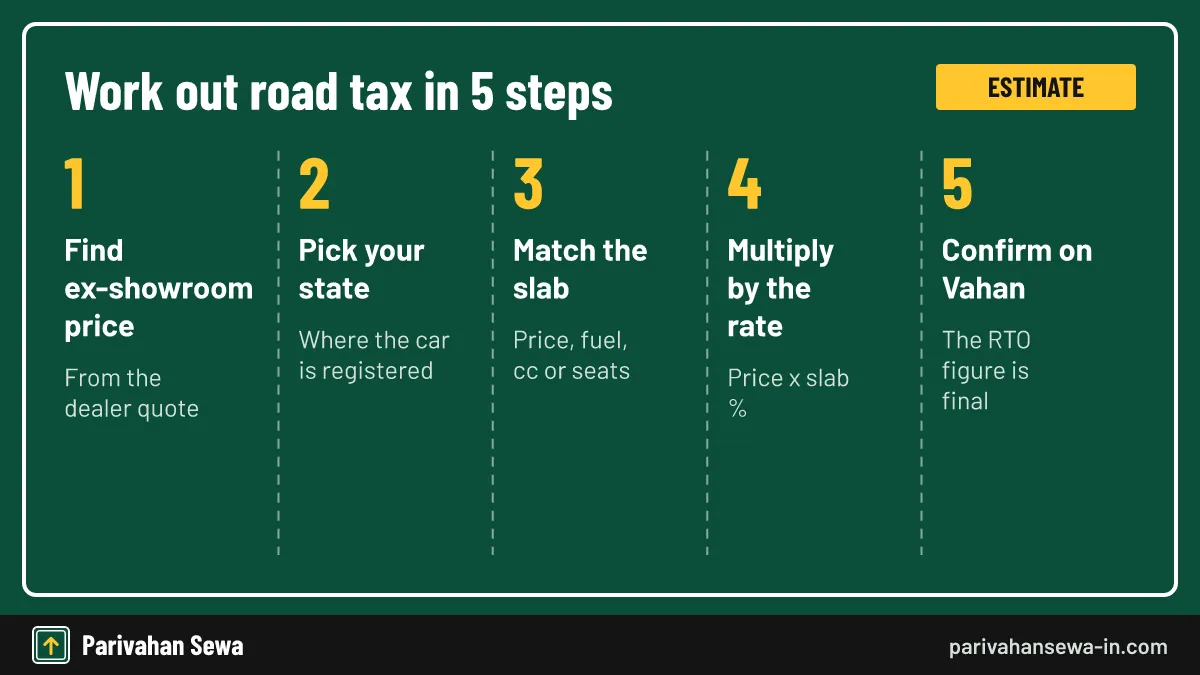
A road tax calculator takes the ex-showroom price of your vehicle and applies the percentage set by the state where it will be registered. The rate depends on price band, fuel type, engine size or seating. The answer is an estimate; the RTO works out the exact amount on Vahan when you register.
The three inputs that matter
You need the ex-showroom price from the dealer quote, the state of registration and the vehicle’s slab details. For cars that usually means price and fuel. For bikes it may be engine cc. Without all three, any estimate can be badly off.
Why online calculators disagree
Private calculators use rate tables that may be old, or round off slab edges. States also add cess or local charges that a simple tool misses.
Where the official figure comes from
When the dealer applies for registration, the Vahan system calculates the tax from the state’s master rates. That figure on the tax receipt is the only one that counts.
Car tax calculator: a worked example
A car tax calculator is simple arithmetic: price multiplied by the slab rate. Take a petrol car with an ex-showroom price of ₹8 lakh. The same car pays very different road tax depending on where it is registered, because each state puts ₹8 lakh in a different slab.
| State | Slab that applies | Rate | Estimated road tax (₹) |
|---|---|---|---|
| Delhi (petrol) | ₹6–10 lakh | 7% | ₹56,000 |
| Uttar Pradesh | Up to ₹10 lakh | 8% | ₹64,000 |
| Gujarat | Flat rate | 6% | ₹48,000 |
| Maharashtra (petrol) | Up to ₹10 lakh | 11% | ₹88,000 |
| Karnataka | ₹5–10 lakh | 14% | ₹1,12,000 |
How to read the example
The difference between Gujarat and Karnataka on this one car is ₹64,000. That is why the state of registration matters more than the model when you budget. Diesel versions pay more in Delhi and Maharashtra.
Adding cess and local charges
Some states add a cess or a city charge on top of the slab. Uttar Pradesh, for example, is reported to add ₹1,500 in temporary charges in cities such as Noida and Ghaziabad. Add such items before you compare quotes.
What is road tax in India and who sets it?
Road tax in India is a state tax on owning and using a motor vehicle on public roads. Each state and Union Territory sets its own rates under its motor vehicles taxation act. The central government does not fix road tax, though it sets registration fees and the national vehicle database.
A state subject
Motor vehicle tax is listed for states in the Constitution, so every state legislature passes its own taxation law. That is why there is no single national rate card.
What the money pays for
States use the revenue for roads, bridges and transport services. It is separate from highway toll, which is a user charge on specific roads and is paid through FASTag. Our road tax guide explains how state road tax is paid and checked.
Vehicle tax in India: the three layers you pay
Vehicle tax in India comes in three layers: GST when you buy the vehicle, road tax when it is registered, and smaller fees for registration, plates and the RC card. Insurance is a separate cost, not a tax, but it also sits in the on-road price. This is the basic shape of new car tax in India.
Layer one: GST
GST is charged by the manufacturer and dealer and is already inside the ex-showroom price. You do not pay it separately at the RTO.
Layer two: road tax
Road tax is paid to the state at registration. For private cars it is usually one-time; for commercial vehicles it is often yearly or quarterly.
Layer three: fees
Central rules set the registration fee. For a private car it is ₹600, with ₹200 more for a smart card RC. States may add their own service charges.
What is the total tax on cars in India?
The total tax on cars in India is GST plus state road tax plus small fees. For a small petrol car after September 2025 that means 18% GST inside the price and road tax of roughly 4% to 14% on top in most states. Bigger cars pay 40% GST and higher road tax slabs.

A rough share of the on-road price
On a ₹8 lakh small petrol car, GST is already part of the ₹8 lakh. Road tax then adds from about ₹48,000 in Gujarat to ₹1,12,000 in Karnataka. Registration and plates add a few thousand more.
What is automobile sales tax in India?
Automobile sales tax in India means GST, the Goods and Services Tax that replaced excise duty and state VAT in July 2017. GST is charged at each sale in the chain and is included in the ex-showroom price. There is no separate state sales tax on a new vehicle any more.
Before GST
Earlier, buyers paid central excise duty and state VAT, with rates varying by state. GST brought one national rate per category.
Vehicle sales tax after the September 2025 GST change
Vehicle sales tax was simplified on 22 September 2025. The GST Council removed the 28% slab and ended the compensation cess on cars. Small cars moved to 18%, all other cars to 40%, and electric cars stayed at 5%.
What the cess used to add
Before the change, a car paid 28% GST plus a cess of 1% to 22% depending on size and engine. A big SUV carried a total of about 50%. Now the same SUV pays a flat 40%.
What it means for buyers
Small cars gained the most, since their total tax dropped from 29–31% to 18%. Since road tax is charged on the ex-showroom price, a lower price also trims the road tax slightly.
How much car sales tax applies to small and big cars?
Car sales tax under GST is 18% on small cars and 40% on others. A small car is a petrol, CNG or LPG car up to 1,200 cc, or a diesel car up to 1,500 cc, and not longer than 4 metres. Anything outside those limits pays 40%.
| Car type | GST + cess before 22 Sep 2025 | GST from 22 Sep 2025 |
|---|---|---|
| Small petrol, CNG, LPG (up to 1,200 cc, up to 4 m) | 28% + 1% = 29% | 18% |
| Small diesel (up to 1,500 cc, up to 4 m) | 28% + 3% = 31% | 18% |
| Mid-size, luxury cars, SUVs, larger hybrids | 28% + 15–22% = 43–50% | 40% |
| Electric cars | 5% | 5% |

The 4-metre rule
Length matters as much as engine size. A compact SUV under 4 metres with a 1.2-litre petrol engine pays 18%. Stretch it past 4 metres and it pays 40%, even with the same engine.
A quick GST example
A small car priced at ₹6,00,000 before tax carries ₹1,08,000 of GST at 18%. You never see this as a separate line at the RTO because the dealer has already charged it.
How much is the tax new car buyers pay at the RTO?
The tax new car buyers pay at the RTO is the state’s one-time road tax plus registration and smart card fees. GST is not paid again here. In most states the dealer collects the amount with the on-road price and pays it on Vahan for you.
What the dealer quote should show
Ask for an itemised quote with separate lines for ex-showroom price, road tax, registration, insurance, plates and any extras.
When you pay it yourself
If you register the car yourself, you pay the tax online on Vahan or at the RTO counter after the dealer uploads the sale details.
Which tax new vehicle owners pay at registration?
The tax new vehicle owners pay depends on the class. Private cars and bikes usually pay one-time tax. Taxis, buses and goods vehicles often pay yearly, half-yearly or quarterly tax, sometimes based on seats or weight. Electric vehicles may get a reduced rate or a waiver.
Private and transport classes
A car bought for personal use is a non-transport vehicle. A car used as a taxi is a transport vehicle with a yellow plate and a different tax schedule, plus permit and fitness rules.
BH series vehicles
Eligible employees can choose the BH number plate. These cars pay tax for two years at a time: 8% up to ₹10 lakh, 10% up to ₹20 lakh and 12% above, with diesel 2% higher and electric 2% lower.
How much is tax on car purchase in India?
The tax on car purchase in India is GST of 18% or 40% inside the price, plus state road tax that usually ranges from about 4% to 22% of the ex-showroom value. Add registration and smart card fees. For most small cars, the road tax line is the largest item after the price itself.

Budget rule of thumb
For a small petrol car, keep 8% to 15% of the ex-showroom price aside for road tax and fees in most large states.
Car tax rates by price slab
Car tax rates in most states rise with the car’s price. A cheaper car falls in a lower percentage band, and once the price crosses a slab edge the whole price is taxed at the higher rate. A few states use engine cc instead, and Gujarat uses one flat rate.
Price-based slabs
Delhi, Uttar Pradesh, Karnataka, Kerala, Tamil Nadu and Odisha all set bands by price. Karnataka, for example, uses four bands: under ₹5 lakh, ₹5–10 lakh, ₹10–20 lakh and above ₹20 lakh.
Engine and fuel slabs
Rajasthan sets car tax by engine size and fuel: 6% for a petrol car up to 800 cc, rising to 12% for a diesel car above 1,200 cc. Maharashtra uses price bands but different rates for petrol, diesel and CNG.
The slab-edge trap
A car priced just above a slab edge can pay more tax than one just below it. In Uttar Pradesh, crossing ₹10 lakh moves the rate from 8% to 10%.
State wise road tax in India for private cars
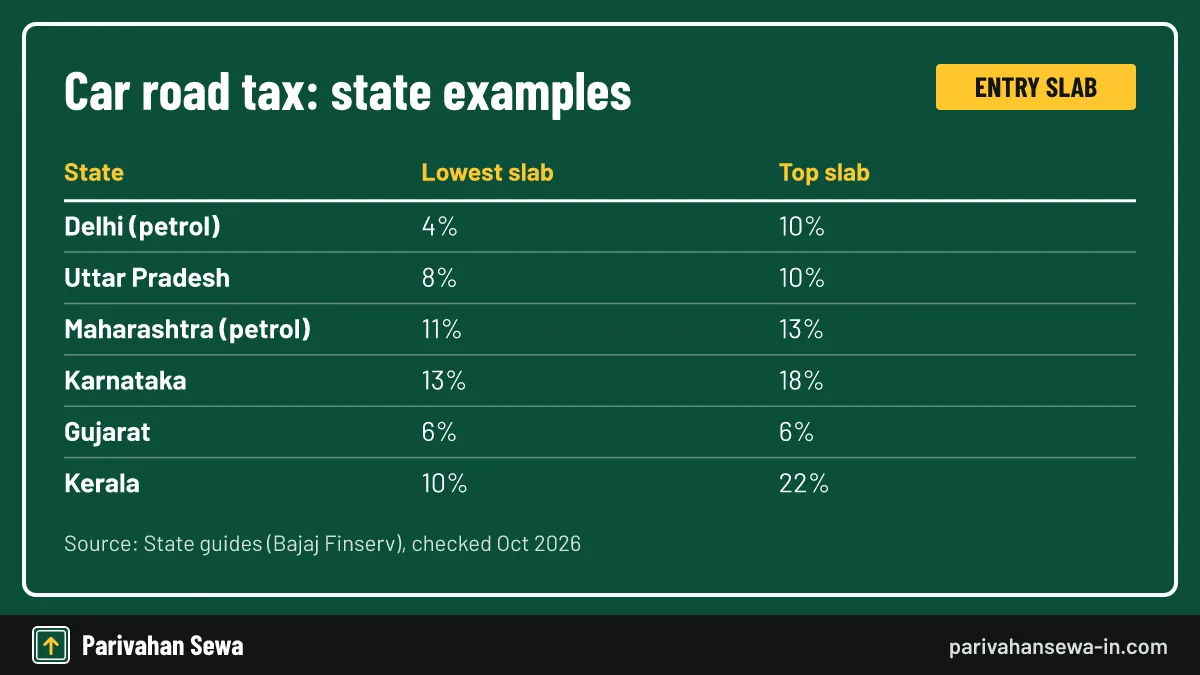
State wise road tax in India varies more than any other part of the car price. The table shows reported rates for new private cars in sixteen states and UTs. Use it to compare, then confirm the current rate with your state transport department.
| State or UT | Reported rate for new private cars |
|---|---|
| Delhi | Petrol 4% / 7% / 10%; diesel 5% / 8.75% / 12.5% (up to ₹6 lakh, ₹6–10 lakh, above ₹10 lakh) |
| Uttar Pradesh | 8% up to ₹10 lakh; 10% above |
| Haryana | 5% up to ₹6 lakh; 8% ₹6–20 lakh; 10% above ₹20 lakh |
| Maharashtra | Petrol 11–13%; diesel 13–15%; CNG/LPG 7–9% (by price band) |
| Gujarat | 6% flat |
| Karnataka | 13% / 14% / 17% / 18% (under ₹5 lakh to above ₹20 lakh) |
| Tamil Nadu | 12% / 13% / 18% / 20% (up to ₹5 lakh to above ₹20 lakh) |
| Kerala | 10% / 13% / 15% / 17% / 22% (up to ₹5 lakh to above ₹20 lakh) |
| Rajasthan | Petrol 6–10%; diesel 8–12% (by engine cc) |
| Madhya Pradesh | 8% up to ₹10 lakh; 8% petrol / 9% diesel ₹10–20 lakh; 16% above |
| Odisha | 6% / 8% / 10% / 12% / 20% (up to ₹5 lakh to above ₹40 lakh) |
| Bihar | 8% / 9% / 10% / 12% (up to ₹1 lakh to above ₹15 lakh) |
| Uttarakhand | 8% / 9% / 10% (up to ₹5 lakh to above ₹10 lakh) |
| Assam | 4% (₹3–15 lakh); 5% (₹15–20 lakh); 7% above |
| Himachal Pradesh | 6% up to ₹15 lakh; 7% above |
| Chandigarh | 6% up to ₹20 lakh; 8% above |
States with their own guides
For more detail, read our guides to UP road tax, Haryana road tax, road tax in Karnataka and Telangana road tax.
West Bengal and Puducherry
West Bengal and Puducherry use fixed amounts by engine size or weight rather than a simple percentage. West Bengal’s 2024 amendment moved cars to lifetime or one-time tax under its Schedule IV, so check the state’s own schedule.
Why does road tax percentage vary so much?
The road tax percentage varies because each state balances revenue, road costs and policy goals in its own taxation law. Some states keep rates low to attract registrations; others charge more on costly cars or diesel. Fuel, engine size and owner type also change the rate within a state.

Fuel and pollution
Delhi, Maharashtra and Rajasthan charge diesel cars more than petrol. CNG cars pay less in Maharashtra, and many states cut tax for electric vehicles. Uttar Pradesh announced a waiver for strong and plug-in hybrids in July 2024.
Owner type
Published state tables are usually for individual owners. In some states a car owned by a company falls under a different column, so ask the RTO which one applies before you register a car in a firm’s name.
Which is the lowest road tax state in India?
There is no official ranking for the lowest road tax state in India, because the answer depends on the car’s price and fuel. Among the states in our table, Assam (4% from ₹3–15 lakh) and Delhi (4% for petrol cars up to ₹6 lakh) have the lowest entry slabs. Gujarat’s flat 6% is among the lowest for costly cars.
Low tax is not a loophole
You can register a car only where you actually live or work, with valid address proof. Registering in a cheaper state while keeping the car elsewhere for over 12 months breaks Section 47 of the Motor Vehicles Act and leads to re-registration and tax in your real state.
Tax on four wheeler in India: what decides the slab
The tax on four wheeler in India depends on five things: price, fuel, engine size, owner type and use. A private petrol hatchback sits in the lowest band of most states; a company-owned diesel SUV can sit in the highest. Transport four-wheelers follow a different schedule.
Price and fuel
Price is the main driver in most states. Fuel shifts the rate up for diesel and down for CNG or electric in many of them.
Seats and weight for transport use
Taxis and goods four-wheelers are often taxed by seating capacity or gross vehicle weight, with payment by quarter or year rather than once.
Imported cars
Maharashtra charges imported cars 20%, much higher than locally made ones. Other states also carry special rates for imported vehicles.
What is life tax for car owners?
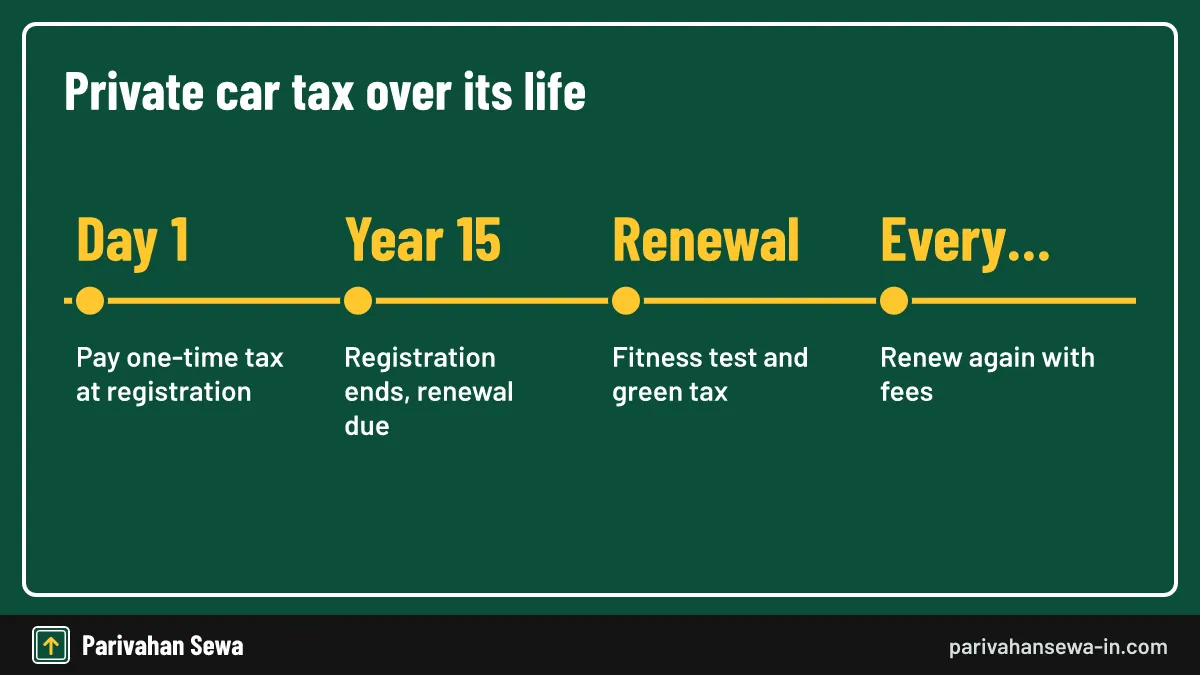
Life tax for car owners is the one-time road tax a private car pays at first registration. It is called life or lifetime tax because no yearly tax is due afterwards. In most states it covers the first 15 years, the length of the first registration of a private vehicle.

What life tax is not
It is not a lifetime pass. After 15 years, renewal of registration usually brings fresh tax and often a green tax for older vehicles.
Moving to another state
Life tax is paid to one state. If you move and re-register the car, the new state charges its own tax on the car’s age and value, and you claim the unused part from the old state.
One time tax for a new car is for how many years?
The one time tax for a new car is for about 15 years in most states. That matches the validity of the first registration certificate of a private car. After that the owner renews the registration for five years at a time, paying renewal fees and any tax the state charges.
Renewal fees after 15 years
Central renewal fees for a private car rose to ₹5,000 from 1 April 2022, and ₹1,000 for a motorcycle. Fitness checks and state tax come on top. See RC renewal after 15 years fees for the full list.
State differences
A few states set the one-time period differently or let owners choose between one-time and periodic payment. Your RC and Vahan record show the exact validity.
What does tax valid upto mean on an RC?
Tax valid upto is the date until which your vehicle’s road tax is paid, as recorded on Vahan. For a new private car on one-time tax, it is normally about 15 years after registration. For a taxi or truck on quarterly tax, it may be only a few months away.
Where to see it
The date appears in the Vahan record, on mParivahan’s virtual RC and on the tax receipt.
When the date has passed
An expired tax date means tax is due, with a penalty that grows with delay.
How do you do a car road tax check?
A car road tax check takes about two minutes on Vahan. Enter the registration number, open the tax service, verify with the chassis digits and OTP, and read the tax pane. It shows the amount paid, the tax mode and the date the tax is valid until.
- Open Vahan citizen services. Go to vahan.parivahan.gov.in and enter your vehicle registration number.
- Choose the tax service. Open Online Services and pick Pay Vehicle Tax or Pay Your Tax, as your state labels it.
- Verify the vehicle. Type the last five characters of the chassis number and confirm with the OTP.
- Read the tax pane. Check the tax mode, the amount due and the validity date shown on screen.
- Pay or note the status. Pay any due amount online, or note that tax is already paid up to the date shown.
If the payment fails
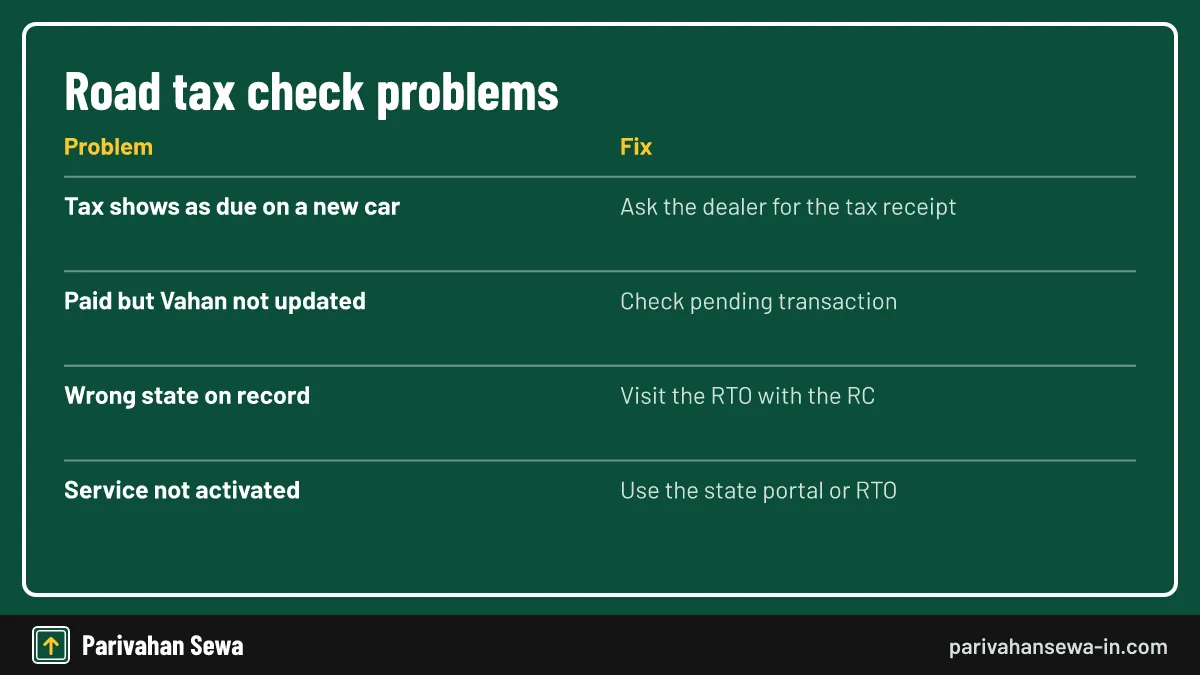
Do not pay twice. Use Status > Check Pending Transaction, which can take an hour or two to update. Our online payment guide covers receipts and failed payments.
Before buying a used car
Run the same check on any used car. Unpaid tax stays with the vehicle, so the buyer inherits the problem.
How much is road tax in Delhi for new car buyers?
Road tax in Delhi for new car buyers is reported at 4% to 12.5% of the ex-showroom price for individual owners. Petrol cars pay 4%, 7% or 10% by price band; diesel cars pay 5%, 8.75% or 12.5%. The bands are up to ₹6 lakh, ₹6–10 lakh and above ₹10 lakh.
A Delhi example
A petrol car at ₹8 lakh falls in the ₹6–10 lakh band and pays about ₹56,000. The same price in diesel would pay 8.75%.
Delhi RTO tax rates for petrol and diesel cars
Delhi RTO tax rates follow a simple three-band table for individual owners. Diesel cars pay about a quarter more than petrol cars in each band.
| Ex-showroom price | Petrol car | Diesel car |
|---|---|---|
| Up to ₹6 lakh | 4% | 5% |
| ₹6–10 lakh | 7% | 8.75% |
| Above ₹10 lakh | 10% | 12.5% |

What RTO tax in Delhi is based on
RTO tax in Delhi is based on the ex-showroom price, the fuel and the owner type. Company-owned cars may fall under a different column, so check before registering a car in a firm’s name.
What are RTO charges in Delhi for a new car?
RTO charges in Delhi for a new car include road tax, the central registration fee of ₹600 for a private car, ₹200 for a smart card RC, and the cost of high security plates. The dealer often adds a handling fee, which is not an RTO charge.
How is Delhi road tax for commercial vehicle owners worked out?
Delhi road tax for commercial vehicle owners is not the same as the private car table. Taxis, buses and goods vehicles are taxed by seats, weight and permit, and may pay one-time or periodic tax. We could not verify the current Delhi transport schedule, so confirm the amount on Vahan.
What to have ready
Keep the permit type, seating capacity or gross weight, and the fitness certificate details ready when you open the tax service.
Entering other states
A Delhi taxi that enters another state may also owe that state’s entry tax. Our check post tax guide explains how that is paid.
What is road tax in Delhi for 2 wheeler owners?
Road tax in Delhi for 2 wheeler owners is a one-time tax at registration, based on the bike’s price. We could not confirm the current Delhi two-wheeler slabs from a reliable source on our check date, so we do not quote a figure. The dealer’s Vahan tax receipt or the RTO will show the exact amount.
How to get the figure
Ask the dealer for the tax line before you pay the booking amount, or check the fee pane on Vahan after the dealer applies.
Electric scooters
Electric two-wheelers often get tax relief under state EV policies. Check the EV subsidy guide for central and state schemes.
How much is road tax in UP for new car buyers?
Road tax in UP for new car buyers is reported at 8% of the ex-showroom price up to ₹10 lakh and 10% above. Cities such as Ghaziabad, Noida, Kanpur, Meerut and Agra are reported to add ₹1,500 in temporary charges. The same rates apply to petrol and diesel.
An Uttar Pradesh example
A ₹8 lakh car pays about ₹64,000. A ₹12 lakh car moves to 10% and pays about ₹1.2 lakh.
Hybrid relief
Uttar Pradesh announced a full road tax waiver for strong and plug-in hybrids in July 2024. Its scope and end date should be checked with the UP Transport Department before you rely on it.
What is the UP RTO tax rate?
The UP RTO tax rate for a new private car is 8% up to ₹10 lakh and 10% above, as reported. Older cars bought from another state pay tax on re-registration based on age, and used cars over 15 years pay green tax at renewal. The full UP picture is in our UP guide.
Where to pay
You can pay on Vahan for UP vehicles. For step-by-step help, see the UP road tax guide.
Commercial vehicles in UP
Taxis, buses and goods vehicles follow different UP schedules by seats and weight, paid by period.
What are car registration charges in UP?
Car registration charges in UP combine the state road tax with the central registration fee. A private car pays the 8% or 10% road tax, ₹600 as the registration fee and ₹200 for a smart card RC, plus plates and any city charge. The dealer usually collects these together.
Typical on-road add-ons
Beyond tax and fees, expect insurance and the high security registration plate in the on-road quote. Ask for each on its own line.
Registering yourself
If you register the car yourself, book an RTO slot after the dealer uploads the sale, pay the tax on Vahan and take the car for inspection if asked.
Maharashtra road tax for car: petrol, diesel and CNG
Maharashtra road tax for car owners is reported at 11% to 13% for petrol, 13% to 15% for diesel and 7% to 9% for CNG or LPG, rising with price across three bands. Imported cars pay 20%. Maharashtra revises rates in state budgets, so confirm before you pay.
| Fuel (individual owner) | Up to ₹10 lakh | ₹10–20 lakh | Above ₹20 lakh |
|---|---|---|---|
| Petrol | 11% | 12% | 13% |
| Diesel | 13% | 14% | 15% |
| CNG or LPG | 7% | 8% | 9% |
| Imported car | 20% | 20% | 20% |
A Maharashtra example
A ₹8 lakh petrol car pays about ₹88,000. The CNG version of the same car would pay 7%, saving a large sum at registration.
Re-registering a car from another state
Maharashtra charges a falling share of its full rate for older cars brought in from other states, from 97.2% for a car one to two years old down to 27.7% for the oldest band.
How much is road tax in Mumbai?
Road tax in Mumbai is the same as in the rest of Maharashtra, because the state sets one table. A car registered at Mumbai Central (MH-01), Andheri (MH-02), Wadala (MH-03) or Borivali (MH-47) pays the same rate as one registered in Pune or Nagpur.
What changes in Mumbai
Only the RTO, queue times and local handling charges change.
Road tax for commercial vehicles in Maharashtra
Road tax for commercial vehicles in Maharashtra depends on the vehicle class, seats, laden weight and permit, and is usually paid by period rather than once. We could not verify the current Maharashtra schedule from a reliable source, so we do not quote rates here. Vahan shows the exact due amount.
Information Vahan asks for
Keep the registration number, chassis digits, permit details and the tax period you want ready. The tax pane lists the modes your vehicle class allows.
How much is Gujarat RTO tax?
Gujarat RTO tax is reported as a flat 6% of the ex-showroom price for private cars, jeeps and SUVs. Two-wheelers up to eight years old also pay 6%, and goods vehicles up to 7,500 kg pay 6% of cost. Gujarat is one of the simplest states to estimate.
A Gujarat example
A ₹8 lakh car pays about ₹48,000. Since the rate is flat, a ₹25 lakh car pays the same 6%.
Transfer tax in Gujarat
Gujarat charges a transfer tax when a car changes hands, reported at 15% of the original lump-sum tax if the car is up to eight years old. The buyer files the transfer on Vahan after the sale.
How much is car tax in Karnataka?
Car tax in Karnataka is among the highest in India, reported at 13% under ₹5 lakh, 14% for ₹5–10 lakh, 17% for ₹10–20 lakh and 18% above ₹20 lakh. Electric cars are reported at 4%. Older cars from other states pay a share based on age.
A Karnataka example
A ₹8 lakh car pays about ₹1,12,000 in road tax, nearly double the Delhi figure for the same petrol car.
More detail
Bengaluru registrations, cess and re-registration of cars from other states are covered in our road tax in Karnataka guide.
How is bike road tax charged?
Bike road tax is charged once at registration in most states, as a percentage of the price or by engine cc. Maharashtra uses engine bands, Karnataka and Telangana use price bands, and Gujarat uses a flat 6%. Imported bikes pay much higher rates in Maharashtra. Because it is paid once, this is often called life tax for bike owners.
| State | How it is charged | Reported rate |
|---|---|---|
| Maharashtra | By engine cc | 10% up to 99 cc; 11% for 99–299 cc; 12% above 299 cc (minimum ₹1,500) |
| Karnataka | By price | 10% under ₹50,000; 12% ₹50,000 to ₹1 lakh; 18% above ₹1 lakh |
| Telangana | By price | 9% up to ₹50,000; 12% above |
| Gujarat | Flat | 6% (up to 8 years old) |
A bike example
A ₹90,000 bike in Karnataka pays 12%, about ₹10,800. A ₹1 lakh 150 cc bike in Maharashtra pays 11%, about ₹11,000.
Two wheeler tax: how states charge scooters and bikes
Two wheeler tax follows one of two methods. Engine-based states raise the rate for bigger engines; price-based states raise it for costlier bikes. A 125 cc scooter and a 125 cc commuter bike usually fall in the same band in an engine-based state, even if prices differ. Across India, 2 wheeler road tax is one-time for private bikes in most states.

Scooters versus motorcycles
Tax does not depend on whether it is a scooter or a motorcycle. Only the price or engine band counts.
Electric scooters
Many states cut tax for electric two-wheelers under their EV policies. Check whether the relief is still running when you buy.
How much is road tax for two wheeler owners?
The road tax for two wheeler owners on a new bike is roughly 6% to 18% of the price, depending on state and band. On a typical ₹1 lakh commuter, that means about ₹6,000 to ₹12,000 in most of the states we checked. The Vahan tax receipt shows the exact figure.
What raises the bill
Crossing a price or cc band, an imported model, or company ownership can each push a bike into a higher rate.
What lowers it
Electric models often get relief, and a few states offer concessions for certain users. Ask the RTO about any relief before registration.
What is old car tax on a used or moved car?
Old car tax comes up in three cases: buying a used car, moving a car to another state and renewing a car after 15 years. Within one state, the original one-time tax carries over to the buyer. Moving states means paying the new state’s tax on the car’s age and value.
Moving a car between states
A car kept in another state for over 12 months must be re-registered there. Get a no objection certificate from the old RTO, pay the new state’s tax, then claim a refund for the unused period from the old state.
Re-registration rates by age
States tax older incoming cars at a share of the new-car rate. Maharashtra charges 97.2% of its rate for a one- to two-year-old car, falling to 27.7% for the oldest band.
Renewal after 15 years
At renewal, states may charge a green tax plus the renewal and fitness fees. Diesel cars face age limits in some regions, so check local rules first.
What is tractor tax?
Tractor tax is the road tax on a tractor registered with the RTO. Many states treat farm tractors differently from tractors used for hire or haulage. Gujarat, for example, is reported to charge 3% of the cost on tractors in commercial use, while some agricultural vehicles may get exemptions or lower rates.
Agricultural or commercial
A tractor used on a farm is registered as an agricultural or non-transport vehicle in most states. A tractor-trailer used to carry goods for hire is a transport vehicle with its own schedule.
Is tractor road tax charged on farm tractors?
Tractor road tax on farm tractors depends on the state. Some states charge a reduced one-time tax, some give a concession for farmers, and others tax them like other non-transport vehicles. We could not verify a nationwide rule, so ask your RTO or check the state’s taxation schedule.
What to ask the RTO
Ask whether the tractor will be registered as agricultural or commercial, which rate applies, and whether a trailer needs separate registration and tax.
Using a farm tractor for hire
If a farm tractor is later used for paid haulage, the owner may need to change the class and pay the commercial tax difference.
Official links
Vahan citizen services (pay or check vehicle tax)vahan.parivahan.gov.in ↗Parivahan Sewaparivahan.gov.in ↗GST portalgst.gov.in ↗Motor Vehicles Act, 1988 (India Code)indiacode.nic.in ↗Road tax calculator questions
Is there an official road tax calculator?
Vahan works out the exact tax for your vehicle when you or your dealer apply. Private estimates, including ours, are only a guide.
Is road tax charged on the ex-showroom price or the on-road price?
Most states apply the rate to the ex-showroom price or the invoice value of the vehicle. Your state's tax act decides the exact base.
Does road tax include GST?
No. GST is a central and state sales tax built into the ex-showroom price. Road tax is a separate state tax charged on top when the vehicle is registered.
How much road tax does an ₹8 lakh car pay?
As an estimate, about ₹56,000 in Delhi for petrol, ₹64,000 in Uttar Pradesh, ₹48,000 in Gujarat, ₹88,000 in Maharashtra for petrol and ₹1,12,000 in Karnataka. Confirm on Vahan before paying.
Do electric cars pay road tax?
Many states cut or waive road tax on electric vehicles. Karnataka's EV rate is reported at 4%. Check your state's current EV policy.
Can I register my car in a cheaper state to save tax?
Only if you genuinely live there. The registration address must be yours, and a car kept in another state for more than 12 months must be re-registered there under Section 47 of the Motor Vehicles Act.
Is life tax refundable if I sell my car?
No. The tax stays with the vehicle when it is sold within the same state. A refund for the unused period arises only when the vehicle is re-registered in another state.
Do I pay road tax again after 15 years?
Usually yes. At renewal of registration after 15 years, states charge tax again, often with a green tax, along with the renewal and fitness fees.
Is road tax the same for diesel and petrol cars?
Not always. Delhi, Maharashtra and Rajasthan charge diesel cars more than petrol cars in each slab. Uttar Pradesh and Gujarat use one rate for both, as reported.
What happens if I pay road tax late?
States add a penalty that grows with the delay, and the vehicle can be stopped for running without valid tax.
Does a BH series car pay road tax differently?
Yes. BH series private vehicles pay tax for two years at a time: 8% up to ₹10 lakh, 10% from ₹10 to 20 lakh and 12% above ₹20 lakh, with 2% more for diesel and 2% less for electric.
Is this website the RTO?
No. This is an independent guide. Pay only on Vahan, your state transport site or at the RTO.
Parivahan Sewa (parivahansewa-in.com) is an independent information website and is not affiliated with MoRTH, Parivahan or any state transport department. Confirm fees and rules on the official portal before you pay or apply.