Road tax in Karnataka: lifetime tax rates, cess and how to pay
Road tax in Karnataka on a new private car is a one-time lifetime tax of 13% to 18% of its cost, plus an 11% cess on that tax. Two-wheelers are reported at 10% to 18%. Electric cars pay 5%, 8% or 10% by price under the 2026 amendment. Vehicles from other states pay a reduced share by age after 30 days.
Key takeaways
- Road tax in Karnataka for private cars and bikes is a lifetime tax charged once, as a percentage of the vehicle's cost.
- Cars pay 13%, 14%, 17% or 18% under Part A5 of the Karnataka Motor Vehicles Taxation Act, 1957, with an 11% cess on top.
- The 2026 amendment taxes electric cars at 5% up to ₹10 lakh, 8% up to ₹25 lakh and 10% above that.
- A vehicle from another state that stays more than 30 days pays 93% (new) down to 25% (over 15 years) of the new-vehicle tax.
- Buses and sleeper coaches pay quarterly tax per seat; most new cabs and light goods vehicles pay lifetime tax.
- This is an independent guide; confirm the amount on Vahan or with your RTO before paying.
On this page · 25 sections
What is road tax in Karnataka and who pays it?
Road tax in Karnataka is the motor vehicle tax the state levies on every vehicle fit for use on its roads. Private cars and two-wheelers pay it once, as a lifetime tax, when they are first registered. The registered owner, or the person in possession of the vehicle, is liable to pay.
The law behind it
The tax comes from section 3 of the Karnataka Motor Vehicles Taxation Act, 1957 (Karnataka Act 35 of 1957). The rates sit in Part A of its Schedule, split into numbered parts such as A1 for two-wheelers, A5 for cars and A8 for motor cabs.
Lifetime tax is paid in advance
Under section 4(3), lifetime tax is paid in a lump sum in advance and covers the vehicle for its life on Karnataka’s rolls. A vehicle with a current registration certificate is treated as fit for road use, so the tax is due even if it is rarely driven.
How much is Karnataka road tax for cars?
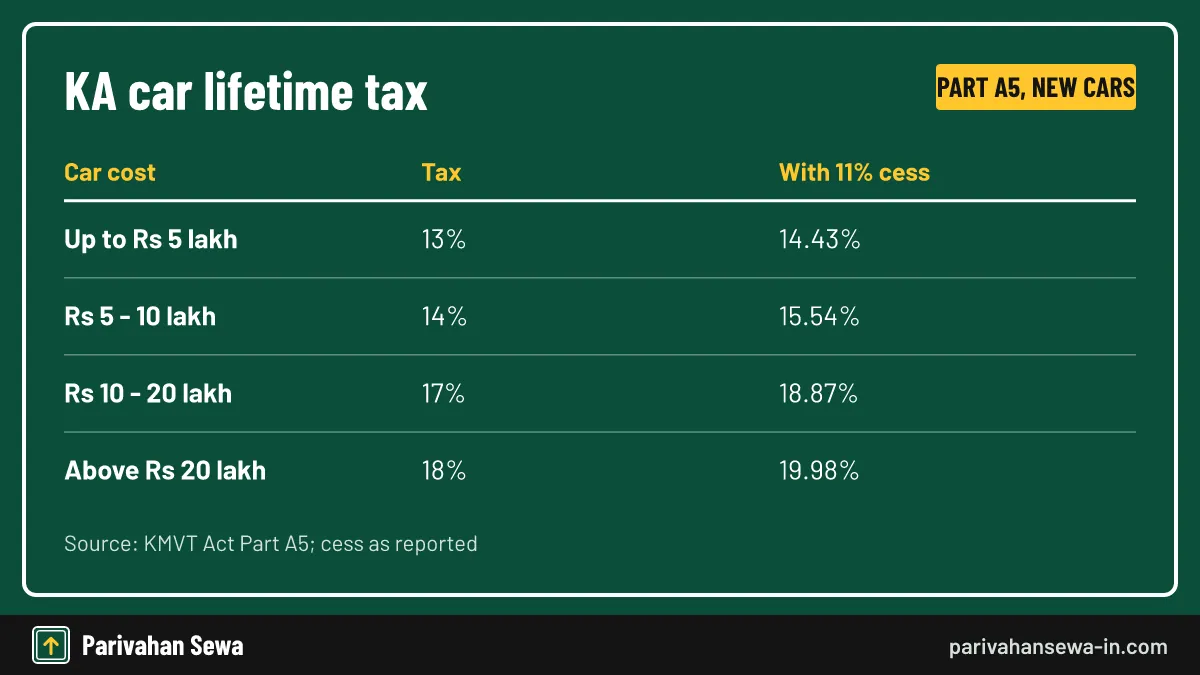
Karnataka road tax for cars depends on the cost of the vehicle. Part A5 charges new motor cars, jeeps, omni buses and private service vehicles 13% up to ₹5 lakh, 14% from ₹5 lakh to ₹10 lakh, 17% from ₹10 lakh to ₹20 lakh and 18% above ₹20 lakh.
| Cost of the new car | Lifetime tax | Tax with 11% cess |
|---|---|---|
| Up to ₹5 lakh | 13% | 14.43% |
| Above ₹5 lakh to ₹10 lakh | 14% | 15.54% |
| Above ₹10 lakh to ₹20 lakh | 17% | 18.87% |
| Above ₹20 lakh | 18% | 19.98% |
What counts as a car here
Part A5 covers motor cars, jeeps, omni buses and private service vehicles with a floor area up to 5 square metres.
The whole price falls in one band
The percentage applies to the full cost, not just the slice above a band edge. A car priced just over ₹10 lakh pays 17% on the entire amount, so compare variants close to a limit.
How much is road tax for bike in Karnataka?
The road tax for bike in Karnataka is reported at 10% of cost for two-wheelers under ₹50,000, 12% from ₹50,000 to ₹1 lakh and 18% above ₹1 lakh. These Part A1 rates come from a secondary source, as the 2026 Bill did not reprint them, so confirm the figure at your RTO.
| Cost of the new two-wheeler | Lifetime tax (reported) |
|---|---|
| Below ₹50,000 (lowest band) | 10% |
| ₹50,000 to ₹1 lakh | 12% |
| Above ₹1 lakh | 18% |
Scooters and motorcycles alike
Part A1 treats motorcycles, motor scooters and cycles with an engine attachment the same way. Engine size does not matter; the invoice cost decides the band.
Why the top band hurts
The jump from 12% to 18% at ₹1 lakh is steep.
Road tax in Karnataka for 2 wheeler: worked examples
Putting real prices through the slabs shows what road tax in Karnataka for 2 wheeler buyers actually pay. These are our estimates using the reported rates and the 11% cess. The dealer’s on-road quote and the RTO receipt are the figures to rely on.
- ₹45,000 scooter at 10%: ₹4,500 tax plus ₹495 cess, about ₹4,995.
- ₹90,000 scooter at 12%: ₹10,800 tax plus ₹1,188 cess, about ₹11,988.
- ₹1,50,000 motorcycle at 18%: ₹27,000 tax plus ₹2,970 cess, about ₹29,970.
The ₹1,000 welfare cess
Spinny reports a further ₹1,000 cess at registration of any non-transport personal vehicle, for the state’s transport workers’ welfare fund. Check whether your quote already includes it.
Electric scooters
The 2026 Bill sets out new slabs for electric cars and cabs but we found no matching two-wheeler table. Ask the dealer for the current e-scooter rate before you book.
What is the Karnataka road tax percentage for electric vehicles?
The Karnataka road tax percentage for electric cars is 5% up to ₹10 lakh, 8% from ₹10 lakh to ₹25 lakh and 10% above ₹25 lakh, under the new Part A5(a). Before this, only electric cars above ₹25 lakh paid 10%, and cheaper EVs were exempt.

Worked EV figures
A ₹20 lakh electric car pays 8%, or ₹1,60,000, plus ₹17,600 cess and ₹1,000, about ₹1,78,600. A ₹9 lakh EV at 5% comes to about ₹50,950 with both cesses.
Status of the change
The slabs are in LA Bill No. 12 of 2026, which takes effect on a date the government notifies. Spinny reports the rates in force from 1 April 2026. We could not see the notification itself, so confirm before you buy.
What cess is added to vehicle tax in Karnataka?
Vehicle tax in Karnataka carries an 11% cess on the road tax paid under section 3, as reported by Spinny. On a ₹1,12,000 tax bill that adds ₹12,320. A separate ₹1,000 cess is reported at registration of non-transport personal vehicles.
The cess is on the tax, not the price
Because the cess is 11% of the tax, it turns a 14% slab into an effective 15.54% of the car’s cost.
GST is a different tax
GST is already built into the ex-showroom price and goes to the GST system. Road tax and cess go to the Transport Department and are added at registration.
How is road tax in Bangalore added to the on-road price?
Road tax in Bangalore is the same state lifetime tax, collected by the city’s RTOs. Dealers add it to the ex-showroom price along with the cess, registration fee, number plate, insurance and handling charges. Only the tax and official fees are fixed by law.
Same rates across the state
A car registered at a Bengaluru RTO pays exactly what it would pay in Belagavi or Mangaluru. The office changes the KA number series, not the tax.
Read the quote line by line
Ask the dealer to show road tax separately from insurance and accessories.
Which RTO charges in Bangalore come on top of road tax?
RTO charges in Bangalore for a new private vehicle usually include the central registration fee, the smart card fee, the HSRP number plate and, where it applies, hypothecation entry for a loan. These are set by the Central Motor Vehicles Rules and Karnataka rules, not by the dealer.
Fees we did not quote
Fee amounts change by notification and vehicle class. Vahan works out the exact sum for your vehicle, so use the figure it shows rather than a dealer’s round number.
How to use a Karnataka road tax calculator by hand
A Karnataka road tax calculator only does three sums: pick the slab for the cost, multiply, then add 11% of the result. For a ₹15 lakh petrol car: 17% gives ₹2,55,000, the cess adds ₹28,050 and the welfare cess ₹1,000, about ₹2,84,050.
The steps in order
Find the cost on the invoice, choose the band, apply the percentage to the full cost, add 11% of that tax, then add the ₹1,000 cess for a personal vehicle. For a used vehicle, multiply by the age percentage first.
Compare with other states
To see how Karnataka’s rates stack up against other states, try our road tax calculator guide, which covers the main state slabs side by side.
Karnataka road tax for other state vehicles
Karnataka road tax for other state vehicles works out as a share of the new-vehicle tax, based on age. Explanation-2 to section 3 brings an outside-registered vehicle under the Karnataka schedules once it has been in the state for more than 30 days, notwithstanding the Motor Vehicles Act.

Visiting vehicles and transport vehicles
Tourist taxis and buses that only pass through pay entry or check post tax for the period instead. Our check post tax guide explains how that is paid online.
Central employees on transfer
Motorcycles of central government, defence and central PSU or nationalised bank staff brought in on transfer pay ₹125 a quarter instead of lifetime tax, if tax was already paid in the old state.
When does other state vehicle tax in Karnataka start?
Other state vehicle tax in Karnataka becomes payable after the vehicle has been in the state for more than 30 days, under Explanation-2 to section 3. Separately, section 47 of the Motor Vehicles Act requires a new registration mark once a vehicle has been kept in another state for over 12 months.
Two clocks, two duties
The 30-day rule is about tax; the 12-month rule is about the number plate.
How is lifetime tax worked out for a used vehicle moved into Karnataka?
For an already registered vehicle, Clause B of each table charges a percentage of the new-vehicle tax based on age from the month of registration. It starts at 93% for vehicles up to 2 years old and falls to 25% for vehicles over 15 years.
| Age from month of registration | Share of new-vehicle tax |
|---|---|
| Up to 2 years | 93% |
| 2 to 3 years | 87% |
| 3 to 4 years | 81% |
| 4 to 5 years | 75% |
| 5 to 6 years | 69% |
| 6 to 7 years | 64% |
| 7 to 8 years | 59% |
| 8 to 9 years | 54% |
| 9 to 10 years | 49% |
| 10 to 11 years | 45% |
| 11 to 12 years | 41% |
| 12 to 13 years | 37% |
| 13 to 14 years | 33% |
| 14 to 15 years | 29% |
| More than 15 years | 25% |
A worked example
A car that cost ₹10 lakh falls in the 14% band, so new-vehicle tax is ₹1,40,000. If it is four to five years old, it pays 75%: ₹1,05,000, plus ₹11,550 cess, about ₹1,16,550.
What documents are needed to re-register a vehicle in Karnataka?
To move a vehicle onto Karnataka’s rolls, you need a no objection certificate on Form 28 from the old RTO, a police or SCRB report, Form 27 for a new KA mark, the original RC and insurance, and the financier’s consent if the vehicle is on loan.

Getting the NOC
The NOC is issued by the RTO where the vehicle is now registered. Our guide to the no objection certificate covers how to apply and track it.
If the NOC is late
A Bengaluru guide notes that if the NOC does not arrive within 30 days, you can apply with a copy of the Form 28 request, the postal acknowledgement and a declaration.
Can you claim a tax refund when you leave Karnataka?
Yes. Section 7(3) refunds part of the lifetime tax when the vehicle is removed to another state on transfer of ownership or change of address, or when registration is cancelled after scrapping. The share falls with every year since registration.
How the refund falls
The refund tables in the 2026 Bill return 93% of the tax within a year, 87% after one to two years, then less each year down to 25% after 14 to 15 years. After 15 years, nothing is refunded.
Unused periodic tax
For quarterly or annual tax, section 7(1) refunds a portion when the vehicle was not used for at least one full calendar month of the paid period.
What are the 15 year old vehicle registration fees in Karnataka?
The 15 year old vehicle registration fees in Karnataka combine the central renewal fee, a fitness test fee, the smart card fee and Karnataka’s green tax. For a private car that comes to about ₹6,700 if you renew on time, before service charges.
| Item (private vehicle over 15 years) | Car | Motorcycle |
|---|---|---|
| Renewal of registration (central) | ₹5,000 | ₹1,000 |
| Fitness test (over 15 years) | ₹1,000 | ₹500 |
| Smart card RC | ₹200 | ₹200 |
| Karnataka green tax | ₹500 | ₹250 |
| Estimated total, on time | ₹6,700 | ₹1,950 |
Late renewal costs more
Applying after the RC expires adds a late fee, reported at ₹300 for each month of delay for private vehicles. See our guide to RC renewal after 15 years fees for the central rules.
Road tax for commercial vehicles in Karnataka
Road tax for commercial vehicles in Karnataka is collected in two ways. Buses, contract carriages and sleeper coaches pay quarterly tax per seat or berth. New motor cabs, light goods vehicles, tractor-trailers and construction equipment pay a lifetime tax on cost when registered.

Goods vehicles
New goods vehicles weighing over 1,500 kg and up to 12,000 kg gross pay lifetime tax under Part A6, as do such vehicles migrating from other states. Goods autos up to 1,500 kg fall under Part A4.
New 10% lifetime classes
The 2026 Bill puts new commercial tractor-trailers, construction equipment vehicles and drilling-rig vehicles on a 10% lifetime tax, with the same age table for used ones.
How does road tax for yellow board vehicle in Karnataka online payment work?
Road tax for yellow board vehicle in Karnataka online payment runs through Vahan citizen services, the same as private vehicles. A yellow board cab pays lifetime tax once; buses and other quarterly-tax vehicles return each quarter. The tax screen reads the class, seats and permit type from the record.
Motor cab slabs
Under the proposed Part A8, new motor cabs pay 5% up to ₹10 lakh, 9% from ₹10 lakh to ₹15 lakh and 15% above. Electric cabs pay 5%, 8% or 10% under Part A8(a).
Pay before the period starts
Section 4(1) says periodic tax is due in advance, within a month from the start of the quarter, half-year or year you choose.
What tax do buses and contract carriages pay per seat?
Contract carriages pay a quarterly amount for every passenger seat. The 2026 Bill proposes ₹1,500 per passenger for most contract carriages, ₹2,000 for larger ones outside rule 151(2), ₹2,500 per seat for luxury buses and ₹3,000 per berth for sleeper coaches.
- Over 20 passengers, meeting KMV rule 151(2): ₹1,500 per passenger.
- 12 to 20 passengers, other: ₹1,500 per passenger.
- Over 20 passengers, other: ₹2,000 per passenger.
- LMV contract carriages converted from maxi cabs by 28 May 2021: ₹700 per passenger.
- Luxury buses: ₹2,500 per passenger (down from ₹3,500).
- Sleeper coaches: ₹3,000 per sleeper (down from ₹4,000).
These are proposed figures
The amounts above come from the Bill. If it has not been notified for your quarter, the older rates in the Act still apply, so check the Vahan assessment.
How to pay road tax in Karnataka?
How to pay road tax in Karnataka depends on the vehicle. A new private vehicle’s lifetime tax is collected at registration, usually through the dealer. For a transport vehicle’s periodic tax or arrears, pay on Vahan citizen services with the registration and chassis numbers.
- Open Vahan citizen services. Go to the Vahan Vehicle Related Services page and choose Karnataka as the state.
- Enter the vehicle. Type the KA registration number and the last five characters of the chassis number, then validate.
- Choose Pay Your Tax. Pick the tax service and confirm the OTP sent to the mobile number on the RC.
- Check the assessment. Read the tax, cess, penalty and arrears lines and the period the payment covers.
- Pay and save the receipt. Pay by card, UPI or net banking and download the receipt before closing the page.

When to go to the RTO
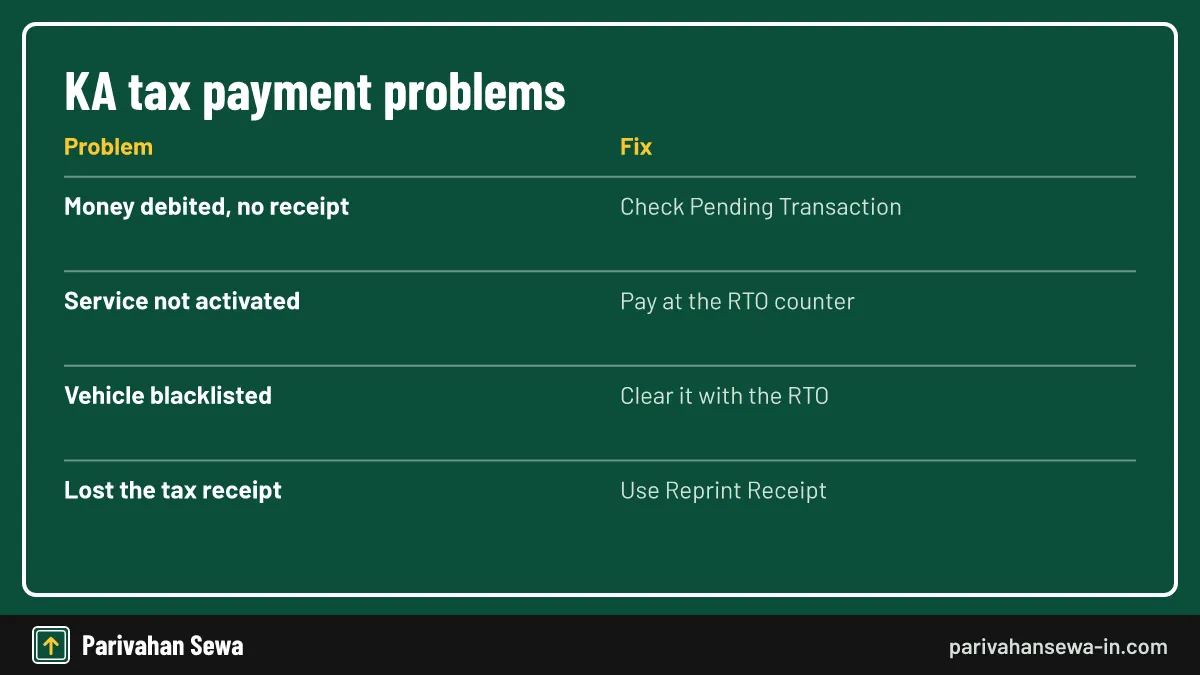
Transfers, re-registration and refunds may still need the RTO to check documents. If Vahan says the service is not activated for your office, pay at the counter instead.
Can you pay road tax in Karnataka online?
Yes. Road tax in Karnataka online payment is available through Vahan, which most state RTOs use for tax. Menu labels such as “Pay Your Tax” or “Pay Vehicle Tax” vary, but the flow is the same: number, chassis digits, OTP, assessment, payment.
If the payment hangs
A failed or unconfirmed payment can stay pending for one to two hours. Use Status, then Check Pending Transaction before paying again, to avoid a double debit.
Where to get your Karnataka road tax receipt
Your Karnataka road tax receipt can be downloaded again from Vahan. Go to Status, then Reprint Receipt, and search by application number, receipt number, bank transaction number or registration number. Save the PDF and keep a printed copy with the RC.
Why the receipt matters
Checking officers ask for proof of tax, and an RTO wants it for transfer, NOC, re-registration or a refund claim.
What is a Karnataka state permit?
A Karnataka state permit lets a transport vehicle carry passengers or goods for hire within the state. Under section 66 of the Motor Vehicles Act, no transport vehicle may be used without a permit. In Karnataka these are granted by the State Transport Authority and the Regional Transport Authorities.
Permit and tax are separate
A permit does not replace tax. The tax screen reads the permit type to set the amount, and both must be valid for the vehicle to run legally.
Validity
A regular permit is valid for five years from grant or renewal under section 81, and renewal should be sought at least 15 days before it expires.
Which permits does Karnataka issue for transport vehicles?
Karnataka’s transport authorities issue stage carriage, contract carriage and goods carriage permits for use within the state, plus temporary and special permits. For travel across India, operators use the national goods permit or the All India Tourist Permit through Vahan.
Temporary and special permits
A temporary permit covers a short need such as a season or pending renewal. Our temporary permit guide explains how to apply on Vahan.
Trucks going out of state
For lorries running across many states, the national permit replaces separate state permits, though home-state tax must still be paid.
What happens if tax on a vehicle stays unpaid in Karnataka?
A vehicle without valid tax can be stopped, checked and seized. Spinny reports that if the tax is still unpaid 30 days after seizure, the vehicle may be sold after notice and a hearing of objections, unless the owner pays the dues first. Penalties are added to the assessment.
Arrears follow the vehicle
Unpaid tax shows on the Vahan record and blocks services such as transfer, NOC and fitness renewal until cleared.
Who pays a lower rate or is exempt in Karnataka?
Some owners pay less. Invalid carriages and adapted vehicles for Divyangjan pay ₹10 a quarter. Transferred central government employees’ motorcycles pay ₹125 a quarter. Tractors and trailers owned by farmers or listed agricultural co-operatives pay under a separate Part A2 table.
Vintage and classic cars
Vintage and classic cars are taxed under their own Part A3 rates rather than the normal car slabs.
Finding the right part
The road tax overview explains how states group vehicles into classes. In Karnataka, the class on your RC decides which Part of the Schedule applies.
Official links
Vahan citizen services (tax payment)vahan.parivahan.gov.in ↗Karnataka Transport Departmenttransport.karnataka.gov.in ↗Vahan check post tax (other-state vehicles)vahan.parivahan.gov.in ↗Vahan national permitvahan.parivahan.gov.in ↗Karnataka Motor Vehicles Taxation (Amendment) Bill, 2026prsindia.org ↗Road tax in karnataka questions
How much road tax will an ₹8 lakh car pay in Karnataka?
It falls in the 14% band, so the tax is ₹1,12,000. Adding the 11% cess (₹12,320) and the ₹1,000 welfare cess brings it to about ₹1,25,320.
Is road tax in Bangalore different from the rest of Karnataka?
No. The same state Act applies in every district. Bengaluru buyers pay the same slabs as buyers in Mysuru or Hubballi; only the RTO office differs.
Do electric cars still pay zero road tax in Karnataka?
Not any more, according to the 2026 amendment and reports that it applies from 1 April 2026. Electric cars pay 5%, 8% or 10% of cost by price band.
What is the road tax on a ₹90,000 scooter in Karnataka?
At the reported 12% rate it is ₹10,800, or about ₹11,988 with the 11% cess. The RTO receipt shows the binding figure.
When must an other-state car pay Karnataka tax?
The Act taxes an outside-registered vehicle that stays in Karnataka for more than 30 days. Re-registration with a KA number is required after 12 months.
Can I get my Karnataka road tax back if I move away?
Yes. Section 7(3) refunds part of the lifetime tax when the vehicle moves to another state or is scrapped. The share falls each year and is nil after 15 years.
How do I get a copy of my Karnataka road tax receipt?
Use Status, then Reprint Receipt on Vahan citizen services, searching by application number, receipt number or registration number.
Who issues permits in Karnataka?
The State Transport Authority and the Regional Transport Authorities under the Transport Department. National and tourist permits are applied for through the Vahan permit system.
Is this the Karnataka Transport Department website?
No. This is an independent guide. Pay only on Vahan, at a Karnataka RTO counter or through a channel the Transport Department names.
Parivahan Sewa (parivahansewa-in.com) is an independent information website and is not affiliated with MoRTH, Parivahan or any state transport department. Confirm fees and rules on the official portal before you pay or apply.