UP road tax explained: rates, waivers, penalties and check posts
UP road tax on a new private car is a one-time payment on its cost: 8% without AC or 9% with AC up to ₹10 lakh, and 11% above ₹10 lakh, as reported for the April 2025 schedule. Two-wheelers pay 7% up to ₹40,000 and 10% above. EVs are exempt only if made, sold and registered in UP until October 2027.
Key takeaways
- UP road tax for private cars and two-wheelers is paid once, at registration, on the cost of the vehicle.
- Cars are reported at 8% or 9% up to ₹10 lakh (non-AC or AC) and 11% above ₹10 lakh; bikes pay 7% or 10% around the ₹40,000 line.
- The EV and strong-hybrid waiver ended on 13 October 2025; until October 2027 only EVs made, sold and registered in UP stay tax-free.
- Goods vehicles, autos and e-rickshaws pay every year by tonnage or seats, with an optional one-time choice for three-wheelers.
- Check posts, Punjab border tax and Karnataka or MP entry tax affect commercial trips; private cars on a visit rarely pay.
- This is an independent guide. Confirm the final amount on Vahan or with your UP RTO before paying.
On this page · 38 sections
What is UP road tax?
UP road tax is the motor vehicle tax that Uttar Pradesh charges before a vehicle may use public roads in the state. For private cars and two-wheelers it is a one-time payment at registration, worked out as a percentage of cost. Commercial vehicles usually pay by the year instead.

Why the state charges it
Roads, bridges and enforcement are state subjects, so each state fixes its own vehicle tax. UP’s rate is separate from the GST you pay the dealer and from the registration fee, which is set by central rules.
What the receipt proves
The tax receipt, and the “tax valid upto” date on the vehicle record, prove that the vehicle has paid. For a private car that date normally runs for the life of the first registration.
Which law governs UP road tax?
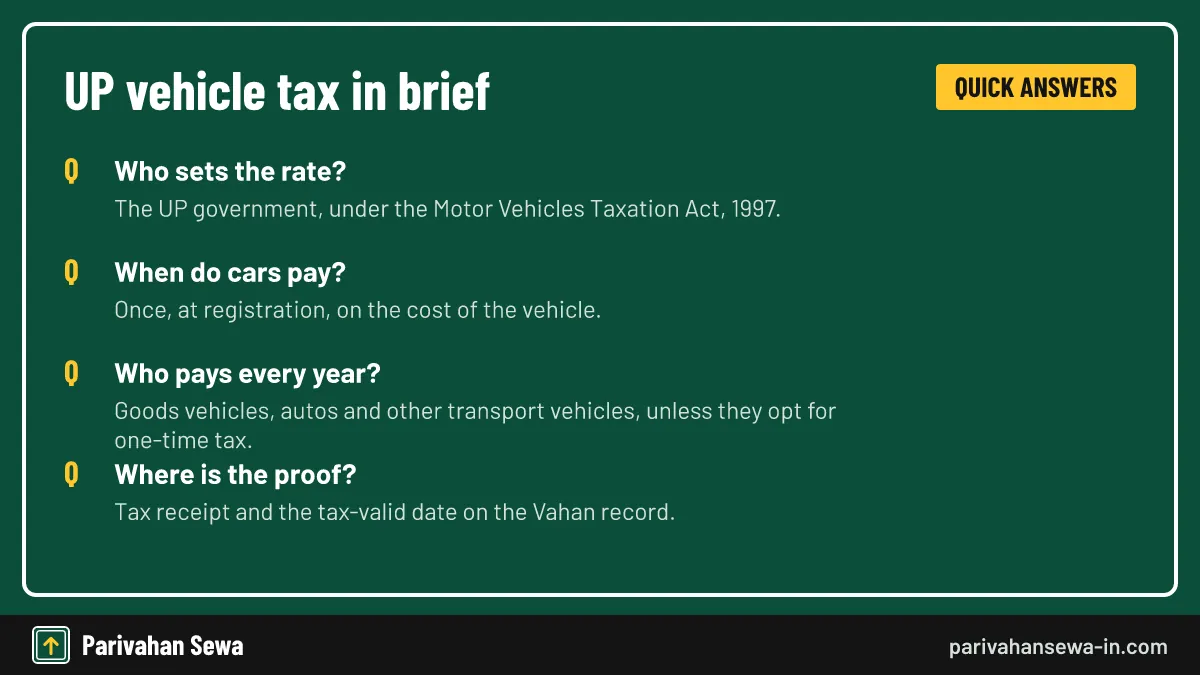
The Uttar Pradesh Motor Vehicles Taxation Act, 1997 is the law behind UP road tax. It lists who must pay, allows the state to notify rates, and sets out penalties, refunds and seizure powers. Rates themselves come from government notifications, which is why they change without a new Act.
The 1997 Act and its rules
The Act is read with the UP Motor Vehicles Taxation Rules, which fix forms, dates and the procedure for declarations. Officers at the RTO apply both when they work out your tax.
Why notifications matter
A new notification can change a rate overnight. The car rates on this page are tied to a notification reported as dated 21 April 2025, and we flag where sources disagree.
Who has to pay UP road tax?
Anyone who registers a vehicle in Uttar Pradesh pays UP road tax, whether a person, a company or a fleet. Owners from other states pay only when they keep the vehicle in UP long enough to need fresh registration, or when a transport vehicle plies here without a valid permit.
New buyers
The dealer usually collects the tax with the on-road price and pays it while generating the registration. If you register the vehicle yourself, the RTO collects it before issuing the registration mark.
Owners shifting into UP
If you move to Lucknow, Kanpur or Noida with a car from another state, the tax becomes due once you re-register. The 12-month rule is explained further down.
Is UP road tax paid once or every year?
It depends on the vehicle type. Private cars and two-wheelers pay once for the period of first registration. Goods vehicles pay an annual tax by loading capacity, and autos and e-rickshaws pay per seat or per tonne each year, with a one-time option. Taxis and buses follow their own period schedules.
One-time for private use
The one-time tax covers the vehicle until its first registration expires. A renewal after that period brings a fresh charge, covered in the 15-year section.
Periodic for transport use
Transport vehicles show a tax-valid date that moves forward with each payment. Driving after that date counts as using an untaxed vehicle, even if the permit and fitness are current.
What is the UP tax price for a new private car?
The UP tax price for a new private car is reported as 8% of cost for a car without AC up to ₹10 lakh, 9% for a car with AC up to ₹10 lakh, and 11% for any car above ₹10 lakh. Since nearly every new car has AC, most buyers pay 9% or 11%.
| New private car (cost) | One-time UP road tax |
|---|---|
| Up to ₹10 lakh, without AC | 8% |
| Up to ₹10 lakh, with AC | 9% |
| Above ₹10 lakh, with or without AC | 11% |
Cost means invoice cost
The percentage is applied to the vehicle’s cost on the invoice. Insurance, accessories, extended warranty and the registration fee are not part of that base.
Petrol, diesel and CNG
Sources do not show a separate fuel split for UP cars. Diesel cars in NCR districts face age limits rather than a higher tax, which we touch on later.
How do AC and the ₹10 lakh line change the car rate?
Two facts decide the car rate in UP: whether the car has air conditioning, and whether its cost is above ₹10 lakh. Below the line, AC adds one point to the rate. Above it, AC stops mattering and the rate jumps to 11% on the full price.
The AC question
The AC split is a leftover from a time when many budget cars had no air conditioning. Today it mainly affects stripped base variants and some commercial-style vans registered privately.
The cliff at ₹10 lakh
Because the higher rate applies to the whole price, a car costing a few thousand rupees above ₹10 lakh can pay over ₹25,000 more tax than one just below it. Compare invoice values before you choose a trim.
Why do older guides show different UP car rates?
Many insurer and finance pages have not been updated since the 2025 change, so their figures can understate your tax.
- Older one-time table: 8% up to ₹10 lakh and 10% above, printed by guides written before 2025.
- Older AC split: 7% for non-AC and 8% for AC cars up to ₹10 lakh, then 10% above.
- Legacy price bands: 3%, 6%, 8% and 9% across four bands up to and above ₹20 lakh, still printed on some pages but outdated.
- Reported 2025 schedule: 8% non-AC or 9% AC up to ₹10 lakh, and 11% above, which this page treats as current.
How to settle a conflict
When two sources disagree, the Vahan tax screen at registration wins. Ask the dealer to show that screen or a printout before you pay the balance.
Our approach
We show the reported 2025 rates as current because two independent reports point to the same 9–11% range. We will update this page if the notification text shows otherwise.
UP tax price worked out for three car budgets
Running real budgets through the slabs shows how the UP tax price behaves. The examples below use the reported 2025 rates and assume a car with AC. They are estimates; the amount Vahan calculates when the dealer files the registration is the one you pay.
| Example car (with AC) | Cost | Estimated one-time tax |
|---|---|---|
| Compact hatch at 9% | ₹8,00,000 | ₹72,000 |
| Sub-4m SUV at 9% | ₹9,80,000 | ₹88,200 |
| Same SUV, higher trim at 11% | ₹10,40,000 | ₹1,14,400 |
| Mid-size SUV at 11% | ₹15,00,000 | ₹1,65,000 |

Reading the jump
The gap between ₹9.8 lakh and ₹10.4 lakh is only ₹60,000 in price but about ₹26,200 in tax. That is the slab-edge effect in action.
Discounts and the base
A dealer discount shown on the invoice lowers the cost and so the tax. A cash-back paid later, outside the invoice, does not.
How much UP road tax does a two-wheeler pay?
New two-wheelers pay UP road tax once, at 7% of cost up to ₹40,000 and 10% above ₹40,000. Because few new motorcycles cost under ₹40,000 today, most scooter and bike buyers in Uttar Pradesh end up at the 10% rate.
Worked through the reported rates, a ₹38,000 scooter pays about ₹2,660 at 7%, a ₹90,000 motorcycle about ₹9,000 at 10%, and a ₹2,00,000 motorcycle about ₹20,000, also at 10%.
Source: Uttar Pradesh RTO (Zurich Kotak), UP road tax (Bajaj Finserv). Checked October 2026.Mopeds and low-cost models
The 7% band now mostly covers basic mopeds and a few used imports. Electric scooters are a separate case because of the EV waiver rule.
Big bikes
There is no extra band for premium motorcycles in the reported table, so a ₹3 lakh bike also pays 10%. Some older guides show an 8% band above ₹2 lakh; that table is out of date.
Do electric vehicles pay UP road tax?
Under the UP EV Manufacturing and Mobility Policy 2022, electric vehicles got a 100% waiver of road tax and registration fee. From 14 October 2022 to 13 October 2025 the waiver covered any EV sold and registered in UP. Since 14 October 2025 it covers only EVs manufactured, sold and registered in Uttar Pradesh.

What the waiver covers
Reports say it applies to two-wheelers, three-wheelers, cars, e-buses and e-goods carriers. Both the one-time tax and the registration fee are waived when the vehicle qualifies.
Who checks eligibility
The RTO checks the vehicle’s manufacturing details on Vahan. If the model was built outside UP, expect the normal rate on the tax screen even if the dealer is in Lucknow.
What changed for EV buyers after 13 October 2025?
The first three-year window closed on 13 October 2025. A news report two days later said dealers paused some registrations while they waited for guidance, and that buyers of cars built outside UP now faced the usual 9–11% rate. The second window runs to 13 October 2027.
The made-in-UP condition
The condition shifts the benefit towards vehicles assembled in the state. Many electric two-wheelers and e-rickshaws are built in UP, but most electric cars are not, so car buyers should check before booking.
If the rule changes again
Policy windows can be extended or revised. Ask the RTO for the order number that applies on your registration date and keep it with your papers.
What happened to the UP waiver for hybrid cars?
In July 2024 UP extended the full road tax waiver to strong and plug-in hybrid cars, which cut thousands of rupees from models such as large hybrid MPVs and SUVs. A later report said the waiver might apply only to vehicles qualifying under FAME II, and the benefit was tied to the first policy window.
After October 2025
The October 2025 report covered both electric and strong hybrid vehicles, saying the exemption had expired and buyers faced normal rates unless the vehicle was made in UP.
What to ask the dealer
Ask whether the hybrid on the invoice gets any waiver on the Vahan tax screen. If the dealer quotes a waiver, ask to see it on that screen before you pay.
How are goods vehicles taxed in UP?
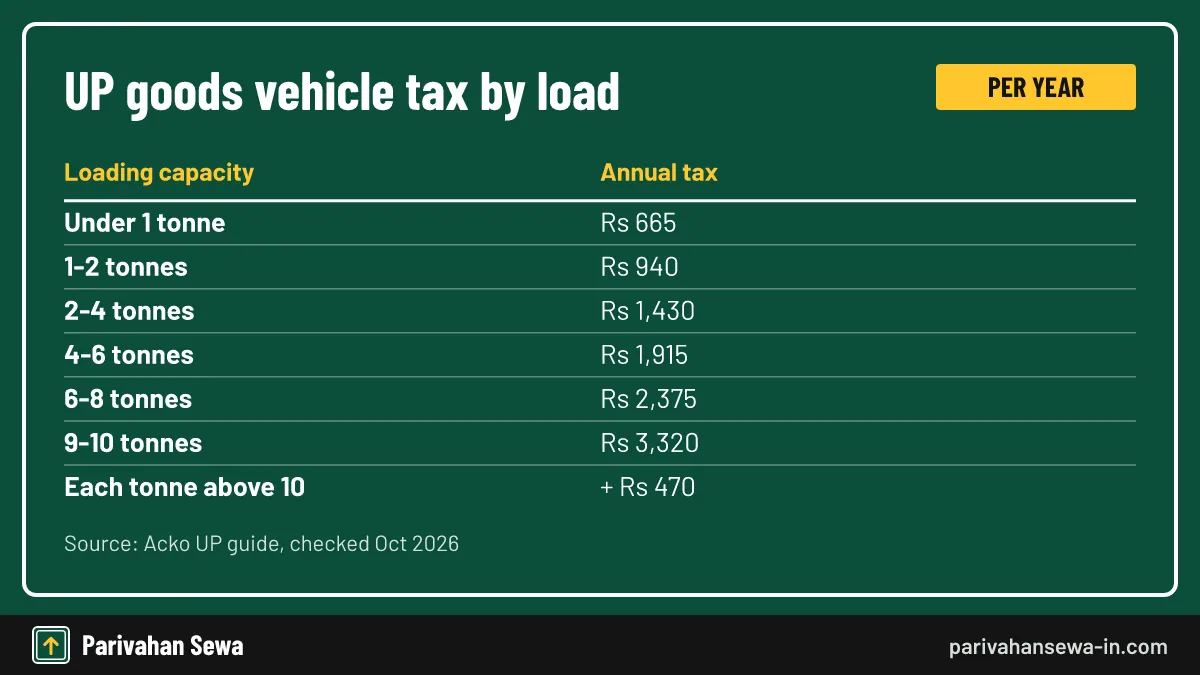
Goods vehicles in Uttar Pradesh pay an annual tax based on loading capacity in tonnes. Reported rates start at ₹665 a year below one tonne and reach ₹3,320 for 9–10 tonnes, with ₹470 for every extra tonne above ten. The tax is paid by period, not once.
| Loading capacity | Annual tax |
|---|---|
| Under 1 tonne | ₹665 |
| From 1 to 2 tonnes | ₹940 (₹946 in some guides) |
| From 2 to 4 tonnes | ₹1,430 |
| From 4 to 6 tonnes | ₹1,915 |
| From 6 to 8 tonnes | ₹2,375 |
| From 8 to 9 tonnes | ₹2,865 |
| From 9 to 10 tonnes | ₹3,320 |
| Above 10 tonnes | ₹3,320 plus ₹470 per extra tonne |
A heavy truck example
A 12-tonne truck works out at ₹3,320 plus two extra tonnes at ₹470 each, so about ₹4,260 a year, as calculated from the reported table.
National permit trucks
Trucks with a national permit also pay the permit’s authorisation fee. That is separate from UP road tax and is collected through the permit system.
What do three-wheelers and e-rickshaws pay in UP?
Passenger three-wheelers with fewer than 12 seats are reported at ₹600 per seat a year, or ₹5,400 per seat as an optional one-time tax. Goods three-wheelers pay ₹850 per tonne a year or ₹7,600 per tonne one-time. Electric models made in UP may qualify for the EV waiver.
| Three-wheeler type | Annual tax | Optional one-time tax |
|---|---|---|
| Passenger, under 12 seats | ₹600 per seat | ₹5,400 per seat |
| Goods | ₹850 per tonne or part | ₹7,600 per tonne or part |
An auto example
A three-seat passenger auto pays about ₹1,800 a year, or ₹16,200 once. The one-time choice suits owners who plan to keep the vehicle for many years.
E-rickshaw owners
Many e-rickshaws sold in UP are assembled locally. If yours is, the waiver may bring the tax to nil; the Vahan tax screen will show whether it applied.
How do taxis and buses pay tax in UP?
Taxis, maxi cabs, stage carriages and contract buses pay UP road tax by seating capacity and period, often quarterly. We could not verify the current per-seat amounts from a source we trust, so we do not quote them. The Vahan tax screen shows the figure for your vehicle and permit type.
Paying by period
Operators usually pay before each quarter or year begins. Paying for a longer period cuts trips to the RTO and avoids gaps in the tax-valid date.
Tourist permits
Tourist taxis and buses with an All India Tourist Permit pay their home-state tax plus the permit fee. Entry tax on such vehicles is covered in the AITP section below.
What is Uttar Pradesh transport tax?
Uttar Pradesh transport tax is the everyday name for motor vehicle tax collected by the UP Transport Department. It covers one-time tax on private vehicles, periodic tax on transport vehicles, and the tax paid by outside vehicles that ply in UP. People also use the phrase loosely for registration and permit charges.
Tax versus fees
Tax goes to the state’s revenue. Fees, such as the registration fee, driving licence fee and permit fee, pay for a service. Your Vahan receipt lists the two on separate lines.
Not the same as GST
GST on a vehicle is charged by the dealer and shared between the Centre and the state. It never appears at the RTO and is not refunded if the vehicle leaves UP.
What else does the UP transport office collect?
Besides UP road tax, the RTO collects the registration fee, smart-card RC charge, high security plate charges through the dealer, permit and fitness fees, and fines compounded at the office. Each is separate, so a “total RTO charge” quote combines several heads with different rules.
Fees set at the centre
Registration, fitness and licence fees come from the Central Motor Vehicles Rules. They are the same across states, unlike road tax.
Charges set by the state
Road tax, any state cess and the tax on outside vehicles come from UP law. These are the lines that change when the state issues a new notification.
What do outside goods and passenger vehicles pay per day in UP?
Transport vehicles from other states that ply in Uttar Pradesh without a permit that covers UP pay a daily tax. Reported rates are ₹50 a day for light goods, ₹75 for medium goods and ₹100 for heavy goods, with ₹20 for non-AC and ₹30 for AC public service vehicles.
| Outside vehicle type | Reported daily tax in UP |
|---|---|
| Light goods vehicle | ₹50 a day |
| Medium goods vehicle | ₹75 a day |
| Heavy goods vehicle | ₹100 a day |
| Non-AC public service vehicle | ₹20 a day |
| AC public service vehicle | ₹30 a day |
Monthly and quarterly options
The same source says a monthly payment equals 12 days’ tax and a quarterly one 30 days’ tax. It does not say whether passenger rates are per seat, so confirm on the checkpost screen.
Where the step-by-step lives
Our UP border tax guide covers the entry form fields for vehicles coming into Uttar Pradesh.
Where can UP vehicle owners clear their tax?
UP-registered vehicles pay tax on Vahan citizen services with Uttar Pradesh selected, or at any RTO counter. The online flow asks for the registration number, an OTP on the registered mobile, the tax mode and the period. Our UP tax online pay guide walks through each screen.
Who needs to pay online
Private owners rarely need this after registration. Goods vehicle, taxi and auto owners use it for every renewal of the tax period.
Counter payment
At the RTO, the clerk prints the demand, you pay by the accepted mode, and the receipt is updated on Vahan. Keep the stamped copy.
What happens if UP road tax is paid late?
Late UP road tax attracts a monthly penalty on the tax due, and the vehicle can be detained for running untaxed. Sources disagree on the rate: an insurer guide quotes 4% a month capped at double the tax, while a CAG audit cites 5% a month for additional tax under Section 9.
Why the rate differs
The penalty may vary by vehicle class and by which tax is late. The Act and later amendments, not a guide, decide the rate. Vahan adds the penalty automatically when you pay.
Stop the clock early
Every month or part of a month counts, so pay as soon as you notice the lapse. If a payment failed, settle it before a new month starts.
Can you get UP road tax refunded?
Yes, in limited cases. The 1997 Act allows a refund of tax paid in excess, or for a period the vehicle did not use UP roads, on an application to the taxation officer. Common cases are shifting the vehicle to another state, deregistration after scrapping, or a double payment.
What to keep ready
Keep the original tax receipt, the NOC or scrapping certificate, the new state’s registration if you moved, and a cancelled cheque for the bank details.
Double payments
If you paid twice because a transaction looked failed, first check Vahan’s pending transaction status. Only a payment that actually reached the state can be refunded.
What if you move a UP car to another state?
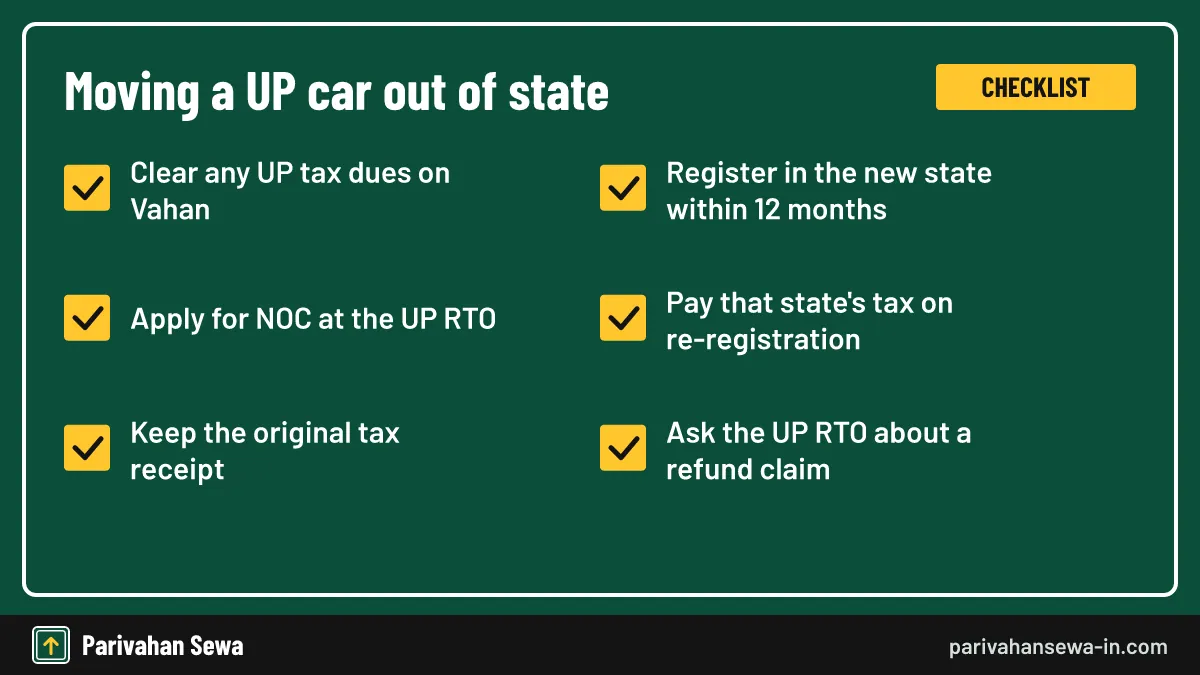
Shifting a UP car means getting a No Objection Certificate from your UP RTO, re-registering in the new state and paying that state’s tax. Section 47 of the Motor Vehicles Act gives you 12 months before re-registration becomes compulsory.
Clear UP dues first
The NOC is not issued while tax, challans or other dues are pending on Vahan. Check the record and pay anything outstanding before applying.
Claiming back UP tax
Once the vehicle is registered elsewhere, ask the UP RTO about a refund for the unused period. The rules decide how much of the one-time tax comes back.
What if you bring an outside car to Uttar Pradesh?
A car from Delhi, Haryana or Bihar can run in UP while on a visit. If you settle here and keep it for more than 12 months, you must get a UP registration mark and pay UP road tax on re-registration, usually reduced by the car’s age.
The 12-month rule
Section 47 of the Motor Vehicles Act, 1988 sets the 12-month period. Students and transferred employees often cross it without noticing.
NCR commuters
Living in Noida with a Delhi-registered car is common. The rule follows where the car is kept, not where you work, so plan the re-registration early.
Does a UP car pay tax again after 15 years?
When a private vehicle’s first registration ends after 15 years, renewal brings a green tax in UP, reported at 10% of the original one-time tax, along with the renewal and fitness fees. Our green tax guide explains how the charge works across states.
Diesel cars in NCR
Separate pollution rules apply to older diesel cars in the NCR districts of UP. See our note on diesel car validity in UP before you renew one.
Renewal is a choice
You can also deregister and scrap an old car instead of renewing it. Scrapping may make you eligible for concessions on a new vehicle.
How do you check whether UP road tax is paid?
Open the vehicle’s record on Vahan or mParivahan and look for the “tax valid upto” field. For a private car it should show a date many years ahead, matching the registration validity. For a goods vehicle it shows the end of the paid period.
When buying a used vehicle
Check the tax-valid date before paying the seller. Unpaid tax and penalties stay with the vehicle, so the new owner inherits them.
If the field looks wrong
A blank or past date on a car that paid one-time tax usually means a data error from the dealer upload. Take the receipt to the RTO and ask for a correction.
What is a vehicle check post?
A vehicle check post is a transport department station at a state border or highway point where officers check permits, tax, overloading and documents of commercial vehicles. Some states also run separate posts for excise, forest produce or GST. Private cars are seldom stopped unless they carry goods.
What officers check
For transport vehicles: the permit, tax receipt for the state, fitness, insurance, PUC, the driver’s licence and the load. A missing receipt can mean paying tax and a penalty on the spot.
The online receipt
A receipt from the Vahan checkpost service is accepted in place of a counter payment. Our guide to check post tax covers who has to pay it.
Are vehicle check posts still running at state borders?
Fewer than before. After GST began on 1 July 2017, many states shut their commercial tax check posts, and in 2021 MoRTH told states that regular transport check posts were no longer needed because vehicle data is online. Some states closed transport posts; others still run them.
States that closed posts
Madhya Pradesh closed its interstate transport check posts from 1 July 2024, and Telangana ordered all RTA check posts shut in October 2025. Maharashtra announced closure of its 22 posts in 2025, though a later report said they were still working.
UP’s own position
We could not find a current official list of UP transport check posts. Enforcement squads and online receipts do the job on many routes, so carry proof of tax even where no barrier stands.
How do you pay checkpost tax online?
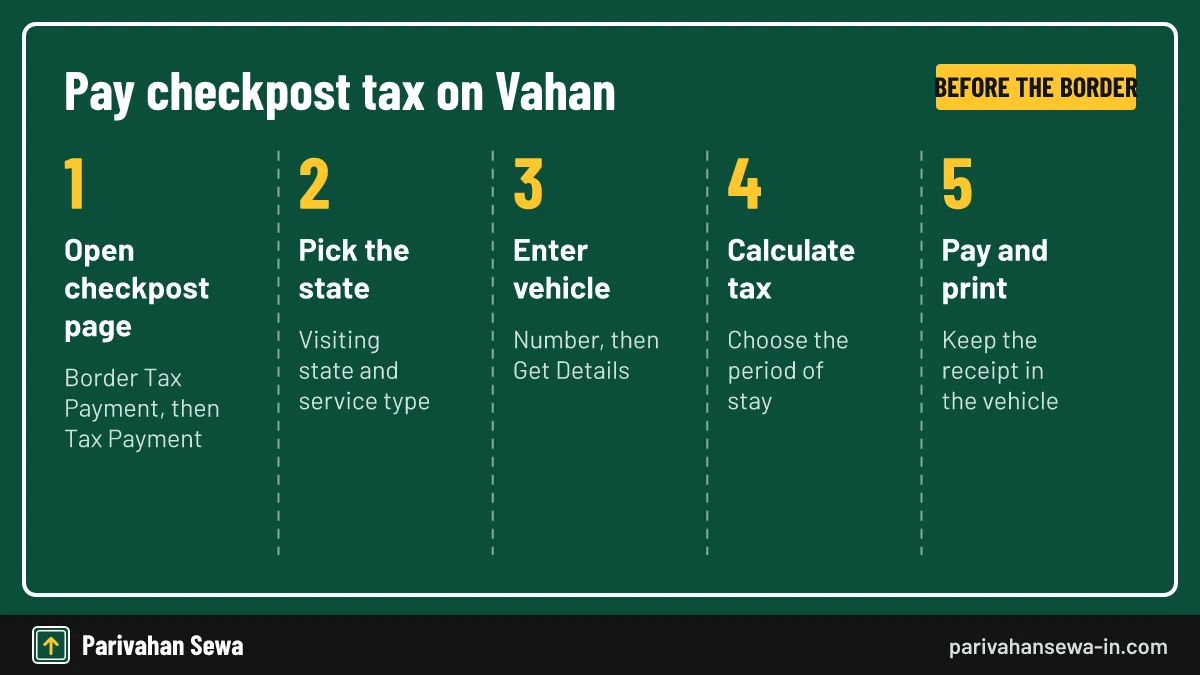
To pay checkpost tax online, open the Vahan checkpost service, choose Border Tax Payment and then Tax Payment, pick the state you are entering and your service type, enter the vehicle number, calculate the tax for your period and pay. The receipt is your proof at the border.
- Open the checkpost service. Go to the Vahan checkpost page and choose Border Tax Payment, then Tax Payment.
- Select the visiting state. Pick the state you are entering and the service type for your vehicle.
- Enter the vehicle number. Type the registration number and press Get Details to load the vehicle.
- Calculate the tax. Enter the period of stay and route details, then press Calculate Tax.
- Pay and keep the receipt. Pay online and print or save the receipt to show at the border.
Payment gateways differ
Each state links the checkpost module to its own treasury gateway. Bihar, for example, routes payment through its OGRAS gateway and issues a tax token receipt.
Counter payment is still possible
Where a check post operates, the officer can calculate the tax and issue a receipt on the spot. Online payment avoids the queue and the chance of a dispute.
What should you carry after you pay checkpost tax?
After you pay checkpost tax, carry the receipt in print or on your phone, along with the registration certificate, permit, insurance, fitness and PUC certificates. The receipt must cover every day the vehicle stays in the state.
Match the dates
Check the from and to dates on the receipt against your trip. Overstaying the paid period can bring a fresh demand plus penalty.
Keep a digital copy
Save the PDF and a screenshot. If the network fails at the border, an offline copy saves time with the officer.
What is Punjab border tax?
People searching Punjab border tax usually mean the entry tax that Himachal Pradesh charges Punjab vehicles. A report from August 2025 put it at ₹70 for a five-seater car and ₹110 for a seven-seater, valid for 24 hours, and protesters blocked the Nangal–Una highway over it. The Tribune reported on 31 March 2026 that Himachal then fixed the passenger-vehicle fee at ₹100; confirm it locally.
In short, a five-seater pays ₹70 and a seven-seater ₹110 for each 24-hour entry into Himachal, as reported.
Source: Protest over Himachal entry tax (The Tribune, 28 Aug 2025), Himachal fixes passenger-vehicle entry fee at ₹100 (The Tribune, 31 Mar 2026). Checked October 2026.Calls for a reciprocal tax
Punjab MLAs and the Rupnagar zila parishad have asked for a matching tax on Himachal vehicles. We found no report that one is in force.
Punjab’s own vehicle tax
Tax on vehicles registered in Punjab is a separate subject. See our Punjab road tax guide for those rates.

How does Karnataka border tax online payment work?
For Karnataka border tax online payment, operators of other-state tourist vehicles use the Vahan checkpost service with Karnataka as the visiting state. A 2016 report said Karnataka had charged an annual entry tax on such vehicles since 2013, payable for the whole year whatever the length of stay.
Who pays it
Mainly tourist taxis and buses from neighbouring states. Private cars on a holiday are not the target of the levy.
Karnataka’s own road tax
For vehicles registered in Karnataka, rates are on our road tax in Karnataka page. We did not find current entry tax rates, so check the amount on the checkpost screen.
How does MP border tax online payment work after 2024?
MP border tax online payment still runs through the Vahan checkpost service when a tax is due, but Madhya Pradesh closed its interstate transport check posts from 1 July 2024. In April 2026 the High Court ordered the 45 posts restored, then stayed that order in May 2026, so they stay closed for now.
What changed for operators
With no barrier to stop at, the receipt is checked by road safety and enforcement points instead. Pay online before entering if your permit does not already cover MP.
MP’s own road tax
For vehicles registered in the state, see our Madhya Pradesh road tax guide.
What is HR Vahan tax?
HR Vahan tax is the motor vehicle tax for Haryana-registered vehicles, paid on Vahan with Haryana selected. Haryana’s private car rates are 5%, 8% and 10% by price, and it gave a full EV waiver up to ₹30 lakh from July 2026. Our Haryana road tax guide has the full detail.
Why UP owners ask
NCR owners often compare Haryana and UP before registering a car at a Gurugram or Noida address. The address on your documents, not the dealer’s location, decides the state.
Paying for an HR vehicle
The Vahan flow is similar to UP’s: enter the HR number, verify with the chassis digits and OTP, check the amount and pay.
Do tourist vehicles with an AITP pay entry tax?
A MoRTH circular of 4 August 2023 asked states not to levy border or check post tax on vehicles holding a valid All India Tourist Permit. The Supreme Court in 2024 left state border tax demands in place and sent challenges to the High Courts, so practice still varies by state.
Home-state tax still applies
Under the 2023 permit rules, an AITP vehicle must have paid tax in the state where it is registered. For a UP-registered tourist taxi, that means UP road tax stays due.
What to carry
Carry the permit, the home-state tax receipt and any entry tax receipt you paid. If an officer demands tax, ask for a written receipt.
How does UP road tax compare with nearby states?
UP road tax for a car with AC sits at 9% up to ₹10 lakh and 11% above, which is higher than Delhi or Haryana and close to Bihar. The comparison below uses rates reported by insurer guides; each state revises its slabs on its own.
| State | Private car one-time tax (as reported) |
|---|---|
| Uttar Pradesh | 8% non-AC or 9% AC up to ₹10 lakh; 11% above |
| Delhi | Petrol 4%, 7%, 10%; diesel 5%, 8.75%, 12.5% by price band |
| Haryana | 5% up to ₹6 lakh; 8% to ₹20 lakh; 10% above |
| Bihar | 8% up to ₹1 lakh; 9% to ₹8 lakh; 10% to ₹15 lakh; 12% above |
Registering where you live
You must register the vehicle where you ordinarily live or have your business. Registering at a relative’s address in a cheaper state can lead to a demand for UP tax later.
More states
Our road tax hub lists every state guide we have written so far.
Which UP road tax mistakes cost buyers money?
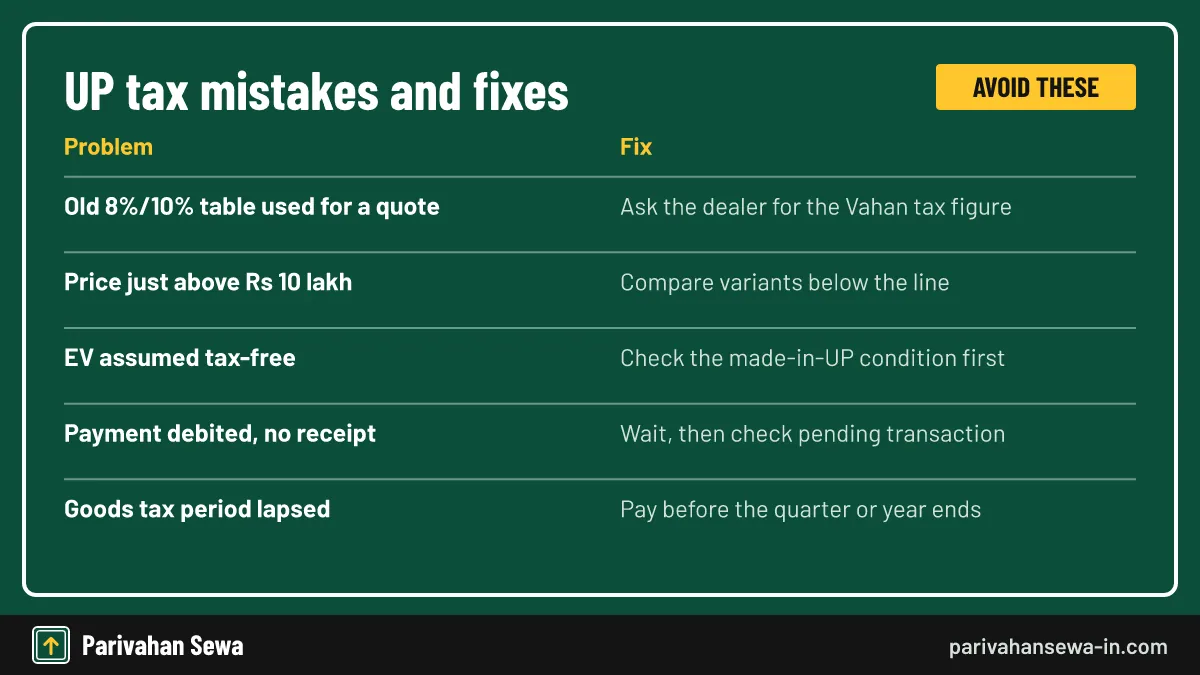
The costliest UP road tax mistakes are quoting from an outdated rate table, choosing a variant just above ₹10 lakh without checking, assuming every EV is tax-free, and paying again after a payment looked failed. Each is easy to avoid with one check before paying.
Agent quotes
Agents sometimes quote a round “RTO charge” that hides an extra fee. Ask for each head on its own line and compare it with the Vahan screen.
Failed payments
If money left your account but no receipt appeared, wait an hour or two and use the pending transaction check on Vahan before paying again.
What should you do before paying tax at a UP RTO?
Before paying tax at a UP RTO, check the invoice cost, the AC status and fuel type on the invoice, the EV or hybrid waiver status, and the registration address. Then pay only on Vahan or at the counter, and save the receipt as a PDF.

Documents for a new registration
The dealer usually handles Form 20, the invoice, insurance, address proof and the manufacturer’s Form 21 and 22. If you register yourself, carry originals and copies.
Keep a record
Store the tax receipt with your insurance policy. You will need it for an NOC, a refund claim or the sale of the vehicle.
Where do the UP figures on this page come from?
UP government sites did not load from our checking machine on 30 October 2026, so the rates here come from insurer guides and news reports, each linked under its table. Where sources disagreed, we say so. The amount on the Vahan tax screen at your RTO is always the binding figure.
How we check
Each figure is stored with its source and checked date, and fee pages are reviewed about every 90 days. Read our editorial policy for how corrections are handled.
Tell us if a rate changed
If your Vahan receipt shows a different rate, the notification has probably changed. Note the date and rate and let us know so we can update the page.
Official links
Vahan citizen services (pay vehicle tax)vahan.parivahan.gov.in ↗Uttar Pradesh Transport Departmentuptransport.upsdc.gov.in ↗Vahan checkpost (border tax payment)vahan.parivahan.gov.in ↗UP Motor Vehicles Taxation Act, 1997 (PRS copy)prsindia.org ↗UP road tax questions
Is UP road tax for a private car paid every year?
No. A private car or two-wheeler pays a one-time tax at registration. Goods vehicles, autos and many transport vehicles pay every year.
How much UP road tax will a ₹8 lakh car with AC pay?
About ₹72,000 at the reported 9% rate. The Vahan tax screen at registration shows the binding amount.
Why does a car just above ₹10 lakh cost so much more in tax?
The 11% rate applies to the whole cost once the car crosses ₹10 lakh, not just the part above the line.
Are electric cars tax-free in Uttar Pradesh in 2026?
Only if the EV is manufactured, sold and registered in UP, under the window that runs to 13 October 2027. Other EVs pay the normal rate.
Do hybrid cars still get the UP road tax waiver?
Reports say the strong-hybrid waiver ended with the first policy window on 13 October 2025. Ask your RTO whether any order has changed that.
What is the UP tax price for a ₹90,000 motorcycle?
About ₹9,000, using the reported 10% rate for two-wheelers costing more than ₹40,000. This rate comes from insurer pages only; confirm it.
What is the penalty for late road tax in UP?
Guides quote a monthly penalty on the tax due, capped by the Act. Reported rates differ, so the amount Vahan shows is the one that applies.
Can I get a refund of UP road tax if I move to another state?
A refund claim for the unused period is made to the UP RTO under the 1997 Act after you get an NOC and re-register elsewhere. Ask the RTO for the current form.
Does a Delhi car pay UP road tax on a trip to Noida or Agra?
A private car on a visit does not. If it stays in UP for more than 12 months, Section 47 requires re-registration and UP tax.
How do I pay checkpost tax for a taxi entering another state?
Use the Vahan checkpost service: choose Border Tax Payment, select the state, enter the vehicle number, calculate the tax, pay and save the receipt.
Is there a Punjab border tax on private cars?
The tax that Punjab drivers complain about is Himachal's entry tax, reported at ₹70 for a five-seater and ₹110 for a seven-seater for 24 hours in 2025; a March 2026 report says the passenger-vehicle fee is now ₹100.
Is this website the UP Transport Department?
No. Parivahan Sewa is an independent guide. Pay only on Vahan, the UP Transport Department site or at an RTO counter.
Parivahan Sewa (parivahansewa-in.com) is an independent information website and is not affiliated with MoRTH, Parivahan or any state transport department. Confirm fees and rules on the official portal before you pay or apply.