Chassis number print: how to take it right for RTO papers
A chassis number print is a pencil rubbing of the number punched into your vehicle's frame. Lay thin paper over the stamped number, rub a soft pencil across it until every character shows, and paste or attach it to the RTO form. Offices ask for it on transfer, NOC and similar files to confirm the vehicle matches the RC.
Key takeaways
- A chassis number print (also called a chassis impression or pencil print) is a rubbing of the number stamped into the frame.
- Only the number punched into the metal works; plates and stickers carrying the same number are not accepted.
- RTOs commonly ask for it with Form 29 and 30, Form 28 (NOC) and sometimes Form 35; the list varies by state.
- You need thin paper, a soft pencil, tape and a clean cloth, and the vehicle must be present.
- Take spare prints in one sitting and check every character against the RC before you file.
- Never scrape, file or repaint the stamped number; damaged numbers need the RTO's own process.
On this page · 22 sections
What is a chassis number print?
A chassis number print is a pencil rubbing of the identification number punched into a vehicle’s frame. Thin paper is placed over the stamped characters and a soft pencil is rubbed across it, so the raised edges show up as dark letters. RTO staff compare that rubbing with the RC and the forms.
Other names for the same thing
Counter staff and agents call it a chassis impression, chassis trace, pencil print or simply “chassis rubbing”. All of these mean the same sheet of paper showing the frame number.
What the print proves
A typed number on a form can be copied from anywhere. A rubbing can only be made by someone standing next to the vehicle. That is why an RTO treats the print as physical proof that the vehicle exists and carries the number recorded in Vahan.
Why does the RTO ask for a chassis impression?
The RTO asks for a chassis impression to tie the paperwork to a real vehicle. Stolen or rebuilt vehicles are sometimes passed off with another vehicle’s documents. A rubbing from the frame lets the office see that the punched number matches the registration record before it changes owner, state or loan details.
Guarding against stolen vehicles
When a vehicle changes hands, the RTO is the last checkpoint before a new name goes on the record. A frame number that does not match the RC is a warning sign the office cannot ignore, and the file is held until the mismatch is explained.
Replacing a full inspection
For many routine services, a clear rubbing saves the inspector from examining the vehicle in person.
Which RTO services need a chassis number print?
A chassis number print is usually requested whenever the registration record changes in a way that could hide a vehicle swap. Transfer of ownership, an NOC for another state and loan removal are the common cases. The exact list differs between states and even between RTOs, so read your office’s own checklist.
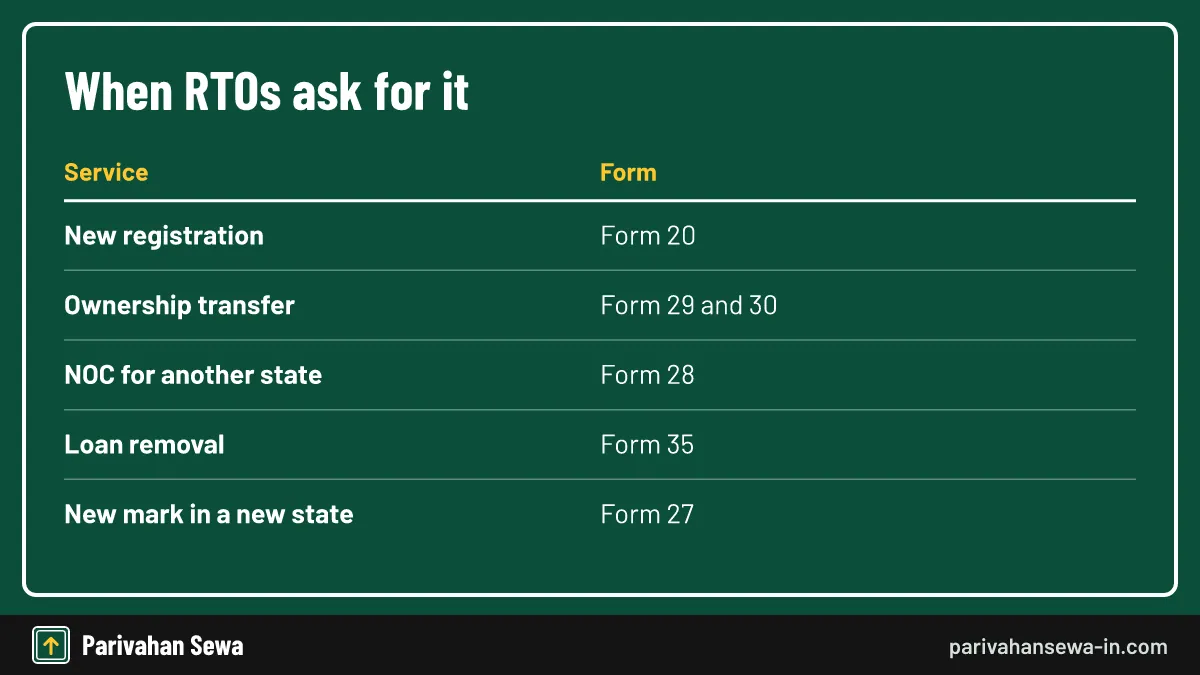
| Service | Form usually filed | Is a pencil print commonly asked for? |
|---|---|---|
| New registration | Form 20 | Yes, the form has a space for it; the dealer normally handles it |
| Transfer of ownership | Form 29 and Form 30 | Yes, at many RTOs |
| NOC for another state | Form 28 | Yes, in most document lists |
| Loan (hypothecation) removal | Form 35 | In some states |
| New mark in a new state | Form 27 | Often, with the NOC |
Why the list changes by state
These forms are central forms under the Central Motor Vehicles Rules, 1989, but each state decides its own supporting documents. A Gujarat office may insist on the rubbing for every transfer, while another office may only ask when the inspector cannot see the vehicle.
Where to confirm
Check the checklist printed at your RTO, the document list shown when you apply on Vahan, or your state transport department’s website. If none mention it, take a print anyway; it costs nothing and saves a second trip.
What do you need to take a chassis number print?
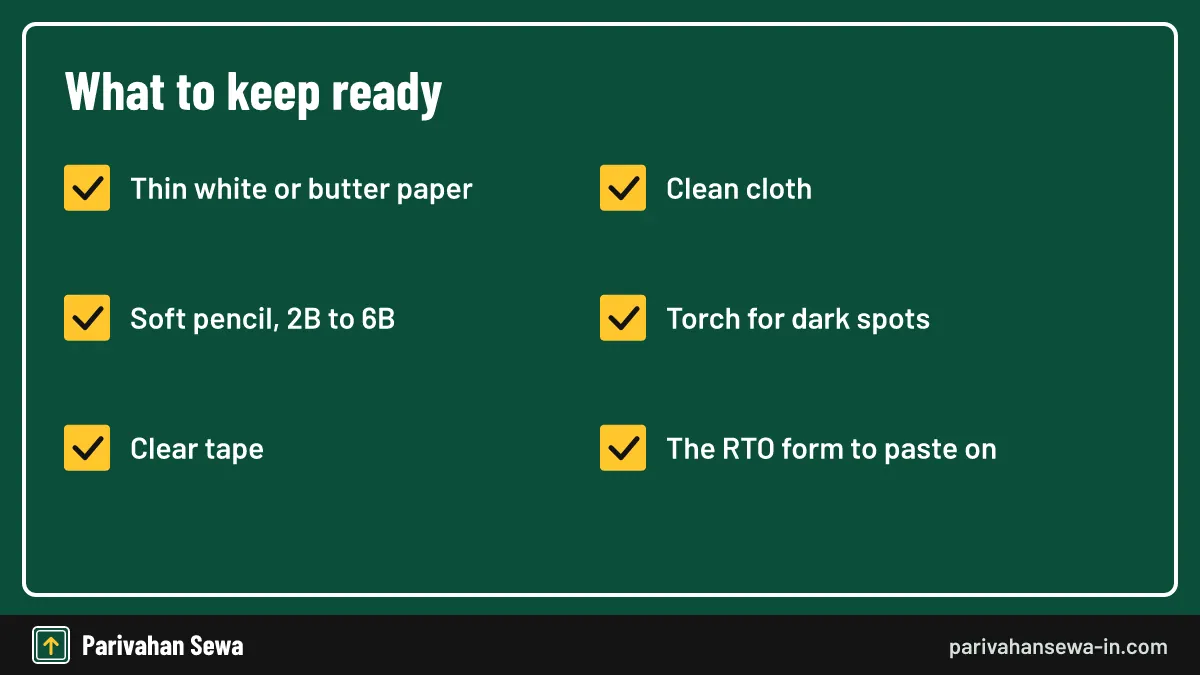
You need very little to take a chassis number print: thin paper, a soft pencil, some tape and a cloth. The vehicle must be parked on level ground where you can reach the stamped number comfortably. A torch helps when the number sits in a dark corner of the frame or under a panel.
Choosing paper and pencil
Plain thin A4 paper or butter paper works best because the stamped edges press through it easily. Thick photocopy paper hides fine characters. A 2B to 6B pencil gives dark, even shading; a hard HB pencil tends to tear the sheet.
Helpful extras
Clear tape stops the paper sliding mid-rub. A dry cloth removes dust and grease.
How do you take a chassis number print step by step?
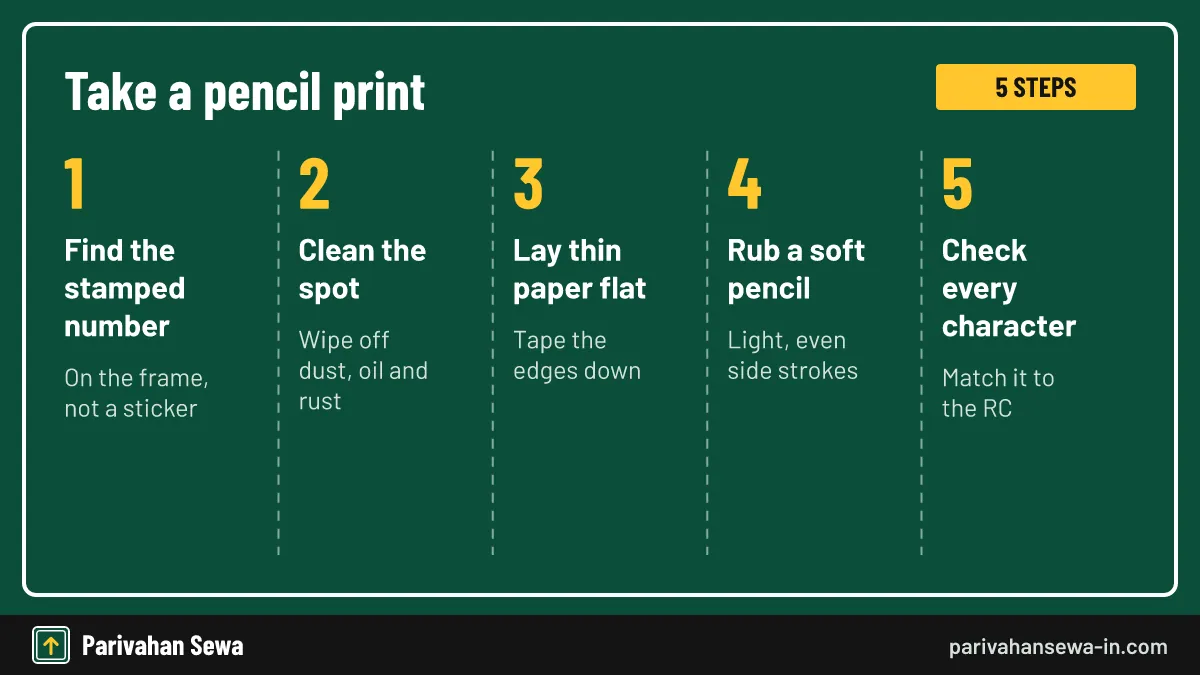
To take a chassis number print, clean the stamped area, tape thin paper over it and rub a soft pencil across the number until every character appears. Then check the result against your RC. The whole job takes a few minutes once you have found the right spot on the frame.
- Find the stamped number. Locate the chassis number punched into the frame, not a sticker or riveted plate.
- Clean the spot. Wipe away dust, grease and loose rust with a dry cloth.
- Lay thin paper flat. Place thin white paper over the number and tape the edges so it cannot slide.
- Rub a soft pencil. Hold a soft pencil almost flat and rub in light, even strokes across the number.
- Check and label. Check every character against the RC and write the registration number beside the print.
Technique that gives sharp letters
Use the side of the lead, not the tip, and rub in one direction. Pressing too hard fills the hollows as well as the edges, which blurs the characters.
Checking the result
Read the rubbing in daylight. Every letter and digit must be clear, including the first and last characters, which are the ones most often cut off at the paper’s edge.
Which surface gives a valid chassis impression?
A valid chassis impression comes only from the number punched or etched into the vehicle’s frame or body shell. Riveted plates, door-pillar stickers and the plate behind the windscreen show the same number but are not accepted, because they can be removed and fixed onto another vehicle.
Stamped number versus labels
Rule 122 of the Central Motor Vehicles Rules covers embossment of the chassis number, engine number and date of manufacture. That stamped mark is the permanent one. Labels are there for convenience when reading the number, not for rubbing.
Finding the spot
If you are unsure where the stamped number sits on your model, our guide to the chassis number in bike and car frames explains the usual locations and how to read the characters.
How do you take a chassis impression on a bike or scooter?
On most two-wheelers, the stamped number sits on the frame near the steering head, the tube just behind the handlebar. Because that tube is curved, the paper needs to be pressed around it. On scooters a small panel or the floor mat may have to come off first.

Working on a curved tube
Cut a narrow strip of paper, slightly longer than the number, and tape both ends around the tube. Rub along the length of the tube rather than across it, so the pencil follows the curve evenly.
When a panel hides the number
Some scooters and bikes with full fairings hide the number behind a plastic cover. Remove only the cover your service centre shows you, and refit it afterwards. A mechanic can take the print for you if you are not comfortable removing parts.
How do you take a chassis impression on a car?
On cars the punched number is usually on a flat panel, such as the floor near the front passenger seat, the firewall under the bonnet or a frame member. A carpet flap or plastic cover often lifts to reveal it. Flat panels make cars easier to rub than bikes.
Getting at the floor-mounted number
If the number is under the front passenger seat area, lift the carpet flap, wipe the panel and slide the seat back for room.
Ignore the windscreen plate
The number visible through the windscreen and the one on the door pillar sticker cannot be rubbed for RTO use. They help you read the number, but the print must come from the stamped panel itself.
How many copies of the chassis print are needed?
There is no single national count for chassis print copies. Each RTO decides how many sets of forms it wants, and each set may need its own rubbing. Owners report being asked for anything from one to several copies. Take one print per form copy, plus two spares, in a single sitting.
Why spares matter
A print torn or smudged at the counter means another trip to the vehicle. Spare rubbings take seconds to make at home but save a day if the clerk rejects the first set.
Labelling each copy
Write the registration number and the date lightly beside each rubbing.
Where does the chassis print go on RTO forms?
The chassis print is pasted or taken directly in the box set aside for it on the form, or attached on a separate sheet if no box exists. Form 20 has a chassis number field marked for a pencil print. Transfer and NOC files often carry the print on a page stapled behind the forms.
| Form | What it is for | Where the print usually goes |
|---|---|---|
| Form 20 | Application for registration | Chassis number field on the form |
| Form 29 / Form 30 | Notice and application for transfer | Separate sheet or space on the form, as the RTO asks |
| Form 28 | No objection certificate | Space on the form or attached sheet |
| Form 35 | Ending a hire-purchase or loan entry | Attached sheet where the state asks for it |
Taking the rubbing directly on the form
Forum users advise taking the pencil print on each copy of the form before filling the rest, so a failed print does not spoil a completed form. Lay the form section over the number, then fill in the other fields afterwards.
Where to learn the forms
For what each transfer form asks for and who signs where, see our explainer on Form 29 30. This page sticks to the rubbing itself.
Should the engine block be traced as well?
Many RTO checklists ask for the engine number rubbing alongside the chassis print, written as “chassis and engine pencil print”. The engine number is stamped on the engine block, often in a tighter spot. Take both at the same time if your checklist lists both, so you do not have to return.
Reaching the engine stamp
On bikes the engine number is usually on the crankcase near the left side; on cars it is on the block, sometimes visible only from below.
Learn the engine number first
Engine numbers follow no international format and are shorter than chassis numbers. Our guide to the engine number shows where to look and how to read it before you start rubbing.
Who checks the chassis print at the RTO?
The chassis print is checked by RTO counter staff and, where needed, a motor vehicle inspector (MVI). Staff compare the rubbing with the RC and the Vahan record. If anything looks wrong, the inspector may want to see the vehicle and match the stamped number in person.
When an inspection is called
Physical inspection is more likely for older vehicles, vehicles coming from another state, modified vehicles and any file where the print is unclear. Bring the vehicle if your RTO’s checklist says so.
Prints taken at the office
Some RTOs have staff or approved helpers take the print in the parking area.
Can a chassis number print be done online?
A chassis number print cannot be produced online, because it is a physical rubbing of the vehicle. What can be online is the application itself: many services are applied for on Vahan, and the print is then uploaded as a scan or handed over at the RTO with the forms.
Vahan services that still need paper
Transfer, NOC and similar services are started online with the registration number and chassis details. After payment, many RTOs still want the signed forms and pencil print at the counter. Follow the document instructions shown for your application.
Typing the chassis number online
Online services often ask for only part of the chassis number, such as the last five characters, to verify the vehicle. That typed entry is a separate check and does not replace the rubbing where the RTO asks for one.
Why does a chassis number print get rejected?
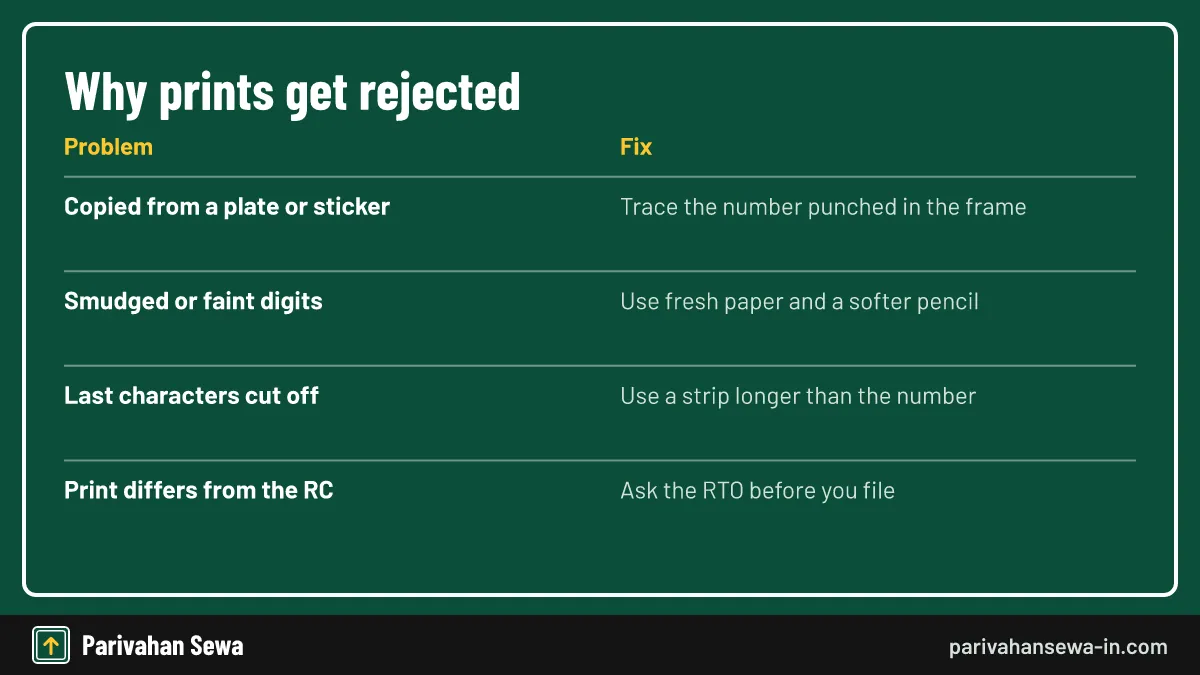
A chassis number print is usually rejected because it was taken from the wrong place, because characters are smudged or missing, or because the rubbing does not match the RC. Each of these makes the RTO doubt the vehicle’s identity, so the file goes back until a clear, correct print is provided.
The most common mistakes
Rubbing a sticker or plate, cutting off the first or last character, pressing so hard that letters merge, and folding the paper across the number are the usual faults.
Avoiding a second trip
Read the print aloud against the RC before you leave the vehicle. If any character is uncertain, take another rubbing straight away while you are still there.
How do you fix a faint or rusty chassis impression?
A faint or rusty chassis impression can usually be improved by cleaning the surface gently and switching to a softer pencil and thinner paper. Remove only loose dirt and flaking rust with a dry cloth or soft brush. Never grind, file or sand the stamped characters, because that damages the identity mark.
Better results on worn numbers
Rub in several light passes rather than one heavy pass. Tilting the pencil flatter picks up shallow edges.
When cleaning is not enough
If the characters stay unclear after cleaning, stop. Take the clearest print you can, photograph the area and speak to the RTO before filing.
What if the stamped number is damaged or unreadable?
If the stamped number is badly rusted, cut during repairs or otherwise unreadable, a normal rubbing will not work. Speak to your RTO first. Offices handle these cases through an inspection and re-marking process that can involve checks of the vehicle’s history; the steps and documents differ by state.
Do not restamp it yourself
Punching a number into the frame without the RTO’s approval can make the vehicle look tampered with, and can cause trouble at transfer, insurance claims and police checks. Wait for the office’s written direction.
What to bring to the RTO
Carry the RC, insurance, ID, photos of the damaged area and any repair invoices that explain the damage.
How should the print match the RC?
The print must match the chassis number on the RC character for character. Modern vehicles carry a 17-character identification number, and a single wrong character can lead to rejection. Older vehicles may have shorter numbers. Compare the rubbing with the RC, the insurance policy and the Vahan record.
| Check | Where to look | What to do if it differs |
|---|---|---|
| Characters in the print | RC smart card or printed RC | Take a fresh, clearer rubbing |
| Number on the insurance policy | Policy schedule | Ask the insurer to correct it |
| Number in Vahan | Vehicle details on Vahan | Ask the RTO about a record correction |
Common look-alike characters
Characters such as 0 and O, 1 and I, 8 and B, or 5 and S can be confused on a worn rubbing. Identification numbers normally avoid I, O and Q, which helps you read doubtful characters.
When the RC itself is wrong
If the rubbing is clear but the RC shows a different number, do not file the transfer yet. Ask the RTO how to correct the record, and keep your rubbing and photos as evidence.
Is a chassis print needed when a new vehicle is registered?
Yes, a chassis print is part of the paperwork for a new vehicle, but the dealer usually takes it. Form 20, the application for registration, has a chassis number field marked for the pencil print. Most buyers never see it because the dealer files the registration on their behalf.
What the buyer should check
Ask to see the registration papers before they go in, and compare the chassis number on the invoice, the Form 21 sale certificate and the print.
Vehicles registered outside a dealer
If you import a vehicle, buy one with a separately built body or register one yourself, the RTO may ask you to provide the rubbing and bring the vehicle for inspection.
Why should a used vehicle buyer take the print?
A buyer should take or watch the chassis print being taken because it confirms the vehicle being bought is the one on the RC. Doing it before money changes hands protects the buyer from stolen, swapped or rebuilt vehicles, and it gives the RTO the rubbing it will ask for at transfer.
Matching before you pay
Take the rubbing yourself, compare it with the seller’s RC and with the Vahan record, and check that the engine number matches too. Any mismatch is a reason to stop the deal until it is explained.
Filing the transfer
Once the papers are ready, the full Vahan process with documents and tracking is in our guide to vehicle ownership transfer online.
Chassis impression for an NOC or interstate move
A chassis impression is a standard part of the no objection certificate file. When a vehicle is moving to another state, document lists commonly include Form 28, the RC, insurance, road tax receipt, PUC certificate and a chassis and engine pencil print. The new state’s RTO usually wants another print when it assigns a new number.
Two offices, two prints
The old RTO uses the print to issue the NOC; the new RTO uses its own rubbing when you apply for a new mark on Form 27.
Learn the NOC process
The documents, fees and timelines for the NOC itself are explained on our NOC certificate page. This page only covers the rubbing.
What does the law say about the stamped frame number?
Rule 122 of the Central Motor Vehicles Rules, 1989 deals with embossment of the chassis number, engine number and date of manufacture. A 2024 amendment added a sub-rule for certain two- and three-wheeler categories, requiring the identification number to be embossed, etched or punched as per AIS 177:2021.
Why the stamp must stay untouched
The stamped mark is the vehicle’s permanent identity. Altering, grinding or restamping it outside the RTO’s process can draw suspicion of tampering and lead to the file being refused or referred for checks.
Check the current rule text
The rule summaries here come from secondary legal sources. For the exact current wording, check the Central Motor Vehicles Rules and MoRTH notifications on official government sites.
Chassis print dos and don’ts
A few simple habits make every chassis number print quicker to accept. Take several rubbings at once, label them, and keep copies in your vehicle file. Protect the stamped number from damage, and never hand signed blank forms to anyone who offers to “manage” the print for you.

Good habits
Take spares in one sitting, write the vehicle number beside each, store a photocopy with your RC copy.
Things to avoid
Do not scrape, file or paint over the stamped digits. Do not accept a rubbing someone brings you from elsewhere when you are buying a vehicle; take it yourself from the frame.
Official links
Vahan citizen servicesvahan.parivahan.gov.in ↗Parivahan Sewa (Download Forms)parivahan.gov.in ↗Motor Vehicles Act, 1988 (India Code)indiacode.nic.in ↗Chassis number print questions
What is chassis number print in RTO?
It is a pencil rubbing of the chassis number stamped into the vehicle frame. The RTO uses it to confirm that the vehicle in front of it is the one named on the RC and in the forms.
Is chassis impression the same as chassis print?
Yes. Chassis impression, chassis print, chassis trace and pencil print all mean the same rubbing of the stamped number.
Which pencil is best for a chassis number print?
A soft lead pencil such as 2B to 6B gives a dark, even rubbing. Hard pencils tear thin paper and leave faint marks.
Can I take a chassis print from the sticker on the door?
No. Stickers and riveted plates only repeat the number. The print must come from the number punched into the metal.
Do I need the vehicle at the RTO for a chassis print?
You need the vehicle wherever the print is taken. Some RTOs let you bring the print; others want the inspector to see the vehicle or take the print at the office.
How many chassis prints should I take?
Take one for every copy of each form, plus spares. RTOs ask for different numbers of copies, so check the office checklist first.
Can I use a photocopy of the chassis print?
Many offices want the original rubbing pasted on the form. A photocopy is useful for your own record, not as a substitute.
What if my chassis number is rusted?
Clean loose rust gently with a cloth and try a softer pencil. If the digits are gone, ask the RTO about its inspection and re-marking process; do not restamp it yourself.
Is a chassis number print needed for online services?
Some services applied for on Vahan still ask for the print to be uploaded or handed over at the RTO. Follow the instructions shown for your application.
Parivahan Sewa (parivahansewa-in.com) is an independent information website and is not affiliated with MoRTH, Parivahan or any state transport department. Confirm fees and rules on the official portal before you pay or apply.