Delhi electric vehicle policy: what EV Policy 2.0 pays, waives and phases out
The Delhi electric vehicle policy now in force is EV Policy 2.0, reported to run from 1 July 2026 to 31 March 2030. It offers a purchase incentive on electric two-wheelers and autos that falls each year, a scrappage-linked benefit for buyers who retire an old vehicle, and a road tax waiver on electric cars up to ₹30 lakh. Hybrids get nothing.
Key takeaways
- The Delhi electric vehicle policy 2.0 reportedly runs from 1 July 2026 to 31 March 2030, replacing the 2020 policy.
- Electric two-wheelers get a reported ₹30,000 incentive in year one, falling to ₹20,000 and then ₹10,000.
- Car buyers gain mainly through a scrappage incentive and a tax waiver for EVs priced up to ₹30 lakh.
- From 1 January 2027 only electric autos and light goods vehicles are to be newly registered; two-wheelers follow from 1 April 2028.
- Hybrids and plug-in hybrids are left out of incentives and tax relief.
On this page · 25 sections
What is the Delhi electric vehicle policy?
The Delhi electric vehicle policy is the Delhi Government’s plan to get residents, transporters and fleet owners to switch to battery electric vehicles. The current version, EV Policy 2.0, mixes cash incentives, a scrappage bonus, tax relief and dates after which only electric versions of some vehicle classes can be registered.

Who runs it
Reports name the Transport Department of the Government of NCT of Delhi as the nodal agency. Delhi Transco Ltd is to build charging infrastructure with the power department and the distribution companies.
What it is not
It is not a national scheme. Central support such as PM E-DRIVE sits on top of it and has its own rules, covered in our EV subsidy guide. The Delhi policy only applies to vehicles registered in Delhi.
Delhi electric vehicle policy at a glance
In short, the policy pays most to people who buy early and to those who scrap an old vehicle. It also closes the door on new petrol and CNG autos from 2027 and two-wheelers from 2028. Hybrids get nothing, and car buyers gain mainly through scrapping and a tax waiver.
Targets behind the numbers
The policy aims for at least 30% electrification of Delhi’s total fleet by 31 March 2030. Reports say the 2020 policy brought the EV share of the city’s sales to about 14% by 2025, so the new targets roughly double the ambition.
What changed between EV policy Delhi 2020 and 2.0?
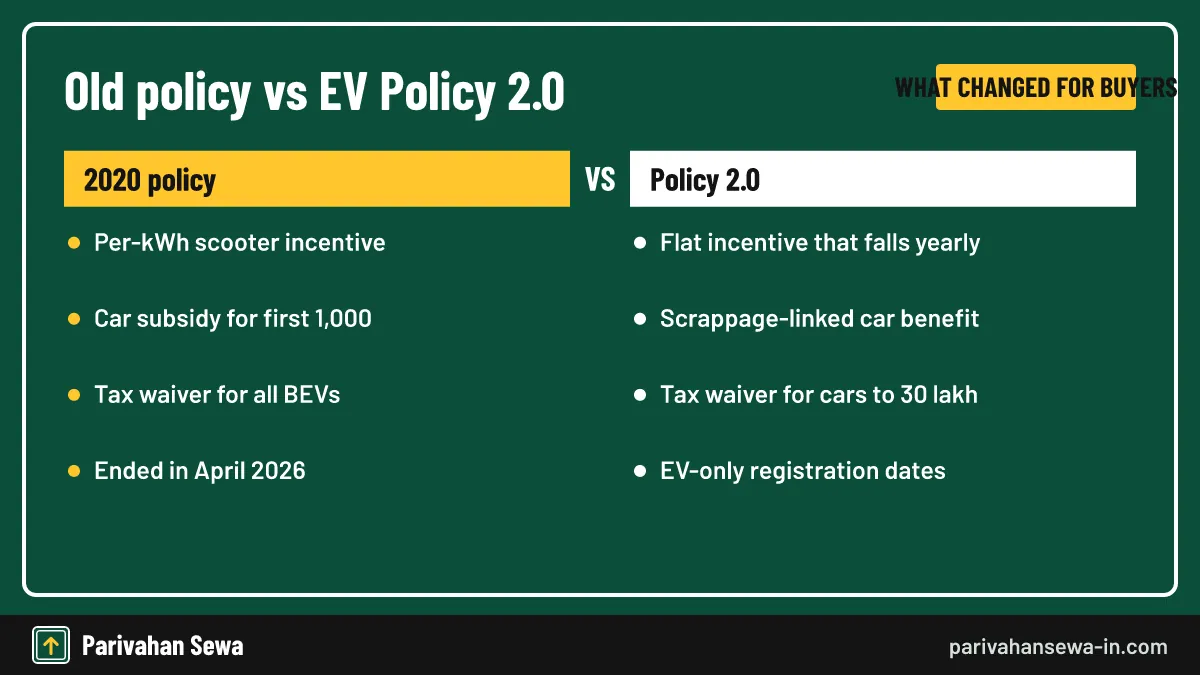
The EV policy Delhi brought in during 2020 paid buyers per kWh of battery, gave cars a large subsidy and waived road tax on every battery electric vehicle. Version 2.0 swaps the per-kWh model for flat amounts that shrink each year, ties car support to scrapping, and limits the tax waiver to cars up to ₹30 lakh.
From subsidy to scrappage
The clearest shift is for car buyers. Under the old policy the first 1,000 e-cars got a direct subsidy. Under 2.0 the reported benefit for a private car comes mainly when you scrap an older petrol or diesel vehicle, which links the EV push to cleaning up the existing fleet.
From incentives to mandates
The 2020 policy only encouraged. Version 2.0 also compels: after set dates, RTOs in Delhi are to register only electric autos, light goods carriers and then two-wheelers.
When did the new Delhi policy start, and how long does it run?
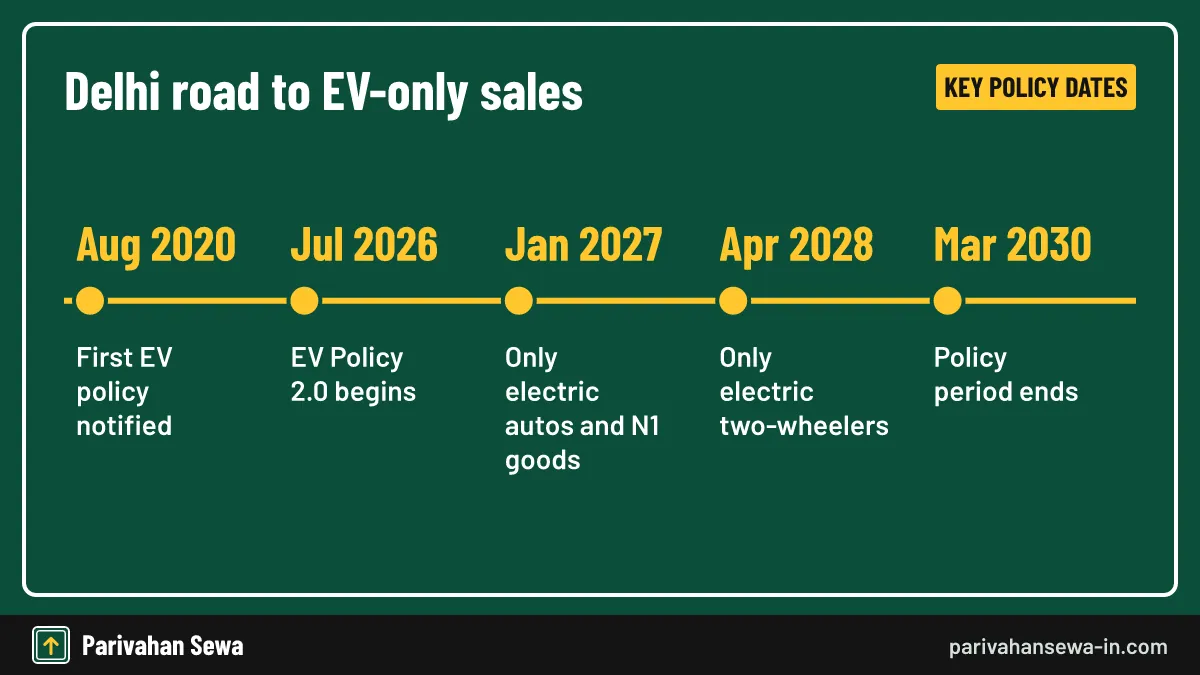
Reports of the Delhi Cabinet decision give 1 July 2026 as the start and 31 March 2030 as the end of EV Policy 2.0. A report dated 7 July 2026 said the policy had been notified. Incentive amounts are set by policy year, so the year in which your vehicle is registered matters.
The gap before it
The 2020 policy formally expired in August 2023 but was extended several times while the new draft was debated. The last reported extensions ran to 31 March 2026 and then a further 15 days, described by officials as final. Buyers in the gap should check which policy applied on their registration date.
What subsidy on electric scooter in Delhi can you get?
The subsidy on electric scooter in Delhi under EV Policy 2.0 is reported as ₹30,000 in year one, ₹20,000 in year two and ₹10,000 in year three. It applies to battery electric two-wheelers registered in Delhi. An extra scrappage amount of about ₹10,000 is reported for riders who scrap an old two-wheeler.

| Vehicle | Year 1 | Year 2 | Year 3 |
|---|---|---|---|
| Electric scooter or motorcycle | ₹30,000 | ₹20,000 | ₹10,000 |
| Electric auto (three-wheeler) | ₹50,000 | ₹40,000 | ₹30,000 |
| Electric N1 goods vehicle | Up to ₹1,00,000 | Not reported | Not reported |
How it compares with the old amount
The 2020 policy paid ₹5,000 per kWh, capped at ₹30,000. Under the reported 2.0 terms, a first-year buyer gets a flat amount, so smaller-battery scooters may now earn more than before.
Low-speed scooters
Scooters capped at 25 km/h and 250 W are treated differently from registered motor vehicles. Since they are generally not registered with an RTO, it is unlikely they qualify for a Delhi incentive that depends on a Delhi RC.
How much is the Delhi govt subsidy on electric vehicle buyers?
The Delhi govt subsidy on electric vehicle purchases depends on the vehicle class. Reports give up to ₹30,000 for two-wheelers, up to ₹50,000 for autos and up to ₹1 lakh for N1 goods vehicles in the first year. Private cars get no flat subsidy; their gain comes from scrapping and the tax waiver.
Private cars
For a family car the reported package is the road tax and registration fee waiver on EVs priced up to ₹30 lakh, plus the scrappage incentive if you retire an old car. A buyer with no car to scrap gets the tax waiver only, and only if the car is under the price limit.
Commercial three-wheelers
E-autos get the highest flat amount among passenger vehicles. Since Delhi plans to register only electric autos from 2027, auto drivers replacing a CNG vehicle are the group most directly pushed towards the incentive.
What does a BEV electric vehicle mean under the policy?
A BEV electric vehicle is a battery electric vehicle: it runs only on a battery and an electric motor, with no petrol, diesel or CNG engine. Delhi’s incentives and tax waivers are meant for BEVs. Hybrids, which pair a battery with an engine, are excluded under EV Policy 2.0.
BEV, HEV and PHEV
A hybrid (HEV) charges its small battery from the engine and braking. A plug-in hybrid (PHEV) has a larger battery you can charge from the wall but still carries an engine. Only the BEV has no tailpipe, which is why it alone counts.
How to check your vehicle
Look at the fuel field on the RC or in a Vahan search. It should read Electric (BOV) or similar. If it shows petrol/hybrid or another combination, the vehicle is not a BEV for policy purposes.
Which vehicles are left out of the incentives?
Hybrid and plug-in hybrid cars are left out of both the incentives and the tax relief. Electric cars above the reported ₹30 lakh price limit lose the tax waiver. Vehicles registered outside Delhi and unregistered low-speed scooters are also unlikely to qualify.
Why hybrids were dropped
An earlier draft had proposed hybrid support, including a road tax cut for hybrids up to ₹30 lakh. The final policy reported in June 2026 removed it, so a strong hybrid bought in Delhi pays normal road tax.
Expensive EVs
Before 2.0, every BEV in Delhi was exempt from road tax. Reports now describe the waiver as limited to electric passenger cars priced up to ₹30 lakh. A premium EV above that line pays the usual Delhi rate; confirm whether the limit uses ex-showroom or invoice price.
What is the scrappage incentive?
The scrappage incentive is a payment for owners who scrap an old petrol or diesel vehicle and buy an EV. Reports give about ₹10,000 for two-wheelers, ₹25,000 for three-wheelers and ₹1 lakh for four-wheelers. It is limited to the first 1,00,000 eligible applicants and paid by direct benefit transfer.
| Scrapped vehicle class | Reported scrappage incentive |
|---|---|
| Two-wheeler | About ₹10,000 |
| Three-wheeler | ₹25,000 |
| Four-wheeler | ₹1,00,000 |
| N1 truck | ₹50,000 |
| Gramin Seva vehicle | ₹15,000 |
Which old vehicles count
Reports describe the scrapped vehicle as one below BS-IV norms, while others say BS-IV or older. The difference matters for a 2017-2020 car, so read the notified text. The vehicle should also be registered in Delhi.
The scrapping proof
You need the certificate of deposit from a registered vehicle scrapping facility. Our car scrapping policy guide explains how that certificate is issued and what else it can be used for.
Are road tax and registration fees waived for a Delhi electric vehicle?
Yes, for most buyers. A Delhi electric vehicle that is a passenger car priced up to ₹30 lakh is reported to get a 100% waiver of road tax and registration fees under EV Policy 2.0. Electric two-wheelers and autos have long been exempt in Delhi; confirm their current position in the notification.
What still has to be paid
A waiver of road tax and the registration fee does not cover everything. Expect to pay for the number plate, insurance, any smart-card RC charge and dealer handling. Ask for an itemised on-road price so you can see that the waiver has actually been applied.
When will Delhi register only electric autos and two-wheelers?
Under EV Policy 2.0, from 1 January 2027 only electric three-wheelers and electric N1 light goods vehicles are to be newly registered in Delhi. From 1 April 2028 the same is reported for two-wheelers, ending new petrol and CNG scooter and motorcycle registrations in the city.
What happens to existing vehicles
Reports say vehicles already registered on fossil fuels may complete their life. Your petrol scooter does not lose its RC in 2028; it simply cannot be replaced by a new petrol model registered in Delhi. Delhi’s separate age limits still apply, as our guide to the Delhi diesel cars ban explains.
How do you claim the incentive?
Claiming usually starts at the dealer: the vehicle is registered in Delhi on Vahan, then the claim is filed on the Delhi transport or EV portal with the RC, invoice and bank details. Reports say approved amounts go to an Aadhaar-linked bank account by direct benefit transfer.

- Pick an eligible EV. Choose a battery electric model from a registered Delhi dealer; hybrids do not qualify.
- Scrap your old vehicle if you can. Hand it to a registered scrapping facility and keep the certificate of deposit.
- Register the EV in Delhi. The dealer files the registration on Vahan; check that the RC shows electric fuel and your Delhi address.
- Apply for the incentive. Submit the claim on the Delhi portal with your RC, invoice, bank account and any scrapping certificate.
- Track the payment. Keep every document until the direct benefit transfer reaches your account.
Who files the claim
The exact 2.0 process and portal address were not confirmed in the sources we found, so ask the dealer whether they file it or whether you must. Never pay anyone to fast-track it.
What documents should you keep ready?
Keep the registration certificate, the tax invoice, Aadhaar, a bank account linked to Aadhaar, proof of Delhi address and, for the scrappage incentive, the certificate of deposit for the old vehicle.
Address proof
The RC must carry a Delhi address. If you moved to Delhi recently and your old RC is from another state, update your records first; our guide to Delhi vehicle registration covers how RCs are issued in the city.
Bank details
Make sure the name on the RC and the bank account match exactly, including initials.
How did the old scheme pay a Delhi electric vehicle buyer?
The 2020 policy, notified on 7 August 2020, paid a Delhi electric vehicle buyer by battery size or by class. Two-wheelers got ₹5,000 per kWh up to ₹30,000. The first 1,000 e-cars got ₹10,000 per kWh up to ₹1,50,000. Road tax and registration fees were waived for every BEV.
| Vehicle (2020 policy) | Purchase incentive | Scrapping incentive |
|---|---|---|
| Electric two-wheeler | ₹5,000 per kWh, max ₹30,000 | Up to ₹5,000 |
| Electric car (first 1,000) | ₹10,000 per kWh, max ₹1,50,000 | Up to ₹7,500 |
| E-auto | ₹30,000 | Up to ₹7,500 |
| E-rickshaw or e-cart | ₹30,000 | Not listed |
Interest relief and chargers
E-autos and goods carriers also got a 5% interest subvention on loans. Home and workplace chargers had a 100% subsidy up to ₹6,000 per point for the first 30,000 points. Do not assume these continue.
Why was the old policy extended so many times?
The 2020 policy was meant to last three years and lapsed in August 2023. It was extended repeatedly while a new draft went through committee review and public consultation, so incentives would not stop abruptly. The final reported extension ran to mid-April 2026, shortly before 2.0 was approved.
What the delay meant for buyers
Extensions were announced close to each expiry date. If you filed a claim in that period, keep the reference and check its status; write to the department if it is still pending.
What does the policy plan for charging?
EV Policy 2.0 plans more than 30,000 public charging points across Delhi, with about 32,000 mentioned in coverage of the approval. Delhi Transco Ltd is to lead the build-out with the power department and distribution companies,.
Charging at home
The 2020 policy’s home charger subsidy was tied to that policy. Our sources do not say whether 2.0 repeats it. Ask your distribution company about an EV tariff connection before you install a wall box.
Finding a public charger
Operator apps show live charger availability. The planned network will be built over the policy period, not all at once.
Does the Delhi policy cover commercial fleets too?
Yes, and fleets carry much of the burden. School bus operators are to convert at least 10% of their fleet to electric within two years of notification. Autos and light goods carriers face EV-only registration from 2027, and the first 1,000 electric N2 trucks bought within three months get a 10-year exemption from No Entry hours.
Delivery and ride-hailing fleets
Delivery fleets face the 2028 two-wheeler date, and a year-one vehicle earns the largest incentive.
Buses
The reported 30% target for 2030 covers the whole fleet, buses included, not just private vehicles.
How will the policy affect used and existing vehicles?
Existing petrol, diesel and CNG vehicles keep their registration until the end of their normal life. The policy does not cancel any RC. What changes is that a Delhi owner cannot replace an old auto with a new CNG auto after 2026, or an old scooter with a new petrol scooter after March 2028.
Buying used
A used petrol scooter or car bought in Delhi can still be transferred to you. Check its age against Delhi’s limits first. A used EV bought second-hand is unlikely to earn a purchase incentive, which is generally paid on the first registration.
What is the electric scooter age limit?
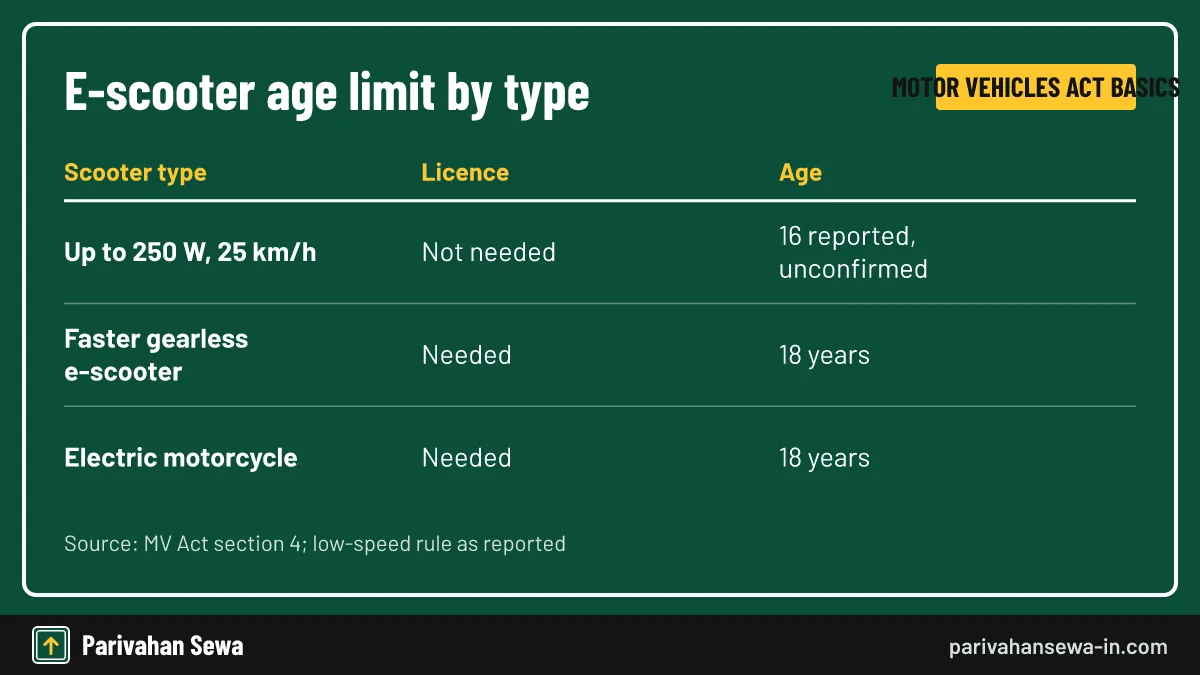
The electric scooter age limit is the same as for any motor vehicle if the scooter needs registration: you must be 18 to get a licence for a gearless scooter. Low-speed e-scooters with motors up to 250 W and a top speed of 25 km/h are reported to need no licence, and many sources say riders of 16 can use them.
Where 16 comes from
Section 4 of the Motor Vehicles Act lets a 16-year-old drive a motorcycle of engine capacity not exceeding 50cc. Electric scooters have no engine capacity, so this rule fits them awkwardly. We found no official text giving an electric equivalent, so treat any age below 18 as unconfirmed.
Parents’ check
If a teenager rides a scooter that actually needs registration, the owner can be held responsible. Read the scooter’s homologation certificate or brochure: it should state whether the model is a low-speed vehicle exempt from registration.
What is the electric bike age limit for faster models?
The electric bike age limit for any electric motorcycle or scooter that needs a licence is 18 years, the general age for driving in a public place under section 4. These vehicles need a registration certificate, insurance and a learner or permanent licence, exactly like petrol bikes.
Licence class
Electric two-wheelers are gearless, so a licence for a motorcycle without gear normally covers them. Our guide on whether an electric scooter needs a licence explains the classes and tests.
Why speed decides
The licence rule follows the vehicle’s certified power and speed, not its looks. A small-looking scooter certified above 25 km/h still needs a licence and an adult rider.
Do low-speed e-scooters need registration in Delhi?
Low-speed scooters up to 250 W and 25 km/h are widely reported to need no registration or licence anywhere in India, including Delhi. Since they carry no Delhi RC, they generally fall outside the Delhi incentives, which are tied to registration. Any modification that raises speed takes them out of the exemption.
Tampering risk
Unlocking the speed limiter makes it an unregistered motor vehicle, risking a challan for no registration, licence or insurance.
What is the Karnataka electric vehicle policy?
The Karnataka electric vehicle policy started in 2017, when the state cabinet approved the Karnataka Electric Vehicle and Energy Storage Policy, the first such state policy in India. In February 2025 Karnataka launched the Clean Mobility Policy 2025-30, aimed at ₹50,000 crore of investment and 1 lakh jobs by 2030.

What it focuses on
Karnataka’s policy is built around manufacturing: capital subsidies for EV and component makers, stamp duty relief and planned clusters at Harohalli, Dharwad and Gauribidanur. It is less about cash for individual buyers than Delhi’s scheme.
Why it is here
If you live in Karnataka, the Delhi incentives do not apply to you; Karnataka’s own rules do.
How does the Karnataka EV policy compare with Delhi?
The Karnataka EV policy courts factories and investors, while Delhi pays buyers and restricts new fossil-fuel registrations. Karnataka has no reported EV-only registration dates. Delhi has no comparable manufacturing package, since it has little industrial land for vehicle plants.
Buyer impact
For a buyer, Delhi’s policy gives direct cash and tax relief. In Karnataka the main buyer benefit was a road tax exemption, but from 1 April 2026 electric cars moved into slabs of 5% to 10% of cost. Our road tax in Karnataka guide sets out the slabs.
Common mistakes when claiming the Delhi EV incentive
Most failed claims trace back to a few avoidable errors. The list below covers the ones that matter under the reported 2.0 rules.
Registering outside Delhi
Buying from a Noida or Gurugram dealer and registering there puts the vehicle under UP or Haryana rules. The Delhi RC is the key to every Delhi benefit.
Scrapping after buying
If you want the scrappage incentive, get the certificate of deposit in line with the policy’s order of steps. Ask the dealer whether it must be issued before the new EV is registered.
Assuming a hybrid qualifies
Strong hybrids sold as “electrified” get no Delhi incentive under 2.0.
What should you check before buying an EV in Delhi?
Check the policy year and current incentive, the vehicle’s ex-showroom price against the ₹30 lakh tax limit, the fuel entry on the invoice, the battery warranty and where you will charge. Then confirm the figures on the Transport Department site.
Central support on top
Central schemes can lower the price further. For the national picture, see our Vahan services hub and the EV subsidy guide linked above.
Official links
Transport Department, Govt of NCT of DelhiEV policy notification and incentive notices ↗Vahan citizen servicescheck how your EV is registered ↗Parivahan Sewaparivahan.gov.in ↗Motor Vehicles Act, 1988 (India Code)section 4 on driving age ↗Delhi electric vehicle policy questions
Is the Delhi EV policy still valid in 2026?
Yes. The 2020 policy was replaced by EV Policy 2.0, which reports say came into force on 1 July 2026 and runs to 31 March 2030.
How much subsidy does an electric scooter get in Delhi?
Reports of EV Policy 2.0 give ₹30,000 in the first policy year, ₹20,000 in the second and ₹10,000 in the third. Check the year in which your vehicle is registered.
Is there a subsidy on electric cars in Delhi?
The reported 2.0 policy does not give a flat purchase subsidy on cars. Car buyers can gain from a scrappage incentive of up to ₹1 lakh and a road tax and registration fee waiver for EVs up to ₹30 lakh.
Do hybrid cars get any benefit in Delhi?
No. Hybrids and plug-in hybrids were left out of the final policy, although an earlier draft had proposed support for them.
Will petrol scooters be banned in Delhi?
New registration of petrol and CNG two-wheelers is reported to stop from 1 April 2028. Scooters already registered can keep running for their normal life, subject to Delhi's age limits.
What is the age limit for an electric scooter?
A scooter that needs a licence needs a rider aged 18 or more. Low-speed models up to 250 W and 25 km/h are reported to need no licence, and many sources quote 16 as the minimum age, but we could not confirm an official figure.
Can I claim the Delhi incentive on a vehicle registered in Noida or Gurugram?
The incentives are for vehicles registered in Delhi. A vehicle registered at a UP or Haryana RTO falls under that state's own policy.
What is the Karnataka EV policy?
Karnataka approved India's first state EV policy in 2017 and launched the Clean Mobility Policy 2025-30 in February 2025. It focuses on manufacturing investment rather than buyer subsidies.
Parivahan Sewa (parivahansewa-in.com) is an independent information website and is not affiliated with MoRTH, Parivahan or any state transport department. Confirm fees and rules on the official portal before you pay or apply.