Diesel car validity in UP: 10 years in the NCR districts, 15 years elsewhere
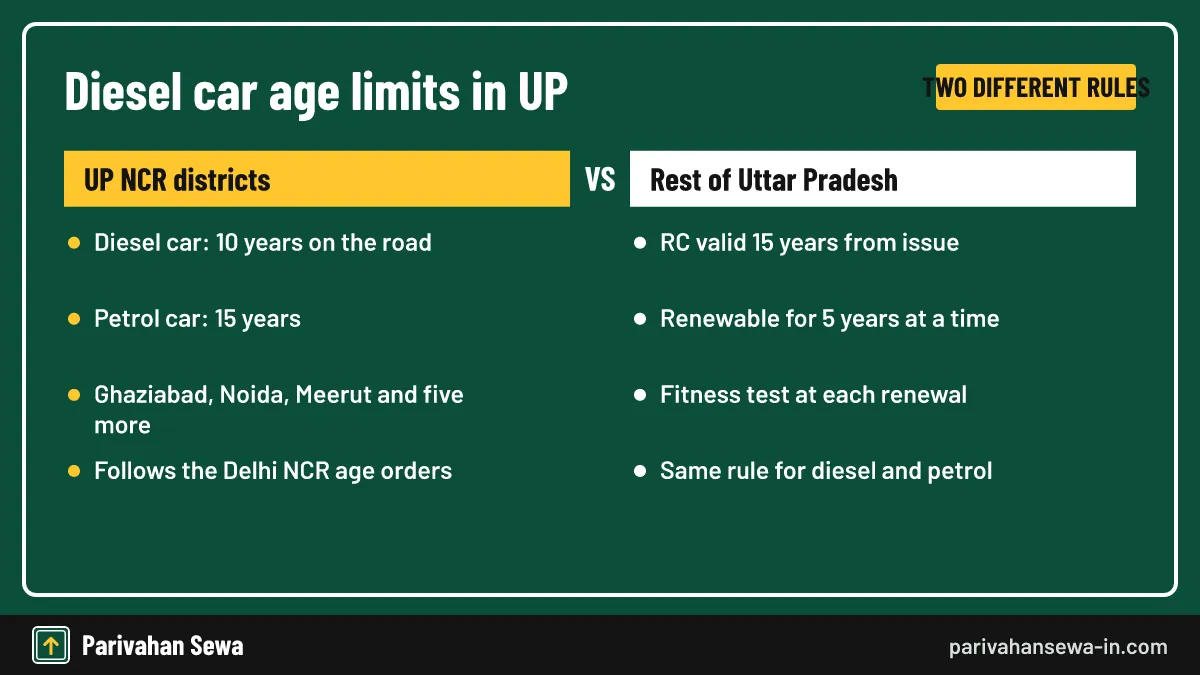
Diesel car validity in UP depends on where the car is registered. In the eight NCR districts, such as Ghaziabad and Noida, the Delhi NCR age orders limit diesel cars to 10 years and petrol cars to 15. Elsewhere in Uttar Pradesh, a private car's RC is valid for 15 years and can then be renewed for five years at a time after a fitness test.
Key takeaways
- Diesel car validity in UP is 10 years in the NCR districts and follows the normal 15-year RC rule in the rest of the state.
- The UP districts inside the NCR are Baghpat, Bulandshahr, Gautam Buddh Nagar, Ghaziabad, Hapur, Meerut, Muzaffarnagar and Shamli.
- Section 41 of the Motor Vehicles Act makes a private RC valid for 15 years, then renewable for five years at a time.
- Renewing a 15-year-old private car is reported at ₹5,000 plus ₹200 for a smart card, a fitness test fee and any late fee.
- An over-age NCR diesel car can usually be moved out of the NCR with an NOC or scrapped at a registered facility.
On this page · 36 sections
What is diesel car validity in UP?
Diesel car validity in UP means how long a diesel car registered in Uttar Pradesh may legally stay on the road. The answer has two parts: 10 years in the state’s NCR districts, and the normal 15-year registration rule, with five-year renewals, everywhere else in UP.
Why UP has two answers
Western UP shares the National Capital Region with Delhi, Haryana and Rajasthan. Age limits set for Delhi NCR to fight air pollution reach these districts. The other districts of Uttar Pradesh, from Agra to Gorakhpur, follow only the Motor Vehicles Act.
What validity is not
Validity is not the same as the engine’s life or insurance cover. It is a legal permission recorded on your registration certificate (RC) and on Vahan.
How long is diesel car registration validity in UP?
Diesel car registration validity in UP is 15 years from the date the RC was issued, for a private (non-transport) car. This comes from section 41(7) of the Motor Vehicles Act. The RTO can then renew it for five years at a time.
Fifteen years from issue, not from purchase
The clock starts on the date of registration printed on the RC, not the invoice date or the manufacturing month. If a car was bought in March but registered in April, April is the starting point for the 15 years.
Same rule for petrol, diesel and CNG
The Act does not set a different RC period for each fuel. A diesel, petrol or CNG car gets the same 15-year certificate.
Which UP districts follow the 10-year diesel rule?
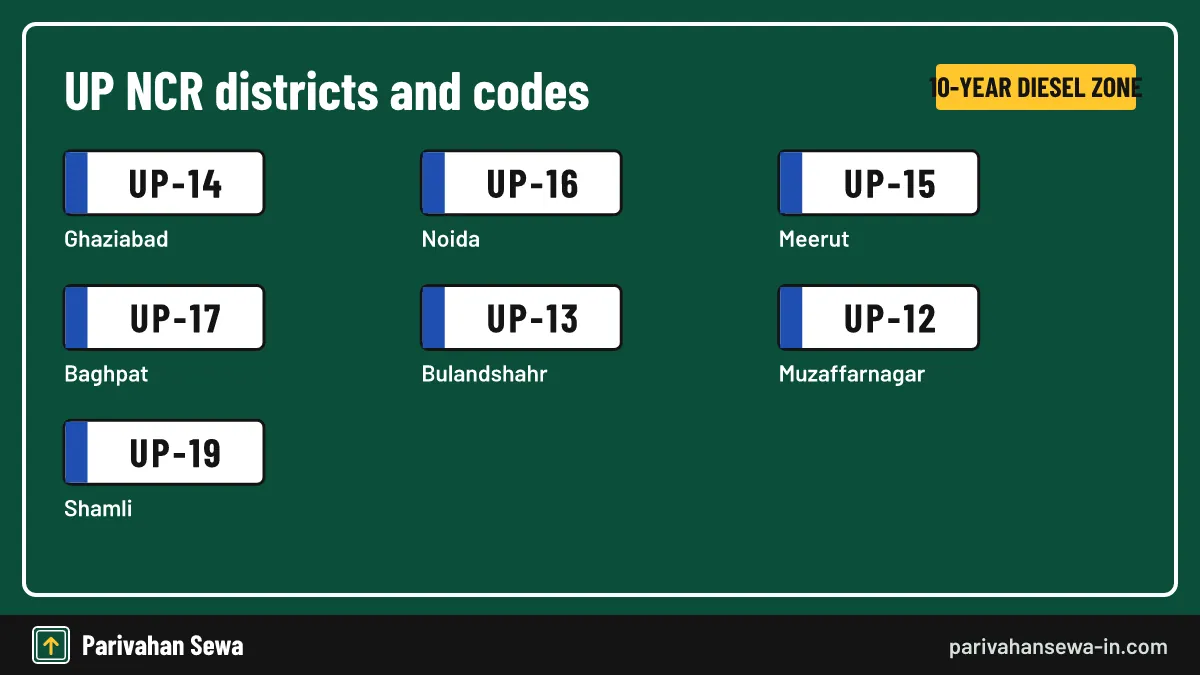
The 10-year diesel rule reaches the eight Uttar Pradesh districts inside the National Capital Region: Baghpat, Bulandshahr, Gautam Buddh Nagar (Noida), Ghaziabad, Hapur, Meerut, Muzaffarnagar and Shamli. Cars registered in these districts are treated as NCR vehicles for age limits.
RTO codes to look for
On a number plate, the NCR codes include UP-14 Ghaziabad, UP-16 Noida, UP-15 Meerut, UP-17 Baghpat, UP-13 Bulandshahr, UP-12 Muzaffarnagar and UP-19 Shamli. Hapur is also in the NCR; read its code from your RC if you are unsure.
Districts proposed but not included
Aligarh, Bijnor, Hathras and Mathura have been proposed as NCR additions, but they are not listed as members. Until that changes, cars registered there follow the normal 15-year rule.
What is petrol car validity in UP?
Petrol car validity in UP is 15 years from registration, followed by five-year renewals, in districts outside the NCR. In the eight NCR districts, a petrol car is limited to 15 years under the Delhi NCR age orders, so renewal there is not a simple option.
Outside the NCR
In Lucknow, Kanpur, Varanasi or Prayagraj, a petrol car that turns 15 can be renewed on Vahan after a fitness test. As long as it keeps passing and the owner pays the renewal fee, it can be renewed again at 20 and 25 years.
Inside the NCR
In Ghaziabad or Noida, a petrol car reaching 15 years usually has three choices: move out of the NCR with an NOC, sell to a buyer outside the NCR, or scrap it. Confirm the current position with your RTO before you decide.
Petrol vehicle validity in UP for bikes and other vehicles
Petrol vehicle validity in UP for motorcycles and scooters follows the same 15-year RC rule as cars. A private two-wheeler’s registration ends 15 years after issue and can be renewed for five years after an inspection and the renewal fee.
Two-wheelers in the NCR districts
The age orders for Delhi NCR are usually reported for petrol vehicles over 15 years, which includes two-wheelers. A bike registered in Ghaziabad or Meerut should be treated the same way as a petrol car of that age.
Commercial vehicles
Taxis, goods carriers and buses are transport vehicles. They need a fitness certificate renewed at fixed intervals and may face separate age limits under their permits.
What is diesel car validity in India?
Diesel car validity in India is 15 years for the RC of a private car, the same as petrol, with five-year renewals after that. Only Delhi NCR applies a shorter 10-year limit to diesel cars, through tribunal and court orders rather than the Motor Vehicles Act.
What the national law says
Section 41 governs the RC term for the whole country. Every state, from Kerala to Punjab, issues a private RC for 15 years.
Where state rules differ
States set road tax, green tax and renewal charges, so the cost of keeping an old diesel car differs by state. The legal term does not. For a wider view of how long cars can stay registered, see our guide to car validity in India.
Is there a national diesel vehicle validity in India?
No national rule sets a separate diesel vehicle validity in India. Section 59 of the Motor Vehicles Act lets the Central Government notify a maximum age for vehicle classes, but we found no such notification fixing an age limit for private diesel cars.
What section 59 allows
The Centre may notify an age limit from the date of manufacture, with different ages for different classes. Vehicles used for exhibitions, research or vintage rallies can be exempted.
Why the NCR is different
The NCR limits come from orders of the National Green Tribunal and the Supreme Court in air pollution cases, not from a section 59 notification. That is why they apply only in that region and not across India.
What is the life of diesel car in India?
The life of diesel car in India has two meanings: its legal life and its mechanical life. Legally, the RC lasts 15 years and can be renewed in most states. Mechanically, a well-kept diesel engine can run far longer, but it must still pass inspection.
Legal life
Outside the NCR there is no fixed end point. A diesel car can be renewed at 15, 20 and 25 years and beyond, provided it clears each fitness check and the owner pays the fees.
Mechanical life
How long a diesel engine lasts depends on servicing, fuel quality, driving pattern and how far it travels each year. No law sets a kilometre limit.
What is petrol car life in India?
Petrol car life in India follows the same legal pattern as diesel: 15 years on the first RC, then five-year renewals while the car passes fitness tests. In Delhi NCR, petrol cars are limited to 15 years, five more than diesel cars.
Petrol car validity in India versus diesel
Outside the NCR, there is no difference in legal life between petrol and diesel. Inside the NCR, a petrol car gets five extra years.
Costs that grow with age
Older petrol cars face a higher renewal fee after 15 years, an age-based fitness fee and, in some states, green tax. These costs, not a legal ban, are what usually make owners outside the NCR retire an old car.
How many years can a car be used in India?
How many years can a car be used in India has no single number for private cars. Outside Delhi NCR, a car can be used as long as its RC is renewed every five years after the first 15 and it passes the fitness test each time.
The practical limit
The real limit is cost and condition. Each renewal brings the renewal fee, a fitness test fee that rises with age and possible state taxes.
Exceptions to remember
In Delhi NCR, including the eight UP districts, the limits are 10 years for diesel and 15 years for petrol. Commercial vehicles may face separate age limits under permit rules.

What is the 15 year car rule?
The 15 year car rule is section 41(7) of the Motor Vehicles Act: the RC of a private, non-transport vehicle is valid for 15 years from the date of issue. After that the owner must renew it, and each renewal under section 41(10) lasts five years.
What it applies to
It covers private cars, jeeps, motorcycles and scooters, whether they run on petrol, diesel or CNG. It does not apply in the same way to transport vehicles, which run on a fitness certificate renewed at shorter intervals.
What it does not do
The rule does not ban a car at 15 years. It only ends the first RC term. People often confuse it with the NCR age limit, which does stop a petrol car at 15 years in Delhi NCR.
15 years vehicle rule: renewal, not an automatic ban
Under the 15 years vehicle rule, a vehicle reaching 15 years does not lose the right to exist; it loses its current registration until renewed. Outside the NCR, renewal on Vahan, a fitness test and the fees bring it back into force for five years.
Renewal in practice
The owner applies on Vahan, pays the renewal fee and other charges, and takes the vehicle for inspection. Our guide to RC renewal after 15 years fees covers each charge, the late fee and the Form 25 application.
When renewal is refused
The RTO can refuse renewal if the vehicle fails inspection, if the chassis or engine number does not match, or if tax or challans are pending. Fix the problem and apply again.
What happens to a 15 year old vehicle?
A 15 year old vehicle reaches the end of its first registration term. Outside the NCR, the owner renews the RC after a fitness test. Inside the NCR, a petrol vehicle reaches its age limit, so the owner moves, sells or scraps it.
The owner’s checklist at 15
Look up the validity date, clear pending challans, renew insurance and PUC, and decide early whether to renew, move or scrap. Applying before the date avoids a late fee of about ₹300 a month reported for private vehicles.

If you do nothing
The vehicle stays on Vahan with an expired registration. Using it on a public road is an offence, and insurers may question a claim on a car with an expired RC.
Was there a 15 year old vehicle ban in India 2019?
We found no national 15 year old vehicle ban in India 2019. Searches for it usually trace back to Delhi NCR age limits, which were already in force through tribunal and court orders, and to debate about a national vehicle scrapping policy that came later.
Where the confusion comes from
News about Delhi NCR vehicles often reached readers across India without the regional context. A headline about Delhi’s 15-year petrol limit could read like a national ban.
What changed after 2019
The renewal fee for vehicles over 15 years rose from 1 April 2022, to a reported ₹5,000 for a private car. A scrapping system with registered facilities was also set up.
Latest news on 15 year old vehicle registration
The latest news on 15 year old vehicle registration centres on Delhi. On 1 March 2025 the Delhi Government decided that fuel stations would stop supplying vehicles older than 15 years from 1 April 2025. We could not verify how that measure stands today.
What to check before you act
News on old vehicles moves fast, and some measures have been announced, changed or challenged in court. Before you sell, scrap or move a car on the strength of a headline, check the Delhi transport department or your UP RTO for the current notice.
What has not changed
Outside the NCR, the Motor Vehicles Act still gives a private RC 15 years, then five-year renewals. Renewal fees and fitness fees have risen, but the right to renew a car that passes inspection remains. For a fuller round-up, see our diesel car ban guide.
What is the 10 year diesel car rule?
The 10 year diesel car rule says a diesel car older than 10 years may not be used in Delhi NCR. It comes from air pollution orders of the National Green Tribunal and the Supreme Court, and it applies to the NCR districts of UP, Haryana and Rajasthan as well as Delhi.
How it differs from the RC term
A Ghaziabad diesel car’s RC may still show 15 years, because section 41 sets that term. The NCR order overrides it in practice and stops the car’s use after 10 years.
How it is counted
The limit is generally counted from the date of registration. Some reports use the manufacturing date. If your car is close to 10 years, ask the RTO which date it uses.
Is there a 10 year old diesel car ban in India?
No 10 year old diesel car ban in India applies nationally. The 10-year limit is confined to Delhi and the NCR. A 10-year-old diesel car registered in Lucknow, Bengaluru or Pune keeps its 15-year RC term and can be renewed after that.
Why buyers outside the NCR benefit
Over-age NCR diesel cars often move to other states through NOCs and sales. Buyers there get a car with legal years left on its RC.
Proposals are not law
From time to time, proposals to restrict older diesel vehicles in other cities appear in the news. Until a state or the Centre issues a notification, they are not binding.
What is the position of diesel cars in Delhi?
Diesel cars in Delhi may be used for up to 10 years under the reported age limit. After that, the owner can apply for an NOC to move the car outside the NCR or scrap it. New diesel cars can still be bought and registered within the limit.
Buying a diesel car in Delhi
Delhi charges higher road tax on diesel cars than petrol cars in each price band. A buyer should weigh that higher tax against the shorter 10-year life before choosing diesel for Delhi use.
Seasonal restrictions
On top of the age limit, the Graded Response Action Plan can restrict older BS III and BS IV vehicles during severe pollution. These curbs are temporary and announced stage by stage, so check the current stage before driving an older diesel car.
What is diesel car validity in Delhi?
Diesel car validity in Delhi is 10 years under the reported age limit, even though the RC itself is issued for 15. A diesel car reaching 10 years should be moved out of the NCR with an NOC, sold to a buyer outside the region, or scrapped.

The NOC route
The Delhi transport department handles NOCs for vehicles going to other states. Apply well before the 10-year mark. A car that is already over age may face extra checks. For the full Delhi story, see our guide to the Delhi diesel cars ban.
Scrapping in Delhi
An owner who chooses scrapping takes the car to a registered vehicle scrapping facility, which issues a certificate of deposit. That certificate can bring benefits on a new vehicle in many states, depending on local rules.
How is diesel vehicle validity in Delhi counted?
Diesel vehicle validity in Delhi is generally counted from the date of first registration, which is shown on the RC and on Vahan. A car registered in July 2016 reaches 10 years in July 2026, regardless of when it was built or bought.
Re-registered cars
If a diesel car was first registered in another state and later re-registered in Delhi, the original registration date usually counts. Re-registration changes the number, not the car’s age.
When the dates differ
Some old records carry a manufacturing month that differs from the registration date. If you are close to the limit, print the Vahan record and ask the RTO which date it applies. Do this before you plan a sale or NOC.
Diesel car ban in Delhi till date
The diesel car ban in Delhi till date covers diesel cars older than 10 years, with petrol cars limited to 15. New diesel cars are not banned. The rule has been enforced through tribunal and court orders, and enforcement methods have varied over time.
How it has been enforced
Enforcement has included impounding of over-age vehicles found on roads and, under the 2025 decision, plans to stop fuel supply to vehicles over 15 years. The details have shifted, so check the latest Delhi notice.
Penalties when caught
An over-age car on a Delhi road can be impounded. Where its registration has also lapsed, section 192 of the Act sets a fine of ₹2,000 to ₹5,000 for a first offence. Read our pollution challan in Delhi guide for emission fines.
Can I drive 10 year old diesel car in Delhi?
Can I drive 10 year old diesel car in Delhi is answered no under the reported limit: a diesel car older than 10 years should not be used in Delhi. If the car is exactly at the mark, check the registration date carefully.
If your car is under 10 years
A diesel car below 10 years can be driven in Delhi with a valid RC, insurance and PUC certificate. During severe pollution, GRAP stages may still restrict it for a period, so watch for announcements.
Diesel vehicles in Delhi from other states
An owner from Lucknow or Kanpur with an older diesel car should not plan trips into Delhi in it. The car may be valid at home, but the Delhi limit applies on Delhi roads. Under section 47, a vehicle kept in another state for more than 12 months must also be re-registered there.
What can you do with a 10 year old diesel car in Delhi?
With a 10 year old diesel car in Delhi, the owner has three main options: get an NOC and re-register it in a state outside the NCR, sell it to a buyer who will do that, or scrap it at a registered facility. Keeping it parked on a public road is not an option.

Selling it
A buyer outside the NCR can take the car once the NOC and transfer papers are ready. Dealers and used-car buyers in other states handle many such cars. Our guide to an old car in Delhi covers selling and buying over-age vehicles.
Converting it
Some owners ask about electric retrofitting. We could not verify the current Delhi rules for retrofitted over-age cars, so confirm with the transport department that such a vehicle can stay registered before you spend money on a kit.
What is petrol car validity in Delhi?
Petrol car validity in Delhi is 15 years under the reported age limit. Unlike the rest of India, where a petrol car can be renewed at 15 years, a Delhi petrol car reaching 15 is treated as over age and must be moved, sold outside the NCR or scrapped.
The RC versus the limit
A Delhi petrol car’s RC lasts 15 years, matching the limit, so the two dates coincide. That makes Delhi petrol cars simpler than diesel ones: the RC expiry is the end of road use in Delhi.
Moving before 15 years
An owner who plans to keep the car should apply for an NOC before the 15-year date. A car going to a district outside the NCR can then be re-registered and renewed there under the normal rule.
Has petrol car validity in Delhi been extended?
We found no verified order extending petrol car validity in Delhi beyond 15 years. Searches for an extension usually follow news about the fuel cut-off for old vehicles and court hearings on it. Check the Delhi transport department for any current change.
Why the question keeps coming up
Owners of well-kept petrol cars often argue that age alone is a poor test of pollution. Petitions on this point have reached the courts.
What an extension would need
A change would come through a court order or an official notification for Delhi and the NCR. A social media post or a forwarded message is not enough.
Rules for 15 year old private petrol cars in Delhi
15 year old private petrol cars in Delhi are over the reported age limit and should not be used on Delhi roads. The owner can apply for an NOC to move the car outside the NCR, sell it to such a buyer, or scrap it and keep the certificate of deposit.
Parking an old car
An over-age car parked in a public place can be impounded. If you want to keep it while you arrange a sale or NOC, keep it in private parking and do not drive it on public roads.
Vintage cars
Cars of historic value can be registered as vintage under separate rules, with their own plates and limits on use. This is a narrow route for genuine classics, not a way to keep a daily-use car on the road.
What is car validity in Delhi?
Car validity in Delhi is 10 years for diesel cars and 15 years for petrol cars under the reported age limits, while electric cars follow the normal RC rules. CNG cars are usually treated with petrol cars, but check the record if your car has a converted kit.
Electric cars
Electric cars are not covered by the fuel-based age limits. Their RC still runs for 15 years and is renewed after a fitness test.
CNG cars
A factory-fitted CNG car is generally treated by its base fuel, usually petrol. A car converted from diesel or petrol may carry a fuel endorsement on its RC.
What is the car rule in Delhi?
The car rule in Delhi most people mean is the age limit: 10 years for diesel, 15 for petrol. Other Delhi rules also affect cars, such as GRAP restrictions during severe pollution and the need for a valid PUC certificate at all times.
GRAP stages
The Graded Response Action Plan raises restrictions as air quality worsens. At higher stages it limits older BS III and BS IV vehicles and some vehicles from outside Delhi.
PUC and fuel
A car without a valid PUC certificate can be fined in Delhi. Under the 2025 plan, fuel stations were also to check vehicle age.

What is vehicle NOC validity?
Vehicle NOC validity is the period during which a no objection certificate from the RTO can be used to re-register a vehicle elsewhere. No single national period is set; many guides cite about six months, but each state prints its own validity on the NOC.
Why validity matters for NCR cars
An over-age NCR diesel car can usually leave the region only on an NOC. If the NOC lapses before you re-register the car, you may need a fresh one, and an older car may face more questions the second time.
How the RTO decides
Under section 48 of the Act, the RTO must grant or refuse the NOC within 30 days, after a police report that the vehicle is not stolen and a check that dues are paid. If it does not reply in 30 days, the NOC is deemed granted.
How long does a NOC stay valid for a car?
A car’s NOC stays valid for the period printed on it, which varies by state. Plan to re-register the car within that time. For UP owners moving a car out of the NCR, apply for the NOC only when the buyer or the new district is ready.
Timing the move
Ask the receiving RTO which papers it needs before you apply for the NOC. That way you can re-register soon after the NOC arrives. For applying, fees and Form 28, see our guide to the no objection certificate.
If the NOC expires
Contact the issuing RTO. Some states renew or reissue an expired NOC on request; others ask for a fresh application. Keep the original NOC and the application receipt, because the RTO will ask for both.
What is a non utilization certificate at the RTO?
A non utilization certificate at the RTO is a record that a vehicle is not being used for a stated period. It is mainly used by owners of vehicles that pay tax every quarter or year, so tax does not build up while the vehicle is off the road.
Does it apply to a private car in UP?
Private cars in Uttar Pradesh usually pay road tax once at registration, so non-use rarely affects their tax. Transport vehicles pay periodic tax, and that is where a non-use declaration matters.
Non-use is not renewal
Declaring a car as not in use does not extend its RC validity or stop the 10-year NCR clock. When the declared period ends, the car must have a valid RC, insurance and PUC before it returns to the road. For UP tax rules, see UP road tax.
What does a car check up involve?
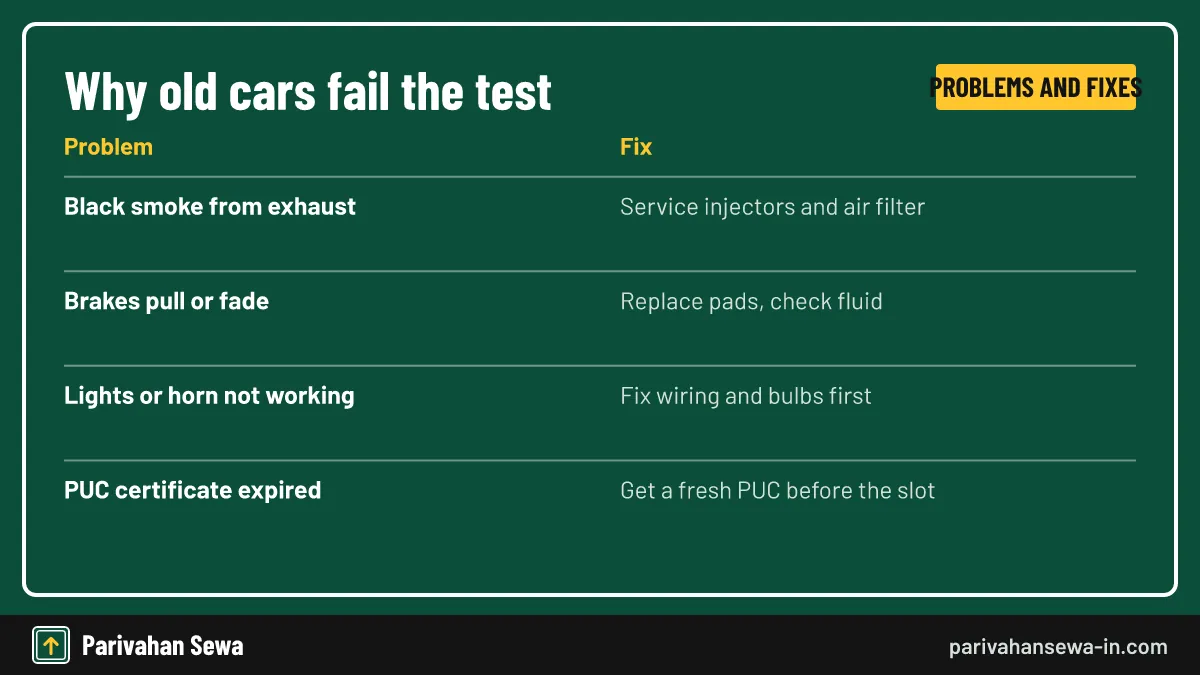
A car check up for RC purposes is the fitness inspection a private car must pass when its registration is renewed after 15 years. Inspectors check brakes, steering, lights, horn, tyres, body and emissions. Testing is moving to automated stations.
What is tested
The inspection covers brakes, lights, indicators, horn, tyres, steering, suspension, the body and chassis, and smoke or emissions. At an automated testing station, machines record each result.
Getting ready
Service the car before the slot. A diesel car with black smoke is a common failure, so clean or replace injectors and filters. For the fitness certificate itself, fees and slots, see our guide to the fitness certificate.
How do you renew an old diesel car’s RC in UP?
In a UP district outside the NCR, you renew an old diesel car’s RC on Vahan citizen services, pay the charges and take the car for its fitness inspection. Start a month or two before the validity date so the test slot falls before the RC lapses.
- Check the validity date. Look up the registration number on Vahan or mParivahan and note the fuel type and the registration validity date.
- Work out which rule applies. Check whether the registering RTO is in one of the eight UP NCR districts or elsewhere in the state.
- Clear dues and papers. Pay pending challans and tax, renew insurance and get a fresh PUC certificate.
- Apply for the right service. Choose renewal of registration, an NOC for another state, or cancellation for scrapping on Vahan citizen services.
- Finish the in-person step. Take the car for its fitness inspection, or hand it to a registered scrapping facility and keep the certificate.

What the renewal costs
| Charge for a private car over 15 years | Amount |
|---|---|
| Renewal of registration fee | ₹5,000 |
| Smart card RC | ₹200 |
| Late fee for each month of delay | ₹300 |
| Fitness test fee, light motor vehicle over 15 up to 20 years | ₹1,000 |
| Example total on time, before fitness and state charges | ₹5,200 |
| Example total six months late, before fitness and state charges | ₹7,000 |
State charges on top
Uttar Pradesh may add its own heads, such as tax or service charges, to the renewal. The Vahan fee screen lists every head before you pay.
Should you scrap an old diesel car in UP?
Scrapping makes sense when an old diesel car cannot be moved, sold or renewed at a reasonable cost. A registered vehicle scrapping facility takes the car, cancels its registration through Vahan and issues a certificate of deposit for the owner.
What you get from scrapping
The facility pays a scrap value for the car and issues the certificate of deposit. In many states, that certificate brings a concession on road tax or registration of a new vehicle.
Finding a registered facility
Use only a facility registered with the transport authorities, so the RC is cancelled properly and you are not liable for the car later. Our list of car scrap yards near me explains how to find one and what papers to carry.
What is the fine for driving after the RC expires?
Driving a car on a public road after its RC has expired breaks section 39 of the Motor Vehicles Act. Section 192 sets the penalty: a fine for a first offence and a higher fine, possible prison, or both for a repeat.
| Offence under section 192(1) | Penalty |
|---|---|
| First offence, vehicle without valid registration | ₹2,000 to ₹5,000 |
| Second or later offence | ₹5,000 to ₹10,000, up to one year in prison, or both |
Insurance risk
An insurer can question a claim on a car whose RC has lapsed. Even if the policy is paid up, a lapsed registration gives the insurer grounds to dispute cover.
Over-age NCR vehicles
In the NCR, an over-age car has been reported to face impounding even if its RC date has not passed. How a seized car is released depends on local rules, so ask the enforcing authority what it needs before you try to retrieve it.
UP, Delhi and other states compared
The table below sets the UP rules beside Delhi and the rest of India. It shows how far the NCR limits depart from the 15-year RC rule that applies elsewhere, and why a car’s registering RTO matters more than its fuel alone.
| Where the car is registered | Diesel car | Petrol car | Renewal after the limit |
|---|---|---|---|
| UP NCR districts (Ghaziabad, Noida, Meerut and others) | 10 years | 15 years | Not available; NOC, sale or scrapping |
| Rest of Uttar Pradesh | 15-year RC | 15-year RC | Every 5 years after a fitness test |
| Delhi | 10 years | 15 years | Not available; NOC, sale or scrapping |
| Other states outside the NCR | 15-year RC | 15-year RC | Every 5 years after a fitness test |
Reading the table
The NCR rows show road-use limits from tribunal and court orders. The other rows show the RC term under section 41.
Haryana and Rajasthan NCR
Districts of Haryana and Rajasthan inside the NCR follow the same Delhi NCR limits as the UP districts. A Gurugram or Faridabad diesel car faces the 10-year limit just as a Ghaziabad one does.
Official links
Vahan citizen servicesrenewal, NOC and validity check ↗Parivahan Sewaparivahan.gov.in ↗UP Transport Departmentstate notices for Uttar Pradesh ↗Motor Vehicles Act, 1988 (India Code)indiacode.nic.in ↗Diesel car validity in up questions
What is diesel car validity in UP?
In the eight UP districts inside the NCR, diesel cars are limited to 10 years under the Delhi NCR age orders. In the rest of Uttar Pradesh, the RC of a private diesel car is valid for 15 years and can be renewed for five years at a time.
Can I use a 12-year-old diesel car in Lucknow?
Lucknow is not in the NCR, so the normal rule applies: the RC is valid for 15 years from issue. A 12-year-old car with a valid RC, insurance and PUC can be used.
Is Noida covered by the 10-year diesel rule?
Yes. Noida is in Gautam Buddh Nagar district, which is part of the NCR, so the 10-year diesel and 15-year petrol limits apply to cars registered there.
What is petrol car validity in UP?
Outside the NCR it is 15 years from registration, renewable for five years at a time. In the NCR districts, petrol cars are limited to 15 years.
How many years can a car be used in India?
There is no national age limit for private cars. The RC is valid for 15 years and can be renewed every five years while the car passes the fitness test. Delhi NCR is the main exception.
Can I drive a 10 year old diesel car in Delhi?
Under the reported Delhi limits, a diesel car over 10 years old should not be used in Delhi. Check the Delhi transport department for any change before driving it there.
How much does it cost to renew a 15-year-old car RC?
The reported central fee is ₹5,000 for a private car, plus ₹200 for a smart card, a fitness test fee and a late fee of about ₹300 a month if you are late.
Can I move my old Ghaziabad diesel car to another UP district?
You need an NOC from the Ghaziabad RTO and must re-register it in a district outside the NCR. Ask the RTO first, as rules for NCR vehicles can change.
How long is an RTO NOC valid?
No single national validity applies. Many guides cite about six months, but check the validity printed on your NOC and re-register before it lapses.
What is a non utilization certificate?
It is an RTO record that a vehicle is off the road for a period, mainly so periodic tax does not build up. Ask your UP RTO whether and how it applies to your vehicle.
What is the fine for driving with an expired RC?
Section 192 sets ₹2,000 to ₹5,000 for a first offence and ₹5,000 to ₹10,000, up to a year in prison, or both, for a repeat offence.
Does a car check up happen at RC renewal?
Yes. A private car is inspected for fitness when its RC is renewed after 15 years, and again at each five-year renewal.
Parivahan Sewa (parivahansewa-in.com) is an independent information website and is not affiliated with MoRTH, Parivahan or any state transport department. Confirm fees and rules on the official portal before you pay or apply.