Form 1 and 14 guide: the fitness form and the school register
Form 1 and 14 are two separate forms under the Central Motor Vehicles Rules, 1989. Form 1 is the self-declaration of physical fitness that goes with a learner's or driving licence application for a non-transport vehicle. Form 14 is the yearly register in which a licensed driving school records the students it admits. You sign the first; the school keeps the second.
Key takeaways
- Form 1 is your own declaration of physical fitness under CMVR rule 5(1); no doctor signs it.
- Form 14 is a driving school's yearly enrolment register under CMVR rule 27(a), with an alphabetical list of students.
- A transport vehicle licence needs a doctor's Form 1-A, not Form 1.
- Form I and XIV are the same two forms written in Roman numerals.
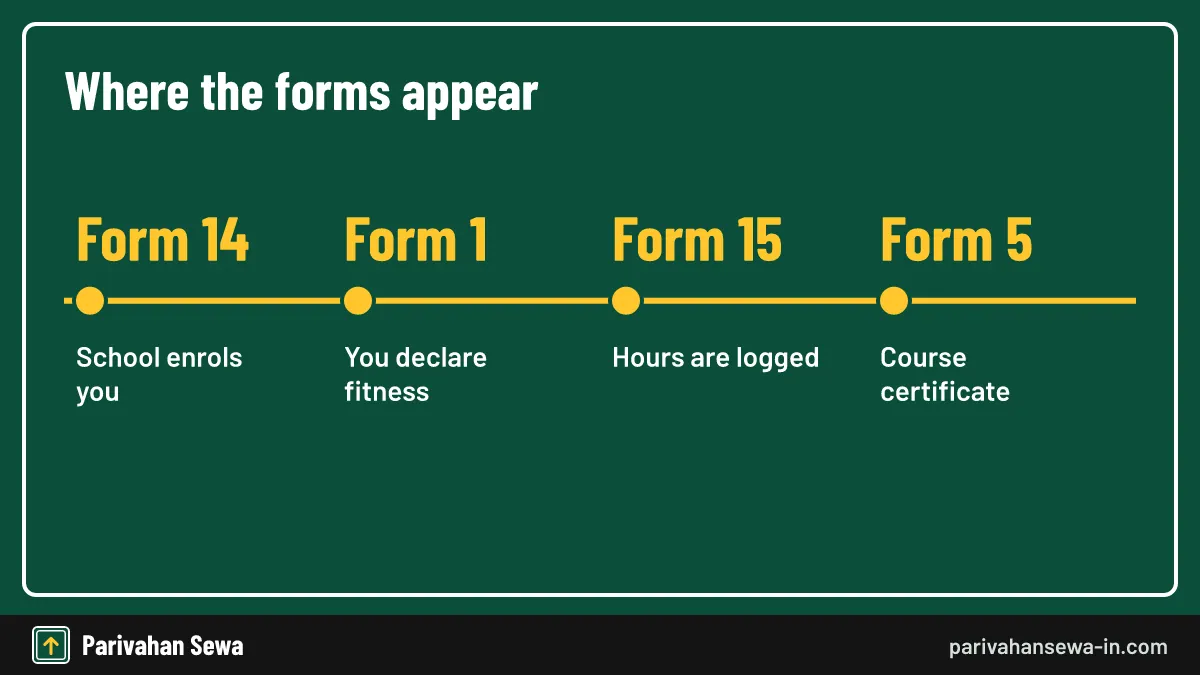
- Beside Form 14, schools keep Form 15 (daily driving hours) and issue Form 5 when a course ends.
- An APL 1 card is a ration card term, not a transport document.
On this page · 26 sections
What are form 1 and 14 and where do they come from?
Form 1 and 14 are two numbered forms in the Central Motor Vehicles Rules, 1989 (CMVR), the central rules made under the Motor Vehicles Act, 1988. Form 1 belongs to the person applying for a licence. Form 14 belongs to a licensed driving school. They are searched together because both appear when someone learns to drive.

Two forms, two owners
Form 1 is a self-declaration of physical fitness under rule 5. Form 14 is a register of enrolment under rule 27(a). The learner signs one, and the school maintains the other in its office.
Why central forms matter
Because both forms are numbered in the central rules, the number means the same thing in every state. A state portal may change the look of a page, but Form 1 and Form 14 keep the same purpose across India.
What is Form 1 in the licence process?
Form 1 is the page on which you declare that you are physically fit to drive. Under CMVR rule 5(1), it goes with an application for a learner’s licence, a driving licence, an added class of vehicle, or renewal of a licence for a non-transport vehicle, such as a private car or motorcycle.
What it asks
The form asks you to state your fitness for driving, including conditions that could affect safe control of a vehicle. Read every question on the current printed or online form; the questions, not a guess, decide what you declare.
What it does not do
Form 1 is not a medical test. No clinic signs it, and it does not replace a doctor’s certificate where the rules ask for one.
Who has to sign the Form 1 self-declaration?
You, the applicant, sign Form 1. That is what makes it a self-declaration: the RTO relies on your own statement about your fitness. Nobody else can sign it for you, and the details on it should match the identity and address proof you submit with the licence application.
Signing online
On the Sarathi portal the declaration is usually built into the application, so you confirm it on screen rather than upload a separate page. Some offices still ask for a signed paper copy at the counter.
Why honesty matters
A licence granted on a false declaration can be questioned later. If a condition might affect your driving, ask a doctor and use the medical certificate route instead.
When is a self-declaration not enough?
A self-declaration is not enough for a transport vehicle licence, such as a taxi, bus or goods vehicle. CMVR rule 5(1) asks those applicants for a Form 1-A medical certificate signed by a registered medical practitioner. The Act also asks for a medical certificate when a holder aged forty or above renews a licence.
How Form 1-A differs
Form 1-A carries a passport-size photograph and is valid for one year from the date of issue. The full process, including who may sign it, is on our page on the medical certificate form 1a.
When the RTO may ask anyway
Section 9(3) of the Act lets the licensing authority ask a driving licence applicant for a medical certificate. If the RTO asks, a Form 1 alone will not settle the file.
What is Form 14 at a driving school?
Form 14 is the yearly register of students that a licensed driving school must keep. CMVR rule 27(a) says the holder of a school licence maintains, on an annual basis, a register in Form 14 along with an alphabetical list of the students admitted that year.
Who it applies to
Only schools licensed under rule 24 keep it. A friend or family member who teaches you to drive keeps no register, and private learners never see a Form 14.
Why the RTO wants it
The register shows who was enrolled and when. It lets the licensing authority match a school’s Form 5 certificates against real admissions, which helps stop certificates being issued to people who never trained.
What does the Form 14 register record?
The Form 14 register records the students a school admits each year, kept with an alphabetical list of the same students. The bare-act text we checked does not print the register’s columns, so the exact headings should be read on the official form or the copy your state transport office uses.
What to expect as a learner
When you join a licensed school, expect it to note your name and enrolment. Ask for the date of admission in writing, as it helps if your course dates are questioned later.
What the register is not
It is not a licence application. It is an office record that stays with the school.
Who keeps the Form 14 register and who can inspect it?
The driving school licence holder keeps the Form 14 register. Under CMVR rule 27(g), the school must keep its premises, records and registers open for inspection by the licensing authority, and under rule 27(e) it must send any returns or information the authority asks for.
Where it must be kept
Rule 27(f) bars a school from moving out of its licensed premises without the authority’s prior written approval. In practice, the register is kept at the licensed address.
What else must be on show
Rule 27(j) asks the school to display its original licence and the names and addresses of its instructors at a prominent place in the office. Rule 27(h) asks it to show its name, address and phone number on training vehicles.
How do Form 1 and Form 14 connect for a learner?
For a learner at a licensed school, Form 1 and 14 meet at the start of training. The school records you in its Form 14 register, and you sign Form 1 for your learner’s licence application. Neither form depends on the other legally, but both sit in the same file of paperwork.
The school route
A school may help you fill the learner’s application, but the Form 1 declaration is still yours. The school’s own record is Form 14, and later Form 15 and Form 5.
The self-taught route
Learning on your own, you still file Form 1; Form 14 never comes up.
Form I and XIV: are they the same forms?
Form I and XIV are the same two forms written in Roman numerals. “I” is 1 and “XIV” is 14. Older printed copies, typed office lists and some state gazettes number forms this way, so a counter clerk may say “Form XIV” for the driving school register.
Reading Roman numbers on forms
XV is 15, V is 5, and XI to XIII are 11 to 13: the other school forms near Form XIV.
What to check
Read the printed title. A form about physical fitness is Form 1, whatever numbering style the copy uses.
Why do people search form i and 14?
People search form i and 14 when an office, school or older document mixes the two numbering styles, writing “Form I” with an ordinary “14”. The forms meant are still Form 1 and Form 14. The mix is a typing habit, not a separate form.
Where the mix appears
Photocopied checklists and agents’ notes often switch styles, and a list that also names Form 1-A adds to the confusion.
How to avoid the wrong form
Match the title, not just the number. Form 1 talks about physical fitness; Form 1-A is a doctor’s medical certificate; Form 14 is a school register.
What if your form i and xiv search was about another law?
The Roman-numeral search form i and xiv may also come from a non-transport setting, because many Indian Acts number their forms this way. This page covers only the motor vehicle meaning. If your employer, contractor or a labour office asked for “Form I and XIV”, check the Act named on the request.
How to tell the difference
A transport form names the Motor Vehicles Act or CMVR at the top; a form from another Act names that Act.
Where to ask
For a non-transport form, ask the office that issued the request, not an RTO.
Which other school records sit beside Form 14?
Besides the Form 14 register, a licensed school keeps or issues several other numbered records under rules 24 to 27. The table below lists them so you can tell which paper is yours and which stays with the school.

| Form | What it is | Who holds it |
|---|---|---|
| Form 11 | Licence to run a driving school | School |
| Form 12 | Application for a school licence | School (to RTO) |
| Form 13 | Renewal of a school licence | School (to RTO) |
| Form 14 | Yearly enrolment register | School |
| Form 15 | Daily driving hours per trainee | School |
| Form 5 | Course completion certificate | Trainee |
The learner’s copy
Of these, only Form 5 is handed to you. Keep it for your licence application.
The office copies
Forms 14 and 15 are working records. Forms 11 to 13 are about the school’s own licence, not yours.
What is the Form 15 driving hours record?
Form 15 is the record of daily driving hours a school keeps separately for each trainee. CMVR rule 27(i) asks for it. Where Form 14 shows that you were admitted, Form 15 shows how much actual driving you did each day of the course.
Why hours are counted
Rule 31 sets minimum hours of actual driving. The Form 15 entries are how a school shows it met them before issuing a certificate.
Checking your own hours
Note your own sessions and raise any difference before the course ends.
What is Form 5 and who issues it?
Form 5 is the driving certificate a licensed school gives each student who completes the course, under CMVR rule 27(d). Under rule 14, a driving licence application includes a Form 5 certificate from the school where you trained, if you trained at one.
How it links to Form 14
A Form 5 should only go to someone who appears in the school’s Form 14 register and finished the course. That is the check the register makes possible.
If you trained privately
No Form 5 is needed if you did not train at a school. The licence test at the RTO is then the main proof of your skill.
What training must a school give before issuing Form 5?
CMVR rule 31 sets the minimum course. For a non-transport vehicle it covers syllabus parts A, B, C, F, G and K over at least 21 days, with at least 10 hours of driving. For a transport vehicle it covers parts E to K over at least 30 days, with at least 15 hours of driving.

What the parts cover
The syllabus runs from driving theory and traffic education to vehicle mechanism, maintenance, fire hazards and first aid. A trainee with a St. John Ambulance first-aid certificate is exempt from Part K.
Where Form 15 fits
The daily Form 15 log is the school’s proof of these hours. Ask to see the total before you sign anything at the end.
Form 1 and Form 14 side by side
Placed next to each other, Form 1 and 14 differ in owner, purpose and rule. The table below sums up the main points so you can tell at once which form an office means.
| Point | Form 1 | Form 14 |
|---|---|---|
| What it is | Self-declaration of physical fitness | Yearly register of students |
| Filled by | Licence applicant | Licensed driving school |
| Rule | CMVR rule 5(1) | CMVR rule 27(a) |
| Used for | Learner’s, driving, added class, renewal (non-transport) | Record of admissions, open to inspection |
| Sent to RTO | Yes, with the application | Kept at school, shown on inspection |
The quick test
If you are the one signing, it is Form 1. If it is a book of names in a school office, it is Form 14.
What they share
Both are free central forms that support the licence system’s checks on who drives.
How do you fill in Form 1 correctly?
Fill Form 1 in clear ink or on screen, using the same name and address as your ID proof, and answer every fitness question honestly. Sign and date it yourself, then attach it to the licence form it supports. The steps below follow the usual order.
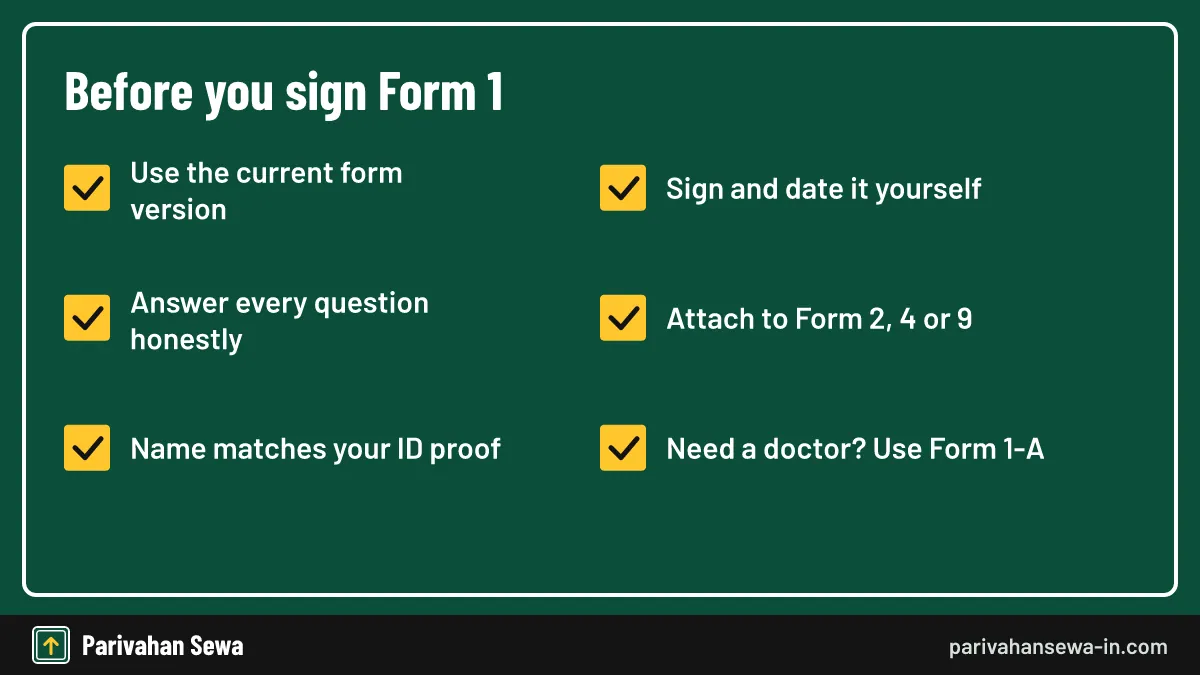
- Get the current form. Download Form 1 from Parivahan or use the version built into the Sarathi application.
- Fill your details. Write your name and address exactly as on your ID proof.
- Answer every question. Answer each fitness question honestly; do not leave blanks.
- Sign and date. Sign it yourself and add the date and place.
- Attach it. Upload or attach it with your learner’s, driving licence or renewal application.
Paper or online
On Sarathi the declaration is part of the application; on paper, keep a photocopy.
When to stop and see a doctor
If an answer on the form makes you unsure about your fitness, get a medical opinion and use Form 1-A instead.
Where can you get these forms?
Form 1 is a citizen form, so it is listed with the other licence forms on the Parivahan website and is built into Sarathi applications. Form 14 is a school register, so schools usually get the format through their state transport department or print it from the rules.
Check the version
Forms are revised by notification, so use the copy on the official portal, not an old photocopy.
No fee for the form
The forms themselves are free to download. Any fee you pay is for the licence service, set under rule 32 and shown on Sarathi when you apply.
How do the forms fit into a licence application?
Form 1 travels with the main licence form for the service you want. The table below shows which CMVR form carries it, and where a school’s Form 5 and a doctor’s Form 1-A come in. Form 14 never goes with your application; it stays in the school.
| Service | Main form | Goes with it |
|---|---|---|
| Learner’s licence | Form 2 | Form 1, or Form 1-A where required |
| Driving licence | Form 4 | Form 1-A where required, Form 5 if trained at a school |
| Renewal of a licence | Form 9 | Form 1 (non-transport) or Form 1-A |
| Licence issued | Form 7 | Smart card or laminated card |
Reading the abbreviations
If terms like LL, DL or LMV on these forms confuse you, our page on the DL full form explains the short forms used on licences.
Vehicle forms are separate
Registration and transfer forms such as Forms 20, 29 and 30 deal with vehicles, not drivers. See the form 29 30 guide for those.
Which licence forms come before and after Form 1?
Before Form 1 there is nothing to file; it is the first numbered form in the CMVR. After it come Form 1-A (medical certificate), Form 2 (learner’s licence application), Form 4 (driving licence application) and Form 7 (the licence card), with Form 9 for renewal.
Why Form 1 comes first
The rules put fitness first because every other licence step assumes the applicant can drive safely.
What licence does a driving school itself need?
A school that teaches driving for payment needs its own licence in Form 11, granted by an officer not below the rank of Regional Transport Officer under CMVR rule 24. It applies in Form 12, renews in Form 13, and the licence is valid for five years.
Renewal timing
Rule 25 asks for renewal at least 60 days before expiry.
Why it matters to you
Only a licensed school keeps a valid Form 14 register and issues a Form 5 that the RTO accepts. Ask to see the displayed Form 11 licence before you pay.
Do newer driver training centres change anything?
Rules for accredited driver training centres apply from 1 July 2021. A candidate who passes the test at such a centre is exempt from the driving test at the RTO. These centres run under their own rules, so their records may differ from the Form 14 register of an ordinary school.
What stays the same
You still declare fitness, so Form 1 (or Form 1-A) is still part of your application.
What to ask the centre
Ask which certificate it issues and whether your RTO accepts it.
Common mistakes with Form 1 and Form 14
Most problems with Form 1 and 14 come from small slips: an unsigned declaration, the wrong fitness form for a transport licence, or a learner who never checks that a school actually enrolled them. Each is easy to avoid if you know where to look.

Learner mistakes
The usual errors are leaving Form 1 unsigned, a name that differs from the ID proof, or using Form 1 for a commercial licence that needs Form 1-A.
School-side gaps
If a school cannot show your Form 14 entry or Form 15 hours, choose another licensed school.
What is an APL 1 card?
An APL 1 card is not a transport form. APL stands for Above Poverty Line, a ration card category used in India before the National Food Security Act, 2013. The search sits near Form 1 and 14 only because it contains a “1”; it has no link to licences or driving schools.
Categories after 2013
Under the NFSA, ration cards are mainly Priority Household (PHH) and Antyodaya Anna Yojana (AAY). Some states still use their own names, including APL, for households outside those groups.
What the “1” may mean
States number their own card types differently. We could not confirm a single national meaning for “APL 1”, so check with your state.
Is an APL 1 card a transport document?
No. An APL 1 card is a ration card category, issued by a state government, not by an RTO. It is not needed for Form 1, for a learner’s licence, or for any Vahan service, and an RTO cannot issue, change or check it.
Can it work as address proof?
Address proofs are listed in CMVR rule 4, and states may add more. Ask your RTO first.
Keep the two apart
Ration card work goes to the food department; licence work goes to the RTO.
Where do APL card questions go?
Questions about an APL card, a ration card category or a ration card application go to your state food and civil supplies department or its online portal.
What to bring
Each state sets its own documents; carry your existing card and ID.
Back to transport services
For licences, RC and other vehicle services, start at our Vahan guide, which links every service on this site.
Official links
Sarathi (driving licence services)sarathi.parivahan.gov.in ↗Parivahan Sewa (Download Forms)parivahan.gov.in ↗Motor Vehicles Act, 1988 (India Code)indiacode.nic.in ↗Form 1 and 14 questions
What is form 1 and 14 in simple words?
Form 1 is a page where you declare that you are physically fit to drive. Form 14 is the register a driving school keeps of the students it admits each year. They are two separate forms from the Central Motor Vehicles Rules, 1989.
Do I need Form 14 to get a licence?
No. You never fill Form 14 yourself. It is the driving school's own register. If you learn at a licensed school, your name goes into it; if you learn on your own, it does not apply to you.
Does a doctor need to sign Form 1?
No. Form 1 is a self-declaration, so you sign it. A doctor signs Form 1-A, the medical certificate needed for a transport vehicle licence and in some other cases.
Is form I and XIV different from form 1 and 14?
In the motor vehicle rules they are the same forms. I is 1 and XIV is 14 in Roman numerals. Other laws also number forms in Roman numerals, so check which Act your office means.
Which applications need Form 1?
Under CMVR rule 5(1), a learner's licence, a driving licence, an added class of vehicle, and renewal of a licence for a non-transport vehicle are accompanied by a Form 1 self-declaration.
Can I see my entry in a school's Form 14 register?
The rules require the school to keep the register and open it to the licensing authority for inspection. Asking the school to confirm your enrolment entry is reasonable, especially before you rely on its Form 5 certificate.
What is Form 15 at a driving school?
Form 15 is the separate record of each trainee's daily driving hours. It sits beside the Form 14 enrolment register and shows that the minimum driving hours were given.
What is an APL 1 card?
APL means Above Poverty Line, a ration card category used before the National Food Security Act, 2013. It has nothing to do with Form 1 and 14 or transport. Ask your state food and civil supplies department for ration card details.
Where do I download Form 1?
Form 1 is a central form, so it is listed with the other licence forms on the Parivahan website, and Sarathi applications include the declaration online. Check the version before you print it.
Parivahan Sewa (parivahansewa-in.com) is an independent information website and is not affiliated with MoRTH, Parivahan or any state transport department. Confirm fees and rules on the official portal before you pay or apply.