TTO set filled samples, box by box, for the RTO ownership papers
A TTO set is the bundle of transfer of ownership papers the RTO wants when a vehicle is sold: Form 29 (seller's notice), Form 30 (transfer application signed by both sides), the original RC, insurance, PUC and ID proof. This page walks through filled samples of each form with dummy details, shows every signature box, and adds Form 35 and the Form 1-A medical certificate.
Key takeaways
- A TTO set is not one form: it is Form 29, Form 30 and the supporting papers filed together.
- Copy the registration, chassis and engine numbers from the RC itself; one wrong character sends the set back.
- Form 30 has a seller part, a buyer part, a financier part for loan vehicles and an office part you leave blank.
- Maharashtra offices add a chassis and engine pencil print, PAN or Form 60/61 and a purchaser's undertaking.
- A closed loan needs Form 35, signed by the owner and the financier, before the buyer's name can go on the RC.
- The Form 1-A doctor's certificate belongs to licence applications, not to the vehicle transfer set.
On this page · 38 sections
What is a TTO set?
A TTO set is the full bundle of transfer of ownership papers that an RTO asks for when a vehicle changes hands. It is not a single form. It combines the seller’s notice on Form 29, the joint application on Form 30, the original RC and the proofs that back them up.

Where the name comes from
Stationery shops near RTOs and agents print the forms in bundles and sell them as a “TTO set” or “transfer set”. The papers inside are the central forms under the Central Motor Vehicles Rules, 1989, so a set bought in Nagpur reads the same as one printed in Kochi.
What this page covers
This guide shows filled samples of each form with made-up details, so you can see where every entry goes. For what each form is and where to download it, see our guide to Form 29 30, which this page does not repeat.
What papers does a TTO set contain?
A typical TTO set contains two copies of Form 29, Form 30, the original RC, a valid insurance certificate, a PUC certificate, ID and address proof of the buyer, and PAN or Form 60. Loan vehicles add Form 35 or the financier’s consent, and interstate sales add the NOC.
| Paper | Needed when | Who provides it |
|---|---|---|
| Form 29 (two copies) | Every sale | Seller |
| Form 30 | Every sale | Seller and buyer |
| Original RC | Every sale | Seller |
| Insurance certificate | Every sale | Seller hands it over |
| PUC certificate | Every sale | Seller |
| ID and address proof | Every sale | Buyer |
| PAN or Form 60/61 | Where the office asks | Seller and buyer |
| Form 35 and bank NOC | Loan still noted on RC | Seller and financier |
| Form 28 NOC | Vehicle leaves the state | Seller |
Papers that sit outside the set
The insurance policy changes with the insurer, not the RTO. Under Section 157 of the Motor Vehicles Act, the buyer applies to the insurer within 14 days of the transfer to record the change.
When an heir or auction buyer applies
A legal heir uses Form 31 and an auction buyer uses Form 32 instead of the Form 29 and Form 30 pair. The rest of the set, such as the RC and insurance, stays much the same.
Form 30 filled sample: what a finished buyer form looks like
A form 30 filled sample shows five blocks: the RTO’s name at the top, Part 1 completed by the seller, Part 2 completed by the buyer, a financier’s consent block used only for loan vehicles, and an office endorsement left blank for RTO staff.

Part 1 in the sample
The seller writes their name, father’s name and address as shown on the address proof, the date of sale, the registration number and the buyer’s name and address. The seller then certifies that the RC and the insurance certificate were handed to the buyer, and signs with the date.
Part 2 in the sample
The buyer writes their own name, father’s name, age and full address, the date of purchase, the same registration number and the seller’s name and address. The buyer signs or gives a thumb impression and adds the date.
The blocks you leave alone
The office endorsement carries the RTO’s reference number and the effective date of transfer. Never write in it. If your vehicle has no loan, draw a single line through the financier block or leave it blank, as your office prefers.
Form 29 filled sample: the seller’s notice box by box
A form 29 filled sample reads like a short letter from the seller to the RTO. It names the office, states that the vehicle was sold on a given date to a named buyer, lists the vehicle numbers, confirms the RC and insurance were handed over, and ends with the seller’s signature.
The body of the notice
The printed text says the seller has sold the vehicle bearing a stated registration number, make, chassis number and engine or motor number. In the sample, every blank is filled with figures copied from the RC card, not from the insurance policy or a dealer invoice.
The declarations near the end
The seller declares that the vehicle is free of encumbrances and accepts responsibility for any wrong information. If a loan is still running, the financier’s consent is filled on the form. The duplicate copy, endorsed by the RTO, comes back to the seller as proof.
How to fill form 29?
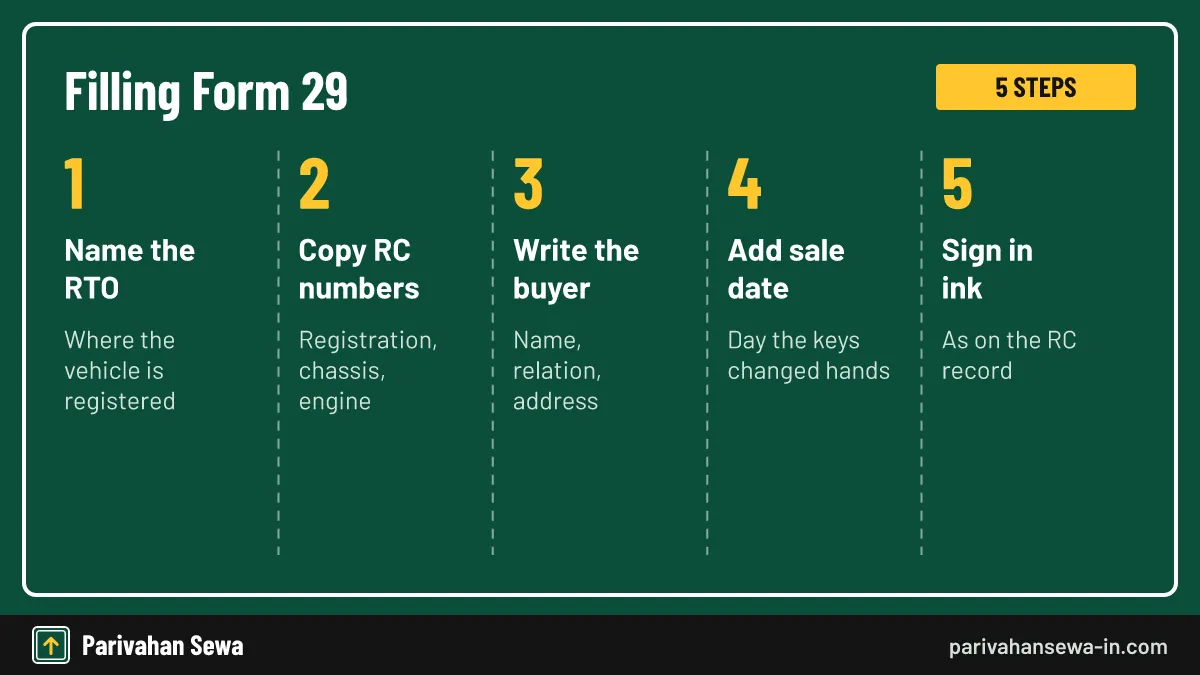
To fill Form 29, write the RTO’s name, copy the vehicle numbers from the RC, enter the buyer’s full name, relation and address, add the date of sale, and sign both copies in ink. Strike out the options that do not apply, such as “son/wife/daughter of”.
- Name the registering authority. Write the RTO where the vehicle is registered at the top of Form 29.
- Copy the vehicle numbers. Copy registration, chassis and engine numbers from the RC.
- Enter the buyer. Write the buyer’s full name, relation and address as on their ID.
- Add the date of sale. Use the date the vehicle and keys were handed over.
- Sign and date. Sign in ink the way you signed for the RC and date both copies.
Pen, letters and cuts
Use one pen colour throughout and write in capital letters. If you make a mistake, start a fresh copy. Offices often refuse forms with cuts or correction fluid.
The date that matters
The date of sale starts the legal clock for both of you. Write the day the vehicle and keys actually left your hands.
How to fill form 29 and 30 together?
Fill Form 29 and Form 30 at the same sitting, with the seller and buyer side by side and the RC on the table. Write the vehicle details once on Form 29, copy them exactly to Form 30, then let each person complete and sign their own part before anyone leaves.
A simple order that works
Start with the seller’s entries on both forms, then the buyer’s Part 2 on Form 30. Compare the two forms line by line: the date of sale, the spelling of both names and the registration number must match on each copy.
Who keeps what afterwards
The buyer usually files the set and keeps the original RC. The seller keeps a photo of every signed page and later collects or receives the endorsed duplicate of Form 29. For the wider online process, see Form 29 and 30 transfer on Vahan.
Form 29 and 30 sample filled with dummy details
Below is a form 29 and 30 sample filled with invented details for a private car. The names, numbers and address are dummies chosen only to show placement. Replace every entry with the details printed on your own RC and ID, and never copy the sample numbers onto a real form.
| Box on the form | Sample entry (dummy) | Copied from |
|---|---|---|
| Registering authority | RTO, City Name (sample) | RC header |
| Registration number | XX 00 XX 0000 | RC |
| Make and model | Example Motors Hatch | RC |
| Chassis number | All 17 characters, e.g. MAXXXXXXXXXXXXXXX | RC, not invoice |
| Engine number | As printed, e.g. EXXXXXXX | RC |
| Seller | A. Seller, son of B. Seller | Seller’s ID |
| Buyer | C. Buyer, daughter of D. Buyer | Buyer’s ID |
| Buyer’s address | Flat 1, Sample Road, City, PIN 000000 | Buyer’s address proof |
| Date of sale | DD-MM-YYYY of handover | Sale letter or receipt |
| Loan entry | None (line drawn) | RC hypothecation field |
Reading the sample
Notice that every number comes from the RC column. The address proof decides the buyer’s address, so a rented flat needs a rent agreement or utility bill in the buyer’s name that shows the same wording.
What the sample leaves out
The sample shows no financier, no Form 28 and no heir details. If any of those apply to you, the forms change, and the sections below on the financier part and Form 35 explain the extra entries.
29 30 form signature: where does each person sign?
On Form 29, the seller signs at the foot of the notice, and the buyer signs where the copy has a confirmation line. On Form 30, the seller signs Part 1, the buyer signs Part 2, the financier signs its consent part when a loan exists, and RTO staff sign the office endorsement.

Signatures and dates together
Every signature box has a date line next to it. Date each signature on the day it is made. A seller who signs a week before the buyer should write that earlier date, not the buyer’s date.
Thumb impressions
A person who cannot sign may give a thumb impression in the same box; the printed forms say “signature or thumb impression”. RTOs often want it attested by a witness or an officer, so ask the counter how they record it.
Which 29 form signature does the RTO compare?
The RTO compares the 29 form signature with the seller’s specimen held in the registration record, which usually comes from the original Form 20 or from an earlier transfer. A clear mismatch is one of the most common reasons a transfer is put on hold at the verification stage.
When your signature has changed
If your signature looks very different today, sign as near to the old style as you honestly can. Some offices accept a signature attestation by a bank or gazetted officer, others ask for an affidavit; confirm before filing so the buyer is not sent back.
Never sign for the other side
A family member signing on behalf of the registered owner is not the same as the owner signing. If the owner cannot be present, ask the RTO what proof it needs, such as a power of attorney, rather than copying a signature.
How is the financier part of Form 30 filled?
The financier part is filled only when a hire-purchase, lease or hypothecation entry still appears on the RC. The bank or finance company writes its full name and address, states that it agrees to the transfer, and an authorised officer signs and dates it, usually with the company seal.
When the loan is already closed
If the loan is paid off but the entry is still on the RC, the bank does not sign Form 30. Instead, remove the entry first with Form 35 and the bank’s NOC, then file the TTO set with the financier block left blank.
When the buyer takes a new loan
The buyer’s own lender is a separate matter. A new hypothecation is noted on the RC through its own application after or alongside the transfer, and a separate endorsement fee applies, shown in the fee table below.
Sale letter form 29: is a sell letter the same thing?
No. A sale letter is a private document between seller and buyer that records the price, date and time of handover. Form 29 is the statutory notice to the RTO. Agents sometimes call the pair “sale letter form 29”, but only Form 29 is a prescribed RTO form.
Why people keep both
The sale letter proves the commercial deal and the exact hour the vehicle changed hands, which Form 29 does not always show.
Where to learn the letter format
Our guide to the vehicle sale letter covers what the letter should say. On this page we only show how it sits beside the RTO forms.
Do you need a vehicle sale letter PDF with Form 29?
A vehicle sale letter PDF is not one of the central transfer forms, so the law does not require it alongside Form 29. Some RTOs, banks and dealers still ask for it. If yours does, print it, have both parties sign it in ink, and file it with the TTO set.
A printed letter beats a phone file
A PDF stored on a phone is fine as a template, but the RTO needs the signed paper or a scan of it.
Matching dates
Make sure the date and time on the sale letter match the date of sale on Form 29 and Form 30. Different dates on different papers raise questions at verification.
Can you rely on a form 29 and 30 sample filled PDF?
Use a form 29 and 30 sample filled PDF only as a reference for layout, never as a form to submit. Downloaded samples often come from old state versions, contain someone else’s details, or skip boxes that your printed form has. Always fill a fresh, blank copy of the current form.
Spot an outdated sample
Check that the sample’s headings mention the right rule, such as Rule 55 for Forms 29 and 30. If the sample looks different from the blank form you downloaded, follow the blank form, because that is what the RTO checks.
What goes wrong on a sample filled form 29 RTO copy?
The errors that send a sample filled form 29 RTO copy back are almost always small: a missing chassis character, a signature unlike the one on record, overwriting, a date of sale that differs between forms, or a loan entry that was never cleared. Each one stops the file at verification.

Number errors
Chassis numbers run to 17 characters on newer vehicles, and the letters O and I are easy to misread. Our page on the chassis number print explains how offices take a pencil trace of it.
Name and address errors
The buyer’s name must match their ID exactly, including initials. An address without a PIN code, or one that differs from the address proof, is another frequent return reason.
How do you check a filled form before submitting it?
Lay the RC, both copies of Form 29 and Form 30 side by side and check five things: the registration number, chassis and engine numbers, both names, the date of sale, and that every signature box is signed and dated.
A two-person check
The seller reads the RC aloud while the buyer checks the forms, then swap roles for the buyer’s details.
Before the agent takes the set
If an agent files for you, check the set yourself first and keep your photographs. Mistakes on a form you signed remain your responsibility even if someone else filled it.
How many copies of each form should you make?
Form 29 is printed in duplicate by design: one copy stays with the RTO, and the endorsed duplicate comes back to the seller. Form 30 is usually filed as one original, plus a second copy where a financier needs the endorsed copy. Offices differ, so check the local checklist before printing.
Extra copies for your records
Make one extra photocopy of every signed page for the seller and one for the buyer.
Copies for loan vehicles
Form 35 is also made in duplicate, and its endorsed duplicate goes back to the financier. If both a loan closure and a transfer are in one visit, keep the two sets in separate folders.
Seller fields and buyer fields compared
The seller and the buyer fill different boxes, and confusing them is a common first-time mistake. The table below sets the seller’s entries against the buyer’s entries across Form 29 and Form 30, so each person knows exactly what to write and sign.
| Entry | Seller writes | Buyer writes |
|---|---|---|
| Own name and relation | Form 29, Form 30 Part 1 | Form 30 Part 2 |
| Other party’s name and address | Buyer’s details | Seller’s details |
| Registration number | Both forms | Form 30 Part 2 |
| Chassis and engine numbers | Form 29 | Checks them |
| Date | Date of sale | Date of purchase |
| Age | Not asked | Form 30 Part 2 |
| Handover statement | RC and insurance handed over | Not asked |
| Signature | Form 29, Form 30 Part 1 | Form 30 Part 2, Form 29 line if printed |
Why the buyer gives an age
The buyer’s age and address go into the registration record against the new owner. Bring an age or date of birth proof where the state list asks for one, as Maharashtra offices do.
Why the seller lists the handover
The handover statement proves the RC and insurance left the seller.
What extra papers go with form no 29 RTO Maharashtra?
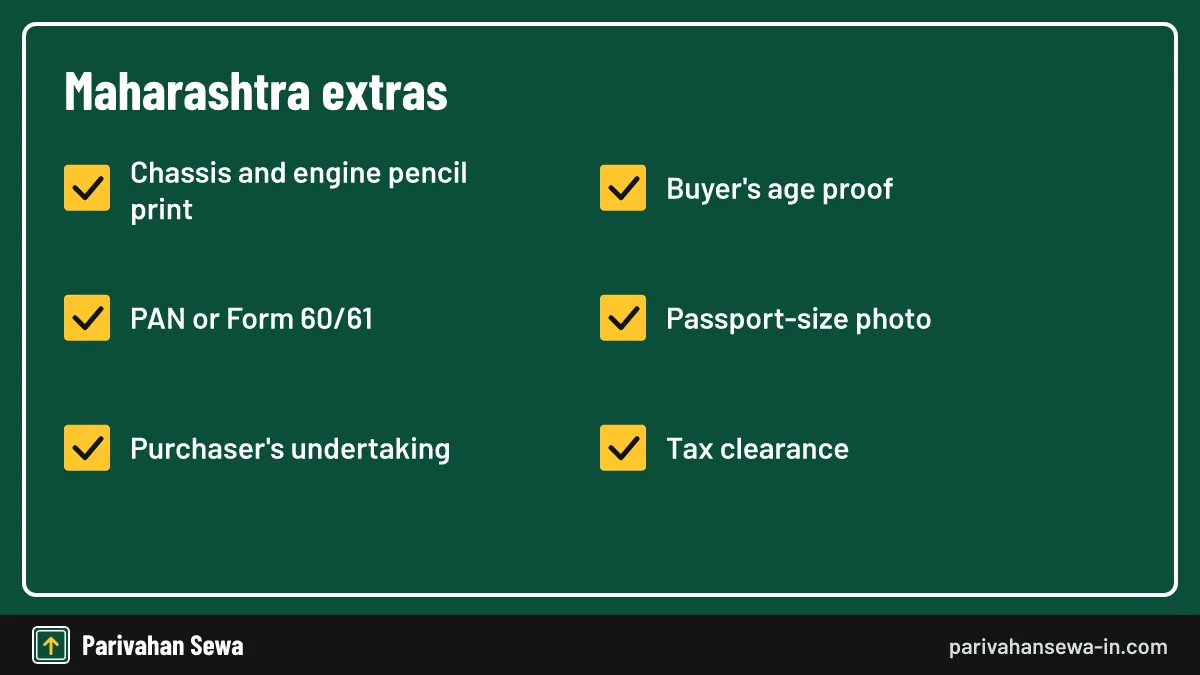
For form no 29 RTO Maharashtra filings, offices add state items on top of the central forms: a chassis and engine pencil print, PAN of seller and purchaser or Form 60/61, the purchaser’s undertaking, proof of the buyer’s date of birth and address, a passport-size photograph and tax clearance.
The pencil print
The pencil print is a rubbing of the chassis and engine numbers taken from the vehicle itself. It means the vehicle must be available, so plan it before the buyer drives away.
Maharashtra fee and service screen
Maharashtra offers many RTO services in faceless mode through Parivahan. The exact amount for your class of vehicle appears on the Vahan fee screen when you apply.
What does the buyer add to form no 30 RTO Maharashtra?
For form no 30 RTO Maharashtra, the buyer completes Part 2 of the central form and attaches the purchaser’s undertaking, PAN or Form 60/61, date of birth proof, address proof and a passport-size photograph. The seller’s Part 1 signature must already be in place before the buyer files.
The purchaser’s undertaking
The undertaking is a short signed statement by the buyer accepting responsibility for the vehicle from the date of purchase.
Who files in Maharashtra
The buyer usually files Form 30 and the set at the RTO that holds the registration. For the Maharashtra online flow, see our guide to vehicle ownership transfer online in Maharashtra.
Where do you get the RTO TT form PDF Maharashtra?
The RTO TT form PDF Maharashtra is simply the central Form 29 and Form 30, which “TT” stands in for at counters. Download them from the Parivahan forms list or the Maharashtra transport department site, print on A4, and fill in ink. No separate Marathi-only form is needed for an ordinary sale.
Printed sets near RTOs
Shops outside Maharashtra RTOs sell ready-printed TT or TTO sets. Check that both copies of Form 29 are included.
Saving the PDF on a phone
A phone copy is fine for reference, but sign only on paper. A signature drawn on a screen is not accepted on the printed form.
Which vehicle transfer form Maharashtra offices accept?
A vehicle transfer form Maharashtra office accepts the central forms: Form 29 and Form 30 for a sale, Form 31 for a transfer after the owner’s death and Form 32 for an auction purchase. Form 28 is added only when the vehicle moves to another state’s registration.
Matching the form to the case
Pick the form by how ownership changed, not by vehicle type. A car and a scooter sold privately both use Form 29 and Form 30.
Death and succession cases
Form 31 is filed by the legal heir, who reports the death and applies within the time the rules allow, usually with a declaration from the other heirs.
How is form 29 RTO Mumbai filed?
A form 29 RTO Mumbai filing follows the Maharashtra list. The application starts on Vahan for the RTO that holds the registration, such as Mumbai Central, Andheri or Wadala, and the signed set is uploaded or handed in as the office directs. The chassis pencil print needs the vehicle on hand.
Choosing the right Mumbai office
Mumbai has several RTOs, and the transfer goes to the one that registered the vehicle. Our page on RTO Mumbai Central lists the services that office handles.
How is form 29 RTO Pune filed?
A form 29 RTO Pune filing uses the same central forms and Maharashtra list. Pune vehicles carry MH-12 numbers, and the newer MH-61 series as MH-12 numbers ran out, but a transfer goes to whichever office holds the registration. The seller’s Form 29 and the buyer’s Form 30 travel as one set.
Pimpri-Chinchwad vehicles
Vehicles registered at the Pimpri-Chinchwad office are filed there, not at the main Pune office, even if the buyer lives closer to the other.
A sale to someone outside Pune
If the buyer lives in another Maharashtra district, the transfer is still within the state. A sale to a buyer outside Maharashtra needs the NOC route described further below.
What do form 29 and 30 Delhi filings need?
Form 29 and 30 Delhi filings use the central forms, applied for on Vahan. Delhi moved most transport services to faceless mode in August 2021, so a transfer is usually applied for online with Aadhaar-based verification and the signed forms uploaded, with office visits kept for tests and fitness checks.
Aadhaar and the online route
A 2022 MoRTH notification extended Aadhaar-based online delivery to a list of registration and transfer services. Without Aadhaar, you can still apply in person with another ID.
Delhi buyers from other states
A buyer who will register the vehicle outside Delhi needs the NOC first. Our no objection certificate guide explains when Form 28 is needed and how long it stays usable.
How does form 29 RTO Kerala work?
A form 29 RTO Kerala filing is the same central Form 29, handled by the Motor Vehicles Department’s RTO or sub-RTO that holds the registration. Kerala’s vehicle services run on Vahan, so the transfer application is made online and the signed forms are uploaded or produced as the office asks.
Kerala office checklists
Individual Kerala offices publish their own document lists. Read the list on the MVD site, mvd.kerala.gov.in, or ask the office before you print and sign the forms.
KL codes and the right office
The office is decided by the registration, not by where the buyer lives. A KL-07 vehicle sold to a Kozhikode buyer is still filed with the Ernakulam office that holds the record.
Form 35 filled sample: closing a loan entry
A form 35 filled sample is short: it is addressed to the registering authority, both the owner and the financier declare that the hire-purchase, lease or hypothecation agreement has ended, it gives the registration number, and asks for the RC note to be cancelled. The owner and the financier each sign and date it.

What you fill in the sample
Write the RTO’s name, the registration number, and strike out whichever of “hire purchase / lease / hypothecation” does not apply. The RC and the fee, if any, are enclosed with the form. The back page is an office endorsement that only the RTO completes.
Where Form 35 fits in a sale
Clear the loan entry before or alongside the TTO set. For the full loan-removal process, see our Form 35 guide; this page only shows the filled layout.
What does form 35 see rule 61 1 mean?
The line “[See Rule 61(1)]” printed under the Form 35 heading points to Rule 61(1) of the Central Motor Vehicles Rules, 1989, which deals with termination of hire-purchase, lease and hypothecation agreements. It tells you the legal basis of the form; you do not fill anything in it.
Rules behind the other forms
Similar lines appear on other forms: Form 29 and Form 30 cite Rule 55, which covers transfer of ownership.
Who signs the hire-purchase termination notice?
The Form 35 termination notice carries two signatures: the registered owner and the financier. The financier’s signature is usually by an authorised officer with the company seal and address. The RTO’s officer later signs the office endorsement once the entry is cancelled.
The duplicate copy
Form 35 is made in duplicate. The duplicate, with the RTO’s endorsement, is returned to the financier so the bank’s records match the RC.
If the bank signs only an NOC
Some lenders send a signed Form 35 with the NOC and a loan closure letter.
Medical certificate filled form: a Form 1-A sample
A medical certificate filled form for a driving licence is Form 1-A. In a filled sample, the doctor writes the applicant’s name and two identification marks, answers six yes/no questions on vision, colour, distance sight, hearing, night blindness and deformity, certifies fitness, and signs across the photograph.

The optional entries
Blood group and RH factor are optional. The doctor fills them only if the applicant wants them printed on the licence.
Not part of a vehicle transfer
Form 1-A belongs to licence applications, not to the TTO set. People search for both because agents sell the forms side by side; for licence medicals in detail, see the medical certificate form 1A guide.
What is a dr certificate at the RTO?
At the RTO, a “dr certificate” almost always means the doctor’s certificate, the Form 1-A medical certificate for a licence. The phrase is shorthand, not a form name, and some people may use it for other papers. If an office asks for one, ask which form it means.
When the RTO wants it
Under CMVR rule 5(1), Form 1-A is needed for a transport vehicle licence. Renewal by a holder aged 40 or above also needs a medical certificate. Most other applicants give the Form 1 self-declaration instead.
Validity of the certificate
A Form 1-A certificate is valid for one year from the date of issue under rule 5(2), so get it close to the date you apply.
What does the doctor check on the medical form?
The doctor records whether the applicant has a defect of vision and whether glasses correct it, can tell red from green, can read a car number plate at 25 metres in daylight, hears ordinary sound signals, has night blindness, and has any deformity or memory loss that would affect driving.
Remarks for an unfit result
If the doctor finds the applicant unfit, the form has space for the reasons.
Who can sign the medical certificate?
Form 1-A is signed by a registered medical practitioner appointed or authorised by the State Government under Section 8(3) of the Motor Vehicles Act. The doctor adds their name, designation, registration number and seal, and signs partly over the photograph.
The signature across the photo
The note on the form says the doctor’s signature should fall partly on the photograph and partly on the certificate.
Online medical uploads
Some states now take the medical certificate through Sarathi uploads or registered doctors. Check your state’s Sarathi instructions before visiting a clinic.
Which fees go with the TTO set?
The forms are free. The central fee for transfer of ownership is half the registration fee for the vehicle class: ₹150 for a motorcycle and ₹300 for a private car, with ₹200 more for a smart card RC. States can add service charges, and some levy their own transfer tax.
| Item | Central fee |
|---|---|
| Transfer, motorcycle | ₹150 |
| Transfer, private car (non-transport LMV) | ₹300 |
| Transfer, transport LMV or medium vehicle | ₹500 |
| Transfer, heavy vehicle | ₹750 |
| Smart card RC (Form 23A) | ₹200 |
| New loan entry, motorcycle | ₹500 |
| New loan entry, car or LMV | ₹1,500 |
| Cancelling a closed loan (Form 35) | No central fee |
What your total may look like
A cash sale of a private car under the central schedule comes to ₹300 plus ₹200 for the smart card. Add any state service charge shown on the Vahan fee screen. For state differences, see RC transfer fees.
Late filing
Section 50 lets a missed deadline be settled by a sum of up to ₹100 instead of prosecution, with states setting amounts by length of delay.
When must the filled forms reach the RTO?
Section 50 of the Motor Vehicles Act sets the clock from the date of sale. The seller reports the sale within 14 days if the vehicle is registered in the same state, or 45 days if it is registered in another state. The buyer files for the transfer within 30 days.

Why the seller should not wait
Until the RTO records the new owner, the seller stays the owner on paper. Challans, tax demands and accident notices keep reaching the seller’s address, which is why the endorsed copy of Form 29 matters.
Insurance runs on its own timeline
The insurance change is a separate step with the insurer. The buyer applies within 14 days of the transfer so the policy is endorsed in their name.
How do you upload the filled set online?
On Vahan, open the vehicle-related services for your state, enter the registration number and the last digits of the chassis number, verify the OTP on the registered mobile, choose transfer of ownership, fill in the buyer’s details, pay the fee, then upload scans of the signed forms and proofs.
Scanning tips
Scan each signed page flat, in colour, with all edges visible. A tilted phone photo that cuts off a signature box is a common reason for an upload to be marked incomplete.
Originals after upload
Some offices accept the uploaded set alone; others ask you to bring the originals and the old RC on an appointment date. The application receipt says which, and the Vahan pillar explains the citizen services menu.
What happens after you submit the filled forms?
After you submit the filled set, the RTO verifies the forms against the registration record, checks for challans, tax dues, blacklisting and loan entries, and then approves the transfer. The new RC is printed in the buyer’s name and the endorsed Form 29 duplicate is sent to the seller.

Tracking the file
Track progress with the application number on Vahan’s status page. If the status stalls at verification, it often means a signature or number did not match.
When the set is returned
A returned set usually needs a fresh form rather than a correction on the old one. Fill a new copy, sign it again and resubmit with the same application number if the office allows.
Is the TTO set different for a bike and a car?
No. A bike and a car use the same forms: Form 29 and Form 30 for a private sale. What changes is the fee, which follows the vehicle class, and sometimes the checklist: Pune’s Maharashtra list, for example, has asked for PAN or Form 60/61 mainly for cars.
Bike-specific points
Two-wheeler chassis and engine numbers are often stamped in awkward places, so the pencil print can take longer.
Can an agent fill the forms for you?
Yes, an agent can fill the forms, but you sign them yourself and you remain responsible for every entry. Read each box against your RC before signing, never sign a blank set, and keep photos of the finished pages so you can check what was filed.
Agent fees are not RTO fees
Agent charges sit on top of the government fee and are not set by the RTO. Keep the official Vahan receipt.
Official links
Parivahan Sewa (forms and services)parivahan.gov.in ↗Vahan citizen servicesvahan.parivahan.gov.in ↗Sarathi licence servicessarathi.parivahan.gov.in ↗Motor Vehicles Act, 1988 (India Code)indiacode.nic.in ↗Tto set questions
What does TTO stand for in a TTO set?
TTO stands for transfer of ownership. A TTO set is the group of papers that moves a vehicle's registration from the seller to the buyer.
Is a filled sample of Form 30 an official document?
No. A filled sample is only a guide to show where each detail goes. The RTO accepts your own form, filled with your real details and original signatures.
Can I fill Form 29 and Form 30 in capital letters?
Yes. Capital letters in blue or black ink are the easiest for counter staff and data-entry operators to read, and they reduce spelling disputes.
Does the buyer sign Form 29?
The seller is the main signatory of Form 29. Many copies of the form also have a line for the buyer's signature, so sign it if your printed form has that space.
What if the seller's signature has changed since the RC was issued?
Sign as close as possible to the specimen on record. If that is not possible, ask the RTO whether it wants an attested signature or an affidavit before you file.
Do I need to attach the sale letter to the TTO set?
A sale letter is not one of the central forms, but many buyers and dealers keep one as proof of price and handover time. Some offices ask for it, so check the local list.
Where does the bank sign on Form 30?
In the financier's consent part. The bank fills it only when the vehicle is still under hire-purchase, lease or hypothecation and agrees to the transfer.
Is Form 35 part of every TTO set?
No. Form 35 is needed only when a closed loan is still noted on the RC. Without a loan entry, leave it out.
Who issues the Form 1-A medical certificate?
A registered medical practitioner appointed or authorised by the State Government signs it, adds the registration number and seal, and signs across the photograph.
Is a filled Form 1-A valid forever?
No. Under CMVR rule 5(2) a Form 1-A certificate is valid for one year from the date of issue.
Can I submit a scanned TTO set online?
Many RTOs let you apply on Vahan and upload signed scans. Some still want the originals at the counter, so follow the instructions on your application receipt.
Parivahan Sewa (parivahansewa-in.com) is an independent information website and is not affiliated with MoRTH, Parivahan or any state transport department. Confirm fees and rules on the official portal before you pay or apply.