Motor vehicle inspection: who checks your vehicle, when and why
Motor vehicle inspection is the physical check of a vehicle's identity and roadworthiness by the RTO, a Motor Vehicles Inspector or an automated testing station. Transport vehicles face it at every fitness renewal; private vehicles mainly at re-registration after 15 years, alteration or transfer cases. New dealer-sold vehicles no longer need to be produced at the RTO since section 44 was rewritten in 2019.
Key takeaways
- A motor vehicle inspection checks two things: that the chassis and engine numbers match the record, and that the vehicle is safe to run.
- Since the 2019 amendment, new vehicles sold by an authorised dealer are registered without being produced at the RTO.
- Transport vehicles must now renew fitness through an automated testing station where one is notified for the state.
- Running a transport vehicle without valid fitness is punished like running an unregistered vehicle under section 192.
- Insurance pre-inspection and a used-car vehicle inspection report are private checks, not RTO documents.
- In West Bengal, a commercial vehicle can be checked at any registering authority in the state.
On this page · 23 sections
What is motor vehicle inspection in India?
Motor vehicle inspection is the official check of a vehicle by the transport department to confirm that it is the vehicle on record and that it is fit to use on public roads. It happens at the RTO yard, by a Motor Vehicles Inspector (MVI), or at an automated testing station (ATS).

Identity check and roadworthiness check
Every inspection has two halves: identity, where the chassis number and engine number are matched with the Vahan record, and roadworthiness, where brakes, lights, steering and emissions are tested.
Official inspections versus private checks
People also use the phrase for checks that are not done by the government. An insurer’s survey before a lapsed policy restarts, or a mechanic’s report before you buy a used car, are private inspections.
Which vehicles must be inspected, and how often?
Transport vehicles (taxis, buses, trucks, goods carriers and autos) are inspected each time their fitness certificate is renewed. Non-transport vehicles such as private cars and motorcycles are inspected mainly when their registration is renewed after 15 years and at each later renewal.
Transport vehicles
Section 56 of the Act says a transport vehicle is not validly registered unless it carries a certificate of fitness. That certificate is issued only after a test, so a goods or passenger vehicle sees an inspection lane on a regular cycle. The validity periods and renewal fees sit on our fitness certificate guide.
Private cars and two-wheelers
A private vehicle’s first registration is valid for 15 years. Renewal after that needs a fitness test first, and the test repeats at each five-year renewal.
Who carries out the inspection: MVI, RTO or testing station?
Three agencies can inspect a vehicle. The registering authority (RTO or DTO) is the legal decision-maker. A Motor Vehicles Inspector is the technical officer who examines the vehicle for it. An automated testing station is a machine-based lane, authorised by the state, that runs the fitness test.
The Motor Vehicles Inspector
MVIs are engineers or diploma holders recruited by state transport departments. They inspect vehicles for fitness, alteration, accidents and registration, and they record their findings on Vahan.
Automated testing stations
Section 56(2), as substituted in 2019, defines an authorised testing station as any facility, including automated testing facilities, authorised by the state government. Central rules for recognising and regulating these stations were notified in September 2021, and states license private operators as well as their own lanes.
What happens at a registration inspection?
A registration inspection is the RTO’s check of a vehicle before it records or changes the registration. The inspector confirms the chassis and engine numbers, the make and model, the colour and body type, the seating capacity and any fitted equipment against the application.
Steps at the RTO yard
You park the vehicle in the inspection bay and hand over the application number and originals. The inspector reads the stamped numbers, compares them with the record, checks the number plate and looks at the body and fitments.
What the inspector writes on the file
The result is entered in the Vahan application as approved or objected, with remarks. If the vehicle passes, the file moves to the registering authority for approval. If it fails, the remark tells you exactly what to correct, such as an unreadable chassis number or a colour that differs from the record.
When does the RTO still call a vehicle for inspection?
Even after section 44 was rewritten, several cases still need the vehicle in front of an inspector. The most common are registration renewal after 15 years, alterations, re-registration of a vehicle brought from another state, and cases where the RTO suspects the identity or condition of the vehicle.
Alterations and conversions
Changing the colour, fitting a CNG or LPG kit, converting the body type or changing the engine all alter the registration particulars. The RTO must approve and inspect the change before the record is updated.
Re-registration and old records
A vehicle moved permanently to another state gets a new registration there, and the new RTO may inspect it to match the chassis and engine numbers against the NOC.
Is a new vehicle inspection needed before registration?
Usually not. Section 44, substituted by the Motor Vehicles (Amendment) Act, 2019, says a motor vehicle sold by an authorised dealer need not be produced before the registering authority for its first registration, subject to conditions set by the central government.

What the dealer does instead
The dealer enters the buyer’s details, the invoice and the vehicle data on Vahan, uploads the forms and collects tax and fees. The new vehicle inspection that used to happen at the RTO yard is replaced by the manufacturer’s type approval and the dealer’s declarations, which the RTO checks on screen.
When a new vehicle still goes to the RTO
The exemption covers vehicles sold by an authorised dealer. A vehicle imported by an individual, a chassis sent for separate body building, or a case where the RTO wants to verify something can still be called for a physical check.
What paperwork replaces the physical check for a new vehicle?
Three CMVR forms carry most of the weight. Form 20 is the application for registration under rule 47. Form 21 is the sale certificate from the dealer. Form 22 is the initial certificate of compliance with pollution, safety and roadworthiness standards, given by the manufacturer.
Why Form 22 matters
Form 22 is the paper version of the manufacturer’s promise that the vehicle meets the type-approved specification. Because every vehicle of that model was tested before it went on sale, the RTO does not need to test each new unit again.
Other documents the dealer collects
The dealer also takes the insurance policy, the buyer’s address proof and identity proof, and the invoice that shows the same chassis and engine numbers as Form 21. Our vehicle registration guide covers what you see on Vahan once the record is approved.
What did the motor vehicle amendment act 2019 change?
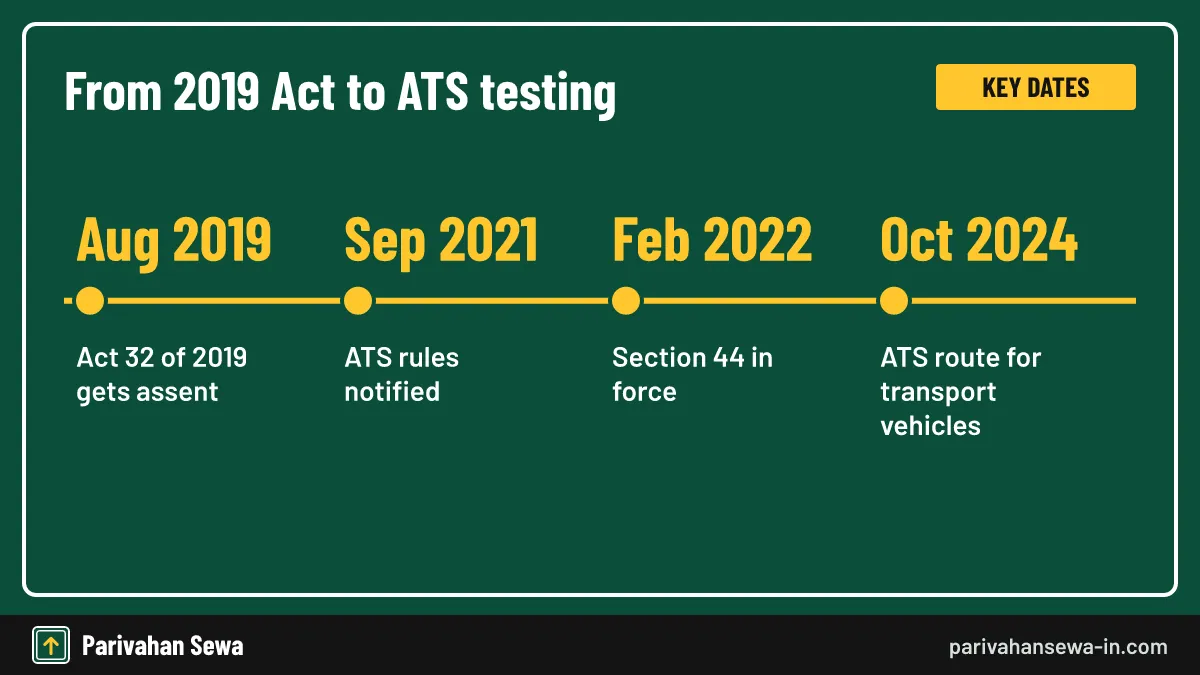
The Motor Vehicles (Amendment) Act, 2019 (Act 32 of 2019, assented on 9 August 2019) rewrote large parts of the 1988 Act; our Motor Vehicle Act summary covers the wider law. For inspections, three changes stand out: dealer-sold new vehicles no longer need RTO production, fitness can be tied to automated testing, and unfit transport vehicles are punished like unregistered ones.
Registration without production
Section 44 now has two parts. Sub-section (1) covers first registration of dealer-sold vehicles, under central conditions. Sub-section (2) lets a registered owner avoid producing the vehicle when it is registered or transferred, under conditions the state sets.
Recall and type approval
The amendment also added section 110A, which lets the central government order a manufacturer to recall vehicles of a type or variant that has a defect.
Which motor vehicle act amendment brought automated testing?
The same 2019 amendment did. It inserted a second proviso into section 56(1): after a date the central government notifies, no certificate of fitness is granted unless the vehicle has been tested at an automated testing station.
How the dates were phased
An April 2022 notification first set 2023 and 2024 start dates for heavy and then medium and light transport vehicles. A 2023 notification moved the mandatory ATS route for heavy, medium and light transport vehicles to 1 October 2024.
How do automated testing stations inspect a vehicle?
An ATS runs the vehicle through a lane of machines. Each machine measures one system, such as brake force, headlamp aim, side slip of the wheels, suspension and exhaust emission, and sends the reading to software.
What happens in the lane
You drive onto rollers that measure braking force on each axle, then past a headlamp tester, a side-slip plate and a suspension tester. A smoke meter or gas analyser checks the exhaust. Cameras record the vehicle at each stage, so the station cannot pass a vehicle that never arrived.
After the test
The station uploads the result to Vahan. If the vehicle passes, the fitness certificate is generated against the registration. If it fails, you get the list of failed items and can book a retest after repairs.
What is checked during a motor vehicle inspection?
A full motor vehicle inspection covers identity, safety systems and emissions. The inspector or lane checks the chassis and engine numbers, brakes, lights, indicators, steering, suspension, tyres, horn, wipers, mirrors, the body and its fitments, and the exhaust against the norms for that vehicle class.

Safety systems
The brakes get most attention: service brake efficiency and parking brake hold are measured or road-tested. Headlamps must be aimed correctly, and indicators, tail lamps and the reflective tape on goods vehicles must work and be visible.
Equipment for transport vehicles
Commercial vehicles have extra items. Depending on the class and state, the inspector looks for a speed limiting device, a vehicle location tracking device, retro-reflective tape, fire extinguishers on buses and a working first-aid box.
Which documents should you carry to the inspection?
Carry the registration certificate, a valid insurance policy, a current PUC certificate, the road tax receipt, the previous fitness certificate for renewals and the permit for a transport vehicle. Bring the Vahan application or booking receipt too, because the inspector works from that file number.
Originals and digital copies
Inspectors usually ask to see originals or DigiLocker copies. A clean PUC certificate is needed because emissions are part of the check; our PUC certificate guide explains how to get one and check its validity.
For alterations and re-registration
If the inspection is for an alteration, bring the fitment invoice and the type-approval or kit certificate from the installer. For re-registration from another state, the NOC from the old RTO and proof of address in the new state are needed.
How do you book an inspection slot online?
Most states let you book through Vahan citizen services. You choose the state and the fitness or relevant service, verify the vehicle with chassis digits and an OTP, pick the RTO or testing station, pay the fee online and select a date.
- Open the Vahan fitness service. Choose the state, then the fitness or inspection-related service for your registration number.
- Verify the vehicle. Enter the chassis digits and the OTP sent to the registered mobile number.
- Pick the testing centre. Select the RTO yard or automated testing station that serves your area.
- Pay the fee. Pay the test fee shown by Vahan online and save the receipt.
- Book and attend the slot. Choose a date, take the vehicle and originals, and collect the result after the test.
If the slot is not available
Testing stations fill up near month-end, when many permits and certificates expire together. Book a week early where you can. If no slot shows, ask the RTO counter about walk-in testing.
What does an inspection cost in 2026?
The fee depends on the vehicle class and the service. For fitness testing, the Central Motor Vehicles (Fifth Amendment) Rules, 2025 revised the charges, with higher amounts for older vehicles.
| Vehicle class | Regular fitness test fee (reported) |
|---|---|
| Motorcycle | ₹400 |
| Three-wheeler, quadricycle or light motor vehicle | ₹600 |
| Medium goods or passenger vehicle | ₹1,000 |
| Heavy goods or passenger vehicle | ₹1,000 |
Why your amount may differ
These figures come from published summaries of the notification, not the Gazette itself, and older vehicles pay age-based charges on top. Treat the table as a guide and pay what Vahan calculates for your registration number, because state fees and ATS charges are added there.
What happens if a vehicle fails inspection?
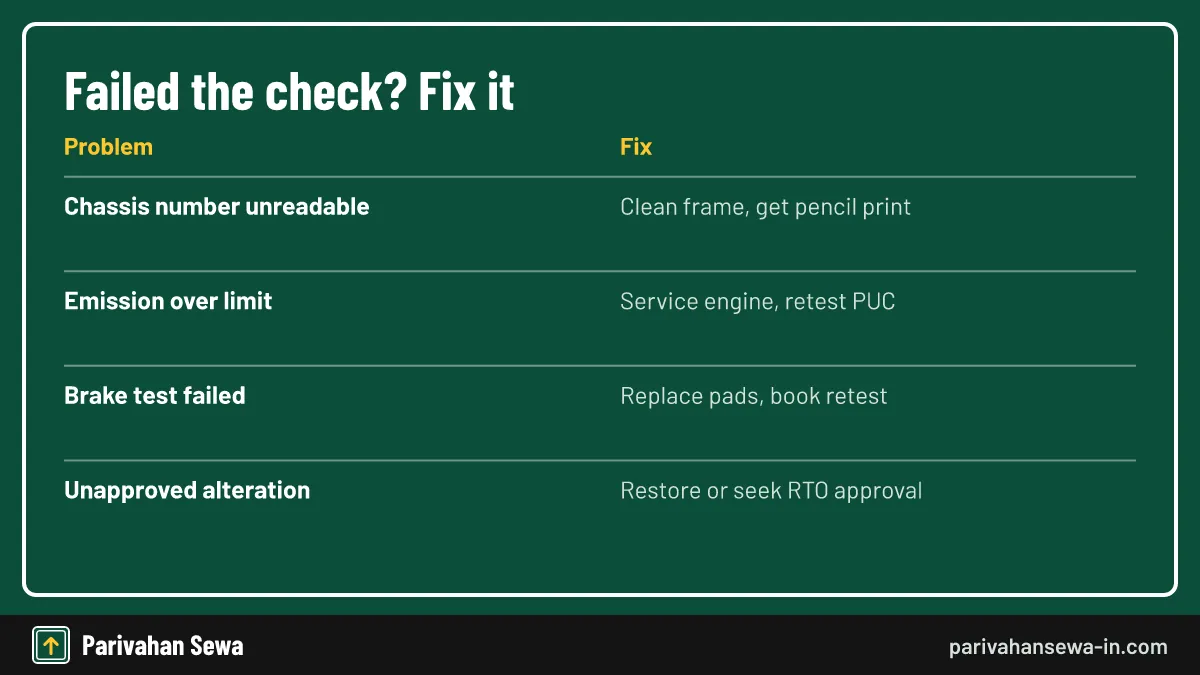
A failed vehicle does not get its certificate or registration change until the faults are fixed. The inspector or lane lists the failed items, you repair them, and you bring the vehicle back for a retest.
Common reasons for failure
Emissions above the limit, weak brakes, misaligned headlamps, bald tyres, an unreadable chassis number and unapproved alterations cause most failures. On transport vehicles, missing reflective tape or a non-working speed governor are also common.
Retest and appeal
A retest usually needs a new slot and may need a fresh fee, depending on the state. Under the Act, the owner can appeal against a refusal of a fitness certificate to the authority the state prescribes.
What is the penalty for running a vehicle without inspection?
There is no separate fine called an inspection fine. A transport vehicle without valid fitness is treated as not validly registered, and the Explanation added to section 192 in 2019 punishes it the same way as driving an unregistered vehicle.
| Offence under section 192 | Penalty |
|---|---|
| First offence | Fine of ₹2,000 to ₹5,000 |
| Second or later offence | Up to one year in jail, or fine of ₹5,000 to ₹10,000, or both |
Other consequences
An insurer can dispute a claim if the vehicle was being used without a valid fitness certificate or registration, and the permit of a commercial vehicle can be suspended. State compounding amounts can differ.
What is a pre vehicle inspection?
A pre vehicle inspection is a check made before something else happens: before an insurer issues cover, before you buy a used vehicle, or before an official test. It is not a legal stage of registration.
Pre-purchase inspection of a used vehicle
Before you pay for a second-hand car or bike, a mechanic or inspection company checks the engine, gearbox, body, chassis, electrics and paint thickness for signs of accident repair. A pre-purchase check also looks at the odometer reading against service records and confirms that the chassis number matches the RC.
How does pre-inspection work when insurance has lapsed?
When a motor policy expires and is not renewed in time, most insurers ask for an inspection before the new policy starts. A surveyor visits, or you record a guided video in the insurer’s app, showing all sides of the vehicle, the odometer and the chassis number.
What the insurer looks for
The surveyor notes existing dents, scratches, broken glass and missing parts, because damage found at the survey is excluded from the new policy. Insurers generally require this once the policy has been expired for a while, and the no-claim bonus is usually lost after a gap of more than 90 days.
Avoiding the inspection
Renew before the expiry date and the policy continues without a survey. You can check the current policy status and download the schedule from our guide to download insurance policy by vehicle number.
What is a vehicle inspection report?
A vehicle inspection report is the written result of an inspection. For a government check, the result lives inside Vahan and leads to a fitness certificate or a registration change. For a private check, it is a PDF with photos and scores.
The official record
The RTO or testing station does not normally hand out a separate consumer report. What you get is the fitness certificate or the approved registration, and the ATS gives a test result showing which items passed or failed.
The private report
Used-car platforms, dealers and independent inspection firms sell detailed reports. These are useful when buying, but they are not accepted by the RTO as proof of fitness.
What does a vehicle inspection report contain?
A good report lists the vehicle’s identity, the date and place of inspection, the inspector’s name, and a section-by-section result for engine, transmission, brakes, suspension, steering, electricals, body and tyres. Better reports add photos and a road-test note.

Identity and history checks
The first page should show the registration number, chassis number and engine number as read from the vehicle, plus the odometer reading. Compare them with the RC and the insurance papers.
Red flags to look for
Watch for notes on flood damage, chassis repair, airbag deployment, replaced panels on both sides and odometer readings lower than the last service record. Any one is a reason to ask more questions.
MV department West Bengal: how are vehicles inspected?
West Bengal’s motor vehicle functions sit with the Transport Department, Government of West Bengal, headquartered at Paribahan Bhawan in Kolkata. District registering authorities and the Public Vehicles Department in Kolkata handle registration and fitness through MVIs and Vahan.
The legal basis in West Bengal
State fitness renewal notices cite section 56 of the central Act and rule 57(1) of the West Bengal Motor Vehicles Rules, 1989, which let a prescribed officer issue and renew fitness certificates. A 2017 state notification encouraged manufacturers with suitable workshops to set up testing stations under section 56(2).
Where to start online
West Bengal uses Vahan for vehicle services, so fitness applications and fee payment start on vahan.parivahan.gov.in after choosing West Bengal. State circulars sit on transport.wb.gov.in. For the national menu of services, see our Vahan guide.
West Bengal: can a transport vehicle go to any registering authority?
Yes. A Transport Department memo dated 18 January 2022 allows commercial vehicles registered in West Bengal to be presented to any registering authority in the state for fitness checking.
Why the rule helps operators
Before the memo, owners had to drive back to their own RTO for the physical inspection, losing days of work.
Inspection, PUC test and insurance survey: how do they differ?
These three checks are often confused. A motor vehicle inspection is a legal check of identity and roadworthiness by the transport department. A PUC test measures exhaust emissions only. An insurance survey records the vehicle’s condition for the insurer.
| Point | Motor vehicle inspection | PUC test | Insurance pre-inspection |
|---|---|---|---|
| Done by | RTO, MVI or ATS | Authorised PUC centre | Insurer’s surveyor or app |
| Covers | Identity, safety, emissions | Exhaust emissions only | Visible condition, damage |
| Result | Fitness certificate or approved registration | PUC certificate | New policy, with exclusions |
| Required by | MV Act, CMVR | MV Act, CMVR | Insurer’s underwriting |
Which one do you need now?
Ask what the paper is for. Renewing a taxi’s fitness or a 15-year-old car’s registration needs an RTO or ATS inspection. A traffic check or insurance renewal needs a valid PUC. A lapsed policy needs the insurer’s survey.
How they connect
A current PUC and valid insurance are usually needed before the inspection. For a short overview, see our vehicle inspection page.
Official links
Vahan citizen servicesvahan.parivahan.gov.in ↗Parivahan Sewaparivahan.gov.in ↗Ministry of Road Transport and Highwaysmorth.nic.in ↗Transport Department, West Bengaltransport.wb.gov.in ↗Motor vehicle inspection questions
Is motor vehicle inspection compulsory for a private car?
Not every year. A private car is inspected when its registration is renewed after 15 years, when it is altered, re-registered in another state or when the RTO has doubts about its identity.
Does a new bike or car have to go to the RTO for inspection?
No, if it is sold by an authorised dealer. Section 44, as substituted in 2019, lets such vehicles be registered without being produced, subject to central conditions.
Who is a Motor Vehicles Inspector?
An MVI is a technical officer of the state transport department who inspects vehicles for registration, fitness, accidents and alterations, and reports to the registering authority.
Can I get a vehicle inspection report from the RTO?
The RTO records its inspection inside the Vahan application and issues the fitness certificate or registration. It does not sell a consumer-style report; those come from private inspection firms.
How long does an automated fitness test take?
The lanes test brakes, lights, emissions and suspension with machines, so the test itself is short. Total time depends on the queue and on whether a retest is needed.
What happens if my insurance lapsed for months?
Most insurers ask for a pre-inspection before a new policy starts, and the no-claim bonus is usually lost once the gap passes 90 days. Damage found at the survey is excluded.
Is a PUC test the same as an inspection?
No. A PUC test only measures exhaust emissions at an authorised centre. A motor vehicle inspection covers identity, brakes, lights, steering and the rest of the vehicle.
Can a West Bengal truck be inspected outside its home RTO?
Yes. A January 2022 Transport Department memo lets commercial vehicles registered in West Bengal be presented to any registering authority in the state for fitness checking.
What is the fine for running a transport vehicle without fitness?
Section 192 treats it like using an unregistered vehicle: ₹2,000 to ₹5,000 for a first offence and ₹5,000 to ₹10,000 or jail up to one year for a repeat.
Parivahan Sewa (parivahansewa-in.com) is an independent information website and is not affiliated with MoRTH, Parivahan or any state transport department. Confirm fees and rules on the official portal before you pay or apply.